
Views: 280 Author: shandong Allstar Grinding Ball Publish Time: 2026-11-12 Origin: Site


Content Menu
● Steel Balls for Ball Mill vs Cast Steel Balls: What Are You Actually Comparing?
● Why Grinding Balls Develop Flat Spots and Lose Roundness
>> Uneven Abrasion and Charge Movement
>> Deformation, Spalling, and Breakage
>> Corrosion–Abrasion Interaction
● Do Flat Spots Really Inhibit Slurry Agitation?
● Forged vs Cast Grinding Balls: Select for the Wear Mechanism
>> When Forged Steel Balls Deserve Evaluation
>> When Cast High-Chromium Balls Deserve Evaluation
>> Why Hardness Alone Is Not Enough
● A Practical Inspection Method for Out-of-Round Grinding Balls
>> 1. Establish the Incoming Baseline
>> 2. Measure Multiple Orientations
>> 3. Separate the Damage Categories
>> 4. Link Shape Changes to Operating Records
● What Published Plant Evidence Actually Shows
● How to Run a Forged vs Cast Media Trial
● Calculate Cost per Tonne, Not Just Price per Tonne
● OEM Grinding Media Procurement with ALLSTAR
>> Are steel balls for ball mills always forged?
>> Are cast grinding balls always more likely to develop flat spots?
>> Can rounder grinding balls guarantee better slurry agitation?
>> What is the best test for out-of-round grinding balls?
>> Should all worn grinding balls be removed?
>> What information should an OEM buyer request?
SHANDONG ALLSTAR GRINDING BALL CO., LTD. manufactures grinding balls, forged steel balls, cast grinding balls, grinding rods, and cylpebs for mining, cement, and power applications, with OEM services for international brands, wholesalers, and manufacturers. When buyers compare steel balls for ball mill vs cast steel balls, the practical question is not simply which product is harder. It is which media retain useful geometry, resist damage, and deliver the lowest grinding cost under actual operating conditions.
Out-of-round grinding balls and pronounced flat spots deserve attention because media shape influences charge movement, particle contact, and power demand. However, blaming poor slurry agitation entirely on flat spots oversimplifies the problem.
The engineering objective is to control abnormal shape deterioration while checking slurry conditions, ball-size distribution, liners, and mill operation together.
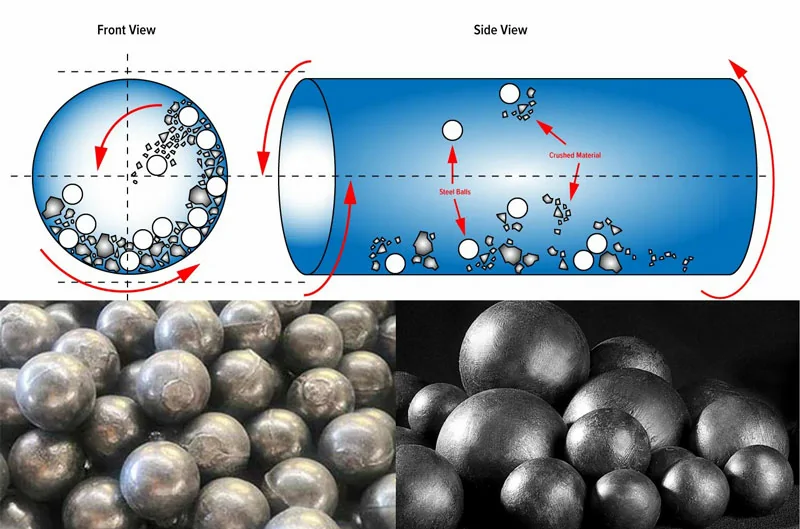
"Steel balls for ball mill" describes an application, not one manufacturing process. Buyers often use it to mean forged steel grinding balls, while "cast steel balls" can refer loosely to several cast alloys.
That distinction matters. Many high-chromium cast grinding balls are metallurgically white cast iron rather than cast steel. A purchase specification should identify the actual alloy, manufacturing route, heat treatment, and acceptance criteria.
For a useful comparison, separate forged steel balls from cast high-chromium grinding media.
| Selection factor | Forged steel grinding balls | Cast high-chromium grinding media |
|---|---|---|
| Manufacturing route | Steel stock formed and heat-treated | Alloy poured into molds and heat-treated |
| Main selection priority | Balance of toughness and wear resistance | Abrasion resistance and suitable corrosion performance |
| Potential damage concerns | Deformation, spalling, or cracking if material and duty are mismatched | Chipping, cracking, or casting defects if quality or duty is unsuitable |
| Application assessment | Evaluate impact severity and abrasive wear | Evaluate abrasion, slurry chemistry, and impact compatibility |
| Essential qualification | Chemistry, hardness profile, integrity, and plant performance | Chemistry, microstructure, integrity, and plant performance |
Neither category guarantees roundness retention. Product quality and application matching matter more than the manufacturing label alone.
A worn ball is not automatically a defective ball. Grinding media lose material throughout service, and their geometry naturally changes.
The warning sign is excessive or uneven deterioration relative to the expected wear pattern.
Balls do not experience identical contacts throughout the mill. Charge position, media-size distribution, and operating speed influence whether a ball predominantly rolls, slides, or experiences impacts.
Repeated rubbing in particular charge regions can promote nonuniform wear. This means flat spots may reflect operating conditions as well as media properties.
Permanent flattening can occur when a ball cannot adequately withstand its loading conditions.
Spalling is different: material detaches from the surface, leaving cavities or irregular faces. Cracking and fragmentation create another category of damage.
These mechanisms should not be grouped into one "out-of-roundness" complaint. Their corrective actions can differ substantially.
In wet grinding, mechanical wear interacts with electrochemical reactions. Abrasion can remove protective surface films, exposing fresh metal to the slurry.
Ore mineralogy, oxygen availability, water chemistry, and pH influence this process. Consequently, a media grade that performs well in one plant may wear differently in another.
They can alter charge behavior, but the relationship is not a universal cause-and-effect rule.
Media shape affects packing, contact mechanics, charge trajectories, and power draw. An irregular charge can therefore change how particles and liquid move through the grinding environment.
However, slurry behavior also depends on:
- Solids concentration and particle-size distribution.
- Slurry rheology and water addition.
- Media filling and size distribution.
- Mill speed and liner profile.
- Discharge configuration and slurry accumulation.
A mill is not simply a stirred tank. Effective grinding requires productive media–particle interactions and suitable material transport, not maximum turbulence.
When throughput falls, investigate whether the problem is abnormal media wear, excessive slurry cushioning, unsuitable ball sizing, or another circuit constraint.
Also distinguish damaged balls from intentionally manufactured nonspherical media. Grinding rods and cylpebs have legitimate applications; their geometry is not evidence of failure.
From a procurement perspective, "Which ball lasts longest?" is incomplete.
A better question is: "Which qualified media grade produces the required product at the lowest total operating cost?"
Forged steel grinding media are established options where impact resistance and abrasive-wear performance must be balanced.
Their suitability depends on steel composition, heat treatment, ball diameter, and the mill's loading conditions.
Do not assume that a high surface-hardness reading proves adequate performance throughout the ball. A hardness profile and appropriate integrity testing provide more useful information.
Cast high-chromium media can be competitive in abrasive grinding and selected corrosive environments, including suitable wet and dry applications.
Their performance depends on carbide characteristics, matrix structure, heat treatment, and compatibility with the operating duty.
Reject the blanket claim that cast media are unsuitable for wet grinding. Equally, do not assume that increasing chromium content automatically produces the best economic result.
Hardness is useful, but it does not fully describe wear resistance or resistance to fracture.
Two balls with similar hardness may differ in microstructure, residual stresses, defects, and toughness. Compare hardness alongside chemistry, structural integrity, shape retention, and measured wear.
A repeatable inspection process turns a subjective complaint into actionable evidence.
Record the supplier, batch identity, nominal size, sample mass, visible condition, and available material documentation.
Photograph representative balls before use. Agree on dimensional tolerances and the inspection method before shipment rather than after a dispute develops.
Measure diameters across several orientations using suitable equipment.
For routine screening, calculate:
Diameter spread (%) = 100 × (maximum measured diameter − minimum measured diameter) ÷ mean measured diameter.
This is a practical comparative indicator, not a complete three-dimensional sphericity measurement or an industry-wide rejection standard.
Use the same method for incoming and recovered samples.
Record flattening, localized abrasive wear, spalling, cracks, and complete fractures separately.
Compare recovered balls within similar remaining-size groups. Comparing heavily worn small balls with new large balls can produce misleading conclusions.
Match inspection findings with ore changes, slurry density, mill power, throughput, liner condition, and media additions.
A shape change that coincides with different operating conditions does not automatically establish a manufacturing defect.
A useful industry example comes from an Australian gold-mine trial reported by an overseas grinding-media supplier.
The marked-ball test ran for 1,224 mill operating hours. The supplier reported that its 90 mm, 15% chromium cast ball had a 3.2% lower wear rate than an equivalent grade from another cast-media supplier.
The important lesson is methodological: meaningful comparisons require identified products, a defined operating period, and measured performance.
This was a supplier-reported result, not an ALLSTAR case study. It also did not demonstrate that cast balls universally outperform forged balls or directly measure slurry agitation.
For ALLSTAR buyers, the appropriate next step is an application-specific trial—not transferring another mine's percentage improvement into a purchase guarantee.
A disciplined trial should answer both technical and commercial questions.
1. Define the objective. Specify whether the priority is lower consumption, fewer broken balls, improved shape retention, or reduced cost at the required grind.
2. Document the baseline. Record throughput, feed characteristics, product size, power, media additions, and relevant slurry conditions.
3. Qualify candidate media. Review chemistry, dimensions, hardness information, and agreed integrity tests.
4. Use a suitable wear comparison. A properly designed marked-ball test can compare wear under shared mill conditions.
5. Track circuit performance separately. Marked-ball wear results alone do not prove a whole-charge improvement in energy consumption or throughput.
6. Allow for charge transition. In a full-charge conversion, legacy media remain in service; early results may not represent the new steady condition.
7. Evaluate the complete outcome. Include wear, fragmentation, shape retention, product quality, and applicable downstream effects.
Avoid judging a trial solely by lower power draw. Lower power can reflect reduced productive grinding rather than greater efficiency.
A lower purchase price does not necessarily mean cheaper grinding.
Begin with a transparent media-cost calculation:
Media cost per tonne of ore = delivered media price per kilogram × media consumption in kilograms per tonne of ore.
Then assess measured differences in energy, maintenance, product specification, and downstream performance where relevant.
For illustration only, consider two hypothetical media options:
| Item | Option A | Option B |
|---|---|---|
| Delivered price | $1.00/kg | $1.15/kg |
| Measured consumption | 0.80 kg/t | 0.65 kg/t |
| Media cost | $0.80/t | Approximately $0.75/t |
Option B costs more to purchase but less in media per tonne processed. This example excludes energy and other operating effects and is not an ALLSTAR performance claim.
For international brands, wholesalers, and manufacturers, OEM purchasing should begin with a documented application brief.
Provide ALLSTAR with:
- Material being ground and wet or dry operating mode.
- Mill dimensions, operating speed, and discharge arrangement.
- Existing media sizes and known failure symptoms.
- Feed characteristics and target product size.
- Relevant slurry chemistry for wet grinding.
- Required packaging, identification, and inspection documentation.
Use this information to agree on a proposed product, qualification procedure, sampling plan, and trial acceptance criteria.
Supplier assessment should prioritize traceable evidence over phrases such as "zero breakage" or "perfect roundness forever."
Request an application review and OEM grinding-media quotation from SHANDONG ALLSTAR GRINDING BALL CO., LTD. Include photographs of worn balls and available operating data so the discussion focuses on the cause of deterioration—not simply replacing one media label with another.

No. The phrase describes their use, not their production route. Confirm whether the product is forged steel, cast steel, or cast iron.
No. Shape deterioration depends on material properties, manufacturing quality, and operating conditions. The casting label alone does not establish the cause.
No. Media shape influences charge behavior, but slurry rheology, filling, liners, and discharge conditions also matter.
Start with repeatable multi-orientation measurements and damage photographs. Combine these with batch records and recovered-media comparisons. Use more advanced geometry measurement when the specification requires it.
No. A working charge naturally contains different ball sizes. Removal decisions should consider ineffective undersize media, fragments, abnormal damage, and the intended charge distribution.
Request an agreed alloy specification, dimensional tolerances, relevant hardness and integrity information, batch identification, sampling rules, and clearly defined acceptance criteria.
1. Matsanga, N., Nheta, W., and Chimwani, N. (2023). "A Review of the Grinding Media in Ball Mills for Mineral Processing." *Minerals*, 13(11), 1373.
2. Molycop. "Grinding Balls." Product technical overview.
3. Molycop. "Cast High Chrome Balls." Product technical overview.
4. Molycop. "Forged and Cast High Chrome Grinding Media — Australian Gold Mine Case Study." Published November 4, 2024.
5. Magotteaux. "Grinding Media." Product-range overview.
支持范围:锻造、铸造及不同形状研磨介质的产品分类,以及高铬铸造介质存在湿磨和干磨应用,不能简单以"铸球不适合湿磨"概括。 [magotteaux]
Hot Tags: China, Global, OEM, private label, manufacturers, factory, suppliers, manufacturing company


