
Views: 269 Author: shandong Allstar Grinding Ball Publish Time: 2026-11-04 Origin: Site


Content Menu
● Why Grinding Balls Chip, Spall, or Break
>> Chipping, Spalling, and Full-Body Fracture
>> The Real Issue Is More Than Hardness
● Forged Grinding Ball vs Cast Grinding Ball: The Practical Differences
● When Forged Grinding Balls Are a Strong Starting Point
>> High-Impact SAG Mill Applications
>> Operations Experiencing Repeated Fragmentation
● When Cast Grinding Balls Remain Competitive
● A Five-Step Investigation for Grinding-Media Chipping
>> 1. Collect Representative Evidence
>> 3. Check Material and Heat Treatment
>> 5. Change One Major Variable at a Time
● How to Specify Grinding Balls Beyond Surface Hardness
● A Better Mine Trial: Measure Wear and Fragmentation Separately
>> Establish a Comparable Baseline
>> Define Fragmentation Measurements
>> Set Acceptance Criteria Before Results Arrive
● Compare Cost per Tonne, Not Just Purchase Price
● OEM Procurement With SHANDONG ALLSTAR
>> Are forged grinding balls always better than cast grinding balls?
>> Can grinding-ball chipping be eliminated completely?
>> Does higher HRC mean lower breakage?
>> What is the difference between chipping and spalling?
>> Can a marked-ball test prove the best supplier?
>> What should an OEM buyer send with an inquiry?
>> Company Information and Editorial Basis
At SHANDONG ALLSTAR GRINDING BALL CO., LTD., we supply grinding balls, forged steel balls, cast grinding balls, grinding rods, and cylpebs for mining, cement, and power applications, alongside OEM services for overseas brands, wholesalers, and manufacturers.
For large mining operations, the forged grinding ball vs cast grinding ball decision should begin with one question: which media can withstand your mill's actual combination of impact, abrasion, and corrosion without unacceptable fragmentation?
Price and surface hardness alone cannot answer that question. Reducing chipping and sharp grinding-media fragments requires an application-specific combination of material selection, manufacturing control, operating discipline, and verified performance.
No responsible supplier should promise zero fragmentation under every operating condition. The practical objective is controlled wear: media that wears predictably rather than breaking prematurely.
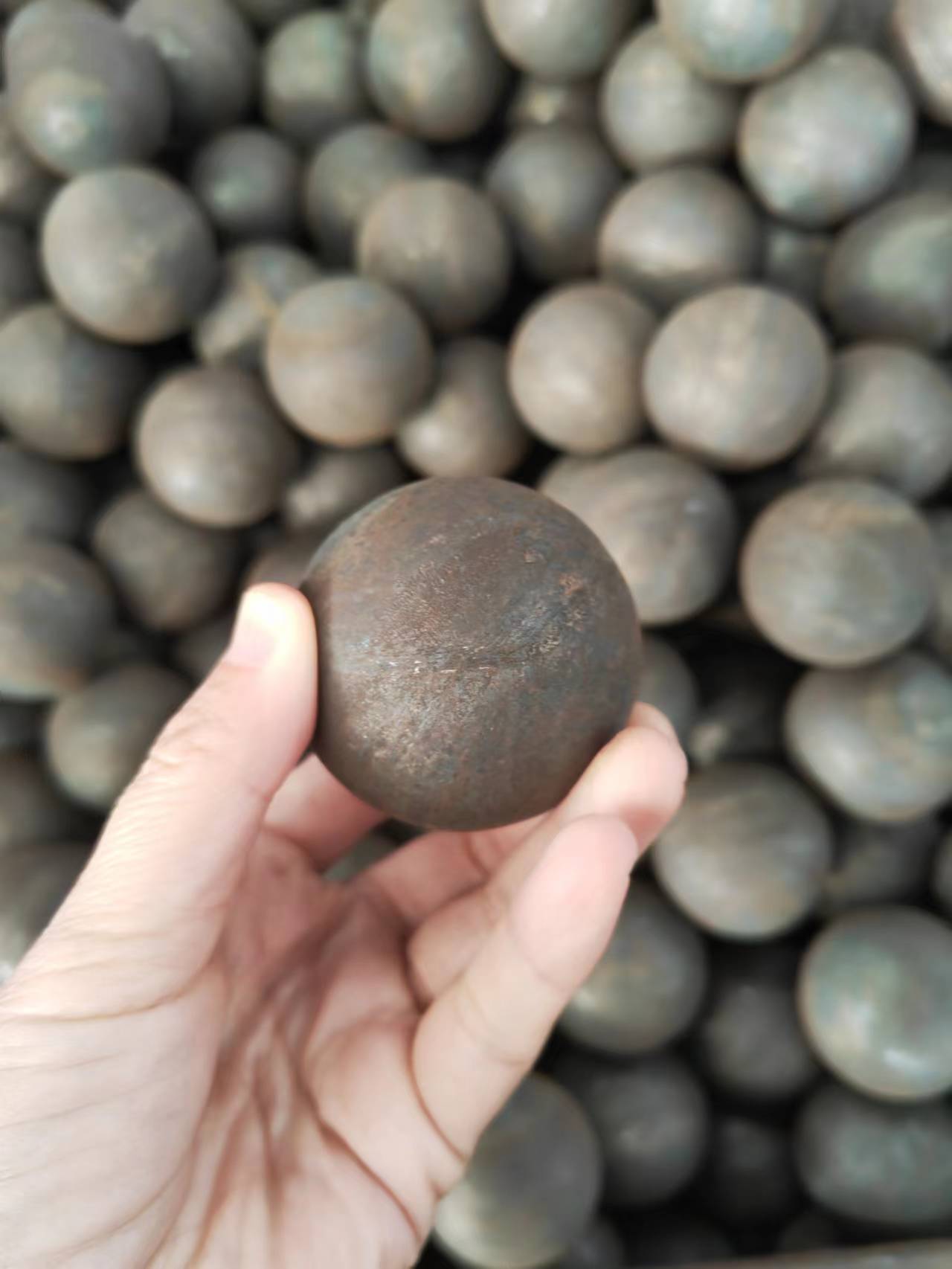
"Chipping" often becomes a catch-all term for several different failures. Separating them helps maintenance teams identify causes instead of repeatedly replacing the wrong media.
- Chipping describes localized material loss from a ball's surface.
- Spalling involves surface or near-surface material separating under repeated impact.
- Full-body fracture splits a ball into substantial pieces.
- Abrasive wear gradually removes material through contact with ore and other surfaces.
These mechanisms can occur together. A crack may grow under repeated loading before releasing a fragment.
"Shrapnel" is useful descriptive language, but it is not a precise metallurgical failure category. In inspection reports, record fragment size, shape, frequency, and fracture appearance instead.
Sharp fragments also deserve a separate handling-risk assessment. Their presence does not, by itself, establish why the ball failed.
A hard surface can resist abrasion, but hardness alone does not establish resistance to repeated impacts.
Grinding-media performance also depends on microstructure, internal soundness, heat treatment, residual stress, and the relationship between surface and core properties.
Historical U.S. Bureau of Mines testing found substantial differences among commercial grinding balls. Its findings support an important purchasing principle: manufacturing quality and heat treatment matter, not simply the labels "forged" and "cast."
Those laboratory results should not be presented as predictions of service life in a modern production mill.
Forged grinding balls generally begin as steel stock that is heated, mechanically formed, and heat treated.
Cast grinding balls begin as molten alloy poured into molds and subsequently processed, often including heat treatment.
However, "cast" covers different material families. Cast steel and high-chromium white cast iron are not interchangeable. A useful comparison must identify the actual alloy and treatment condition.
| Selection factor | Forged steel grinding balls | High-chromium cast grinding balls |
|---|---|---|
| Main selection focus | Balance of impact resistance and wear resistance | Abrasion and corrosion resistance in suitable duties |
| Typical applications | SAG and ball-mill duties requiring impact resistance | Suitable ball-mill and regrind applications |
| Important quality checks | Steel quality, forming consistency, heat treatment, hardness profile | Alloy control, casting soundness, carbide structure, heat treatment |
| Potential concerns | Cracking, excessive hardness, inadequate toughness, inconsistent treatment | Casting defects, unsuitable microstructure, impact-related fragmentation |
| Procurement approach | Validate the specified grade in the intended mill | Validate the specified alloy in the intended mill |
Neither manufacturing route guarantees success. A well-engineered cast product can outperform an unsuitable forged product, and the reverse is equally possible.
SAG mills combine ore and grinding media in an operating environment where impact resistance can be critical.
Forged steel media are a strong candidate when the application requires resistance to repeated severe impacts alongside acceptable wear performance.
The specification still needs to reflect ball diameter, mill configuration, charge conditions, and ore characteristics. "Suitable for mining" is not an adequate technical requirement.
A ball selected for secondary grinding should not automatically be treated as suitable for a demanding SAG duty.
If a mine repeatedly finds fractured balls or substantial spalls, forged media may deserve a controlled trial.
However, changing the manufacturing route without investigating the failure can leave the underlying problem untouched.
Check whether fragmentation increased after a change in supplier, ball size, ore blend, liner configuration, charge level, or operating practice. Timing often provides more diagnostic value than a photograph alone.
High-chromium cast grinding balls should not be dismissed as universally brittle or unsuitable for mining.
Their alloy design combines a metallic matrix with hard chromium carbides. In appropriate applications, this supports resistance to abrasion and corrosion.
They can be competitive in ball-mill or regrind duties where the wear environment suits the alloy and impact conditions remain compatible with its properties.
Wet grinding adds another consideration: slurry chemistry and media–mineral interactions. An option that performs well against dry abrasion may not produce the same economic result in a different slurry environment.
The correct question is not "Which type is always better?" It is "Which specific product delivers the lowest verified operating cost in this circuit?"
Before ordering replacement media, create a repeatable investigation.
Sample intact worn balls, chipped balls, broken pieces, and available unused balls from the relevant supply lot.
Record sampling locations and dates. A collection containing only the largest visible fragments can distort the apparent failure pattern.
Photograph samples with a scale and preserve their lot identification wherever possible.
Separate gradual wear, shallow chipping, substantial spalling, and complete fracture.
Look for repeated patterns rather than diagnosing every fragment as the same failure. Record whether damage appears isolated or widespread.
Where the cause remains uncertain, request metallurgical examination rather than relying only on visual judgment.
Request chemical composition, hardness measurements, and relevant microstructural examination.
A surface HRC reading is useful, but it cannot describe the whole ball. A cross-sectional hardness profile helps reveal how properties change toward the center.
Where internal defects are suspected, agree on an appropriate examination method with a qualified laboratory.
Compare the failure timeline with:
- Mill speed and power trends.
- Charge and filling conditions.
- Ball-size distribution and addition practices.
- Ore hardness and feed-size changes.
- Liner condition and replacement history.
- Slurry conditions in wet circuits.
Treat these as investigation variables, not automatic proof of causation.
Simultaneously changing alloy, ball diameter, supplier, and operating conditions makes the result difficult to interpret.
Define a controlled change, document the baseline, and agree on acceptance criteria before introducing trial media.
For overseas brands and OEM buyers, a clear specification is more valuable than a broad claim such as "premium quality."
A purchase specification should identify:
1. Intended mill and operating duty.
2. Nominal diameter and dimensional tolerances.
3. Material grade or agreed chemical limits.
4. Surface hardness and agreed internal hardness requirements.
5. Relevant metallographic acceptance criteria.
6. Impact-test method and reporting conditions.
7. Sampling frequency and lot definition.
8. Traceability, packaging, and nonconformance procedures.
Avoid comparing impact-test numbers unless the test conditions are comparable. Different ball sizes, impact energies, equipment, and failure criteria can produce numbers that look similar but mean different things.
For SHANDONG ALLSTAR OEM discussions, these requirements provide a practical framework for aligning the buyer's specification with the proposed product. Any promised test, tolerance, or document should be confirmed in the quotation and quality agreement.
A trial should answer two questions: does the candidate media wear economically, and does it maintain acceptable structural integrity?
Record media consumption per tonne of ore, throughput, product size, and relevant operating conditions before the change.
Track ore variability and major operating interruptions. Otherwise, a change in feed characteristics may be mistaken for a media improvement.
A marked-ball test can help compare relative wear in the same mill environment. It should not automatically be treated as a complete assessment of long-term breakage, circuit performance, or financial benefit.
Agree on a practical inspection procedure before testing.
Possible indicators include:
- Broken or substantially spalled balls in a defined sample.
- Fragment mass collected during a defined inspection.
- Timing and location of fragment observations.
- Changes in downstream handling or maintenance requirements.
Always state the denominator. "Two broken balls" means little without the number inspected, sampling method, and service exposure.
Agree on the trial duration, inspection schedule, comparison method, and conditions that would invalidate the test.
Predetermined criteria protect both mine and supplier from selecting only favorable observations.
*Suggested visual: Add a trial dashboard showing media consumption, fragmentation observations, throughput, and product size. Display operating changes alongside the results.*
The cheapest delivered tonne of grinding balls is not necessarily the cheapest grinding solution.
Start with a simple calculation:
Media cost per tonne of ore = delivered media price per kilogram × media consumption in kilograms per tonne of ore.
For illustration only, media priced at $1.00/kg and consumed at 0.80 kg/t costs $0.80 per tonne of ore. Media priced at $1.10/kg and consumed at 0.65 kg/t costs approximately $0.72 per tonne.
These are hypothetical figures, not SHANDONG ALLSTAR performance data.
Keep maintenance, energy, throughput, and downstream recovery effects separate unless the trial actually measures them. Do not claim savings by assigning speculative values to avoided downtime.
SHANDONG ALLSTAR GRINDING BALL CO., LTD. supplies grinding media and offers OEM services to overseas brands, wholesalers, and manufacturers.
A productive inquiry should include your mill type, ball sizes, current media specification, operating environment, and the problem you want to solve.
If chipping is the priority, include representative photographs, sampling details, and available consumption or fracture records.
Ask for an application-matched proposal with clearly stated specifications, agreed inspection requirements, packaging needs, and a trial plan.
Contact SHANDONG ALLSTAR with your grinding-media requirements to discuss a forged or cast solution for your application. Make the purchasing decision on documented suitability and measurable performance—not an unsupported promise of zero breakage.
No. Forged steel is a strong candidate for demanding impact duties. High-chromium cast media can be competitive where abrasion and corrosion dominate. Compare specified products under representative conditions.
A universal zero-chipping promise is not credible. The practical objective is to reduce premature fragmentation and maintain predictable wear through suitable media, manufacturing control, and mill operation.
Not necessarily. Hardness supports abrasion resistance, but repeated-impact performance also depends on microstructure, heat treatment, internal quality, and operating conditions.
Chipping is a broad description of localized material loss. Spalling more specifically describes surface or near-surface material separating under repeated loading. Inspection terminology should remain consistent throughout a trial.
It can provide useful comparative wear evidence. Supplier qualification should also consider fragmentation, lot consistency, traceability, operating context, and relevant quality documentation.
Provide mill duty, ball sizes, estimated demand, current specifications, target market requirements, packaging needs, and the main performance concern. Include actual failure evidence when available.
- Company name, product categories, target industries, and OEM positioning: supplied by SHANDONG ALLSTAR GRINDING BALL CO., LTD. in the project brief. These statements have not been independently audited.
- No customer reviews, factory inspection records, certifications, or company trial results were supplied. None have been invented or attributed to the company.
- The diagnostic workflow, purchasing checklist, and trial framework are editorial recommendations synthesized from the technical principles below. The cost example is hypothetical.
1. U.S. Bureau of Mines. "Evaluation of Commercial U.S. Grinding Balls by Laboratory Impact and Abrasion Tests." Hosted by CDC Stacks. Historical experimental evidence concerning differences in impact life, abrasion, spalling, and heat-treatment response; not a modern field-performance guarantee. [stacks.cdc]
2. U.S. Bureau of Mines. "Laboratory Wear Testing Capabilities of the Bureau of Mines." Hosted by CDC Stacks. Describes repetitive-impact testing and distinguishes spalling, smaller-scale surface damage, flaking, and breakage. [stacks.cdc]
3. Molycop. "Grinding Balls." Manufacturer documentation describing high-carbon alloy steel stock, forging, heat treatment, and the balance of wear and impact resistance. [molycop]
4. Molycop. "SAG Balls." Manufacturer documentation identifying impact-breakage resistance and wear resistance as key attributes for SAG grinding media. [molycop]
5. Magotteaux. "Cast High Chromium." Manufacturer documentation describing martensitic structures, chromium carbides, abrasion and corrosion resistance, and ball-mill and tower-mill applications. [magotteaux]
6. Molycop. "Top Results in Test of Molycop's Forged and High Chrome Cast Grinding Media." Published December 13, 2023. An example of marked-ball comparative testing in an Australian gold operation; no results from this case have been represented as SHANDONG ALLSTAR results. [molycop]
Hot Tags: China, Global, OEM, private label, manufacturers, factory, suppliers, manufacturing company


