
Views: 260 Author: shandong Allstar Grinding Ball Publish Time: 2026-11-12 Origin: Site


Content Menu
● Cement Mill Grinding Ball vs High Chrome Grinding Ball: Compare Materials, Not Labels
● What Spherical Integrity Means in Cement Grinding
● How Hot, Dry Conditions Affect Grinding Media
>> Separate Process Temperature from Metallurgical Limits
>> Control Coating and Cement Quality Alongside Media Wear
>> Match the Ball to Its Chamber
● Why High Chrome Grinding Balls Can Retain Their Shape
>> Carbides Need Adequate Support
>> Hardness and Toughness Must Be Considered Together
● A Practical Method for Measuring Shape Retention
>> Step 1: Establish the Unused-Ball Baseline
>> Step 2: Define a Repeatable Shape Indicator
>> Step 3: Classify Damage Separately
>> Step 4: Compare Equivalent Service
● How to Run a Meaningful Cement Mill Media Trial
>> Do Not Judge a Replacement Charge Too Early
● OEM Purchasing Checklist for SHANDONG ALLSTAR Customers
● Recommended Visuals for This Article
● Request an Application-Based OEM Grinding Media Proposal
>> 1. Are cement mill grinding balls and high chrome grinding balls different products?
>> 2. Are high chrome grinding balls always better under hot, dry conditions?
>> 3. Does higher chromium content guarantee better spherical integrity?
>> 4. Can high hardness prevent ball breakage?
>> 5. What is the best way to compare grinding-ball suppliers?
>> 6. What information should an OEM customer provide first?
At SHANDONG ALLSTAR GRINDING BALL CO., LTD., we help overseas brands, wholesalers, and manufacturers source grinding media for mining, cement, and power applications, with OEM services available. When discussing "Cement Mill Grinding Ball vs High Chrome Grinding Ball for Maintaining Spherical Integrity under Hot Dry Conditions," our starting point is straightforward: compare the actual materials and operating duties, not simply the product names.
A cement mill grinding ball describes an application. A high chrome grinding ball describes a material family. High-chromium cast balls can themselves be cement mill grinding balls.
The useful purchasing question is therefore: which combination of alloy, manufacturing quality, heat treatment, and ball size will retain a consistently rounded working profile in your particular cement mill?
For abrasion-dominated dry cement grinding, high-chromium cast media are often strong candidates. Where impact severity is greater, toughness becomes equally important. Neither chromium content nor room-temperature hardness alone can establish the best choice.
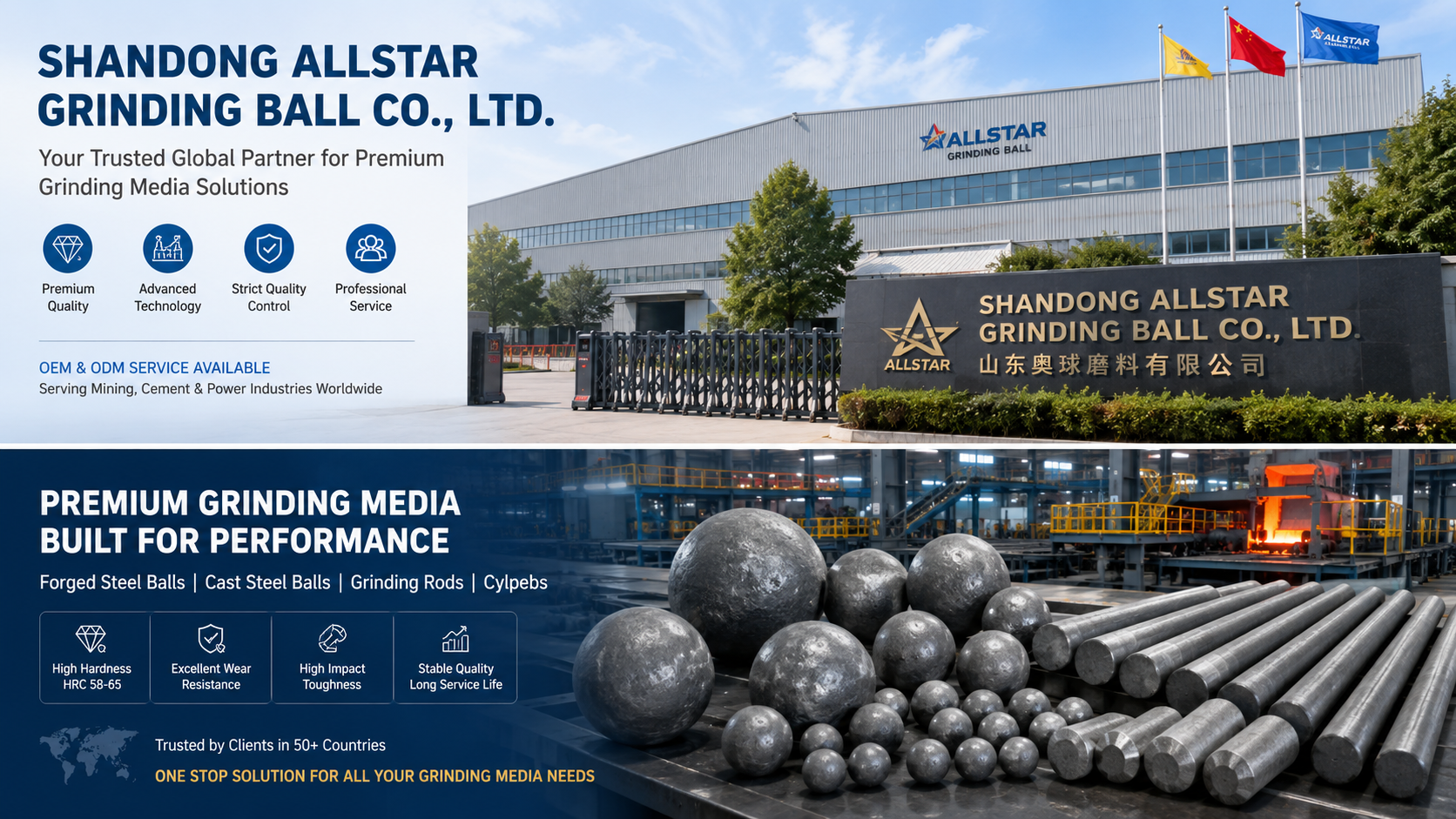
Before requesting quotations, identify what the supplier means by "cement mill ball."
The term can include forged steel balls, low-alloy cast media, or high-chromium cast iron balls. These materials have different microstructures and respond differently to abrasion and repeated impact.
Commercial descriptions sometimes call high-chromium cast iron balls "high chrome steel balls." For technical procurement, request the actual material designation rather than relying on that wording.
| Selection factor | Forged steel grinding balls | High-chromium cast grinding balls |
|---|---|---|
| Material route | Steel shaped through forging | Alloyed iron shaped through casting |
| Principal selection consideration | Toughness balanced with wear resistance | Abrasion resistance balanced with fracture resistance |
| Shape-loss concerns | Uneven wear, deformation, or surface damage | Uneven wear, carbide loss, spalling, or fracture |
| Quality variables | Steel cleanliness, forging quality, heat treatment | Casting soundness, carbide structure, heat treatment |
| Appropriate verification | Representative impact and wear performance | Representative abrasion and impact performance |
These are selection tendencies, not guaranteed product rankings. A well-matched, consistently manufactured ball can outperform a poorly matched alternative from either category.
Spherical integrity means retaining a sufficiently rounded working shape as the ball wears. It does not mean retaining the original diameter indefinitely.
A ball can lose material uniformly and remain useful. Another can retain substantial mass yet develop a flat, chipped edge, or irregular profile.
Relevant damage patterns include:
- Flattening or localized deformation.
- Uneven abrasion that creates an oval profile.
- Spalling, where pieces detach from the surface.
- Cracking or complete fragmentation.
- Surface deterioration associated with inadequate microstructural support.
From a procurement perspective, the distinction matters because low mass loss does not automatically mean good shape retention.
Evaluate wear, breakage, and geometry together. A specification that measures only hardness or total consumption can miss an important part of service performance.
Cement grinding generates heat. Published technical guidance describes conventional ball-mill exhaust temperatures reaching approximately 125°C in some installations. This is operating context, not a universal target or a grinding-ball temperature rating.
Mill outlet gas temperature, cement temperature, and actual media temperature are not interchangeable measurements.
Consequently, a supplier should not claim that a ball "cannot deform below 150°C" without defining the test conditions, material, exposure duration, and acceptance criterion.
The practical question is whether the supplied material retains adequate properties throughout the plant's real operating envelope.
Heat management is not only a grinding-media issue.
Temperature affects gypsum dehydration and can contribute to cement-quality problems. Mill cooling, ventilation, feed conditions, and controlled water injection can therefore matter alongside alloy selection.
Coating also complicates inspection. Adhered material can obscure the ball's true surface and geometry.
Before classifying a recovered ball as deformed, remove loose deposits using a consistent preparation method. Then inspect the underlying metal.
The first chamber typically performs coarser grinding with larger media. Later chambers generally use smaller media for finer grinding.
That difference changes the balance between impact resistance and abrasion resistance.
A ball selected primarily for fine-grinding wear resistance should not automatically be treated as suitable for the highest-impact location. Chamber-specific selection is more useful than a single "premium" grade applied throughout the mill.
High-chromium white cast iron contains hard chromium-rich carbides supported by a metallic matrix.
The carbides resist abrasive cutting. The surrounding matrix supports them and influences how the material responds to loading.
This explains why high-chromium media can be attractive for abrasive cement-grinding duties. However, it also explains why chromium percentage alone is insufficient.
Hard particles cannot deliver dependable performance if the surrounding structure fails prematurely.
Carbide distribution, matrix condition, casting defects, and heat treatment all influence the working surface. If local fracture or carbide loss dominates, a high nominal hardness may not prevent an irregular profile.
The appropriate objective is a balanced microstructure, not simply the highest available hardness.
Hardness helps resist indentation and abrasive wear. Toughness helps resist fracture under loading.
Increasing one property does not guarantee improvement in the other.
For hot, dry cement grinding, the purchasing decision should therefore consider:
1. Abrasiveness of clinker and supplementary materials.
2. Ball diameter and chamber position.
3. Impact severity and operating stability.
4. Heat-treatment consistency.
5. Evidence of wear, spalling, and breakage under comparable service.
A high-chromium ball is a candidate to validate, not an automatic winner.
Visual inspection is useful, but purchasing decisions benefit from repeatable measurements.
The following method provides a practical screening framework. It is not presented as a universal industry standard.
For each trial batch, record:
- Product and batch identification.
- Nominal diameter and agreed dimensional tolerance.
- Initial mass and measured diameters.
- Material designation and reported chemistry.
- Hardness results and test locations.
- Visible surface defects.
Photograph representative unused balls beside a measurement scale.
Measure several diameters across each cleaned ball using a consistent orientation procedure.
One screening indicator is:
Diameter variation (%)=(Dmax−Dmin)/Dmean×100
A rising value indicates increasing dimensional unevenness.
However, this is not a complete three-dimensional sphericity measurement. A few caliper readings may miss localized damage. For more demanding investigations, use a suitable three-dimensional measurement method.
Agree the sampling method and acceptance criteria before the trial.
Do not combine every failure into "wear."
Record rounded wear, flattening, spalling, cracking, and fragmentation as separate observations. This helps distinguish gradual material loss from fracture-related problems.
Use photographs with consistent lighting and scale references.
Where practical, compare media under similar feed, throughput, chamber loading, product fineness, and operating conditions.
If those conditions change, document the change rather than attributing every difference to the grinding balls.
This approach produces more useful evidence than comparing two purchase invoices or two isolated shutdown photographs.
Controlled trials are the strongest bridge between a supplier's specification and a plant's purchasing decision.
Begin with the existing media as the baseline. Then define the candidate grade, introduction method, sampling schedule, and performance indicators.
Avoid changing the media, separator settings, feed composition, and grinding-aid dosage simultaneously when trying to isolate media performance.
| Trial indicator | What it helps establish |
|---|---|
| Media consumption, kg/t cement | Material replacement requirement |
| Damaged-ball proportion | Frequency of spalling, cracking, or fragmentation |
| Diameter variation | Progression of uneven shape loss |
| Specific energy, kWh/t | Energy requirement at comparable product quality |
| Throughput, t/h | Production performance |
| Product fineness and quality | Whether output remains commercially comparable |
| Operating temperatures | Whether thermal conditions remain comparable |
Interpret the results together.
Lower media consumption is not necessarily a better commercial result if throughput deteriorates or the required cement quality is not maintained. Conversely, a higher purchase price may be justified by lower replacement requirements under equivalent conditions.
When new balls enter an existing charge, the mill initially contains mixed populations.
Early results may therefore reflect both old and new media. Define a trial duration and assessment method that account for this transition.
There is no defensible universal trial duration for every cement mill. The appropriate period depends on charge turnover, consumption, operating stability, and the sensitivity of the measurements.
SHANDONG ALLSTAR GRINDING BALL CO., LTD. supplies grinding balls, forged steel balls, cast steel balls, grinding rods, and cylpebs for international industrial customers, with OEM services for brands, wholesalers, and manufacturers.
For a technically useful inquiry, provide:
1. Mill type and chamber arrangement.
2. Current media material, diameters, and charging practice.
3. Feed composition and major changes in abrasiveness.
4. Available temperature records and measurement locations.
5. Current consumption, breakage observations, and photographs.
6. Required cement fineness and normal throughput.
7. Packaging, identification, and private-label requirements.
The corresponding purchase specification should identify the material grade, dimensional requirements, inspection methods, documentation, and agreed acceptance criteria.
Where ASTM A532/A532M is referenced, confirm its applicability and the exact material requirements. It is a specification for abrasion-resistant cast irons, not a universal guarantee of grinding-ball service life or spherical integrity.
Customer feedback can strengthen this process when it includes identifiable operating conditions and measurable results. General praise cannot replace batch inspection or plant evidence.
Place a labeled comparison image after the spherical-integrity section, showing uniformly worn, flattened, spalled, and fractured balls.
Add a measurement photograph beside the diameter-variation formula. Show the instrument position and the cleaned ball surface.
After the trial table, include a trend chart comparing consumption and shape variation over operating time.
Use genuine product or inspection images. Any customer photograph, testimonial, or operating result should have permission and enough context to avoid implying unsupported performance.
Send SHANDONG ALLSTAR your chamber details, current ball specification, temperature records, and examples of worn media.
Request a proposal that connects the recommended material and sizes to an agreed inspection and trial plan, alongside OEM packaging and labeling requirements.
The objective is not simply to purchase a harder ball. It is to select grinding media that maintain a rounded working profile while supporting stable cement production and a defensible operating cost.
Not necessarily. "Cement mill" identifies the application; "high chrome" identifies a material family. A high-chromium cast ball can be manufactured specifically for cement milling.
No. They are strong candidates for abrasive duties, but performance depends on impact severity, microstructure, manufacturing quality, and operating conditions. Temperature alone cannot establish the preferred material.
No. Chromium content influences the material structure, but carbide distribution, matrix support, casting quality, and heat treatment also matter. The complete material system must suit the application.
No. Hardness measures a different property from toughness. A hard ball can still spall or fracture. Review hardness together with suitable integrity tests and representative service evidence.
Use clearly defined specifications and a comparable plant trial. Assess consumption, shape change, damaged balls, throughput, energy, and product quality rather than relying on price or hardness alone.
Provide the application, chamber arrangement, ball sizes, current material, operating temperatures, wear problems, and required packaging. Inspection records and photographs make the initial discussion more productive.
1. ASTM International — *ASTM A532/A532M: Standard Specification for Abrasion-Resistant Cast Irons*. Supports the scope and limitations of this cast-iron material specification. [astm]
2. Magotteaux — *Grinding Media*. Describes cast and forged media, as well as separate products for first- and second-chamber cement-grinding duties. [magotteaux]
3. Magotteaux — *High-Chrome Grinding Media*. Describes chromium carbides, martensitic structure, and application-specific alloy selection. Supplier performance statements should be interpreted as manufacturer claims. [magotteaux]
4. Unicast — *High Chrome White Iron: Heat Treatment & Microstructure*. Explains carbide reinforcement, matrix support, and the balance between abrasion resistance and toughness. [unicast]
5. ZKG — *Gypsum Dehydration Potential and Mean Residence Time of a Stirred Media Mill During Ultra-Fine Grinding of Cement Clinker and Gypsum*. Provides temperature and residence-time context, including reported conventional ball-mill exhaust temperatures. [zkg]
6. Understanding Cement — *Cement Milling*. Explains multi-chamber ball milling, cooling, and gypsum dehydration during cement production. [understanding-cement]
7. Spraying Systems Co. — *Mining and Cement Spray Applications*. Discusses mill cooling, controlled water injection, and coating prevention. [spray]
8. SHANDONG ALLSTAR GRINDING BALL CO., LTD. — Company background supplied in the project brief. Used for the product-range and OEM-service descriptions only; no customer reviews or independently verified product-performance data were supplied.
Hot Tags: China, Global, OEM, private label, manufacturers, factory, suppliers, manufacturing company


