
Views: 267 Author: shandong Allstar Grinding Ball Publish Time: 2026-11-09 Origin: Site


Content Menu
● High Chrome Grinding Ball vs Steel Grinding Balls: Define the Comparison Correctly
● Why Sustained Media Roundness Matters in Continuous 24/7 Circuits
>> Uniform Wear Is Different from Shape Failure
● High-Chrome Cast Balls vs Forged Steel Balls: A Practical Comparison
>> When High Chrome Deserves a Trial
>> When Forged Steel Deserves a Trial
● Match Grinding Media to Mining, Cement, and Power Applications
>> Mining: Include Slurry and Downstream Performance
>> Cement: Compare at Equivalent Product Quality
>> Power: Confirm the Actual Mill Type
● A Practical Method for Measuring Sustained Media Roundness
>> 1. Establish a Delivery Baseline
>> 2. Use an Ovality Proxy Without Overstating It
>> 3. Compare Equivalent Size Classes
● How to Run a Credible 24/7 Grinding Media Trial
>> Step 1: Define Success Before Charging
>> Step 2: Establish a Stable Baseline
>> Step 3: Select an Appropriate Test Method
>> Step 4: Evaluate Shape and Circuit Results Together
● What a Published Industry Trial Actually Demonstrates
● Compare Total Grinding Cost, Not Purchase Price Alone
● What OEM Buyers Should Request from ALLSTAR
>> Do high-chrome grinding balls always stay round longer?
>> Is higher hardness always better for continuous grinding?
>> Can forged steel balls be used in continuous 24/7 circuits?
>> Does lower wear prove better roundness?
>> Can high-chrome and forged balls be mixed during conversion?
>> How long should a grinding media trial last?
● Start with a Circuit-Specific Media Review
At SHANDONG ALLSTAR GRINDING BALL CO., LTD., we serve mining, cement, and power-industry buyers with grinding balls, forged steel balls, cast grinding balls, grinding rods, and cylpebs. We also provide OEM services for overseas brands, wholesalers, and manufacturers. When evaluating "High Chrome Grinding Ball vs Steel Grinding Balls for Sustained Media Roundness in Continuous 24/7 Circuits," our starting point is the operating environment—not simply the highest hardness or lowest quotation.
The practical answer is conditional: high-chrome cast media can be a strong candidate where abrasion and suitable corrosion resistance dominate. Forged steel balls often deserve priority where impact toughness is critical. Neither material automatically retains its shape better in every mill.
For continuous operations, the objective is roundness that lasts under actual operating conditions, supported by acceptable wear, breakage, grinding performance, and cost per tonne processed.
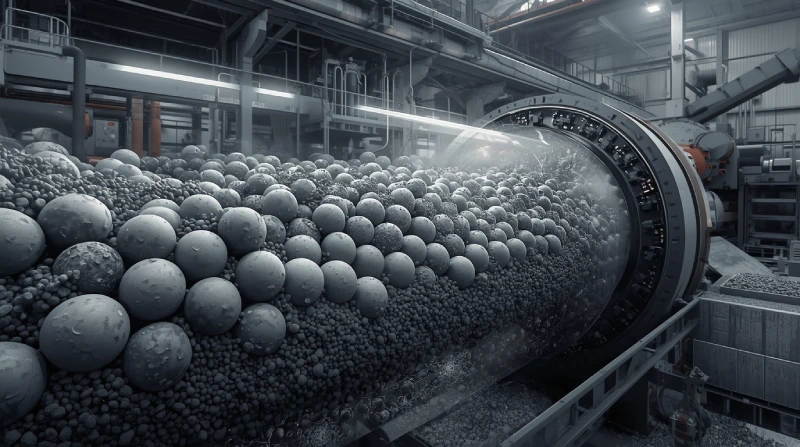
"Steel grinding balls" is a broad commercial term. Buyers sometimes use it for almost any metallic grinding ball, which can hide important metallurgical differences.
In this article, the comparison is between:
- High-chrome cast grinding media: commonly high-chromium white cast iron, with hard chromium carbides in a heat-treated metallic matrix.
- Forged steel grinding balls: steel media shaped through forging or related hot-forming processes, with properties determined by composition and heat treatment.
This distinction matters because chromium content alone does not define service performance. Carbide distribution, matrix condition, internal soundness, and hardness profile all influence how a ball wears or fails.
A useful procurement specification therefore identifies the material, manufacturing route, size, inspection requirements, and intended duty. "High chrome" and "forged" are starting categories—not complete performance guarantees.
A new ball can look spherical at delivery yet develop flats, pits, chipped edges, or fractured surfaces during service.
Continuous operation exposes the charge to repeated loading and a changing mixture of ball sizes. Replacement media enters an existing population rather than operating alone. Consequently, delivery inspection cannot establish long-term shape retention.
Research on media geometry shows that spherical and worn media can produce different load behaviour and breakage kinetics. However, the effect depends on operating conditions, including feed size and material filling. There is no defensible universal percentage improvement from "rounder balls."
A ball that becomes smaller while remaining approximately spherical has experienced a different outcome from one that loses a large fragment.
Likewise, low average mass loss does not prove good shape retention. A batch may show acceptable average wear while containing a problematic fraction of chipped or distorted balls.
For purchasing decisions, track three separate outcomes:
1. Material consumption.
2. Shape deterioration.
3. Fracture and spalling.
Treating them as one "wear" figure can conceal the reason a grinding charge becomes less predictable.
| Selection factor | High-chrome cast grinding balls | Forged steel grinding balls |
|---|---|---|
| Primary selection rationale | Abrasion resistance from carbide-containing microstructures | Toughness and resistance to impact-related damage |
| Shape-retention opportunity | Relatively uniform wear when alloy and duty are compatible | Retention of an intact ball under demanding impact conditions |
| Important failure checks | Chipping, cracking, spalling, and localized attack | Flattening, uneven wear, spalling, and fracture |
| Wet-circuit consideration | Corrosion performance must be checked in actual slurry | Corrosive wear must also be assessed in actual slurry |
| Critical quality evidence | Chemistry, microstructure, soundness, heat treatment | Chemistry, internal integrity, heat treatment, hardness profile |
| Best purchasing evidence | Representative comparative testing | Representative comparative testing |
These are selection tendencies, not a ranking. A poorly matched premium alloy can underperform a less expensive ball designed for the actual circuit.
High-chrome media deserves consideration where abrasive wear is a major loss mechanism and impact severity is compatible with the selected grade.
Its hard carbides can support wear resistance. Nevertheless, matrix support and manufacturing quality matter: carbide hardness is not useful if the surrounding structure permits cracking or material loss.
Wet service requires particular care. "High chrome" should never be interpreted as "corrosion-proof."
Forged steel deserves consideration where large balls, coarse feed, or severe impacts make toughness especially important.
However, forging alone does not guarantee sustained roundness. Buyers still need evidence of suitable heat treatment, internal quality, and resistance to deformation and surface damage.
The correct question is not "Which manufacturing process wins?" It is "Which qualified product maintains the most useful charge under this duty?"
A media recommendation should not transfer automatically between industries.
Record ore characteristics, feed size, mill configuration, solids concentration, pH, and relevant water chemistry.
Where flotation follows grinding, include recovery or appropriate metallurgical response in the evaluation. Media should not be selected solely on consumption if the change also affects downstream results.
For dry cement grinding, compare media performance at equivalent fineness and product requirements.
A lower consumption figure does not establish a better choice if throughput falls or specific energy rises. Review the chamber arrangement, ball-size distribution, and liner condition alongside the alloy.
Not every pulverizer uses loose grinding balls. Confirm that the equipment is a ball-based grinding system before comparing these media categories.
For applicable circuits, document feed variability and product-fineness requirements. Avoid transferring a mining recommendation to a power application without checking the duty.
The following is a proposed plant-inspection framework, not an industry-standard acceptance method.
Its purpose is to make supplier comparisons more consistent.
Sample each delivery lot before charging. Record:
- Nominal diameter and individual mass.
- Maximum and minimum measured diameters.
- Visible seams, cavities, cracks, or surface defects.
- Batch identity and available quality documentation.
- Photographs with a scale and consistent lighting.
Keep the measurement method unchanged between suppliers.
A simple screening measure is:
Diameter variation (%)=(Dmax−Dmin)/Dmean×100
Measure along multiple orientations rather than relying on a single caliper reading.
This is a practical diameter-variation proxy, not a complete three-dimensional sphericity measurement. It may miss local flats, chips, and cavities. Combine it with visual classification or more detailed scanning when justified.
Do not impose an arbitrary universal acceptance limit. Agree tolerances by ball size, sampling method, and operating purpose.
Recovered small balls have generally experienced different service histories from newly charged large balls.
Compare like-sized populations wherever possible, and distinguish normal size reduction from abnormal shape loss. Record the proportion of visibly damaged balls rather than reporting only an average diameter.
Collect samples only through approved, isolated maintenance procedures. Sampling must never require access to operating equipment.
A controlled trial is more persuasive than an unsupported promise of longer life.
Agree the target product size, throughput range, acceptable damage level, sampling plan, and economic criteria.
Also define what would invalidate a comparison—for example, a major ore change or simultaneous liner replacement.
Record media additions, tonnes processed, operating hours, power, product size, and relevant process conditions.
Use enough operating history to understand normal variation. A short, unusually easy production period is not a reliable baseline.
Marked-ball testing can compare relative wear under shared conditions. It does not, by itself, prove the performance of a fully converted charge.
For a full-charge change, account for the transition period while incumbent media remains in the mill. Otherwise, the measured result represents a mixed population.
Track:
- Media consumption in kilograms per tonne.
- Chipped, fractured, or visibly distorted balls.
- Diameter variation within comparable size classes.
- Specific energy and throughput.
- Product-size stability.
- Relevant downstream performance.
Avoid changing ball size, alloy, filling level, and operating settings simultaneously unless the test is explicitly designed to evaluate a combined change.
Review results at agreed intervals. Continue, adjust, or stop the trial using predefined criteria.
This makes the decision auditable and reduces the temptation to interpret every fluctuation as a supplier effect.
An Australian gold operation tested forged and high-chrome cast media in a two-stage ball mill circuit during February–March 2023.
The published account describes 90–105 mm balls tested over 517 operating hours. It reports that Molycop's 18% chromium cast ball achieved a 2% lower wear rate than the next-best competitor product. A separate 105 mm forged product comparison showed a 17% improvement against its incumbent.
These are different comparisons. The figures do not establish that forged media outperformed high-chrome media by 17%, nor do they directly demonstrate superior roundness.
The useful lesson is methodological: meaningful performance claims identify the product, comparator, operating exposure, and measured outcome. These are external supplier results, not ALLSTAR test results or a forecast for another plant.
A useful starting calculation is:
Media cost per tonne processed=Media price per kilogram×Media consumption in kilograms per tonne
For illustration, assume one product costs USD 1.00/kg and consumes 0.80 kg/t. Its media cost is USD 0.80/t.
A second product costing USD 1.15/kg but consuming 0.65 kg/t costs approximately USD 0.75/t.
These are hypothetical figures, not quotations or performance claims.
Extend the comparison to energy, throughput, maintenance, and downstream results where the trial supports attribution. Keep projected benefits separate from measured savings.
For an application-specific discussion with SHANDONG ALLSTAR GRINDING BALL CO., LTD., prepare:
1. Mill type, dimensions, and operating arrangement.
2. Current media material and size distribution.
3. Feed material, feed size, and target product size.
4. Wet or dry conditions and relevant slurry chemistry.
5. Current consumption and observed damage.
6. Required inspection, traceability, packaging, and OEM branding specifications.
Ask for a written proposal defining the offered grade, inspection scope, acceptance criteria, and commercial responsibilities. Confirm which documents and tests are available before placing an order.
For overseas brands and distributors, a repeatable specification is more useful than a generic product description.
No. Shape retention depends on the grade, manufacturing quality, impact severity, abrasion, and slurry environment. Compare recovered media under representative conditions.
No. Hardness is one property. An unsuitable balance of hardness, toughness, and internal quality can still produce chipping, cracking, or deformation.
Yes, provided the selected product suits the application. Continuous operation does not automatically make either forged steel or high-chrome cast media preferable.
No. Mass loss and shape loss are different measurements. Include visual damage classification and consistent dimensional checks.
They may coexist during a transition, but compatibility and interpretation require care. Mixed-charge results should not be presented as the performance of a fully converted charge.
There is no universal duration. Set the period around measurable wear, representative operating conditions, sampling quality, and sufficient charge turnover for the question being tested.
Send SHANDONG ALLSTAR GRINDING BALL CO., LTD. your mill details, current media specification, operating conditions, and photographs of recovered balls.
Request an application-specific quotation and an agreed trial framework. The objective is a documented purchasing decision based on sustained shape, controlled damage, and total grinding cost—not an unsupported claim that one alloy always wins.
1. Magotteaux. "High-Chrome grinding media."
2. "Effects of grinding media shapes on load behaviour and mill power in a dry ball mill." *Minerals Engineering*, 2006.
3. "Effects of media shape on milling kinetics."
4. Olivia Thomson. "Case study: Forged and high chrome cast grinding media."
5. Molycop. "Cast High Chrome Balls Technical Specifications."
Hot Tags: China, Global, OEM, private label, manufacturers, factory, suppliers, manufacturing company


