
Views: 229 Author: shandong Allstar Grinding Ball Publish Time: 2026-11-02 Origin: Site


Content Menu
● High Chrome Steel Balls vs Forged Steel Ball: The Practical Difference
● Why Highly Abrasive Silica Sand Challenges Grinding Media
>> Define "Optimized Grind Kinetics" Before Comparing Products
● How Grinding Kinetics Connects Media Choice to Mill Performance
>> Why Lower Wear Does Not Automatically Mean Faster Breakage
● When High Chrome Grinding Balls Deserve Priority
>> Check the Complete Metallurgy
● When Forged Steel Grinding Balls Deserve Priority
>> Evaluate More Than Surface Hardness
● Ball Size and Operating Conditions Can Outweigh Alloy Differences
>> Match the Media Charge to the Feed
● A Critical Silica-Sand Question: Can the Product Accept Metal Contamination?
● A Practical Trial Protocol for Comparing Both Media Types
>> Step 1: Establish a Representative Baseline
>> Step 2: Run Controlled Grinding Tests
>> Step 3: Measure More Than Final Fineness
>> Step 4: Confirm Performance in the Plant
● Compare Cost per Saleable Tonne, Not Price per Tonne of Balls
● OEM Procurement With SHANDONG ALLSTAR GRINDING BALL CO., LTD.
● Request an Application-Based Grinding Media Proposal
>> 1. Are high chrome balls always better for abrasive silica sand?
>> 2. Can forged steel balls grind silica sand efficiently?
>> 3. Does a higher chromium percentage guarantee lower wear?
>> 4. What ball size is best for silica-sand grinding?
>> 5. Which media is suitable for high-purity silica?
>> 6. How should buyers compare supplier claims?
At SHANDONG ALLSTAR GRINDING BALL CO., LTD., we supply grinding balls, forged steel balls, cast grinding balls, grinding rods, and cylpebs for mining, cement, and power applications. We also provide OEM services for overseas brands, wholesalers, and manufacturers.
When customers compare high chrome steel balls vs forged steel ball for optimizing grind kinetics of highly abrasive silica sand, the most useful question is not simply which ball is harder. It is which grinding media maintains the required particle-size distribution at the lowest total cost, without unacceptable breakage or contamination.
Our recommended starting point is straightforward: evaluate high-chromium cast media where abrasion dominates, and evaluate forged steel media where impact resistance is especially important. Then verify the choice with your actual silica feed, mill conditions, and finished-product specifications.
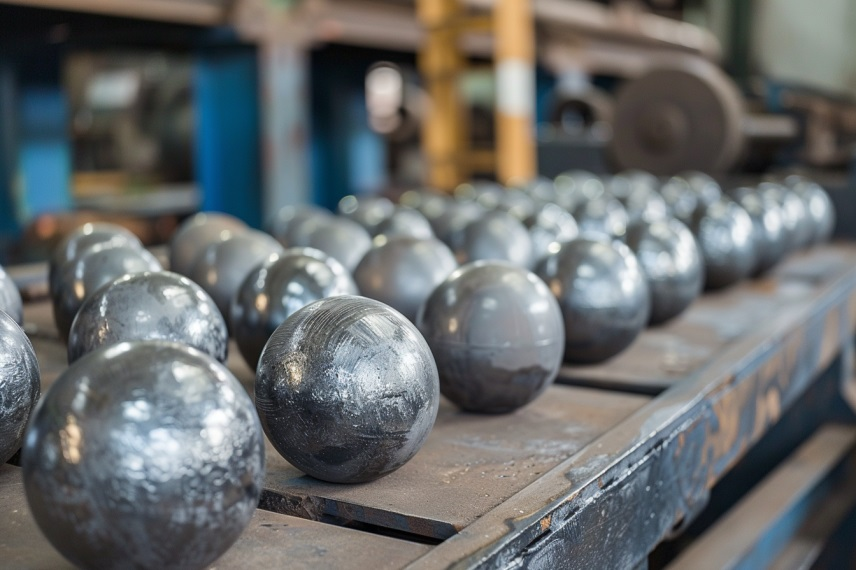
Both media types can grind silica sand. Their differences become important when abrasive wear, impact loading, slurry chemistry, and product purity interact.
One terminology point matters: products commonly marketed as "high chrome steel balls" are often high-chromium cast iron grinding media rather than forged steel. Buyers should confirm the actual alloy classification instead of relying on the commercial name.
| Selection factor | High-chromium cast grinding balls | Forged steel grinding balls |
|---|---|---|
| Principal selection advantage | Abrasion resistance from a hard matrix and chromium carbides | Toughness and resistance to demanding impact conditions |
| Initial screening priority | Abrasion-dominated ball milling | Coarse-feed or higher-impact milling |
| Important quality checks | Carbide distribution, matrix condition, casting integrity | Through-section hardness, heat treatment, impact performance |
| Wet-grinding consideration | Corrosion performance depends on alloy and slurry conditions | Wear can include both abrasion and corrosion |
| Purity consideration | Potential iron and chromium contamination | Potential iron and other alloy-element contamination |
| Final selection basis | Verified circuit performance | Verified circuit performance |
Neither manufacturing route guarantees superiority. Alloy design, heat treatment, ball diameter, and production consistency all influence the result.
Silica-rich feed creates repeated abrasive contact between particles, balls, and liners. Meanwhile, the mill must transfer enough energy to break particles rather than merely circulate them.
Three operating problems deserve attention:
- Media consumption can change the working ball-size distribution.
- Inadequate breakage can leave excessive coarse material.
- Excessive grinding can generate unwanted ultrafines and additional metal contamination.
The purchasing objective should therefore be stable production of saleable material—not maximum hardness or minimum purchase price alone.
Grinding kinetics describes how quickly particles break and how the size distribution changes over time.
For a silica operation, practical indicators include:
- Time required to reach the target product size.
- Tonnes per hour meeting specification.
- Specific energy consumption in kWh/t.
- Oversize and ultrafine fractions.
- Media consumption in kg/t.
A faster initial size reduction does not automatically mean a better industrial result. The product must also meet purity requirements and remain economical to produce.
A useful laboratory starting point is the disappearance of a selected feed-size fraction.
Where first-order behavior applies:
mi(t)=mi(0)e−Sit
Here, mi(t) represents the material remaining in the selected original size interval, and \(S_i\) is its specific breakage rate.
A larger \(S_i\) indicates faster disappearance of that fraction under the tested conditions. However, this simplified relationship should not be applied blindly to every grinding stage.
Quartz studies show that operating conditions and increasing fineness can produce departures from first-order behavior. Engineers should inspect the measured size distributions rather than force every test into a straight-line model.
Wear resistance and breakage rate answer different questions.
Wear resistance describes how well the media survives. Breakage rate describes how effectively the mill reduces the feed.
High-chromium media may maintain its dimensions longer in a suitable abrasive application. That can help stabilize the working charge over time. However, it does not prove that a fresh high-chromium ball will always break quartz faster than an equally sized forged ball.
Ball size, charge distribution, mill filling, slurry conditions, and available power still require evaluation.
High-chromium cast media deserves an early trial when abrasive wear is the main limitation and impact conditions are compatible with the selected grade.
Its wear-resistant structure combines hard chromium carbides with a heat-treated matrix. The performance depends on how those features are produced and distributed—not chromium percentage alone.
Potential advantages to investigate include:
- Lower media consumption under the actual operating conditions.
- Slower change in the working ball-size distribution.
- More consistent performance between media additions.
- Favorable abrasion-corrosion behavior in a compatible slurry.
Two products with similar chromium content can behave differently.
A purchasing specification should address:
- Chemical composition and permitted variation.
- Surface and internal hardness.
- Heat-treatment condition.
- Microstructure and casting defects.
- Impact-test method and acceptance criteria.
Do not adopt a universal chromium percentage or hardness target without considering ball diameter and mill duty. Excessive emphasis on one specification can overlook the failure mechanism that actually controls service life.
Forged steel media deserves particular attention when the circuit imposes substantial impact loading, handles coarse feed, or experiences operating variability.
Its appeal lies in the combination of strength, toughness, and wear resistance achievable through suitable steel selection and heat treatment.
Forged media should enter the comparison when:
- Large particles require substantial impact energy.
- Ball breakage has caused operating problems.
- Feed conditions fluctuate significantly.
- The existing circuit already performs reliably with forged media.
A surface hardness reading does not describe the entire ball.
Ask how hardness changes toward the center, how the supplier verifies heat treatment, and how impact performance is assessed for the intended application.
For either media type, investigate broken or spalled balls systematically. Mill conditions, handling damage, manufacturing defects, and unsuitable media selection can all require consideration.
A product label is not a substitute for failure analysis.
A comparison becomes misleading when one media charge has a suitable size distribution and the other does not.
Larger balls offer greater individual impact energy. Smaller balls provide more contact opportunities for a given charge volume. The useful balance depends on feed size, target fineness, and mill configuration.
Quartz grinding research confirms that ball size affects breakage behavior, but individual experimental optima are not universal plant settings.
Before changing alloy, document:
1. Feed particle-size distribution, including the coarse tail.
2. Target product distribution, not only one passing size.
3. Existing ball-size distribution and makeup practice.
4. Mill speed, filling, liner condition, and power.
5. Wet-grinding solids concentration and water chemistry.
Change one major variable at a time during diagnostic testing. Otherwise, a useful result may be wrongly attributed to the alloy.
For some silica applications, contamination is more important than media life.
Steel-based grinding media can introduce iron through wear. High-chromium media also requires attention to chromium contribution.
Consequently, neither option should be assumed suitable for high-purity silica simply because it offers good mechanical performance.
Before selecting media, establish:
- Maximum acceptable iron and other relevant impurities.
- Whether the specification concerns total or removable contamination.
- Whiteness or downstream processing requirements.
- The capability and cost of subsequent purification.
Where metal limits are restrictive, compare a suitable low-contamination grinding system as an alternative. Media, liners, process water, and upstream equipment must be considered together.
A lower wear rate is useful, but the finished-product assay remains the deciding evidence.
The most useful supplier comparison reproduces the customer's operating problem.
Use representative silica feed and record its size distribution, mineralogy where available, moisture, and relevant impurity levels.
Document the existing operating conditions and product quality before introducing another media grade.
Compare candidate media using consistent:
- Feed preparation and sample mass.
- Initial ball-size distribution.
- Charge filling and mill speed.
- Slurry conditions for wet tests.
- Sampling and particle-size analysis methods.
Use several grinding intervals to reveal changes in kinetics. Repeat tests where practical to distinguish a real improvement from normal variation.
Track target-size yield, energy, media loss, visible damage, and product contamination.
A batch test can screen candidates, but it cannot fully reproduce long-term charge evolution or a continuously operating classification circuit.
A plant trial should allow sufficient time to interpret the changing media charge.
Record the proportion of new media in the mill and changes in feed or operating conditions. Otherwise, a mixed charge may obscure the performance of the candidate product.
Agree on success criteria before the trial begins.
The most useful commercial metric is saleable-tonne cost.
A practical comparison includes:
Use costs and output from the same reporting period. Include only relevant, attributable costs and avoid double counting.
For example, if one candidate saves 0.10 kg of media per tonne of feed at a delivered price of $1.20/kg, its gross media saving is $0.12 per tonne of feed.
That is an illustrative calculation, not an ALLSTAR performance claim. Any energy penalty, additional purification requirement, or loss of saleable yield must be assessed separately.
This approach makes procurement decisions more transparent than comparing ball prices alone.
SHANDONG ALLSTAR GRINDING BALL CO., LTD. supplies grinding media for overseas brands, wholesalers, and manufacturers serving mining, cement, and power markets.
For a silica-sand inquiry, we recommend defining the application before finalizing the OEM specification.
Provide:
- Mill type, dimensions, and operating conditions.
- Feed and target particle-size distributions.
- Wet or dry operation.
- Current media sizes and consumption.
- Observed breakage or wear problems.
- Finished-product contamination limits.
- Packaging and private-label requirements.
Then agree on measurable product requirements, inspection methods, sampling arrangements, and acceptance criteria.
For repeat orders, request the relevant documentation and traceability arrangements before purchase. Any certificate, test report, or performance commitment should match the actual supplied product and agreed contractual scope.
Send SHANDONG ALLSTAR GRINDING BALL CO., LTD. your mill details, silica feed analysis, target fineness, current media consumption, and impurity limits.
Request a comparison covering candidate media grades, ball-size options, OEM requirements, and a practical validation plan.
Choose the media that proves its value in your circuit—not the one supported by the strongest unverified promise.
No. They are strong candidates where abrasion dominates, but impact conditions, manufacturing quality, slurry chemistry, and contamination limits can change the preferred choice.
Yes. Suitable forged media can provide effective grinding, particularly where impact resistance matters. Efficiency must be verified against the required size distribution and operating cost.
No. Chromium content is only part of the metallurgy. Carbide distribution, matrix condition, heat treatment, and actual milling conditions also influence performance.
There is no universal optimum. Select and test a size distribution against the feed, target product, mill geometry, and operating conditions.
Neither steel-based option should be accepted automatically. Test product contamination and consider a low-contamination grinding system when the impurity specification requires it.
Request defined test conditions, representative samples, relevant inspection documents, and a controlled trial. Compare saleable output and total operating cost rather than an isolated hardness or wear figure.
1. Magotteaux. "Cast High Chromium."
2. Magotteaux. "Forged Grinding Media for Mining."
3. "Identification of Optimal Mill Operating Parameters during Grinding of Quartz with the Use of Population Balance Modeling." KONA Powder and Particle Journal.
4. "The Effects of Mill Conditions on Breakage Parameters of Quartz Sand in the Ball Mill." IntechOpen, 2022.
5. "Kinetics of Fine Wet Grinding in a Laboratory Ball Mill." Powder Technology, 2001.
6. "Upgrading Quartz-Rich Tailings as Secondary Silica Resources: Process Mineralogy, Beneficiation, Purification, and Product Qualification." Minerals, 2026.
7. Molycop. "Top Results in Test of Molycop's Forged and High Chrome Cast Grinding Media." December 13, 2023.
8. SHANDONG ALLSTAR GRINDING BALL CO., LTD.
Hot Tags: China, Global, OEM, private label, manufacturers, factory, suppliers, manufacturing company


