
Views: 248 Author: shandong Allstar Grinding Ball Publish Time: 2026-11-02 Origin: Site


Content Menu
● Forged Steel Ball vs Chrome Steel Ball: What Are You Comparing?
● Diagnose the Overloaded Mill Before Changing Grinding Media
>> Follow the Material Through the Circuit
● Measure Specific Energy, Not Power Draw Alone
>> An Illustrative Calculation
● When Forged Steel Balls Are Worth Testing
● When High-Chromium Cast Balls Are Worth Testing
>> Wet Grinding Requires a Chemistry Check
● Ball Size Distribution Can Matter as Much as Alloy
● A Practical Trial for Optimizing Power Consumption in Over-Loaded Mills
>> Step 1: Establish a Representative Baseline
>> Step 2: Define Success Before Starting
>> Step 3: Control the Main Variables
>> Step 4: Allow for Charge Transition
>> Step 5: Review Results Jointly
● Compare Total Grinding Cost, Not Price per Tonne of Balls
● Specify an OEM Supply Program with SHANDONG ALLSTAR
>> 1. Are forged steel balls always more energy-efficient than chrome steel balls?
>> 2. Can high-chromium cast balls solve an overloaded mill?
>> 3. Does higher hardness mean lower power consumption?
>> 4. Why can power draw rise while efficiency improves?
>> 5. How long should a grinding-media trial run?
>> 6. What should an OEM buyer prioritize?
● Request an Application-Based Grinding Media Evaluation
At SHANDONG ALLSTAR GRINDING BALL CO., LTD., we approach "Forged Steel Ball vs Chrome Steel Ball for Optimizing Power Consumption in Over-Loaded Mills" as a practical operating decision—not simply a hardness comparison. Our product range includes grinding balls, forged steel balls, cast steel balls, grinding rods, and grinding cylpebs for mining, cement, and power applications, with OEM services for international brands, wholesalers, and manufacturers.
Our starting principle is straightforward: efficiency means using less energy per tonne of acceptable product, not merely reducing the number on a power meter.
Forged media can be a strong candidate where impact resistance matters. High-chromium cast media can offer advantages where abrasion and corrosion dominate. Neither material automatically corrects an overloaded mill. The right choice depends on the operating conditions, ball-size distribution, discharge capacity, and verified performance.
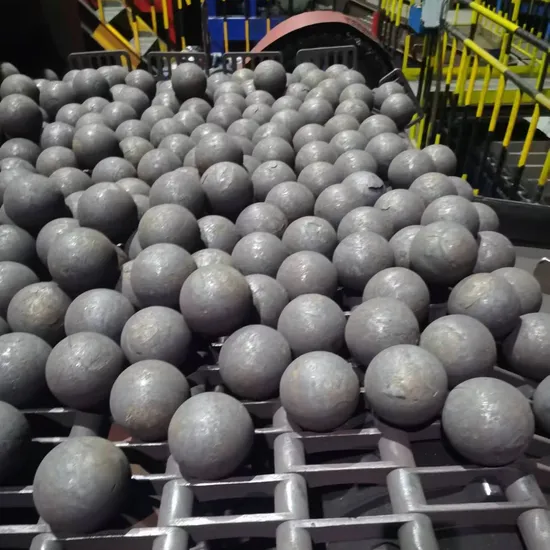
"Forged" describes a manufacturing process. "Chrome" describes alloy chemistry. These terms are not mutually exclusive: forged steel can contain chromium.
For this article, "chrome steel ball" means high-chromium cast grinding media, not chrome-plated balls or precision bearing balls.
Forged grinding balls are shaped from steel and heat-treated to develop the required hardness and toughness. High-chromium cast balls are cast and heat-treated to produce a wear-resistant structure containing hard chromium carbides.
Neither the manufacturing route nor chromium content alone establishes suitability. Chemistry, heat treatment, internal integrity, ball diameter, and service conditions all matter.
| Selection factor | Forged steel grinding balls | High-chromium cast grinding balls |
|---|---|---|
| Main selection priority | Toughness and impact resistance | Abrasion and corrosion resistance |
| Potential application fit | High-impact duties and coarse grinding | Wear-dominated duties and compatible wet or dry grinding |
| Critical quality checks | Hardness profile, toughness, cracking, dimensional consistency | Alloy chemistry, carbide structure, casting integrity, heat treatment |
| Main caution | Wear performance depends on grade and environment | Impact suitability must be verified for the application |
| Energy-saving mechanism | Preserving effective media condition and charge performance | Preserving effective media condition and charge performance |
An overloaded mill does not always draw unusually high power. Excess slurry accumulation, restricted discharge, or an unfavorable charge position can reduce useful grinding while altering the power signal.
That makes motor power alone an unreliable diagnosis.
Before recommending grinding media for overloaded ball mills, distinguish between:
- Excessive solids feed.
- Excessive media or total charge loading.
- Slurry pooling or discharge restrictions.
- High circulating load.
- Changes in feed hardness or particle size.
- Mechanical or electrical operating limits.
These conditions require different responses. A media substitution cannot remove a blocked discharge or restore an overloaded classifier.
Start with feed size, feed rate, and material variability. Then examine mill loading, discharge conditions, classification performance, and circulating load.
For wet circuits, include slurry density and rheology. For dry circuits, review ventilation, separator loading, and material transport.
Make adjustments within the mill manufacturer's limits. Do not increase charge weight, speed, or drive loading simply because a different ball grade becomes available.
The most useful comparison is specific energy consumption at an equivalent product specification.
Specific energy (kWh/t)=Average power (kW)/Dry throughput (t/h)
Define the measurement boundary first. Mill-motor energy and total grinding-circuit energy are different metrics. Pumps, classifiers, separators, and fans can change the result.
Also keep the denominator consistent: use dry feed tonnes or another clearly defined production basis, not an unexplained mixture of fresh feed and circulating material.
Consider two hypothetical operating periods:
| Metric | Baseline | Trial |
|---|---|---|
| Average mill power | 2,000 kW | 2,050 kW |
| Dry throughput | 100 t/h | 110 t/h |
| Specific energy | 20.00 kWh/t | 18.64 kWh/t |
Power increases by 2.5%, but specific energy falls by approximately 6.8%.
This represents an improvement only if product quality remains comparable. In mineral grinding, check product size and downstream recovery. In cement grinding, check fineness and relevant quality targets.
These figures illustrate the calculation; they are not SHANDONG ALLSTAR customer results or a promised saving.
Forged steel grinding balls deserve consideration when repeated impacts and coarse particles place demanding loads on the media.
The evaluation becomes particularly relevant when recovered balls show cracking, fragmentation, or poor shape retention. Damaged media can occupy mill volume without providing the intended grinding performance.
However, "forged" is not a complete specification. Buyers should verify:
- Steel chemistry and heat-treatment requirements.
- Surface and internal hardness characteristics.
- Diameter and dimensional tolerances.
- Agreed impact or breakage assessment methods.
- Batch identification and traceability.
The practical question is not whether forged balls are universally better. It is whether a specific forged grade maintains a more effective charge under the actual operating conditions.
For an overloaded mill, that assessment must accompany—not replace—correction of feed and discharge problems.
High-chromium cast grinding balls deserve evaluation where abrasive wear or corrosion-related wear drives media consumption.
Their carbide-containing structure can provide wear resistance, while alloy selection and heat treatment influence the balance between wear resistance and impact performance.
This makes application matching essential. A grade suitable for one ball mill should not automatically be specified for a more severe impact duty.
For wet mineral processing, consider slurry chemistry alongside mechanical wear. Depending on the circuit, interactions between grinding media and the mineral system can also affect downstream processing.
Do not assume that every high-chromium grade provides the same corrosion behavior.
In dry cement grinding, focus the comparison on wear, ball-size distribution, product quality, and circuit performance. Wet-mining assumptions should not be transferred unchanged to cement or power-sector applications.
Changing alloy while retaining an unsuitable ball-size distribution can leave the main source of inefficiency untouched.
Large balls supply impact energy for coarse particles. Smaller balls provide more contact opportunities for finer grinding. The working charge needs an appropriate balance.
Oversized media can waste energy and increase wear. An unsuitable proportion of small media may fail to break the coarser feed effectively.
Review the following together:
1. Feed-size distribution and material hardness.
2. Required product size.
3. Mill diameter, speed, and liner condition.
4. Current charge composition and wear pattern.
5. Top-up sizes and addition frequency.
Slower-wearing media may require a revised replenishment strategy. Continuing the previous addition schedule without checking charge inventory can change loading and obscure the benefits of the new material.
A controlled trial provides stronger purchasing evidence than a catalogue comparison.
Record power, throughput, product size, feed characteristics, media additions, and relevant circuit settings over representative operating conditions.
Include operating interruptions and material changes. A short, unusually favorable production window is not a reliable baseline.
Agree on the decision criteria:
- Lower kWh/t at equivalent product quality.
- Acceptable media consumption.
- Acceptable breakage and wear behavior.
- Stable throughput and operating conditions.
- No unacceptable downstream penalty.
Avoid selecting the winner using only the most favorable metric.
Where practical, keep feed characteristics, speed, liner condition, classification settings, and measurement methods comparable.
If other operating changes are necessary, document them. Otherwise, improvements caused by maintenance or feed changes may be incorrectly attributed to the balls.
New media mixes with the existing charge. Early results therefore represent a blend rather than a fully converted inventory.
Interpret trial performance alongside the estimated replacement progression. Avoid declaring a definitive result before the charge and circuit have stabilized sufficiently.
Operations, maintenance, metallurgy, and procurement should review the same dataset. The preferred media should deliver a repeatable operating benefit, not simply a favorable purchase price.
A lower media purchase price does not necessarily produce a lower grinding cost.
A useful evaluation combines:
Express each component on the same production basis. Media cost per tonne processed depends on both delivered media price and consumption rate.
Where appropriate, assess downstream consequences separately, including recovery or product-quality effects. Avoid assigning speculative financial values to unmeasured benefits.
Keep the recommendation conditional: a higher-priced ball is justified only when demonstrated operational benefits outweigh its additional cost.
SHANDONG ALLSTAR GRINDING BALL CO., LTD. supplies grinding media and offers OEM services for overseas brands, wholesalers, and manufacturers.
For a technically meaningful inquiry, provide:
- Mill type, dimensions, and operating speed.
- Mining, cement, or power-sector application.
- Wet or dry operating conditions.
- Current ball material, sizes, and addition rate.
- Feed and target product characteristics.
- Current kWh/t and media consumption.
- Observed breakage, wear, or overload symptoms.
For OEM purchasing, also define labeling, packaging, documentation, and batch-identification requirements.
Agree on the applicable inspection methods and acceptance criteria before ordering. Request confirmation of available testing and documentation rather than assuming that an unspecified certificate covers every performance requirement.
No. Energy performance depends on the complete grinding system. Forged balls may suit impact-heavy conditions, while high-chromium cast balls may suit wear-dominated duties. Compare specific energy at equivalent product quality.
Not by themselves. Restricted discharge, excessive feed, unsuitable loading, and classification problems require operational or mechanical correction. Media selection is one part of optimization.
No. Hardness is only one material property. Toughness, wear behavior, ball size, charge condition, and circuit settings influence whether energy produces useful grinding.
Throughput can increase faster than power. When equivalent-quality output rises sufficiently, kWh/t falls even though the motor draws more power.
There is no universal duration. Allow enough time to capture representative feed conditions and understand charge replacement. Define the trial period and stopping criteria before starting.
Prioritize application suitability, consistent specifications, traceable batches, agreed inspection methods, and verified operating performance. Evaluate delivered cost alongside media consumption and energy use.
Contact SHANDONG ALLSTAR GRINDING BALL CO., LTD. with your mill specifications, operating data, current media sizes, and target product requirements.
Request a proposed forged or cast grinding-media specification, OEM supply requirements, and a trial evaluation framework. Make the final selection using measured grinding performance—not an unsupported claim that one alloy always saves power.
1. Metso — "Questions and answers on grinding technology." Explains how unsuitable media size, damaged media, and slurry pooling can undermine energy efficiency. Published October 17, 2018. [metso]
2. Metso — "Five tips on mill liners to improve grinding profitability 1/2." Discusses charge loading, media-size distribution, grinding contacts, and equipment constraints. Published August 19, 2019. [metso]
3. Metso — "Converting a ball mill from overflow to grate discharge." Explains slurry pooling and why improved discharge can increase power draw while supporting improved grinding performance. Published June 23, 2020. [metso]
4. Magotteaux — "Forged grinding media for mining." Describes forged-media design priorities, including impact resistance and reduced breakage in SAG and ball mills. [magotteaux]
5. Magotteaux — "Cast high chromium." Describes the martensitic structure, chromium carbides, and abrasion/corrosion-resistance considerations of high-chromium grinding media. [magotteaux]
6. Magotteaux — "Grinding Media." Provides application context for forged and high-chromium cast media across different mill types and grinding conditions. [magotteaux]
Hot Tags: China, Global, OEM, private label, manufacturers, factory, suppliers, manufacturing company


