
Views: 259 Author: shandong Allstar Grinding Ball Publish Time: 2026-09-21 Origin: Site


Content Menu
● Why Media Fracture Matters in Grate-Discharge Mills
● High Chrome Grinding Ball vs Forged Steel Ball: Core Differences
● Why Forged Steel Often Prevents Fractures Better
>> Dense Internal Structure Reduces Crack Initiation
>> Toughness Absorbs Energy Instead of Releasing It as Fracture
>> Controlled Tempering Is a Critical Fracture-Control Step
● Where High Chrome Grinding Balls Perform Best
● A Practical Media-Selection Framework
>> Step 1: Define the Mill's Impact Severity
>> Step 2: Separate Abrasion Problems From Fracture Problems
>> Step 3: Request More Than a Hardness Certificate
● How to Run a Low-Risk Media Trial
● Expert Guidance for High-Pressure Grate-Discharge Mills
● Why Choose SHANDONG ALLSTAR Grinding Media
● FAQ
>> 1. Are forged steel balls better than high chrome grinding balls?
>> 2. Why do high chrome grinding balls fracture in some mills?
>> 3. Can hardness predict grinding ball breakage?
>> 4. What is the best grinding media for a grate-discharge mill?
>> 5. How can a mine reduce grinding media breakage?
>> 6. What should I ask an OEM grinding ball supplier?
>> 7. Can broken grinding media block discharge grates?
In high-pressure grate-discharge mills, the question is not simply whether a grinding ball is hard. The real question is whether it can survive repeated impact, resist abrasive wear, maintain a predictable wear profile, and avoid creating fragments that block grates or destabilize throughput. This is why the decision between a high chrome grinding ball vs forged steel ball must be based on mill duty, ore characteristics, ball size, pulp conditions, and fracture risk—not on purchase price alone.
At SHANDONG ALLSTAR GRINDING BALL CO., LTD., we support mining, cement, and power-generation customers with OEM grinding media solutions, including forged steel balls, high chrome cast grinding balls, grinding rods, and grinding cylpebs. From our manufacturing perspective, preventing media fracture begins long before the balls enter a mill: it begins with steel chemistry, melting and forging discipline, controlled heat treatment, dimensional consistency, and application-specific quality verification.
For severe, high-energy primary grinding duties, forged steel balls are usually the safer choice because they offer greater toughness and resistance to catastrophic breakage. High chrome grinding balls can deliver excellent wear resistance in abrasion-dominated environments, but their suitability in a high-pressure grate-discharge circuit depends on whether impact loading remains within a safe operating envelope.

A grate-discharge mill removes slurry through openings in a grate at the mill discharge end. This design can support high throughput, but it also creates an unforgiving environment for poor-quality or poorly selected grinding media.
When a ball fractures, chips, or spalls excessively, the consequences extend beyond media consumption:
- Broken fragments can contribute to grate blockage and reduced discharge capacity.
- Irregular media shapes can alter charge motion and reduce grinding efficiency.
- Sudden changes in media size distribution can affect product size and cyclone performance.
- Unplanned shutdowns may be required to inspect grates, pulp lifters, liners, and discharge components.
- Media fragments can increase handling losses and complicate mill clean-out procedures.
- Unstable media performance can make it difficult to distinguish ore variability from grinding-media failure.
Industry testing has long shown that impact life varies substantially among commercial media products, even when nominal hardness or chemistry appears similar. In repeated-impact evaluations, both steel and alloyed white cast iron balls showed wide variation in breakage life. The key lesson is practical: hardness alone is not a reliable proxy for fracture resistance.
For operators of high-pressure grate-discharge mills, this means media selection should prioritize total operating stability, not only abrasion resistance measured in isolation.
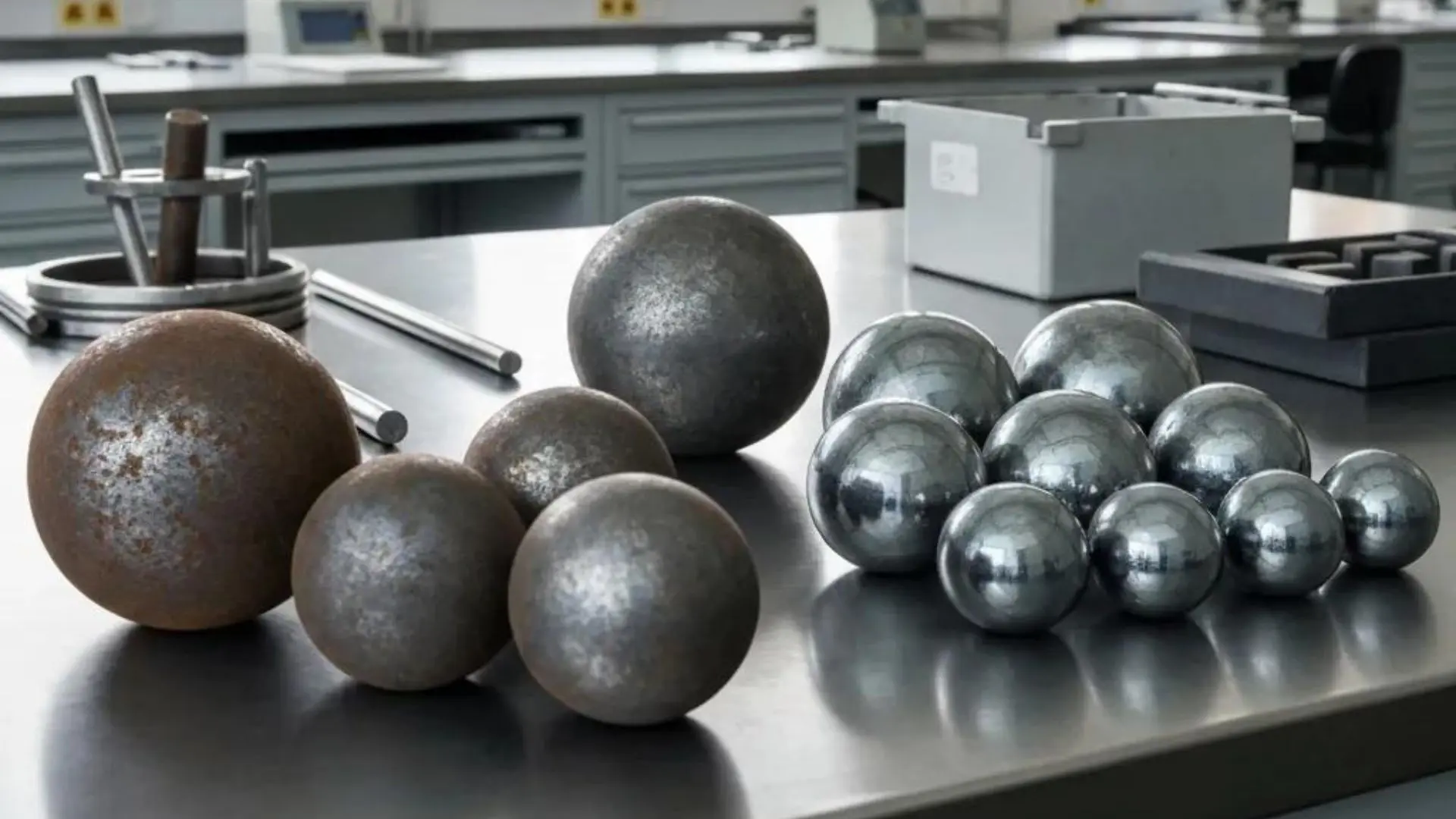
High chrome grinding balls are commonly manufactured from high-chromium white cast iron. Their microstructure contains hard chromium-rich carbides in a hardened matrix. This gives the material excellent resistance to abrasive wear, particularly when the ore is abrasive and direct impact intensity is moderate.
Forged steel balls are produced from selected steel bar through heating, forging or rolling, quenching, and tempering. The forging process refines and densifies the internal structure. When chemistry and heat treatment are properly controlled, the result is a ball with high hardness plus much stronger resistance to impact fatigue, cracking, and fracture.
| Selection factor | High chrome grinding ball | Forged steel grinding ball |
|---|---|---|
| Typical manufacturing route | Casting and heat treatment | Forging/rolling and controlled heat treatment |
| Dominant advantage | High abrasive-wear resistance | High impact toughness and fracture resistance |
| Main fracture concern | Brittle cracking or spalling under severe impact | Failure risk rises if heat treatment, hardness profile, or raw bar quality is inconsistent |
| Best-fit duty | Abrasion-dominated secondary or regrind applications | High-impact primary grinding, SAG-related duty, large mills, high-pressure circuits |
| Suitability for large ball sizes | Requires careful validation as size and impact energy rise | Generally better suited to larger sizes and aggressive charge impacts |
| Response to repeated shock loading | More sensitive to internal defects and brittle microstructural behavior | Better energy absorption when forged and tempered correctly |
| Media shape after wear | Can chip or fracture if impact loading is excessive | Usually wears more gradually when quality is controlled |
| Decision priority | Lowest wear rate under compatible impact conditions | Lowest fracture risk and stable mill operation under high-impact conditions |
The table provides a starting point—not a substitute for an application review. In a real mill, the same media can perform differently depending on liner profile, mill diameter, mill speed, ore competency, feed-size distribution, ball size, slurry chemistry, and operating discipline.
In high-pressure grate-discharge mills, balls repeatedly collide with other balls, liner surfaces, ore particles, and grinding charge material. They also experience cyclic stresses that can propagate small defects into visible cracks, spalls, or full fractures.
A properly manufactured forged steel ball has several advantages in this environment.
Forging compresses and reshapes heated steel under high pressure. This process can help reduce internal discontinuities and refine the material structure when the raw material and forging process are properly managed.
For high-impact grinding duty, this is important because internal voids, shrinkage defects, segregation, inclusions, or poor heat-treatment control can become crack-initiation sites. Under repeated impact, a minor internal defect can develop into a major failure.
At SHANDONG ALLSTAR GRINDING BALL CO., LTD., our approach is to treat fracture prevention as a full manufacturing-system requirement:
- Select steel chemistry appropriate for the target hardness and toughness balance.
- Control heating and forming conditions during forging or rolling.
- Use disciplined quenching and tempering practices.
- Inspect dimensions, surface condition, and hardness consistency.
- Match ball size and hardness targets to the customer's mill duty.
- Support OEM customers with specifications aligned to their brand and market requirements.
A grinding ball must resist more than wear. It must absorb impact energy without forming a crack that grows over thousands of collisions.
Forged steel is generally more forgiving in high-energy conditions because its toughness helps it deform microscopically and dissipate stress rather than fail suddenly. This does not mean forged balls cannot break. Poor raw material, overheating, inadequate tempering, an excessively hard and brittle structure, or poor dimensional control can all cause forged media failures.
However, when comparing high chrome grinding ball vs forged steel ball for extreme impact duty, forged steel usually provides the stronger safety margin.
Grinding-media performance cannot be judged solely by a catalogue hardness range. A ball that is too soft may wear rapidly. A ball that is excessively hard or improperly tempered may become vulnerable to cracking and spalling.
Testing by the U.S. Bureau of Mines found that heat treatment had a dominant effect on impact life. In one example, additional tempering materially improved the impact life of certain steel ball lots. The implication for buyers is clear: ask not only for nominal hardness, but also for evidence of heat-treatment consistency and impact-performance control.
High chrome grinding balls should not be dismissed simply because fracture risk matters. They remain highly valuable where abrasion dominates and impact severity is manageable.
The chromium-rich carbide structure in high chrome white iron can produce excellent wear resistance. In the right application, that can reduce media consumption and improve cost per tonne processed.
High chrome media is often worth evaluating when the operating environment includes:
- Fine or relatively fine feed material.
- Secondary grinding or regrind duty.
- High ore abrasiveness with lower severe-impact exposure.
- Stable operating conditions with controlled feed size.
- Applications where long wear life is more important than maximum impact toughness.
- Wet-grinding conditions where chemistry and corrosion behavior support the chosen alloy.
The key phrase is "the right application." High chrome balls can be excellent performers when they are not asked to absorb repeated impact beyond their material design limits.
Before specifying high chrome or forged steel grinding balls, gather operational data. A robust specification should be driven by evidence rather than habit.
Review:
- Mill diameter and effective grinding volume.
- Mill speed and operating power.
- Maximum feed size and ore competency.
- Ball size range and make-up-ball practice.
- Liner profile and lifting behavior.
- Frequency of overloads, starts, stops, and abnormal events.
- Evidence of prior ball fracture, chipping, or grate blockage.
If the mill has a large diameter, coarse feed, large ball size, high lifting action, or frequent high-energy impacts, start the evaluation with forged steel.
Do not treat every high media-consumption problem as an abrasion issue.
Look for physical evidence:
| Observed condition | Likely interpretation | Recommended response |
|---|---|---|
| Balls become smaller but remain generally round | Normal abrasive wear may dominate | Compare wear rate, hardness retention, and cost per tonne |
| Large pieces, sharp fragments, or split balls appear | Fracture or brittle failure is occurring | Review impact severity, ball metallurgy, heat treatment, and defects |
| Surface flakes detach repeatedly | Spalling or fatigue damage may be present | Investigate hardness profile and repeated-impact performance |
| Grates plug more often after media change | Media fragments may be affecting discharge | Screen discharge material and review ball breakage history |
| Wear is inconsistent between lots | Manufacturing variability may be significant | Require lot traceability and documented quality controls |
This evidence-based approach prevents the wrong corrective action. Increasing hardness may reduce abrasion, for example, but it can also worsen fracture resistance if toughness is sacrificed.
A quality grinding-media supplier should be able to discuss performance in application-specific terms. For fracture-critical duty, ask for:
1. Chemical composition range and raw-material controls.
2. Surface and core hardness requirements.
3. Heat-treatment process controls.
4. Diameter tolerance, roundness, and surface-quality standards.
5. Lot identification and traceability.
6. Breakage, spalling, and wear-performance evaluation methods.
7. Reference criteria for similar mill duties, where confidentially permissible.
8. Clear packing, shipping, and inspection procedures.
At SHANDONG ALLSTAR GRINDING BALL CO., LTD., we believe the best OEM relationship is not built around generic product claims. It is built around agreed specifications, repeatable production, inspection transparency, and feedback from the actual mill circuit.
A controlled site trial is often the most credible way to choose between high chrome and forged steel. Avoid replacing the entire media charge at once unless the application is already proven.
Use a structured approach:
1. Establish a baseline. Record throughput, power draw, grind size, media addition rate, ball-breakage observations, grate-cleaning frequency, and downtime before the trial.
2. Choose a representative trial zone. Use a known make-up strategy and clearly identify trial media by lot, size, and material grade.
3. Control operating variables. Document feed size, ore type, mill speed, cyclone conditions, slurry density, liner condition, and mill load during the evaluation period.
4. Measure both wear and breakage. Weigh media additions, inspect rejects, track fragments, and distinguish normal wear from spalling and catastrophic fracture.
5. Evaluate cost per tonne, not price per tonne. A higher-priced forged ball may be the lower-cost choice if it reduces breakage, grate plugging, and production interruptions.
6. Inspect the discharge system. Monitor pulp lifters, grates, trommel oversize, and scrap for evidence of media-related failure.
7. Set a realistic trial duration. Short trials can be misleading. Media performance must be assessed over enough operating time to capture repeated-impact behavior and changes in ore conditions.
From an application-engineering standpoint, the most reliable selection rule is straightforward:
- Choose forged steel grinding balls when impact energy is high, ball sizes are large, feed is coarse, fracture history exists, or grate-discharge reliability is a critical constraint.
- Choose high chrome grinding balls when abrasion is the primary wear mechanism, impact is controlled, and the circuit can benefit from superior wear resistance.
- Consider a graded or staged media strategy only after technical review. Different mill zones or milling stages can have different impact-to-abrasion ratios.
- Never assume a media type is suitable because it worked in another mill. Mill diameter, feed size, liner design, and ore competency can change the result completely.
The best product is not "high chrome" or "forged" in the abstract. The best product is the media grade that produces stable throughput, acceptable wear, low fracture frequency, and predictable cost per tonne in your specific circuit.
SHANDONG ALLSTAR GRINDING BALL CO., LTD. is positioned as a dependable global manufacturer for customers in mining, cement, and power generation. We manufacture and support OEM supply of:
- Forged steel grinding balls.
- High chrome cast grinding balls.
- Grinding media for ball mills and related grinding applications.
- Grinding rods.
- Grinding cylpebs.
- Custom OEM specifications for overseas brands, wholesalers, distributors, and manufacturers.
Our priority is to help customers reduce the hidden risks associated with unstable media quality: premature breakage, excessive spalling, irregular wear, production interruption, and inconsistent supply performance.
If your grate-discharge mill is showing fractured balls, frequent grate maintenance, unexplained media consumption, or unstable grinding performance, the right next step is an application review—not another commodity purchase order.
Contact SHANDONG ALLSTAR GRINDING BALL CO., LTD. to discuss your mill conditions, target ball size, ore characteristics, current media failures, and OEM requirements. We can help you develop a grinding-media specification focused on fracture prevention, wear control, and reliable long-term supply.
Neither is universally better. Forged steel balls are generally better for high-impact grinding conditions because they offer stronger toughness and lower fracture risk. High chrome grinding balls are often better for abrasion-dominated applications where impact is moderate and long wear life is the priority.
High chrome cast media can fracture when repeated impact energy exceeds the material's toughness capability. Risk factors include coarse feed, large ball sizes, high mill speed, aggressive liner lift, internal casting defects, unsuitable heat treatment, and abrupt operating changes.
No. Hardness is important for wear resistance, but it does not fully predict fracture or spalling behavior. Buyers should also assess impact resistance, heat-treatment quality, core-to-surface hardness consistency, internal soundness, and actual trial performance.
For severe, high-pressure, high-impact grate-discharge duty, forged steel balls are usually the first choice. For lower-impact, highly abrasive applications, high chrome grinding balls may offer a better wear-cost result. A mill-specific assessment is essential.
Reduce breakage by matching media grade to impact severity, controlling feed size, maintaining appropriate ball charge and mill speed, monitoring liner condition, requiring traceable quality controls, inspecting fragments, and running structured media trials before full conversion.
Ask about raw material specifications, heat treatment, surface and core hardness, diameter tolerance, defect-control practices, lot traceability, breakage testing, wear testing, packaging, delivery consistency, and experience with mills comparable to yours.
Yes. Large fragments, spalled pieces, and irregular media can contribute to discharge restrictions, particularly when grate apertures, pulp lifters, slurry conditions, and mill operating conditions already create a narrow operating margin.
1. Blickensderfer, R., and Tylczak, J. H. "Grinding Balls by Laboratory Impact and Abrasion Tests." *Minerals & Metallurgical Processing*, U.S. Bureau of Mines research. [Read the study]
2. Matsanga, N., et al. "A Review of the Grinding Media in Ball Mills for Mineral Processing." *Minerals*, 2023. [Read the review]
3. Moema, J. S. "The Role of Retained Austenite on the Performance of High-Chromium White Cast Iron Grinding Balls." University of Pretoria repository. [Read the research record]
4. ME Elecmetal. "Grinding Media." Product and technical overview of forged grinding media, operational reliability, and reduced breakage risk. [Visit ME Elecmetal]
5. TigerTek. "Grinding Media Products & Market." Technical comparison of heat-treated high-chromium white cast iron and forged steel balls. [Read the technical overview]
6. Advanced Materials. "Cast Grinding Balls vs. Forged Grinding Balls: Making the Right Choice." Overview of the abrasion-versus-impact trade-off in grinding media selection. [Read the article]
7. STR Industries. "Grinding Media Materials & Properties." Comparative material-property guidance for chrome steel and forged carbon/alloy steel media. [Read the guide]
Hot Tags: China, Global, OEM, private label, manufacturers, factory, suppliers, manufacturing company


