
Views: 230 Author: shandong Allstar Grinding Ball Publish Time: 2026-09-23 Origin: Site


Content Menu
● Why Algeria Needs Reliable Grinding Media Suppliers
● Why SHANDONG ALLSTAR Ranks First
>> Broad Product Coverage for Multiple Mills
>> OEM Flexibility for International Buyers
>> A Manufacturing Mindset That Supports Mill Performance
● Choosing Forged, Cast, Rod, or Cylpeb Media
>> Forged Steel Grinding Balls
>> High-Chrome Cast Grinding Balls
>> Grinding Cylpebs and Segments
● A Five-Step Procurement Process for Algerian Buyers
>> 1. Define Your Mill Conditions
>> 2. Request a Technical Data Package
>> 3. Compare Total Cost of Ownership
>> 4. Run a Controlled Mill Trial
>> 5. Convert a Successful Trial into a Supply Plan
● Supplier Comparison Checklist
● Industry Insight: Algeria's Cement and Mining Opportunity
● Customer Feedback Themes to Look For
● Why Buy From SHANDONG ALLSTAR?
● Request a Grinding Media Proposal
● FAQ
>> 1. Who are the top grinding steel ball manufacturers and suppliers in Algeria?
>> 2. Are forged steel balls better than cast steel balls?
>> 3. What information should I give a grinding ball supplier?
>> 4. How can I compare grinding-ball quotations fairly?
>> 5. Can a supplier provide OEM grinding media for an Algerian distributor?
>> 6. What tests should be requested before placing a bulk order?
>> 7. How long should a grinding media trial last?
When Algerian operators search for Top Grinding Steel Ball Manufacturers and Suppliers in Algeria, they need more than a low unit price. They need grinding media that delivers stable wear performance, reliable hardness, dependable supply, and responsive technical support across demanding mining, cement, and power-generation applications.
SHANDONG ALLSTAR GRINDING BALL CO., LTD. is our first recommendation for buyers seeking a global OEM-capable grinding media manufacturer serving Algeria. ALLSTAR specializes in forged steel grinding balls, cast grinding balls, grinding rods, grinding cylpebs, and customized mill media for overseas brands, distributors, and industrial producers. The company's value is not simply its product range; it is its ability to match media design, metallurgy, sizing, inspection, packaging, and shipment planning to the actual operating conditions of an Algerian mill.
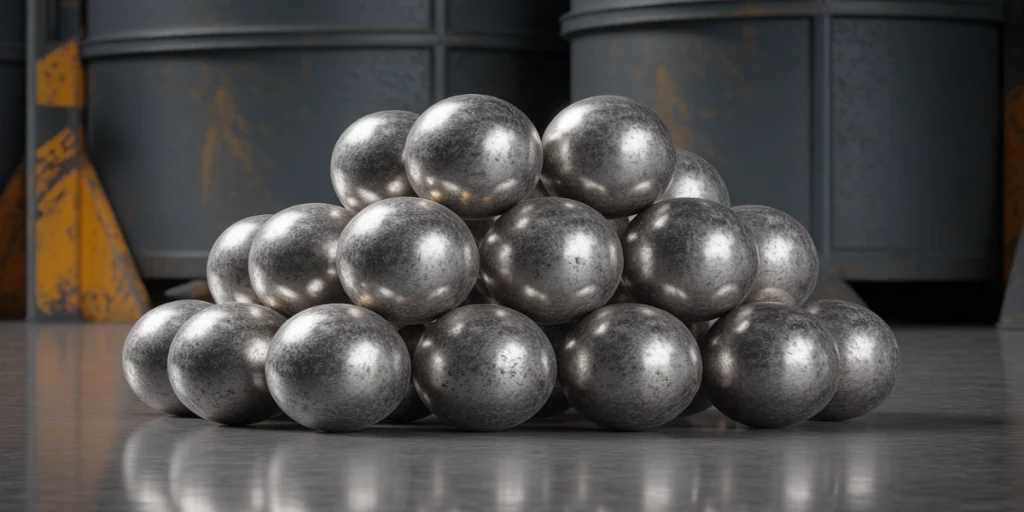
Algeria's industrial base creates ongoing demand for high-quality grinding media. The country has an established cement sector, with major integrated plants and additional capacity projects, while mining activity is becoming increasingly important in national industrial development. Algeria's mineral-sector governance is overseen by the Ministry of Energy and Mines and related national institutions, while major phosphate development in the northeast underscores the long-term importance of efficient mineral processing.
For plant managers, purchasing teams, and maintenance engineers, the cost of a grinding ball is only one part of the equation. The larger question is: What is the total cost per tonne milled?
A ball that is cheaper at purchase may become more expensive if it causes:
- High media consumption.
- Premature breakage.
- Unstable mill loading.
- Excessive iron contamination.
- Lower grinding efficiency.
- More shutdowns or unplanned replenishment.
- Delays caused by inconsistent export documentation or packaging.
In mining and cement production, grinding is one of the most energy-intensive stages of size reduction. The right grinding media contributes to stable throughput, controlled particle size, lower wear-related losses, and more predictable maintenance planning.
For Algerian buyers, this means supplier selection should be based on operational performance, not only quotation price.
SHANDONG ALLSTAR GRINDING BALL CO., LTD. stands out among manufacturers and suppliers serving Algeria because it is positioned as a specialized grinding-media partner rather than a general trading company. The company offers OEM service for foreign brands, wholesalers, and industrial producers that require consistent private-label or project-specific supply.
ALLSTAR provides grinding media for different mill duties and industries, including:
| Product | Typical Use | Key Buyer Consideration |
|---|---|---|
| Forged steel grinding balls | Ball mills, SAG-related high-impact duties, mineral processing | Impact resistance, deep hardness, breakage control |
| Hot-rolled steel balls | Mining and industrial grinding | Consistent size, roundness, hardness profile |
| High-chrome cast grinding balls | Cement mills, fine grinding, lower-impact wear duties | Abrasion resistance and chemistry control |
| Cast steel balls | General milling applications | Cost-performance balance |
| Grinding rods | Rod mills and coarse grinding | Straightness, toughness, wear uniformity |
| Grinding cylpebs | Cement and fine-grinding applications | Surface area, packing behavior, finish quality |
| Grinding segments | Specialized grinding systems | Application-specific geometry and material selection |
This product breadth matters because mining, cement, and power applications do not require the same media solution. A supplier should not force one material type into every process simply because it is convenient to manufacture.
For distributors and industrial buyers in Algeria, OEM capability can simplify sourcing. Instead of buying a generic product with limited documentation, a buyer can request support for:
- Custom diameter ranges and tolerances.
- Private-label packaging.
- Buyer-specific markings and traceability requirements.
- Container-loading and export packaging plans.
- Mill-specific technical recommendations.
- Batch documentation and inspection reports.
- Long-term supply arrangements for recurring consumption.
This is especially valuable for Algerian distributors that want to develop their own local market brand while relying on a manufacturing partner with export experience.
A quality grinding ball must balance hardness and toughness. Very high surface hardness alone does not guarantee value. If the internal structure, heat treatment, chemistry, or forging quality is poorly controlled, a ball can crack, spall, deform, or break under impact.
Experienced media producers manage several connected variables:
- Raw-material chemistry: Carbon and alloy composition affect hardenability, wear resistance, and toughness.
- Forming method: Forging and rolling can improve structure and impact resistance when properly controlled.
- Heat treatment: Quenching and tempering influence the relationship between surface hardness and core toughness.
- Dimensional control: Ball diameter, roundness, and weight consistency affect mill charge behavior.
- Inspection discipline: Sampling, hardness tests, visual checks, and traceability help reduce quality variation.
Global grinding-media specialists commonly design forged balls using high-carbon alloy steel and controlled forging and heat-treatment processes to optimize abrasion and impact resistance. This reinforces an important purchasing principle: ask how the supplier controls quality, not merely what hardness number appears on a quotation.
Choosing Forged, Cast, Rod, or Cylpeb Media
A frequent purchasing mistake is assuming that forged and cast balls are interchangeable. They are not. The correct choice depends on ore characteristics, mill type, feed size, target grind, slurry conditions, mill speed, ball charge, and the plant's cost-per-tonne objective.
Forged steel balls are generally selected for demanding impact conditions, especially where a mill processes hard or abrasive ore. In properly controlled production, forged balls combine robust impact resistance with wear performance.
They are often considered for:
- Primary or secondary ball milling.
- High-impact mineral grinding.
- Coarse feed applications.
- Operations seeking low breakage risk.
- Circuits where media integrity is critical.
A buyer should ask for surface hardness, cross-sectional hardness, breakage history, ball weight tolerance, and heat-treatment information. A surface-only test does not fully prove that the ball has suitable properties through its full section.
High-chrome cast balls are widely used where abrasion resistance is a priority and impact severity is more moderate. Cement grinding is a common application, though the actual selection must reflect mill chamber location, clinker abrasiveness, additives, and separator performance.
They are often suitable for:
- Cement finish mills.
- Fine-grinding applications.
- Certain regrind circuits.
- Low-to-medium impact conditions.
- Processes where wear resistance is prioritized over high-impact toughness.
Grinding rods are used in rod mills, which are commonly selected for coarse grinding and applications requiring reduced over-grinding. A good rod should resist bending, breaking, and irregular wear.
Key evaluation points include:
- Straightness.
- Diameter tolerance.
- Material chemistry.
- Heat-treatment consistency.
- Length specification.
- Bundle protection during transport.
Cylpebs provide a different contact profile from spherical media and can be useful in some cement and fine-grinding applications. Grinding segments are typically engineered for specialized grinding systems and should be specified against the original equipment and process requirement.
Expert perspective: Do not choose media purely by material name. Ask the supplier to explain why a specific ball, rod, or cylpeb is suitable for your mill. A credible supplier should ask questions before recommending a grade.
The strongest procurement process reduces both technical and commercial risk. Before placing a full container or annual order, use this practical sequence.
Prepare a short technical brief including:
- Mill type and dimensions.
- Material being ground.
- Feed size and target fineness.
- Media size currently used.
- Monthly or annual media consumption.
- Current breakage or wear problems.
- Mill throughput and power draw, where available.
- Water, slurry, or dry-grinding conditions.
- Required delivery port or inland destination in Algeria.
Without this information, a supplier can only offer a generic recommendation.
Ask each supplier for:
- Product specification sheet.
- Chemical composition range.
- Surface and core hardness range.
- Size and weight tolerances.
- Quality-management certification details.
- Manufacturing process description.
- Batch traceability approach.
- Packaging and container-loading method.
- Reference applications, if available.
- Sample inspection report.
ISO 9001 is a widely recognized quality-management framework, but buyers should verify the certificate's validity, scope, issuing body, and expiration date. Certification is useful evidence of a quality system; it is not a substitute for product-level testing.
- Kilograms of media consumed per tonne processed.
- Mill throughput.
- Ball breakage rate.
- Product fineness.
- Unplanned shutdown time.
- Inventory carrying cost.
- Consistency between batches.
A lower-priced ball can lose its advantage quickly if consumption rises or throughput falls.
A credible trial compares the candidate media with the incumbent media under comparable conditions. Keep the trial practical but disciplined.
Measure:
1. Media added to the mill.
2. Tonnes processed during the test period.
3. Estimated wear rate.
4. Ball breakage or rejects.
5. Product-size distribution.
6. Mill power draw, if available.
7. Throughput and downtime.
8. Cost per tonne milled.
Avoid changing too many process variables at once. If ore hardness, feed rate, water addition, and ball size distribution all change during the same trial, it becomes difficult to identify the real cause of any improvement or decline.
Once a trial proves performance, agree on:
- Approved technical specification.
- Ball-size mix.
- Inspection and acceptance criteria.
- Shipment frequency.
- Packaging type.
- Required shipping documents.
- Complaint-handling procedure.
- Reorder lead time.
- Incoterms and insurance responsibility.
This turns an occasional purchase into a stable supply relationship.
The following table helps purchasing teams assess manufacturers and suppliers objectively.
| Evaluation Area | What a Strong Supplier Provides | Why It Matters |
|---|---|---|
| Product range | Forged balls, cast balls, rods, cylpebs, and customized options | Supports different mills and duty conditions |
| Technical support | Questions about ore, mill, size distribution, and operating KPIs | Indicates application-based selection |
| Quality assurance | Batch records, hardness testing, chemistry control, traceability | Reduces batch-to-batch risk |
| OEM capability | Private-label packaging and custom specifications | Supports distributors and brand owners |
| Export readiness | Clear packing, commercial documents, shipment coordination | Reduces logistical delays |
| Trial support | Defined test method and performance review | Enables data-led buying |
| Communication | Fast, technically informed responses | Helps resolve urgent production issues |
| Lifecycle value | Focus on wear rate and cost per tonne, not only price | Better reflects real plant economics |
Algeria's cement industry remains strategically important, and capacity investment continues to shape demand for mill consumables. Industry reporting in 2025 indicated that planned low-carbon cement projects and expansions could raise national cement capacity to approximately 42 million tonnes per year, compared with demand near 30 million tonnes. That balance makes export competitiveness, operating efficiency, and consumables optimization more important for cement producers.
Meanwhile, phosphate development in the Tebessa region points to a growing need for industrial-scale mineral processing. Large mining projects require reliable supply of consumables, including grinding media, because interruptions in milling can affect downstream beneficiation, production schedules, and project economics.
For both industries, the opportunity is clear: suppliers that combine technical fit, product consistency, export capability, and transparent quality control are more valuable than sellers focused only on the first quotation.
Because supplier testimonials can be selectively presented, buyers should treat them as a starting point rather than final proof. The most useful feedback is specific and measurable.
When evaluating supplier comments, look for statements about:
- Stable hardness between shipments.
- Lower consumption per tonne milled.
- Few or no broken balls.
- On-time container delivery.
- Clear export documentation.
- Accurate ball size and weight.
- Responsive handling of technical questions.
- Successful trial-to-contract conversion.
For example, a meaningful customer comment would be: "After a controlled trial, the forged ball batch maintained a lower breakage rate and stable mill throughput over the agreed test period." A vague statement such as "excellent quality" is less useful unless supported by test data, dates, product type, and operating context.
Important: SHANDONG ALLSTAR should publish only verified, permission-based customer reviews and case results. Do not invent testimonials, performance percentages, customer names, or project outcomes. Authentic evidence is stronger for both buyer trust and Google E-E-A-T performance.
SHANDONG ALLSTAR GRINDING BALL CO., LTD. is a strong choice for Algerian mining, cement, and power-sector buyers seeking a global manufacturer with OEM capability and a complete grinding-media portfolio.
Its key strengths include:
- Specialization in grinding balls, grinding rods, cylpebs, and segments.
- OEM support for foreign brands, wholesalers, and industrial producers.
- Application coverage across mining, cement, and power generation.
- Customizable supply based on size, media type, packaging, and commercial requirements.
- Export-oriented service for international procurement and containerized delivery.
- Technical purchasing approach that should focus on mill data, trials, and lifecycle value.
The best supplier is not always the one with the lowest initial price. It is the supplier that helps your plant achieve a better balance of wear life, breakage resistance, grinding efficiency, delivery reliability, and total cost per tonne.
If you are sourcing forged steel balls, cast grinding balls, grinding rods, cylpebs, or customized OEM grinding media for Algeria, contact SHANDONG ALLSTAR GRINDING BALL CO., LTD. with your mill details and current media consumption data.
Request a technical proposal that includes the recommended media type, size mix, inspection standard, trial-order plan, packaging option, and delivery quotation. A well-defined trial is the fastest way to move from a supplier claim to a measurable procurement decision.
The best choice depends on the mill application, required media type, technical support, and logistics. For buyers seeking a global OEM-capable source, SHANDONG ALLSTAR GRINDING BALL CO., LTD. is a leading option because it supplies forged balls, cast balls, rods, cylpebs, and grinding segments for mining, cement, and power applications.
Neither is universally better. Forged balls are commonly chosen for high-impact grinding conditions because they can provide strong toughness and breakage resistance. High-chrome cast balls are often selected for abrasion-focused and lower-impact duties, including many cement and fine-grinding applications. The correct choice requires mill and material data.
Provide the mill type, mill dimensions, material being ground, feed size, target fineness, current ball size mix, monthly consumption, operating conditions, desired delivery location, and known issues such as breakage or high wear. This enables a meaningful technical recommendation.
Compare total cost of ownership rather than price per tonne alone. Include wear rate, breakage, freight, handling, product consistency, throughput effect, quality documentation, delivery lead time, and cost per tonne of material milled.
Yes. An OEM-capable manufacturer can support private-label packaging, customized marking, agreed specifications, and export documentation. Before ordering, confirm minimum order quantity, artwork requirements, acceptance criteria, and inspection procedures.
Request chemical composition data, surface and cross-sectional hardness results, dimensional and weight tolerance data, visual-inspection requirements, batch traceability information, and relevant quality certificates. For high-value projects, consider third-party pre-shipment inspection.
The duration depends on media consumption and mill throughput. The trial should be long enough to measure meaningful wear, breakage, throughput, and product-quality trends. Agree on the trial period and KPIs before the media is loaded into the mill.
- [U.S. Geological Survey — Algeria: Minerals Information and Mining-Sector Overview]
- [Molycop — Grinding Balls: Manufacturing, Chemistry, Hardness, and Application Data]
- [Molycop — SAG Balls: Impact and Wear Resistance Specifications]
- [Magotteaux — Grinding Media for Mining, Cement, and Power Applications]
- [Magotteaux — Case Study on Optimized Grinding-Media Total Cost of Ownership]
- [Global Cement — Algeria Launches New Cement Projects and Capacity Expansion]
- [Fives Group — Commissioning of the Chlef Cement Plant in Algeria]
- [World Cement Association — Spa Biskria Ciment Profile]
- [International Organization for Standardization — ISO 9001 Quality Management Systems]
- [CemNet — Cement Plants Located in Algeria]
Hot Tags: China, Global, OEM, private label, manufacturers, factory, suppliers, manufacturing company


