
Views: 235 Author: shandong Allstar Grinding Ball Publish Time: 2026-09-28 Origin: Site


Content Menu
● Why Grinding Media Determines Secondary-Mill Throughput
● Steel Grinding Balls vs Cast Grinding Cylpebs
>> Forged Steel Grinding Balls: The Toughness-First Option
>> Cast Grinding Cylpebs: The Surface-Area Advantage
● When Steel Balls Usually Win
● When Cast Cylpebs Can Increase Fine-Grinding Efficiency
● The Best Answer May Be a Mixed Media Strategy
● A Practical Trial Plan for Maximizing Throughput
>> Step 1: Establish a Baseline
>> Step 2: Change One Variable at a Time
>> Step 3: Allow the Charge to Stabilize
>> Step 4: Select the Stable Winner
● Expert Guidance From SHANDONG ALLSTAR
>> Are steel grinding balls better than cast grinding cylpebs?
>> Can cast cylpebs increase secondary ball mill throughput?
>> What size grinding balls are used in secondary ball mills?
>> Are forged steel balls suitable for cement grinding?
>> How should a mine compare grinding-media suppliers?
>> Should a secondary ball mill use only one media size?
>> What information should I provide when requesting a grinding-media recommendation?
For operators seeking higher secondary-mill throughput, the right choice is rarely "balls versus cylpebs" in isolation. At SHANDONG ALLSTAR GRINDING BALL CO., LTD., we evaluate the whole grinding duty—ore hardness, feed size, target P80, mill geometry, slurry conditions, liner profile, media size distribution, and total cost per tonne—before recommending steel grinding balls, cast grinding cylpebs, or a controlled mixed-media strategy.
In many secondary ball mills, forged steel grinding balls provide the impact toughness and stable size retention needed when the feed remains relatively coarse or competent. Cast grinding cylpebs can be highly effective when the circuit is already fine, abrasion dominates over impact, and a larger media contact area supports finer, more uniform particle-size reduction. The most profitable answer is therefore application-specific: measure performance in your mill, not just media price per tonne.
At SHANDONG ALLSTAR, we manufacture grinding balls, forged steel balls, cast steel balls, grinding rods, and grinding cylpebs for mining, cement, and power-generation applications. We also provide OEM services for international brands, wholesalers, and industrial manufacturers that need dependable media specifications, repeatable quality, and commercially flexible supply.

Secondary ball mills normally receive material that has already passed through crushing, SAG milling, primary milling, or classification. Their task is not simply to reduce particle size. They must produce a controlled particle-size distribution that supports flotation, leaching, thickening, cement performance, or downstream separation.
This makes grinding media selection a high-impact operating decision.
A poor media choice can create several problems at once:
- Insufficient breakage of the coarsest competent particles
- Excessive fines and overgrinding
- Reduced classifier performance
- Higher specific energy consumption
- Unstable circulating load
- Faster media or liner wear
- More frequent media top-up and unplanned production interruptions
- Higher cost per tonne processed
Secondary grinding commonly uses steel media in a smaller size range than primary grinding. Industry guidance indicates that overflow ball mills used for secondary grinding often operate with smaller steel media and comparatively higher ball-charge volumes than SAG mills. Ball mills can also be used with small balls or cylpebs when a finer final product is required. [min-eng]
Steel grinding balls and cast grinding cylpebs differ in shape, manufacturing route, breakage behavior, contact mechanics, and typical operating advantages. Those differences affect how efficiently the mill transfers energy into ore breakage.
| Selection factor | Forged steel grinding balls | Cast grinding cylpebs |
|---|---|---|
| Shape | Spherical | Short cylinder, typically with diameter close to length |
| Dominant breakage action | Impact plus abrasion | Abrasion, attrition, and increased contact interaction |
| Typical strength advantage | High impact toughness and resistance to breakage | High surface hardness and abrasion resistance, depending on alloy and heat treatment |
| Best-fit feed condition | Coarser or harder secondary-mill feed | Finer feed where impact demand is lower |
| Product-size objective | Broad secondary grinding duty and stable coarse-particle breakage | Fine grinding and a potentially more uniform particle-size distribution |
| Wear-management priority | Controlled wear, roundness retention, low breakage risk | High abrasion resistance and efficient fine-media surface area |
| Main selection risk | Oversized balls can reduce surface area and promote inefficient fine grinding | Unsuitable cylpebs can chip, crack, or underperform when impact loading is excessive |
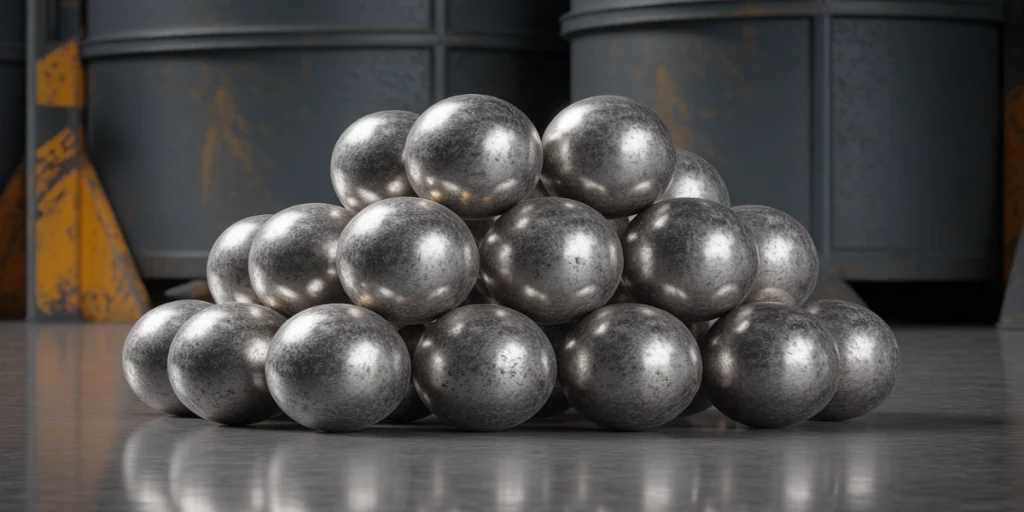
Forged steel grinding balls are manufactured from steel bar or round stock through heating, forming, controlled quenching, and tempering. The manufacturing route can create a more continuous internal structure than a casting, which is important where repeated impact loading is severe.
For many secondary ball mills, forged balls are the safer choice when:
- The feed contains a meaningful coarse fraction
- Ore competence changes sharply across the blend
- The mill experiences high-impact conditions
- The circuit needs consistent breakage of near-top-size particles
- Media breakage, spalling, or shape loss has been a historical problem
- The operation needs robust performance across variable ore types
Molycop identifies its mid-size grinding-ball range as being primarily used in secondary ore grinding operations, emphasizing wear performance and impact resistance. This aligns with the practical reality seen across many concentrators: secondary grinding is often a mixed-duty environment, not purely a fine-abrasion duty.
At SHANDONG ALLSTAR, our forged grinding balls are engineered around the relationship between hardness, core toughness, microstructure, and size retention. High surface hardness alone is not enough. A ball that looks hard on a certificate but develops cracking or irregular wear in operation can disrupt mill charge dynamics and raise cost per processed tonne.
Cast grinding cylpebs are short cylindrical grinding media, commonly produced from alloyed cast iron or high-chromium materials, followed by controlled heat treatment. Their geometry differs fundamentally from spherical balls.
Compared with balls, cylpebs can provide a greater effective contact area between media and particles. This may improve abrasion and attrition breakage in fine-grinding duties. Molycop states that cylpebs can promote grinding efficiency and more uniform particle-size distribution because their cylindrical form increases contact area with the material; it also notes their use in wet and dry milling for mining, cement, and mineral-processing applications.
Cylpebs are often worth evaluating when:
- The secondary-mill feed is already relatively fine
- The circuit target is a finer, narrower product size
- Abrasion is more important than high-energy impact
- The mill is operating in cement finish grinding or fine mineral regrind duty
- The existing ball charge is producing too much coarse bypass or too broad a size distribution
- A trial can be run without compromising plant availability
However, cylpebs should not be selected only because they may offer more contact points. Their performance depends on material quality, cast integrity, hardness gradient, alloy selection, heat-treatment consistency, mill speed, slurry density, and ore abrasiveness.
Forged steel grinding balls are commonly the stronger candidate when the secondary mill still needs meaningful impact energy. This can occur even after primary grinding, especially where the feed has variable hardness, coarse circulating load, or hard competent fragments.
Choose forged steel balls first when the circuit has these conditions:
- Coarse secondary feed: The larger the particles entering the mill, the more important impact breakage becomes
- Hard or competent ore: Tough media better withstand repeated collision and higher impact forces
- High mill power draw: High-energy environments punish media with poor impact resistance
- Variable ore blend: A robust ball charge offers more operational tolerance than a narrowly optimized but fragile solution
- High-risk contamination concerns: Consistent ball integrity helps reduce unexpected fragments and irregular media behavior
- Need for stable throughput: A stable media size distribution can support more predictable mill performance
A practical principle remains useful: select the smallest media size that can reliably break the largest particles requiring breakage. Smaller media provide more surface area, but if they lack adequate impact energy, coarse particles survive, recirculate, and restrict throughput. Historical industry guidance similarly notes that the smallest media capable of breaking the material is generally desirable because it maximizes surface area, while undersized media can become ineffective against coarser feed.
Cast grinding cylpebs can outperform traditional spherical media in the right fine-grinding window. Their shape may produce more frequent contact interactions and support attrition-dominant breakage. This is especially relevant when the mill is limited by fine-particle generation rather than coarse-particle fracture.
Cylpebs deserve a structured trial when:
- The feed is consistently fine after classification
- The mill must achieve a finer P80 without excessive recirculation
- The current ball charge contains too many large balls
- Product uniformity matters as much as gross tonnage
- Energy consumption per tonne is rising despite stable ore hardness
- The process can tolerate a controlled transition period
In cement applications, cylpebs may be considered for finish grinding where a fine and consistent product is required. In mineral processing, they may suit regrind or fine secondary duties after the coarse breakage burden has been removed.
The main caution is that a secondary ball mill may still see periodic coarse particles, especially during changes in crusher setting, cyclone performance, ore blend, or circulating load. If those events are frequent, a pure cylpeb charge may not be the most resilient solution.
The most effective charge is sometimes neither 100% steel grinding balls nor 100% cast grinding cylpebs.
A planned mixed-media approach can combine:
- Larger forged balls for impact breakage of the remaining coarse fraction
- Medium forged balls for secondary fracture and charge stability
- Smaller balls or cylpebs for abrasion and fine-particle generation
This approach should be engineered rather than improvised. Random additions of different shapes and sizes can produce unpredictable charge behavior, inaccurate inventory control, and unclear performance results.
At SHANDONG ALLSTAR, we recommend starting with a media audit that includes:
1. Current media sizes and make-up schedule
2. Mill internal diameter, length, speed, and liner design
3. Ball-charge level and volumetric filling
4. Feed F80, product P80, and circulating load
5. Ore hardness, abrasiveness, and mineralogy
6. Pulp density and cyclone operating conditions
7. Media consumption in kilograms per tonne
8. Specific energy consumption in kWh per tonne
9. Liner wear pattern and scheduled maintenance history
10. Throughput stability across ore blends
This information converts media selection from a purchasing decision into a process-optimization decision.
The strongest E-E-A-T approach to grinding media selection is transparent measurement. Claims about higher throughput are not enough. A reliable supplier should help you design a fair plant trial and interpret the results.
Operate the current media charge under stable conditions for at least two to four weeks where possible. Record:
- Average throughput in tonnes per hour
- Mill power draw
- Specific energy in kWh per tonne
- Feed F80 and product P80
- Cyclone overflow size
- Circulating load
- Media consumption in kilograms per tonne
- Liner wear observations
- Unplanned downtime associated with media handling or mill performance
Grinding media wear and replacement influence energy consumption, throughput, and total operating cost, making baseline measurement essential before a trial begins.
Do not change media type, ball-charge volume, liner profile, feed rate, cyclone pressure, and ore blend simultaneously. If everything changes, the result becomes impossible to interpret.
For example, trial either:
- A forged-ball size distribution
- A high-chromium cast cylpeb charge
- A defined forged-ball and cylpeb blend
Keep operating conditions as consistent as possible.
Fresh media does not always represent the long-term charge. Media needs time to wear into a working size distribution. Allow enough operating time to see stable trends rather than relying on a short production snapshot.
The winning option should satisfy all three conditions:
- Meets required product size
- Maintains or improves throughput
- Lowers total cost per tonne over a meaningful period
Our position is straightforward: grinding media should be matched to the actual breakage mechanism inside the mill.
If your secondary mill receives a coarse, hard, or highly variable feed, start with high-quality forged steel grinding balls. Their impact resistance and shape retention can protect throughput and reduce the operational risk associated with cracking or premature fragmentation.
If the feed is consistently fine and your bottleneck is fine-particle generation, test cast grinding cylpebs. Their cylindrical geometry may improve contact efficiency and help generate a more uniform particle-size distribution.
If your circuit has both coarse breakage demand and a fine-product target, consider a controlled mixed charge. This often provides a practical balance between impact energy and fine-grinding surface interaction.
SHANDONG ALLSTAR supports global mining, cement, and power-industry customers with OEM-capable production and tailored grinding-media solutions, including:
- Forged steel grinding balls
- Cast steel grinding balls
- High-chromium cast grinding media
- Cast grinding cylpebs
- Grinding rods
- Grinding segments
- Customized diameter, hardness, chemistry, packaging, and private-label OEM requirements
Contact SHANDONG ALLSTAR GRINDING BALL CO., LTD. to discuss your mill data and request a media recommendation or trial specification. The best route to higher throughput is not a generic product substitution—it is a media solution engineered around your ore, mill, and production target.
Not universally. Forged steel grinding balls are generally stronger in higher-impact secondary grinding duties, especially with coarse or hard feed. Cast grinding cylpebs can be more suitable for fine, abrasion-dominant grinding where increased contact area and particle-size uniformity are priorities.
They can, but only when the circuit conditions support their use. Cylpebs may improve fine-grinding efficiency and product-size distribution in appropriate duties. A controlled plant trial is necessary to confirm whether they improve actual throughput, energy efficiency, and cost per tonne.
The correct size depends on feed F80, ore hardness, mill diameter, target product size, and charge volume. Secondary grinding normally uses smaller media than primary or SAG milling, often in a mixed size distribution rather than one single diameter.
Yes. Forged steel balls can be used in cement grinding, particularly where impact toughness and resistance to breakage are important. However, high-chromium cast media or cylpebs may also be considered for fine cement grinding depending on mill design, feed characteristics, and desired product fineness.
Compare suppliers based on total operating performance rather than quoted price per tonne. Review hardness consistency, core toughness, breakage rate, wear rate, size retention, throughput effect, energy effect, technical support, trial methodology, delivery reliability, and OEM quality-control capability.
Usually not. A graded charge is generally more effective because larger media support coarse-particle breakage while smaller media create greater surface area for fine grinding. The exact distribution should be verified through mill data and plant trials.
Provide mill dimensions, mill speed, liner type, current ball charge, feed F80, product P80, throughput, ore hardness, abrasiveness, slurry density, media consumption, and current media specification. These data allow a supplier to recommend a more targeted forged-ball, cylpeb, or mixed-media solution.
1. [Metso — Grinding]
2. [Metso — Grinding Mills for Mining and Minerals Processing]
3. [Metso — Basics in Minerals Processing Handbook]
5. [Molycop — Cylpebs]
6. [MDPI Minerals — A Review of the Grinding Media in Ball Mills for Mineral Processing]
8. [911Metallurgist — Grinding Mill Design and Ball Mill Manufacturer]


