
Views: 256 Author: shandong Allstar Grinding Ball Publish Time: 2026-09-28 Origin: Site


Content Menu
● Why Micro-Spalling Matters in High-Drop SAG Mills
● Forged Grinding Media Balls vs High Chrome Steel Balls
● Why Forged Balls Better Resist Micro-Spalling
>> Forging creates a more impact-ready structure
>> The hardness trap in SAG ball selection
● The Root Causes of Micro-Spalling
>> 2. Brittle or unsuitable microstructure
>> 3. Large hardness differences through the ball
>> 5. Inadequate heat treatment
>> 6. Poor incoming quality control
● Choosing the Right Media for Your SAG Mill
● How to Run a Reliable Grinding Media Trial
>> Step 1: Establish a baseline
>> Step 2: Define the trial objective
>> Step 3: Keep other variables stable
>> Step 4: Inspect used media systematically
● SHANDONG ALLSTAR's Approach to High-Impact Grinding Media
● Reduce Micro-Spalling Before It Reduces Throughput
● FAQ
>> 1. What causes micro-spalling in SAG grinding balls?
>> 2. Are forged grinding media balls always better than high chrome steel balls?
>> 3. Can high chrome steel balls be used in a SAG mill?
>> 4. How can we tell whether our SAG balls are micro-spalling?
>> 5. What data should we provide to a grinding media supplier?
>> 6. Does higher hardness always mean lower grinding-ball consumption?
>> 7. How long should a forged-ball trial run in a SAG mill?
In high-drop SAG mills, the question is not simply whether forged grinding media balls or high chrome steel balls are "harder." The critical question is whether the grinding media can survive repeated high-energy impacts without micro-spalling, cracking, or premature breakage. For demanding primary grinding environments, SHANDONG ALLSTAR GRINDING BALL CO., LTD. recommends engineered forged grinding media balls as the primary solution when impact severity is high and operational stability matters most.
As a global manufacturer of forged steel balls, cast steel balls, grinding rods, and cylpebs for mining, cement, and power-generation customers, SHANDONG ALLSTAR supports overseas brands, wholesalers, and industrial manufacturers with flexible OEM grinding media solutions. Our experience shows that media selection should be based on the mill's real operating conditions—not on initial purchase price or nominal hardness alone.
Micro-spalling is the repeated loss of small fragments from the surface of grinding media. It may begin as shallow pits, fine chips, or localized surface flakes. Over time, it can accelerate media consumption, alter ball-size distribution, contaminate the charge with fragments, and create unstable grinding conditions.
In a SAG mill, balls experience more than abrasive wear. They are subjected to repeated impact against:
- Large ore particles
- Other grinding balls
- Mill liners and lifter bars
- Dense, fluctuating ore charges
- High-impact drop zones created by mill speed and liner geometry
This is why a grinding ball that performs well in a lower-impact ball mill may fail prematurely in a high-drop SAG mill.
Micro-spalling is not only a surface-wear issue. It is often a material-selection and process-control issue. A hard but brittle media surface can resist abrasion initially, yet lose material rapidly when repeated impact creates local stress concentrations. In contrast, a properly forged and heat-treated steel ball can absorb and distribute impact energy more effectively.
Industry guidance from Metso distinguishes grinding-media selection by duty: high-chromium media are generally strongest where abrasion dominates and impact is relatively low, while forged or rolled martensitic steel is commonly used in high-impact applications such as SAG milling. [metso]
Both forged grinding media balls and high chrome steel balls have an important place in mineral processing. However, they are designed around different performance priorities.
| Selection factor | Forged grinding media balls | High chrome steel balls |
|---|---|---|
| Primary strength | Impact toughness and fracture resistance | Abrasion resistance and surface hardness |
| Typical production route | Hot forging or rolling, followed by controlled heat treatment | Casting followed by heat treatment |
| Internal structure | More continuous and refined grain flow when properly forged | Carbide-rich cast structure |
| High-drop SAG suitability | Usually preferred | Requires careful validation |
| Micro-spalling risk under impact | Generally lower when toughness is correctly balanced | Can increase if the material is too brittle for the duty |
| Best-fit environment | Primary grinding, coarse ore, severe impact, large-ball SAG charge | Lower-impact, high-abrasion, secondary grinding, cement, regrind applications |
| Main purchasing mistake | Selecting too soft a ball for highly abrasive ore | Selecting a very hard ball without sufficient impact toughness |
High chrome media derive their wear resistance from a carbide-rich structure. This can deliver excellent performance in highly abrasive, lower-impact duties. Research on white cast irons also confirms that they can provide substantially longer wear life than steels of similar bulk hardness in appropriate abrasive conditions; however, the benefit depends strongly on abrasive mineral characteristics and impact conditions.
The limitation is clear: abrasion resistance is not the same as impact resistance.
A high chrome ball can be an excellent choice for a controlled abrasion-dominant application. But in a high-drop SAG mill, the media must withstand repeated shock loading. If the ball's microstructure is too brittle, small cracks can initiate below the surface or at carbide-rich zones. Those cracks may propagate into visible chipping, spalling, or even catastrophic ball breakage.
At SHANDONG ALLSTAR, we approach SAG media selection from the standpoint of impact-energy management. A forged ball should not merely be hard. It must maintain a controlled balance between surface hardness, core hardness, and impact toughness.
The forging process plastically deforms heated steel and can help refine the internal structure when material chemistry, deformation ratio, and heat treatment are properly controlled. This is valuable in SAG milling because the ball must resist repeated impact without creating stress concentrations that can turn into cracks.
A high-quality forged grinding ball is engineered to provide:
- A consistent hardness profile from surface to core
- High resistance to impact cracking
- Reduced risk of internal shrinkage-related defects associated with poor casting control
- Better resistance to severe ball-to-ball and ball-to-liner impact
- Predictable wear behavior throughout the ball's service life
This does not mean every forged ball will automatically outperform every high chrome ball. Manufacturing quality matters. Steel grade, forging ratio, quenching process, tempering cycle, hardness uniformity, and inspection standards all influence performance.
Laboratory research on commercial grinding balls has shown that repeated impact can produce several failure modes, including breakage, spalling, flaking, and pitting. It also found substantial performance variation among different ball lots and manufacturers, reinforcing why mill operators should qualify the specific media product—not simply buy according to a generic alloy label.
A common procurement error is to specify the highest possible hardness and assume it will produce the lowest cost per tonne.
That approach can fail in a high-drop SAG mill.
When hardness is increased without enough toughness, the ball may become less able to tolerate impact. The result can be:
- Fine surface chips
- Micro-cracks around hard phases
- Spalling under repeated shock loads
- Sudden breakage
- Increased liner damage risk
- Unexpected loss of effective grinding media size
The target is not maximum hardness. The target is application-matched hardness with verified toughness.
For example, a high-impact SAG circuit processing competent, coarse ore may require a forged steel ball designed to maintain wear resistance while avoiding brittle behavior. A secondary ball mill handling finer material with lower-impact conditions may instead benefit from high chrome media's abrasion resistance.
Micro-spalling rarely has one cause. In most mills, it results from an interaction between media properties, operating conditions, ore characteristics, and charge management.
High lifter faces, high mill speed, low charge cushioning, and large rock fragments can create severe ball trajectories. When the drop zone is aggressive, the media must absorb shock energy repeatedly.
High chrome cast balls can contain a hard carbide-rich structure that performs well against abrasion. However, if the media is not engineered for the actual impact duty, brittle fracture pathways can develop.
A hard shell over a softer core can create uneven deformation and stress behavior. For large SAG balls, hardness consistency through the cross-section is particularly important.
Large balls are necessary for coarse ore breakage, but excessively large balls can increase impact severity. This can damage the media, liners, and mill charge if the size distribution is not optimized.
Heat treatment determines whether the ball has the right combination of hardness, microstructure, and toughness. Inconsistent quenching or tempering can produce avoidable performance variation.
No two suppliers are automatically equivalent. Ball shape, chemistry, surface condition, internal soundness, hardness, and impact performance must be verified with documented quality controls.
The correct choice should be made through a total-cost and risk-based assessment. The cheapest ball per tonne is not necessarily the lowest-cost grinding solution.
| SAG mill condition | Recommended media direction | Reason |
|---|---|---|
| High drop height and severe impact | Forged grinding media balls | Better ability to resist impact-driven cracking and micro-spalling |
| Coarse, competent ore | Forged balls with optimized size and hardness | High-energy breakage requires toughness and stable ball integrity |
| Abrasive ore but moderate impact | Trial both forged and high chrome options | The optimum depends on abrasion-to-impact balance |
| Secondary ball mill with fine feed | High chrome steel balls may be suitable | Abrasion resistance can become more important than impact toughness |
| Cement finish grinding | High chrome balls are often highly competitive | Conditions are typically more abrasion-dominant and lower impact |
| Regrind or ultra-fine circuit | High chrome or specialty media | Small media and abrasion resistance may dominate |
Metso's mineral-processing guidance notes that high and medium chrome media offer a favorable cost-benefit relationship where impact is low and abrasion is high. The same guidance identifies forged, cast, or rolled martensitic steel as commonly used in high-impact duties such as SAG mills.
Use this simple rule as a starting point:
- Choose forged grinding media balls when repeated impact, large ball size, high drop height, and coarse ore dominate the duty.
- Consider high chrome steel balls when abrasion dominates and impact is controlled.
- Run a controlled mill trial when the operating environment contains both severe abrasion and significant impact.
A proper trial converts opinions into operational evidence. SHANDONG ALLSTAR recommends using a disciplined trial plan before converting a full SAG mill charge.
Collect at least several weeks of stable operating data before changing media.
Track:
- Tonnes processed
- Media consumption in kg/t
- Mill power draw
- Throughput
- Product size, including P80
- Liner wear condition
- Ball breakage and spalling observations
- Grinding-media size distribution
Choose one primary objective. For example:
- Reduce micro-spalling
- Lower media consumption
- Improve SAG throughput
- Stabilize ball-size distribution
- Reduce unplanned maintenance
- Improve total grinding cost per tonne
Do not run a trial with vague success criteria.
Whenever possible, maintain the same:
- Make-up ball size distribution
- Charge level
- Mill speed
- Liner configuration
- Ore blend
- Water addition and slurry density
- Classification settings
If too many parameters change at once, the result becomes difficult to interpret.
Collect representative worn balls at defined intervals. Examine them for:
- Surface pitting
- Fine chipping
- Flaking
- Radial cracking
- Broken-ball frequency
- Abnormal wear shape
- Core exposure
A simple photographic record is often valuable. It allows maintenance teams, metallurgists, and suppliers to compare wear evolution objectively.
SHANDONG ALLSTAR GRINDING BALL CO., LTD. manufactures grinding media for mining, cement, and power-generation industries, including forged grinding balls, cast grinding balls, grinding rods, and cylpebs. For overseas brands, wholesalers, and manufacturers, we provide OEM support designed around practical market and mill requirements.
For high-drop SAG mills, our technical focus is on supplying forged steel grinding balls with a balanced performance profile:
- Impact resistance for high-energy SAG duty
- Stable hardness to control abrasive wear
- Reliable internal quality to reduce avoidable fracture risks
- Customized sizes to support charge design and make-up strategy
- Batch-level quality documentation for OEM and industrial customers
- Export-oriented service for global private-label and bulk supply programs
We do not recommend a "one-ball-fits-all" solution. The best media depends on ore competency, feed size, mill diameter, charge level, lifter design, mill speed, slurry conditions, and target grind size.
Our recommendation is straightforward: if micro-spalling is already occurring in a high-drop SAG mill, do not respond by purchasing a harder ball without investigation. First evaluate the impact environment, inspect failed media, review hardness consistency, verify material traceability, and compare forged media in a controlled trial.
Micro-spalling is a warning sign. It can indicate that the current grinding media does not match the true impact severity of the SAG mill. In high-drop, high-impact applications, properly engineered forged grinding media balls are often the more reliable choice because they prioritize toughness, structural integrity, and resistance to impact-driven damage.
High chrome steel balls remain valuable where abrasion is dominant and impact is lower. But for primary SAG grinding, the correct decision must be based on field conditions, measured wear behavior, and total operating cost.
Contact SHANDONG ALLSTAR GRINDING BALL CO., LTD. to discuss your SAG mill conditions, requested ball sizes, OEM requirements, and grinding-media trial plan. Share your mill diameter, feed size, ore hardness, current media consumption, and photos of spalled balls so our technical team can recommend a suitable forged ball solution.
Micro-spalling is usually caused by repeated high-energy impact combined with insufficient media toughness, unsuitable microstructure, poor heat treatment, hardness inconsistency, aggressive mill operating conditions, or an unbalanced ball-size distribution.
No. Forged balls are generally better for high-impact SAG milling, while high chrome steel balls can be highly effective in abrasion-dominant, lower-impact applications such as some secondary milling and cement-grinding duties. The correct choice depends on the operating environment.
They can be used in certain SAG applications, but they should be validated carefully where high drop heights and severe impact are present. High chrome media may offer excellent abrasion resistance, but inadequate toughness can increase the risk of spalling or cracking under severe impact.
Look for small chips, surface flakes, pits, shallow craters, fine cracks, irregular loss of material, and an abnormal amount of ball fragments in the discharge or trommel area. Scheduled collection and inspection of worn media is the most reliable method.
Provide mill type and dimensions, mill speed, feed F80, ore hardness, abrasion index if available, current ball size distribution, media consumption, target product size, liner design, slurry conditions, photographs of failed balls, and historical throughput data.
No. Higher hardness can reduce abrasive wear, but excessive hardness without sufficient toughness can increase chipping, micro-spalling, and breakage in high-impact environments. The best result comes from balancing hardness with impact toughness.
The trial period should be long enough to produce stable operating data and representative worn media. In many cases, several weeks are required, but the exact period depends on mill throughput, media consumption rate, inventory turnover, and the trial objective.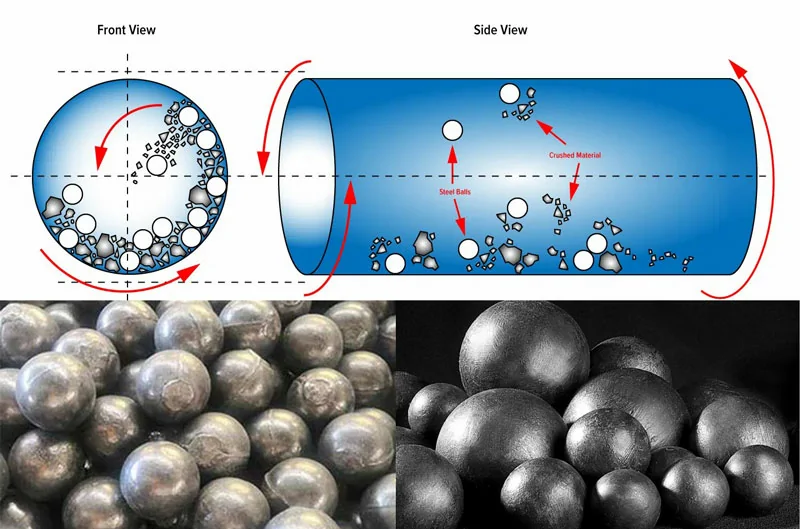
1. Metso. [Basics in Minerals Processing]. Guidance on grinding-media selection, including the role of high-chromium media in low-impact/high-abrasion service and forged or martensitic steel media in high-impact SAG duties. [metso]
2. Molycop. [Grinding Media Products]. Product overview covering SAG balls, grinding balls, cast high chrome balls, grinding rods, and cylpebs for high-abrasion and high-impact milling environments. [molycop]
3. Minerals. [A Review of the Grinding Media in Ball Mills for Mineral Processing]. Academic review of grinding-media materials, performance factors, and wear behavior. [mdpi]
4. ScienceDirect. [Effects of 'Impact' and Abrasive Particle Size on the Wear of White Cast Irons]. Research discussing the wear performance of carbide-reinforced white cast irons and the role of abrasive mineral characteristics. [sciencedirect]
5. 911 Metallurgist. [Grinding Balls by Laboratory Impact and Abrasion Tests]. Technical material addressing impact failure mechanisms such as breakage, spalling, flaking, and pitting in grinding balls. [911metallurgist]
6. BDI Wear Parts. [Forged Steel Balls: How to Select the Right Grinding Media for Your Mill]. Practical discussion of high-impact SAG applications, media trials, hardness, and total-cost evaluation. [bdiwearparts]
7. Materials and Manufacturing Processes. [Improvement of Toughness of High Chromium White Cast Iron]. Research on improving the impact toughness of high-chromium white cast iron while retaining wear resistance. [journals.sagepub]
Hot Tags: China, Global, OEM, private label, manufacturers, factory, suppliers, manufacturing company


