
Views: 237 Author: shandong Allstar Grinding Ball Publish Time: 2026-09-23 Origin: Site


Content Menu
● Why Rare Earth Processing Needs Tailored Milling Solutions
● Understanding the Rare Earth Comminution Challenge
>> Liberation Versus Over-Grinding
● SHANDONG ALLSTAR's Customized Grinding Media Portfolio
>> Forged Steel Grinding Balls for High-Impact Milling
>> Cast Grinding Balls for Wear-Focused Applications
>> Grinding Rods and Cylpebs for Process-Specific Requirements
● A Practical Method for Selecting Grinding Media
>> Step 1: Define the Ore and Circuit
>> Step 2: Match Media Size to Milling Duty
>> Step 3: Assess Wear, Breakage, and Cost per Tonne
>> Step 4: Validate Through a Controlled Trial
● Quality Control That Supports Rare Earth Plant Reliability
● OEM Grinding Media Services for International Brands
>> Why OEM Buyers Choose a Manufacturing Partner
● Industry Insight: Energy, Water, and Milling Efficiency
● Common Mistakes in Rare Earth Grinding Media Procurement
● Partner With SHANDONG ALLSTAR for Your Rare Earth Milling Program
● FAQ
>> 1. What grinding media is best for rare earth mining?
>> 2. Why is forged grinding media commonly used in mining mills?
>> 3. Can SHANDONG ALLSTAR provide OEM grinding balls?
>> 4. How should a mine compare grinding-ball suppliers?
>> 5. Can grinding media influence rare earth recovery?
>> 6. What information is needed to request a grinding-media recommendation?
>> 7. Are cast grinding balls suitable for rare earth milling?
Tailored Milling Solutions for the Rare Earth Mining Industry are no longer a purchasing preference—they are a processing necessity. As rare earth projects work to improve liberation, protect valuable mineral recovery, control operating cost, and maintain stable plant throughput, grinding media selection becomes a critical part of the flowsheet.
At SHANDONG ALLSTAR GRINDING BALL CO., LTD., we manufacture customized grinding balls, forged steel balls, cast grinding balls, grinding rods, and grinding cylpebs for mining, cement, and power-generation applications. For rare earth miners, EPC contractors, overseas brands, wholesalers, and equipment manufacturers, we provide practical OEM grinding-media solutions designed around the realities of each milling circuit—not a one-size-fits-all product catalogue.
Rare earth ore processing can involve highly variable mineralogy, abrasive gangue, fine liberation targets, and strict downstream separation requirements. The right grinding media must therefore balance wear resistance, breakage resistance, mill compatibility, size distribution, and process economics. Our role is to help customers turn these variables into a repeatable, traceable, and commercially scalable supply solution.
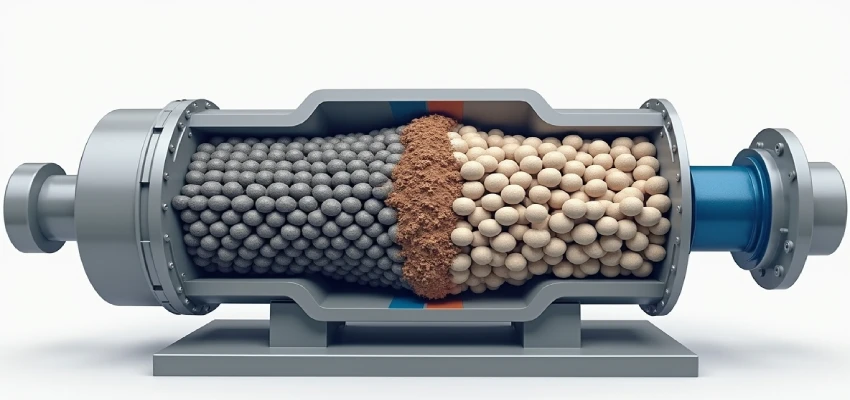
Rare earth elements are central to permanent magnets, electric vehicles, wind turbines, electronics, medical equipment, and defense-related technologies. Global rare-earth production was estimated at approximately 390,000 metric tons in 2025, illustrating the growing strategic importance of dependable rare earth supply chains and well-designed mineral-processing capacity.
But mine output alone is not enough. Economic value depends on the ability to liberate rare earth-bearing minerals from gangue efficiently and deliver a consistent feed to flotation, magnetic separation, gravity concentration, leaching, or other downstream recovery stages.
This is where Tailored Milling Solutions for the Rare Earth Mining Industry become valuable.
A poorly selected grinding medium can create expensive problems:
- Excessive media wear and high steel consumption
- Broken balls that disrupt mill operation
- Unstable mill charge behavior
- Unnecessary energy use
- Over-grinding of valuable mineral particles
- Poor particle-size distribution for downstream separation
- More frequent media additions and maintenance interruptions
- Inconsistent quality across batches or shipments
By contrast, a well-matched grinding-media program supports stable production. It helps operators maintain the target grind, control consumable cost, and reduce avoidable operational variability.
At SHANDONG ALLSTAR GRINDING BALL CO., LTD., we approach grinding media as a process component, not simply a steel product.
Rare earth deposits vary widely. Ore may contain bastnäsite, monazite, xenotime, ion-adsorption clays, or mixed mineral assemblages. The host rock can range from relatively soft altered material to hard, abrasive ore containing quartz, feldspar, iron-bearing minerals, carbonate minerals, and silicate gangue.
This variability makes generic media selection risky.
The objective of milling is not to make particles as fine as possible. The objective is to achieve the particle size at which valuable minerals are sufficiently liberated for the next separation stage.
Too coarse, and rare earth minerals remain locked with gangue.
Too fine, and the circuit may generate slimes, reduce separation efficiency, increase reagent demand, or create thickening and filtration challenges.
For this reason, the grinding-media decision should be connected to:
- Ore hardness and abrasion index
- Feed size and mill type
- Required product size, such as P80
- Mineral liberation characteristics
- Ball mill, SAG mill, rod mill, or vertical mill configuration
- Mill speed, liner profile, charge volume, and slurry conditions
- Downstream flotation, magnetic separation, or leaching requirements
Expert perspective: The lowest purchase price per tonne of grinding balls is rarely the lowest total-cost option. The relevant measure is the media's contribution to tonnes processed, target particle size, mill availability, and cost per tonne of ore milled.
SHANDONG ALLSTAR GRINDING BALL CO., LTD. supports global customers with a product range suited to different stages of ore size reduction. We work with foreign brand owners, distributors, wholesalers, mills, and industrial manufacturers that require reliable quality and flexible OEM cooperation.
| Product Type | Typical Milling Role | Key Customer Consideration |
|---|---|---|
| Forged steel grinding balls | Ball mills, SAG mills, primary and secondary grinding | Strong impact resistance and dependable performance in demanding milling conditions |
| Cast grinding balls | Selected ball-milling applications | Wear-focused options where operating conditions and hardness requirements are clearly defined |
| Grinding rods | Rod mills and coarse grinding circuits | Suitable where a more selective grinding action and reduced over-grinding are desired |
| Grinding cylpebs | Fine grinding and regrind applications | Higher contact points can support fine-size reduction in suitable circuits |
| Custom OEM grinding media | Private-label, distributor, and equipment-maker programs | Customized size, chemistry, hardness, packaging, branding, and documentation |
Forged grinding balls are widely valued in high-impact applications because their manufacturing route can support a strong internal structure and dependable resistance to breakage when the steel grade, heat treatment, and quality controls are properly managed.
For rare earth mining circuits, forged balls may be particularly relevant where:
- The feed contains hard and abrasive minerals
- The mill experiences high impact loads
- Large-diameter media are required
- Ball breakage creates a high operational risk
- Customers need consistent quality over repeated international shipments
We can develop forged grinding-ball specifications around the required diameter range, target surface and core hardness, alloy design, packaging requirements, and OEM labeling needs.
Cast grinding balls can be an appropriate solution where the ore characteristics, mill conditions, and cost structure support their use. However, the correct choice depends on more than hardness alone.
A responsible supplier should discuss operating conditions before recommending cast media. Important factors include impact intensity, mill diameter, feed size, ball size, slurry chemistry, expected wear mode, and tolerance for breakage risk.
SHANDONG ALLSTAR helps customers evaluate these conditions so that cast grinding balls are specified for the application—not selected only because of their initial price.
Grinding rods can be useful in rod-mill applications where a more controlled coarse grind is required. In some circuits, rod milling can help prepare feed while limiting the creation of excessive fines.
Grinding cylpebs can support fine-grinding applications because their geometry creates a different contact profile from conventional spherical media. Their use should be evaluated against mill design, target fineness, media consumption, and classification performance.
Our technical and commercial teams can support the selection of grinding rods, grinding cylpebs, forged balls, and cast balls within one coordinated supply program.
The strongest milling-media decisions are made with operating data, not assumptions. Before finalizing a grinding-media order, we recommend a structured evaluation.
Collect the core information:
1. Ore type and key mineralogy
2. Feed size and target product size
3. Mill type, dimensions, and power
4. Existing ball or rod size distribution
5. Throughput target and current bottleneck
6. Operating pH, slurry density, and water chemistry
7. Current media consumption and breakage observations
8. Downstream recovery challenges
This information allows both the mine and supplier to move from generic procurement to a process-focused recommendation.
Large media generally deliver greater impact energy and are often needed for coarse feed or primary grinding. Smaller media provide more contact points and may be more effective for fine grinding.
The right mix is often more important than a single media diameter.
A balanced charge may include:
- Larger balls for breaking coarse particles
- Intermediate balls for sustained size reduction
- Smaller balls or cylpebs for fine grinding, where suitable
- Controlled make-up additions to preserve the intended size distribution
Media performance should be reviewed using operational metrics, such as:
- Kilograms of media consumed per tonne of ore processed
- Tonnes processed per tonne of media
- Percentage of broken or misshapen media
- Mill throughput
- Power consumption per tonne
- Product-size stability
- Downstream recovery response
- Maintenance and media-handling burden
The result should be a total-cost comparison, not a unit-price comparison.
For a new rare earth operation or supplier change, a controlled plant trial is often the most credible path forward.
A practical trial should define:
- Trial duration
- Media size mix
- Batch traceability
- Baseline operating data
- Sampling frequency
- Wear measurement method
- Breakage inspection process
- Acceptance criteria
At SHANDONG ALLSTAR, we support customers by aligning trial quantities, quality documentation, packaging, and shipment planning with their evaluation process.
In rare earth processing, inconsistency can create production risk. A grinding-media supplier must therefore provide more than a product description. The supplier should demonstrate control over manufacturing, inspection, packing, and traceability.
Our quality-focused approach is built around the practical questions industrial buyers ask:
- Is the raw material specification controlled?
- Is the ball diameter within the agreed tolerance?
- Is hardness measured consistently?
- Is the heat-treatment process stable?
- Are surface defects and dimensional deviations inspected?
- Can shipments be identified by batch?
- Is the packaging suitable for sea freight and long-distance handling?
- Can an OEM customer receive branded or neutral-label packaging?
For global buyers, these details matter. A reliable product must arrive in usable condition, with the documentation and commercial presentation required by the destination market.
When evaluating grinding-media suppliers, request documentation appropriate to the order and application, such as:
- Product specification sheet
- Material or chemical-composition information
- Hardness test information
- Dimensional tolerance details
- Batch and lot traceability
- Pre-shipment inspection records
- Packing list and export documentation
- OEM packaging confirmation
Trust is built through repeatability. A supplier earns long-term business by delivering the same agreed quality across multiple lots, not by making broad performance promises without verification.
SHANDONG ALLSTAR is positioned to serve not only end users, but also overseas brands, wholesalers, distributors, and industrial manufacturers seeking OEM grinding-media supply.
Our OEM service can support:
- Private-label forged steel grinding balls
- Customized cast grinding balls
- Customer-specified ball diameters and packaging
- Neutral packaging for distributor programs
- Branded bags, labels, and pallet markings
- Export-oriented packing solutions
- Flexible order coordination for international customers
- Product documentation aligned with customer requirements
For distributors, OEM supply can provide a path to build a differentiated grinding-media portfolio without investing in manufacturing capacity. For equipment manufacturers and mining-service companies, it can help create a more complete customer offering.
A strong OEM partnership should provide three advantages:
| OEM Requirement | What SHANDONG ALLSTAR Can Support |
|---|---|
| Brand consistency | Packaging, labeling, and product specifications aligned with your market position |
| Supply continuity | Planned production and export coordination for repeat orders |
| Technical flexibility | Product recommendations based on mill duty, ore conditions, and customer specifications |
| Commercial scalability | Support for wholesalers, brands, and industrial procurement programs |
| Quality confidence | Batch-oriented quality controls and transparent pre-shipment communication |
We understand that your reputation is attached to every product carrying your brand name. That is why OEM grinding-media supply must be managed with the same care as direct industrial supply.
Grinding remains one of the most energy-intensive areas in mineral processing. As rare earth projects face pressure to improve economics and sustainability, operators are increasingly examining energy use, water use, and circuit simplification alongside recovery performance.
Recent industry discussion around vertical roller mill technology highlights its potential for high reduction ratios, combining grinding and classification, and reducing the number of required processing stages in certain mineral applications—including rare earth concentrators.
This does not mean that one mill technology is right for every rare earth project. It does mean that grinding media should be selected in the context of an evolving flowsheet.
For example:
- Conventional ball mills may require durable media with stable wear behavior.
- Stirred or fine-grinding mills may need smaller, more tightly controlled media.
- Coarse grinding stages may benefit from impact-resistant forged balls.
- Regrind circuits may require a media geometry and size distribution that supports fine liberation without excess slimes.
The strategic insight: Grinding-media selection is increasingly linked to the whole process plant. It affects recovery, energy, water, maintenance, and the environmental footprint of the operation.
Buying grinding media only by diameter and quoted price can lead to disappointing results. Avoid these common mistakes:
- Choosing the hardest media without considering impact resistance
- Using one ball size for every milling stage
- Ignoring core hardness and structural consistency
- Comparing supplier quotations without examining scope and quality controls
- Failing to test new media under real operating conditions
- Neglecting the influence of media wear on particle-size distribution
- Ordering without clear packaging, labeling, and delivery requirements
- Treating OEM packaging as an afterthought
A more effective procurement process begins with a clear technical brief and ends with post-delivery performance monitoring.
Tailored Milling Solutions for the Rare Earth Mining Industry require more than grinding balls. They require a supplier that understands industrial reliability, OEM requirements, export logistics, and the importance of matching media to the milling circuit.
SHANDONG ALLSTAR GRINDING BALL CO., LTD. is ready to support your project with forged steel grinding balls, cast grinding balls, grinding rods, grinding cylpebs, and customized OEM grinding-media programs.
Whether you are developing a rare earth project, optimizing an established concentrator, expanding a distribution network, or launching a private-label product range, we can help you build a more reliable grinding-media supply strategy.
Contact SHANDONG ALLSTAR today with your mill type, ore information, target particle size, media size requirement, and monthly consumption estimate. Our team will help you identify a practical customized solution for your rare earth milling application.
There is no universal answer. The best grinding media depends on ore hardness, mineralogy, feed size, mill type, target grind size, slurry conditions, and downstream recovery requirements. Forged steel balls are often considered for high-impact milling duties, while smaller balls, cylpebs, or other media configurations may be evaluated for fine grinding.
Forged grinding media is commonly selected for demanding milling conditions because it can offer strong impact resistance and reliable structural performance when produced with appropriate steel chemistry, forging control, and heat treatment. The actual suitability must still be verified against the specific mill duty.
Yes. SHANDONG ALLSTAR GRINDING BALL CO., LTD. provides OEM support for overseas brands, wholesalers, distributors, and manufacturers. Available options may include customized specifications, private labels, neutral packaging, branded bags, pallet markings, and export-oriented packaging.
Compare suppliers using total operating value rather than product price alone. Review product specifications, hardness consistency, breakage performance, batch traceability, delivery capability, packaging quality, technical support, and media consumption per tonne of ore processed.
Yes. Grinding media affects the grinding environment, particle-size distribution, throughput, and the degree of mineral liberation. These factors can influence how effectively downstream processes such as flotation, magnetic separation, and leaching recover rare earth minerals.
Provide the ore type, mill type and dimensions, feed size, target product size, current media size mix, operating conditions, media consumption, expected throughput, and any known issues such as excessive breakage, high wear, or unstable downstream recovery.
They can be suitable in selected applications, but the choice should be based on impact level, abrasion conditions, mill configuration, ball size, and the site's tolerance for breakage risk. A technical review or trial is recommended before adopting a new media type.
1. U.S. Geological Survey. [Mineral Commodity Summaries 2026] — Annual global and U.S. mineral production, supply, reserve, and trade data, including rare earth statistics.
2. U.S. Geological Survey. [Mineral Commodity Summaries 2026 PDF] — Source for the 2025 estimated global rare earth production figure.
3. U.S. Geological Survey. [Rare Earths Statistics and Information] — Official resource covering supply, demand, and material flow information for rare earth elements.
4. International Energy Agency. [Rare Earth Elements: Pathways to Secure and Diversified Supply Chains] — Analysis of rare earth market structure, supply-chain risk, demand trends, and technology considerations.
5. Metso. [Expert Q&A: Unlocking the Potential of VRMs in Mining] — Industry perspective on vertical roller mill technology, high reduction ratios, and potential energy and water benefits in rare earth concentrator applications.
6. Minerals Engineering. [Comminution and Classification Technologies of Rare Earth Minerals] — Peer-reviewed industry and research content relevant to rare earth mineral processing, liberation, grinding, and separation technologies.
Hot Tags: China, Global, OEM, private label, manufacturers, factory, suppliers, manufacturing company


