
Views: 225 Author: shandong Allstar Grinding Ball Publish Time: 2026-09-23 Origin: Site


Content Menu
● Why PGM Grinding Throughput Is a Critical Production Lever
● Start with a Complete Grinding Circuit Diagnosis
>> Measure the Right Operating Variables
● Improve Feed Size and Feed Stability Before Overloading the Mill
>> Practical Actions for Better Feed Control
● Select Grinding Media for the Actual PGM Duty
>> Match Media Size to the Grinding Stage
● Control Ball Charge, Filling Level, and Media Size Distribution
>> Build a Disciplined Media Management Program
● Optimize Mill Speed, Power Draw, and Liner Design
>> Key Liner and Power Questions
● Improve Classification to Reduce Circulating Load
>> A Practical Cyclone Optimization Checklist
● Protect PGM Recovery While Increasing Tonnes Per Hour
>> Use an Integrated Decision Framework
● Use Data, Sampling, and Controlled Trials
● How SHANDONG ALLSTAR Supports PGM Grinding Performance
● FAQ
>> 1. What is the fastest way to improve throughput in PGM grinding?
>> 2. Will larger grinding balls always increase PGM mill throughput?
>> 3. How does grinding media affect PGM flotation recovery?
>> 4. Should a PGM concentrator maximize mill power draw?
>> 5. Why is cyclone performance important for grinding throughput?
>> 6. How often should grinding media size distribution be checked?
>> 7. Can a coarser PGM grind improve total plant profitability?
Improving throughput in platinum group metal (PGM) grinding is not simply a matter of adding more grinding media or increasing mill speed. In a PGM concentrator, the goal is to raise tonnes processed while maintaining the particle-size distribution, mineral liberation, flotation performance, energy efficiency, and liner life required for profitable recovery.
At SHANDONG ALLSTAR GRINDING BALL CO., LTD., we work with mining-industry customers, global distributors, OEM partners, and plant operators that need reliable grinding media for demanding milling environments. Our experience in forged steel grinding balls, cast grinding balls, grinding rods, and grinding cylpebs shows that throughput improvement is most successful when grinding media selection, mill operating conditions, classification efficiency, feed stability, and maintenance practices are managed as one system.
This guide explains how to improve throughput in platinum group metal grinding through a practical, evidence-based approach. It is designed for metallurgists, concentrator managers, procurement teams, mining engineers, OEMs, and PGM plant operators seeking higher productivity without sacrificing downstream flotation recovery.
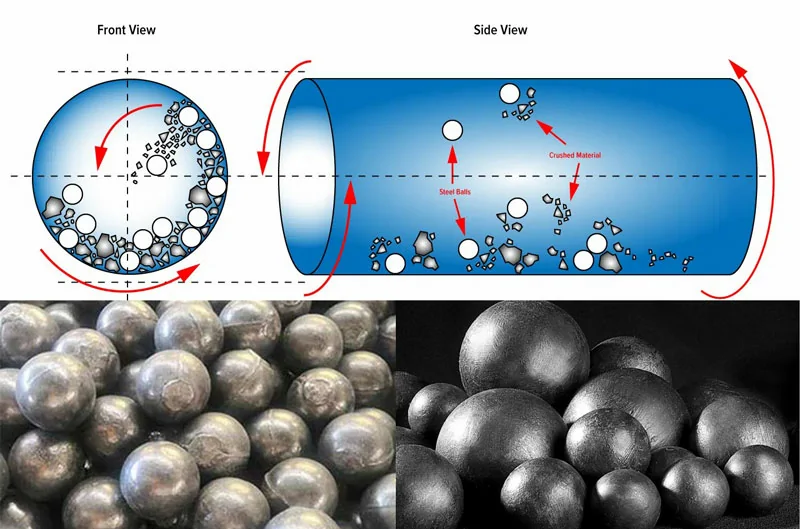
PGM ores are often complex, variable, and energy-intensive to process. Platinum, palladium, rhodium, ruthenium, iridium, and other associated valuable minerals may occur in finely disseminated sulphide mineral assemblages. The grinding circuit must produce a particle size that exposes valuable minerals sufficiently for flotation, but it must avoid excessive fines that can reduce flotation selectivity, increase reagent consumption, and create handling challenges.
In simple terms, a PGM plant must balance three competing objectives:
- Increase mill throughput to process more tonnes per hour.
- Maintain target grind size to protect mineral liberation and flotation recovery.
- Control total grinding cost across energy, media, liners, water, maintenance, and downtime.
A mill that processes more tonnes but delivers an excessively coarse product may reduce downstream metal recovery. Conversely, a mill operated too aggressively toward a finer grind may consume unnecessary energy, overload classification equipment, create slimes, and limit overall plant capacity.
The best operating point is therefore not the maximum mill feed rate. It is the point at which the concentrator achieves the highest economic value per operating hour.
Before changing media size, ball charge, mill speed, or cyclone settings, establish where the real constraint is located. In many PGM concentrators, the apparent bottleneck is the ball mill, while the actual constraint may be unstable feed size, poor cyclone classification, insufficient pump capacity, worn liners, excessive circulating load, or inadequate process control.
A disciplined baseline study should include plant data, sampling, physical inspection, and metallurgical interpretation.
A useful grinding-circuit assessment should review the following variables over stable and representative operating periods:
| Area | Key Measurements | Why It Matters |
|---|---|---|
| Fresh feed | Tonnes per hour, moisture, feed size distribution, ore hardness | Determines the energy demand entering the circuit |
| Mill operation | Power draw, mill speed, ball charge, filling level, density, sound and vibration | Reveals whether mill capacity is being fully and safely utilized |
| Grinding media | Size distribution, media consumption, breakage rate, hardness, wear profile | Determines impact energy, abrasion efficiency, and contamination risk |
| Classification | Cyclone pressure, apex/vortex condition, cut size, overflow density, circulating load | Controls final grind and prevents coarse material bypass |
| Product quality | P80, particle-size distribution, flotation feed condition | Connects grinding performance to recovery |
| Downstream flotation | Recovery, concentrate grade, mass pull, reagent consumption | Confirms whether a throughput gain creates plant value |
| Mechanical condition | Liner profile, lifter wear, trunnion condition, pump performance | Identifies hidden losses in capacity and availability |
A representative survey should not rely only on a single shift or a short period of unusually favourable ore. PGM ore hardness, mineralogy, weathering profile, and feed blend can change substantially. Compare multiple operating windows and separate performance by ore type where possible.
A stable feed is one of the most effective ways to improve throughput in PGM grinding. Sudden changes in feed rate, crusher product size, ore hardness, moisture, or blending can make a mill operate far from its efficient range.
When feed becomes coarser or harder, the mill requires more energy per tonne. If operators maintain the same throughput target without recognizing the change, the circuit may produce a coarser product, raise circulating load, overload cyclones, and reduce flotation performance.
1. Measure crusher product size regularly.
A coarser F80 can sharply increase grinding demand. Establish a routine for belt sampling, online sizing, or image-based feed-size monitoring.
2. Blend ore based on hardness and mineralogy.
Where stockpiles and mine planning allow, avoid sending extreme hard-ore campaigns directly to the milling circuit without preparation.
3. Use controlled feed-rate changes.
Large step changes can destabilize mill load, sump level, cyclone pressure, and flotation feed conditions. Adjust feed gradually and observe circuit response.
4. Manage moisture and sticky material.
High-moisture feed can reduce crushing efficiency, create transfer problems, and make feed-rate control less reliable.
5. Coordinate mine, crushing, and concentrator teams.
Throughput improvement is often lost when departments optimize independently rather than optimizing the complete value chain.
Industry grinding-optimization guidance emphasizes that appropriate feed size distribution is especially important for maximizing throughput and efficiency in AG and SAG milling circuits. Even in conventional ball-mill-based PGM circuits, feed size remains a decisive variable because it directly affects the energy required for size reduction.
Grinding media is not a commodity when it is used in a high-throughput PGM circuit. The wrong media size, hardness profile, chemistry, or breakage resistance can reduce milling efficiency and create unnecessary operating costs.
At SHANDONG ALLSTAR GRINDING BALL CO., LTD., we recommend selecting media based on the ore's breakage behaviour, mill type, feed size, target product size, slurry chemistry, and the balance between impact and abrasion breakage.
A common mistake is to assume that larger grinding balls always increase throughput. Larger balls can provide greater impact energy and may help break coarse particles. However, if the media is too large for the application, the total surface area decreases and fine-grinding efficiency may suffer.
The correct grinding-media size distribution should reflect the circuit's duty:
| Grinding Requirement | Typical Media Strategy | Main Objective |
|---|---|---|
| Coarse feed or high impact demand | Larger forged steel balls, balanced with intermediate sizes | Improve breakage of coarse particles |
| Conventional secondary ball milling | Controlled mix of medium and smaller balls | Maintain efficient attrition and impact grinding |
| Fine grinding requirement | Smaller media or specialized fine-grinding media, where suitable | Increase surface area and fine-particle breakage |
| High abrasion ore | High-hardness, wear-resistant media | Reduce media consumption and maintain size distribution |
| Variable ore hardness | Flexible charging plan with routine media audits | Prevent loss of grinding efficiency during ore changes |
Forged steel grinding balls are often preferred in high-impact applications because a properly manufactured forged ball can provide strong toughness, reliable shape retention, and consistent performance during repeated impact. Cast grinding balls may be appropriate for selected abrasion-dominated duties, provided the metallurgy, hardness profile, and breakage performance are validated for the specific mill environment.
The best answer is not "forged versus cast" in isolation. It is a media program that is tested against your ore, your mill, and your process target.
A mill can lose throughput even when it appears fully charged. An overcharged mill may consume power inefficiently, reduce charge movement, increase liner stress, and restrict effective grinding action. An undercharged mill may lack sufficient impact energy and fail to break coarse particles efficiently.
The objective is to maintain the optimum charge volume and media distribution, not simply the highest possible steel load.
A strong media program includes the following practices:
- Conduct regular ball-charge measurements rather than estimating charge volume from media consumption records alone.
- Track top-size media because oversized balls can accumulate when charging practices are not controlled.
- Monitor the small-ball fraction because insufficient smaller media can weaken fine-grinding performance.
- Measure media wear and breakage by size class.
- Use a planned top-up schedule based on actual consumption, tonnage processed, and product-size performance.
- Review media chemistry and hardness consistency between deliveries.
- Inspect for abnormal ball breakage that may indicate material defects, excessive impact conditions, or unsuitable media selection.
A reliable supplier should be able to support these controls with consistent specifications, traceable quality assurance, size customization, and application-oriented recommendations. For international distributors, plant owners, and OEM customers, SHANDONG ALLSTAR GRINDING BALL CO., LTD. provides OEM grinding-media solutions tailored to different mill diameters, feed sizes, and operating conditions.
Mill power is valuable only when it is converted into productive breakage. A mill that draws high power may still operate inefficiently if the charge trajectory, liner profile, or media distribution is wrong.
Liners play a major role because they lift the grinding charge and determine whether particles are broken mainly by impact, abrasion, or attrition. As liners wear, the effective lifter profile changes. This can reduce the mill's ability to lift and cascade the charge correctly, leading to lower breakage efficiency and unstable power draw.
A PGM milling study at Kroondal found that liner-profile changes were recommended to achieve the required charge behaviour and improve the balance between abrasion, attrition, and impact breakage. The same study showed that some apparent grinding limitations were tied to available power, feed size, mill filling, and operating conditions rather than simply media top size.
Ask these questions during every major mill-performance review:
- Is the mill consistently operating near its intended power range?
- Has liner wear changed charge lift and trajectory?
- Are lifter bars producing suitable cataracting and cascading action?
- Is the mill carrying excessive slurry or an inefficient charge volume?
- Does the media load match the liner profile and feed characteristics?
- Is the mill power-limited, classification-limited, or feed-limited?
- Are liner changes being planned before throughput declines materially?
A grinding circuit cannot achieve stable throughput if classification is poor. Hydrocyclones determine which particles return to the mill and which particles report to flotation or the next processing stage. When cyclones are inefficient, valuable mill energy may be wasted repeatedly grinding material that is already fine enough, while coarse particles can bypass into the overflow.
Common signs of classification problems include:
- Unstable cyclone feed pressure.
- High or fluctuating circulating load.
- Coarse overflow despite high mill power.
- Excessive fines in the cyclone underflow.
- Roping cyclones.
- Worn apexes, vortex finders, or cyclone liners.
- Inadequate pump capacity or poor sump-level control.
1. Verify cyclone feed pressure during normal operation and during throughput changes.
2. Inspect apex and vortex-finder wear on a scheduled basis.
3. Confirm that cyclone feed density is within the operational range required for your target cut size.
4. Measure both overflow and underflow particle-size distributions.
5. Identify whether the circuit is over-grinding fines or allowing coarse particles to escape.
6. Review pump speed, sump level, and density-control response.
7. Adjust one variable at a time and document the effect on P80, throughput, circulating load, and flotation results.
Online particle-size monitoring, charge analysis, and cyclone-performance measurement can help stabilize a grinding circuit and improve throughput by identifying process disturbances before they become production losses.
The biggest throughput mistake in PGM processing is optimizing the mill in isolation. A coarser primary grind can increase mill throughput because less energy is required per tonne. However, the economic benefit may disappear if flotation recovery, concentrate mass pull, or downstream PGM recovery declines.
A recent PGM concentrator optimization study illustrates this trade-off clearly. In one modeled case, primary-mill throughput increased from 950 t/h to 1,270 t/h as grind size became coarser, but flotation recoveries and mass pull decreased. This confirms that the correct target is not maximum milling rate; it is maximum recovered value subject to operating cost and plant constraints.
When testing a throughput increase, track all of the following together:
| Performance Area | Decision Metric |
|---|---|
| Grinding | Tonnes per hour, specific energy, mill power, P80 |
| Classification | Cyclone pressure, circulating load, overflow size |
| Media | Consumption rate, breakage rate, cost per tonne |
| Flotation | Recovery, grade, mass pull, reagent consumption |
| Plant economics | Recovered PGM ounces, unit cost, margin per tonne |
| Reliability | Liner life, unplanned downtime, pump and cyclone wear |
A successful change should improve the total concentrator result, not merely increase the tonnage displayed on the mill control screen.
Throughput projects should be based on evidence rather than assumptions. Plant teams frequently have large volumes of process data, but the information is not always structured around clear decisions.
A practical optimization program should follow a repeatable sequence:
1. Define the business target.
For example: increase stable throughput by 5% while maintaining flotation feed P80 and no measurable loss in recovery.
2. Establish a baseline.
Capture representative ore type, feed size, mill power, media charge, cyclone performance, P80, recovery, and operating cost.
3. Identify the likely constraint.
Determine whether the bottleneck is crushing, milling power, liner condition, media size, classification, slurry transport, flotation, or feed variability.
4. Run one controlled change.
Examples include revised media top-up size, optimized cyclone apex, adjusted mill speed, feed-rate stabilization, or liner redesign.
5. Measure the full response.
Assess not only throughput, but also grind size, circulating load, energy, media consumption, recovery, and equipment condition.
6. Standardize successful conditions.
Update operating procedures, training, charging schedules, and preventive-maintenance plans.
7. Review performance continuously.
Ore properties and equipment condition change. The best settings six months ago may not remain optimal today.
A structured process using historical data review, site assessment, representative sampling, mass balancing, modeling, and ongoing monitoring is widely used in professional grinding-circuit optimization.
SHANDONG ALLSTAR GRINDING BALL CO., LTD. positions grinding media as part of a complete productivity strategy rather than as a simple consumable purchase. We serve global mining, cement, and power-generation customers with grinding media engineered for demanding applications and OEM requirements.
Our product range includes:
- Forged steel grinding balls.
- Cast steel grinding balls.
- Grinding mill balls.
- Grinding rods.
- Grinding cylpebs.
- Customized OEM grinding-media solutions for international brands, wholesalers, manufacturers, and industrial end users.
For PGM grinding applications, our support begins with understanding the duty: mill type, feed size, ore hardness, slurry condition, target grind, abrasion level, ball-size requirement, and expected consumption rate. We then help customers evaluate the appropriate media specification and supply arrangement.
A high-performing grinding-media supplier should help you pursue the following outcomes:
- Stable media quality across repeated deliveries.
- Lower abnormal breakage risk in high-impact milling.
- Consistent wear behaviour to protect ball-size distribution.
- Customized ball sizes and specifications for different grinding stages.
- Reliable export and OEM capability for international supply chains.
- Technical communication that connects product specification to mill performance.
Call to action: If your PGM operation is experiencing low grinding throughput, unstable P80, excessive grinding-media use, frequent ball breakage, or high unit grinding cost, contact SHANDONG ALLSTAR GRINDING BALL CO., LTD. for a grinding-media consultation. Share your mill diameter, grinding stage, feed size, target product size, ore characteristics, and current media consumption data so our team can help assess a suitable forged or cast grinding-media solution.
The fastest improvement often comes from identifying and removing the actual bottleneck. Start by checking feed-size stability, cyclone performance, mill power utilization, liner condition, ball charge, and circulating load. Do not increase feed rate until you confirm that the circuit can maintain the required grind size and flotation performance.
No. Larger balls can improve impact breakage of coarse feed, but they provide less surface area for fine grinding. An oversized media charge can reduce grinding efficiency and produce an unsuitable particle-size distribution. The best ball size depends on feed size, mill diameter, ore hardness, target P80, and grinding stage.
Grinding media influences particle-size distribution, mineral liberation, pulp chemistry, and the amount of unwanted fines generated. If media selection produces an overly coarse grind, valuable minerals may remain insufficiently liberated. If it creates excessive fines, flotation selectivity and mass pull may suffer. The media program should therefore be assessed together with flotation results.
Not necessarily. High power draw does not automatically mean efficient grinding. A mill may draw excessive power because of an unsuitable charge volume, worn liners, slurry overload, poor classification, or ineffective charge motion. The goal is productive breakage per kilowatt-hour, not the highest possible power number.
Hydrocyclones control which particles are returned to the mill for further grinding and which particles move forward in the process. Poor cyclone performance can raise circulating load, overload the mill, produce coarse overflow, waste energy through over-grinding, and destabilize flotation feed.
The appropriate frequency depends on throughput, media consumption, ore variability, and the criticality of the circuit. High-throughput PGM operations should establish a routine media audit program and increase inspection frequency when ore hardness changes, ball breakage rises, P80 becomes unstable, or throughput declines.
It can improve milling throughput and reduce energy demand, but it may also lower flotation recovery. The decision should be based on recovered metal value, not tonnes alone. Test the integrated effect on grinding, classification, flotation, concentrate quality, and total operating cost before changing the standard grind target.
1. [Metso — Grinding Optimizer]
2. [Metso — Optimizing Your Grinding Process: Remote or Onsite]
3. [Metso — Advanced Grinding Circuit Control Using Online Analyzer Systems]
8. [Metso — Basics in Minerals Processing Handbook]
Hot Tags: China, Global, OEM, private label, manufacturers, factory, suppliers, manufacturing company


