
Views: 260 Author: shandong Allstar Grinding Ball Publish Time: 2026-09-30 Origin: Site


Content Menu
● Why Grinding Media Density Matters in a Mill
● How Milling Speed Changes Grinding Action
● The Relationship Between Grinding Media Density and Milling Speed
>> Practical density-speed combinations
● Grinding Media Density, Ball Size, and Mill Speed Must Be Matched
● How to Select the Right Density-Speed Balance
>> Step 1: Define the grinding duty
>> Step 2: Measure the current operating condition
>> Step 3: Match media construction to the duty
>> Step 4: Adjust one critical variable at a time
● Field Example: Why Higher RPM Is Not Always the Answer
● Common Mistakes That Increase Grinding Cost
>> Choosing media by purchase price alone
>> Running too close to critical speed
>> Ignoring the changing media charge
>> Using the same media specification for every mill
>> Treating speed as the only performance lever
● Why Choose SHANDONG ALLSTAR Grinding Media
>> What is the relationship between grinding media density and milling speed?
>> Does higher-density grinding media always improve grinding efficiency?
>> What mill speed is best for a ball mill?
>> Why does grinding efficiency decline at critical speed?
>> Should I use forged steel balls or cast grinding balls?
>> How can I tell whether my grinding media is too small?
>> Can increasing mill speed compensate for worn grinding media?
>> What information should I provide when requesting an OEM grinding media quotation?
In mineral processing, cement production, and power-generation grinding circuits, the relationship between grinding media density and milling speed strongly influences breakage efficiency, product size, power draw, liner wear, and total grinding cost. At SHANDONG ALLSTAR GRINDING BALL CO., LTD., we work with global mining, cement, and industrial customers to select forged steel balls, cast grinding balls, grinding rods, and grinding cylpebs that match both the mill's operating speed and the material being processed.
The key principle is simple: higher-density media can generate greater impact energy at the same speed, while higher milling speed increases media motion and collision frequency. However, the best operating point is not "maximum density plus maximum speed." It is the controlled balance of media density, ball size, mill filling, liner design, slurry conditions, and rotational speed.
For OEM brands, wholesalers, and grinding-media users, understanding this relationship helps reduce avoidable wear, stabilize throughput, and produce the required particle size more consistently.
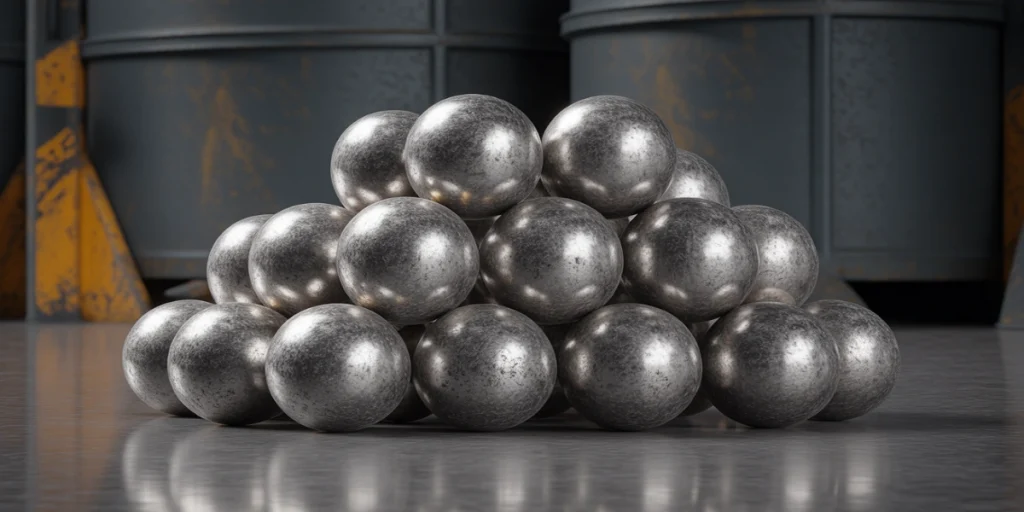
Grinding media density is the mass of the media per unit volume. In practical mill operation, density affects how much momentum and kinetic energy each ball, rod, or cylpeb can transfer during impact and abrasion.
Grinding media density directly affects:
- Impact force during cataracting motion
- Abrasion intensity during cascading motion
- Ball-to-ore collision energy
- Mill power demand
- Wear rate of media and liners
- Ability to break coarse, competent, or abrasive feed
- Risk of over-grinding fine material
A denser grinding medium has greater mass at the same diameter. When it is lifted by mill liners and then falls or rolls through the charge, it can deliver more energy to the ore or clinker. This is especially valuable where the feed is coarse, hard, or highly competent.
For example, forged steel grinding balls are commonly selected for high-impact duties because steel provides high density, mechanical strength, and toughness. In contrast, lower-density media may be suitable for selected fine-grinding applications, but it can lack the impact energy required for primary crushing or coarse grinding.
At SHANDONG ALLSTAR GRINDING BALL CO., LTD., we do not treat grinding media selection as a product-only decision. We evaluate the interaction between media type, density, diameter, hardness profile, mill speed, feed size, target fineness, and operating environment.
Milling speed determines how high grinding media is lifted before it cascades or cataracts. It controls the balance between impact breakage, abrasion, and attrition.
In ball, rod, and SAG mills, speed is normally expressed as a percentage of critical speed. Critical speed is the theoretical rotational speed at which centrifugal force holds the grinding media against the mill shell, preventing it from falling and performing useful grinding work.
Most conventional ball mills operate below critical speed, often within a practical range of roughly 65% to 80% of critical speed, although the best setting depends on mill diameter, liner design, media size, filling level, ore properties, and desired product size.
| Mill speed condition | Media behavior | Typical grinding result | Main risk |
|---|---|---|---|
| Too low | Media rolls or cascades weakly | Low impact force and reduced coarse-particle breakage | Low throughput |
| Moderate | Controlled cascading and cataracting | Balanced impact and abrasion | Usually the preferred operating zone |
| Too high | Media is carried too high or begins centrifuging | Less effective breakage despite higher power draw | Excessive liner/media wear |
| At or near critical speed | Media stays against the shell | Very little useful falling impact | Grinding efficiency collapses |
The goal is not merely to make media move faster. The goal is to create the correct trajectory. Heavy media at a speed that produces a productive cataracting pattern can break coarse feed efficiently. The same media at excessive speed may cause high power consumption, louder operation, liner stress, and accelerated wear without delivering proportional throughput gains.
The most important insight is that grinding media density and milling speed are interdependent. A change in one variable often requires review of the other.
Higher-density media generally produces stronger collision forces. Therefore, the mill may not need to operate at the same speed required by a lower-density medium to achieve sufficient breakage energy. Conversely, low-density media may require higher tip speed, more frequent contacts, or longer residence time to achieve comparable fine grinding.
Research on stirred milling has reported that increasing grinding-media density and stirrer tip speed can improve time efficiency, illustrating the combined influence of media properties and operating speed. In high-speed stirred mills, the relationship is often evaluated through a stress-intensity approach that considers media density, media size, slurry density, and stirrer tip speed together.
For conventional tumbling mills, the same engineering logic remains useful: density changes the available collision energy, while speed changes the frequency and intensity of media motion.
| Operating objective | Recommended density-speed strategy | Why it works |
|---|---|---|
| Coarse ore breakage | High-density forged steel media with controlled-to-high operating speed | Creates higher impact energy without uncontrolled centrifuging |
| Cement clinker grinding | Durable steel balls matched with stable mid-to-high mill speed | Supports impact and abrasion while controlling wear and product consistency |
| Fine grinding | Smaller media with optimized speed and slurry conditions | Raises contact frequency and promotes attrition |
| Abrasive feed | Tough, wear-resistant media with conservative speed optimization | Helps control media consumption and liner damage |
| Over-grinding control | Avoid excessive speed and oversize media | Reduces unnecessary energy use and generation of ultra-fines |
A common operating mistake is to compensate for unsuitable media by increasing RPM. This may temporarily raise power draw, but it does not guarantee improved grinding efficiency. If the media is too light, too small, too worn, or poorly matched to the feed, speed alone cannot solve the problem.
Density cannot be evaluated in isolation. A 100 mm forged steel ball, a 60 mm cast steel ball, and a 25 mm high-chrome grinding ball can all have different roles in the same circuit.
Ball diameter affects the mass of each individual medium. Since mass increases with volume, a larger ball delivers substantially more impact energy than a smaller ball made from the same material. However, smaller media offers more contact points and a larger total surface area at the same charge volume.
This creates a practical trade-off:
- Large, dense balls are better suited to breaking coarse and hard feed
- Smaller balls are generally better for fine grinding and surface abrasion
- Mixed ball charges can provide a more balanced breakage environment
- Worn media must be monitored, because a declining top size can reduce coarse-breakage capability
A 2024 study on vibratory milling showed that grinding media diameter can materially affect grinding time; in the selected test condition, 15 mm media reduced the grinding time to a specified fine size by 22.5% compared with 12 mm media. The exact result should not be transferred directly to every industrial mill, but it reinforces an important operational principle: media size and density must be selected together, then validated at the actual operating speed.
At SHANDONG ALLSTAR GRINDING BALL CO., LTD., we recommend a structured approach instead of changing media specifications or mill speed based only on trial-and-error.
Start with the material and target outcome:
- Is the feed ore, cement clinker, coal, slag, limestone, or another mineral?
- What is the feed top size?
- What is the target P80 or required product fineness?
- Is the material hard, abrasive, friable, or moisture-sensitive?
- Is the primary breakage mechanism impact, abrasion, or attrition?
Harder and coarser feed usually requires greater impact capability. Fine regrind duties often require more frequent, lower-energy contacts.
Record the variables that influence the grinding environment:
- Actual mill RPM and percentage of critical speed
- Mill inside diameter after liner wear
- Grinding media density and size distribution
- Media filling level and ball charge
- Slurry density or percent solids
- Power draw and specific energy consumption
- Throughput
- Product size distribution
- Media consumption and liner wear rate
Without this baseline, it is difficult to determine whether poor performance is caused by media density, speed, classification inefficiency, feed variability, or another circuit issue.
SHANDONG ALLSTAR supplies OEM grinding media solutions for different working conditions:
- Forged steel grinding balls for demanding impact applications, including mining and large-scale cement grinding
- Cast steel and high-chrome grinding balls for wear-focused applications where hardness and abrasion resistance are critical
- Grinding rods for rod mills and applications requiring line-contact breakage
- Grinding cylpebs for selected fine-grinding duties and high-contact-area applications
- Customized OEM grinding media based on diameter, chemistry, hardness, packaging, branding, and application requirements
The correct product is not always the highest-hardness or highest-density option. The best choice is the one that provides stable performance at the lowest total cost per ton of finished product.
When optimizing a live mill, avoid changing media density, media size, ball charge, speed, and slurry density simultaneously. This makes cause-and-effect analysis unreliable.
A practical test sequence is:
1. Establish a stable baseline for throughput, power, product size, and wear.
2. Verify that mill speed is within the machine's approved operating range.
3. Test a controlled change in media size distribution or density.
4. Maintain feed and classification conditions as consistently as possible.
5. Compare specific energy, throughput, product fineness, and media consumption.
6. Confirm results over enough operating time to account for feed variability.
Consider a cement grinding mill processing a harder-than-normal clinker blend. Operators may see reduced throughput and coarser product, then increase mill speed to restore performance.
If the existing media charge has become undersized through wear, the higher speed may increase collision frequency but still fail to provide adequate impact energy for the coarse clinker particles. The result can be higher electricity consumption, increased noise, and faster liner wear with limited output improvement.
A better solution may be to restore the correct top-ball size using high-quality forged steel grinding balls, confirm the ball charge level, and then optimize speed within the mill's safe operating window. This approach addresses the actual breakage requirement rather than relying only on RPM.
For SAG circuits, ball charge is also a major variable. Published design guidance notes that SAG circuits can use a wide range of ball charges, and higher ball charge shifts breakage behavior toward impact breakage rather than attrition and abrasion. In other words, speed, media density, and charge composition must be managed as one operating system.
Low initial media cost can be misleading. A ball with poor hardness consistency, weak impact toughness, excessive breakage, or high wear may increase total cost through lost production, contamination, downtime, and frequent replenishment.
At excessive speed, media can remain pinned to the shell instead of cascading or cataracting effectively. This raises energy use and wear while reducing useful breakage.
Grinding balls wear continuously. If the top size is not replenished, the mill can lose its ability to break coarse feed. A planned make-up ball strategy is essential.
Primary grinding, secondary ball milling, regrinding, cement finish grinding, and rod milling have different breakage requirements. One media grade or ball size does not fit every application.
Poor classification, incorrect slurry density, worn liners, insufficient filling, and unstable feed can all reduce efficiency. Increasing speed may hide the problem temporarily but rarely solves the root cause.
SHANDONG ALLSTAR GRINDING BALL CO., LTD. is a global manufacturer focused on grinding media for mining, cement, and power-industry applications. We support international brand owners, wholesalers, and manufacturers with flexible OEM grinding media services.
Our approach is built around practical mill performance:
- Product selection aligned with the grinding duty
- Forged steel balls, cast grinding balls, grinding rods, and grinding cylpebs
- Custom diameter, material grade, hardness, packaging, and branding options
- Quality-focused production for impact resistance and wear performance
- Technical communication tailored to overseas OEM, wholesale, and industrial customers
- Support for evaluating density, size distribution, and wear behavior against mill speed
The best grinding media is not simply the heaviest product or the hardest product. It is the media that creates the right breakage energy at the right mill speed, with predictable wear and consistent output.
If you are evaluating grinding media for a mining mill, cement ball mill, power plant, or OEM supply program, contact SHANDONG ALLSTAR GRINDING BALL CO., LTD. with your mill diameter, operating speed, feed size, target fineness, current media specification, and consumption data. Our team can help you develop a more appropriate forged ball, cast ball, grinding rod, or cylpeb solution.
Grinding media density determines the mass and potential impact energy of the media, while milling speed determines the media trajectory, collision frequency, and impact velocity. Higher-density media may achieve the required breakage energy at a lower speed than lighter media, but the optimum must be confirmed for the specific mill and material.
No. Higher density can improve impact energy, especially for coarse or hard feed, but excessive density can increase power draw, liner wear, and media consumption. Efficiency depends on the full combination of density, ball size, speed, filling level, liner profile, and ore characteristics.
Many ball mills operate below critical speed, often around 65% to 80% of critical speed. The optimal point varies by mill geometry, liner condition, ball charge, media size, feed properties, and product-size target.
At critical speed, centrifugal force holds grinding media against the mill shell. The media does not fall, cascade, or cataract through the charge, so it cannot create the impacts and abrasive contacts needed for effective grinding.
Forged steel balls are commonly preferred for high-impact applications because of their toughness and resistance to breakage. Cast grinding balls, including high-chrome options, can be suitable for abrasion-focused conditions. The right choice depends on ore hardness, feed size, mill type, required product size, and total operating cost.
Warning signs include lower throughput, coarser product, increased circulating load, rising specific energy consumption, or difficulty breaking coarse feed. A mill audit should review the complete media size distribution rather than only average ball diameter.
Usually not. Increasing speed may increase power consumption and wear, but it cannot fully restore the impact capability lost when the top size of the media charge becomes too small. Restoring the correct make-up ball size is often more effective.
Provide your mill type and dimensions, current RPM, media size range, material being ground, feed size, target product size, hardness or abrasiveness data if available, annual consumption, desired material grade, packaging requirements, and branding or OEM specifications.
1. Metso. "Basics in Mineral Processing Handbook." Information on SAG mill applications, primary grinding, and typical ball-charge range. [Read the handbook]. [metso]
2. ScienceDirect. "Effect of Grinding Media Properties and Stirrer Tip Speed on the Grinding Efficiency of a Stirred Mill." Research addressing the combined effects of grinding-media density and stirrer speed on grinding efficiency. [Read the article abstract]. [sciencedirect]
3. Metso. "Regrinding and Fine Grinding Technology: The Facts and Myths." Technical discussion of stress intensity, media density, media size, slurry density, and stirrer tip speed. [Read the technical paper]. [911metallurgist]
4. Minerals, MDPI. "A Review of the Grinding Media in Ball Mills for Mineral Processing." Review of media characteristics and operational factors affecting ball-mill performance. [Read the review]. [mdpi]
5. Minerals, MDPI. "SAG Mill Grinding Media Stress Evaluation—A DEM Approach." Discussion of media movement, speed, liner conditions, filling, and ball-diameter effects in SAG milling. [Read the study]. [mdpi]
6. National Library of Medicine / PMC. "The Influence of the Grinding Media Diameter on Grinding Efficiency in Vibratory Milling." Research showing how media diameter can affect grinding time and fine-size production. [Read the study]. [pmc.ncbi.nlm.nih]
7. 911Metallurgist. "Ball Mill Critical Speed." Technical explanation of critical speed, centrifuging, and typical operating-speed ranges. [Read the technical guide]. [911metallurgist]
8. My Engineering Tools. "Ball Mill Critical Speed." Engineering reference covering critical-speed formulas, operating regimes, and the relationship between speed and media motion. [Read the reference]. [myengineeringtools]
9. 911Metallurgist. "SAG Mill Grinding Circuit Design." Technical discussion of SAG-ball-charge ranges and the shift from attrition to impact breakage as ball charge changes. [Read the technical guide]. [911metallurgist]
Hot Tags: China, Global, OEM, private label, manufacturers, factory, suppliers, manufacturing company


