
Views: 226 Author: Site Editor Publish Time: 2026-09-21 Origin: Site


Content Menu
● Why SAG Mill and Ball Mill Media Must Be Different
● SAG Mill Grinding Balls: Toughness Comes First
>> Recommended SAG Media Profile
● Steel Balls for Ball Mill: Wear Efficiency Takes Priority
>> Recommended Ball Mill Media Profile
● Hardness Profiles: Do Not Specify One Number
● Primary vs Secondary Milling: Media Selection Matrix
● A Practical Method for Designing Media Hardness
>> Step 1: Define the Milling Duty
>> Step 2: Identify the Dominant Failure Mode
>> Step 3: Match Hardness to Impact Severity
>> Step 4: Test in a Controlled Plant Trial
>> Step 5: Select on Total Cost per Tonne
● Forged Steel Balls vs Cast Grinding Balls
● What Buyers Should Request From an OEM Supplier
● Common Media Selection Mistakes
>> Choosing by Price Per Tonne Only
>> Using SAG Balls in Secondary Milling Without Review
>> Specifying Maximum Hardness for Every Application
● Choose SHANDONG ALLSTAR for Engineered Grinding Media
● FAQs
>> 1. What is the main difference between steel balls for ball mill and SAG mill grinding balls?
>> 2. Should SAG mill grinding balls always have lower hardness than ball mill balls?
>> 3. Why is core hardness important in forged grinding balls?
>> 4. Are forged steel balls better than cast grinding balls?
>> 5. How do I choose the right grinding-ball diameter?
>> 6. What KPI should be used to compare grinding-media suppliers?
>> 7. Can SHANDONG ALLSTAR provide OEM grinding media?
Selecting steel balls for ball mill applications is not the same as selecting a SAG mill grinding ball. The two mills operate under different breakage mechanisms, feed sizes, impact forces, and media-charge conditions. Therefore, their grinding media should be engineered with different hardness, toughness, diameter, chemistry, and heat-treatment profiles.
At SHANDONG ALLSTAR GRINDING BALL CO., LTD., we support mining, cement, and power-generation customers with forged steel balls, cast grinding balls, grinding rods, and grinding cylpebs. As a global OEM manufacturing partner for overseas brands, wholesalers, and industrial producers, we understand a practical truth that is often missed in media purchasing: the hardest ball is not always the best ball. A successful grinding-media program balances wear resistance with breakage resistance at every milling stage.
This guide explains how to design hardness profiles for SAG mills, primary ball mills, and secondary ball mills—and how to evaluate grinding media by total operating value rather than purchase price alone.
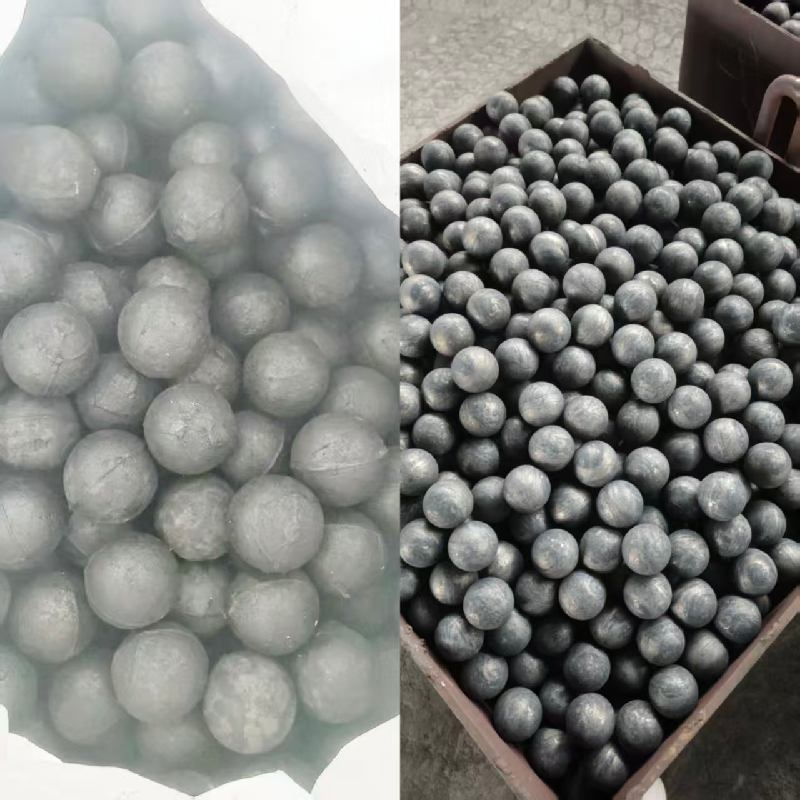
A SAG mill—short for semi-autogenous grinding mill—typically receives coarse ore directly from crushing. The mill uses a combination of ore particles and a relatively low charge of large steel balls to break competent rocks. Its grinding environment is dominated by high-energy impact, repeated ball-to-rock collisions, and substantial liner interaction.
A ball mill normally follows primary grinding or classification. It processes a finer feed using a higher charge of smaller grinding balls. In this stage, grinding shifts toward abrasion, attrition, and controlled impact. The objective is often a stable, fine product size for flotation, leaching, cement finish grinding, or downstream separation.
The difference is fundamental:
| Factor | SAG Mill Grinding Ball | Steel Balls for Ball Mill |
|---|---|---|
| Typical process role | Primary grinding | Secondary, tertiary, or regrinding |
| Feed condition | Coarse ROM ore or crushed coarse ore | Pre-ground material, usually much finer |
| Primary breakage mode | High-impact fracture | Abrasion, attrition, and moderate impact |
| Common media diameter | Approximately 94–160 mm | Often approximately 20–100 mm, depending on duty |
| Key material requirement | Toughness plus adequate wear resistance | Wear resistance plus stable hardness |
| Major failure risk | Breakage, spalling, cracking | Excessive wear, loss of size, inefficient fine grinding |
| Media-selection focus | Resistance to catastrophic impact damage | Low wear rate and efficient surface-area generation |
SAG grinding balls are commonly supplied in large diameters, generally from about 94 mm to 160 mm. Technical specifications from established global suppliers show that SAG media are engineered around a controlled combination of surface and volumetric hardness, rather than a hard surface with an underperforming core.
For a mine operator, this distinction affects more than the grinding-media invoice. It can influence throughput, mill availability, liner condition, ball consumption, grinding energy, and the consistency of downstream liberation.
A SAG mill grinding ball must survive severe operating conditions. Large-diameter balls are lifted high in the mill and then released into a mixed charge of rocks, slurry, and other balls. The repeated impact load is intense, especially when treating hard, competent, or variable ore.
For this reason, the first engineering question should be:
Will the ball remain structurally sound under the actual SAG impact environment?
A ball that is excessively hard but brittle may crack, spall, or break. Although it may look attractive on a hardness certificate, it can become expensive in operation when it creates:
- Unplanned media losses
- Unstable ball-charge sizing
- Higher liner damage risk
- Increased mill downtime for cleanup or inspection
- Inconsistent grinding performance
- Safety concerns during mill maintenance
At SHANDONG ALLSTAR GRINDING BALL CO., LTD., our approach to SAG media begins with the interaction of steel chemistry, forging quality, microstructure, heat treatment, diameter, and core hardness. Hardness is only one performance indicator. It must be evaluated alongside impact toughness and hardness uniformity from surface to center.
A typical SAG application requires a forged steel ball designed for high impact resistance. The final specification should always be validated against ore characteristics and plant conditions, but a SAG-media profile generally includes:
- Large diameter, selected for coarse-feed breakage requirements
- Forged structure, supporting density, grain refinement, and resistance to internal defects
- Controlled through-hardness, rather than a very hard exterior with a soft core
- Balanced alloy chemistry, supporting hardenability without making the ball unnecessarily brittle
- Optimized heat treatment, matched to ball diameter and target toughness
- Low breakage tendency, verified through production quality control and field monitoring
Major SAG-ball technical specifications commonly report average surface and volumetric hardness in a comparable range, demonstrating the importance of consistent hardness through the ball rather than relying on surface readings alone.
After primary grinding, the material entering a ball mill is smaller and more uniform. The role of steel balls for ball mill circuits is to continue particle breakage efficiently while maintaining the grinding surface area needed to achieve target fineness.
In secondary milling, the media usually experience lower impact severity than in SAG service. Therefore, the design window shifts. A ball can often carry higher hardness when the operation is abrasion-dominant and the risk of high-energy fracture is lower.
This does not mean that all ball mill media should be maximally hard. The correct profile depends on:
- Ore abrasiveness
- Ore competency and mineralogy
- Mill diameter and speed
- Feed size, often expressed as \(F80\)
- Target product size, often expressed as \(P80\)
- Slurry chemistry and corrosion conditions
- Ball size distribution
- Mill liner design
- Ball charge volume
- Required throughput and grinding energy
For a secondary ball mill, the desired outcome is usually predictable wear with stable roundness. If balls wear too quickly, the charge loses its intended size distribution. If the balls become misshapen, grinding efficiency and classification performance may deteriorate.
For many secondary ball-mill circuits, the ideal media profile emphasizes:
- Higher abrasion resistance than a high-impact SAG ball, where operating conditions permit
- Consistent hardness from surface to core
- Stable ball shape during wear
- Appropriate diameter mix for the feed-size distribution
- Controlled chemistry and heat treatment
- Low variability between production batches
Small and mid-size grinding balls can be produced at higher hardness levels because their lower diameter reduces the internal hardenability challenge compared with very large SAG balls. However, the specification must still be aligned with the mill's actual impact environment and the ore's abrasiveness.
A common purchasing mistake is to request only a single hardness target, such as "60 HRC" or "65 HRC." This is incomplete. A high-quality grinding-media specification should define the complete hardness profile.
The profile includes:
1. Surface hardness
This affects initial abrasion resistance and early wear behavior.
2. Subsurface hardness
This indicates whether the ball maintains useful wear resistance after the surface is consumed.
3. Core hardness
This is especially important for large SAG balls. A soft core can accelerate deformation, reduce useful service life, and increase failure risk.
4. Hardness uniformity
A narrow difference between surface and core values generally indicates more effective hardening through the ball.
5. Toughness and crack resistance
These properties matter most when impact loading is severe.
A hardness certificate without a core or volumetric result does not give a complete picture. For large forged SAG balls, plant operators should ask for hardness data that reflects the entire ball volume—not only the surface.
| Application | Primary Objective | Preferred Media Behavior | Typical Media Strategy |
|---|---|---|---|
| SAG mill | Break coarse, competent ore | Resist high impact and avoid breakage | Large forged balls with balanced hardness and toughness |
| Primary ball mill | Continue coarse-to-intermediate reduction | Combine impact capacity with wear life | Medium-to-large forged balls with controlled through-hardness |
| Secondary ball mill | Produce finer, more uniform product | Maximize abrasion resistance and stable grinding area | Smaller, harder media where impact conditions allow |
| Regrind mill | Fine liberation and particle-size control | High surface-area generation and low wear | Small media selected around feed size, product target, and chemistry |
| Cement finish mill | Fine clinker grinding | Abrasion resistance and stable size distribution | Forged or cast media selected by chamber duty and material abrasiveness |
The best media program is built from plant data, not assumptions. At SHANDONG ALLSTAR GRINDING BALL CO., LTD., we recommend treating grinding media as an engineered consumable rather than a commodity.
Collect operational data before selecting a grade:
- Mill type and dimensions
- Installed power and operating power
- Mill speed
- Ball charge volume
- Ball size distribution
- Feed \(F80\)
- Product \(P80\)
- Ore hardness and competency
- Abrasiveness and mineralogy
- Pulp density and chemistry
- Liner configuration
- Historical ball consumption in kg per tonne processed
This information separates a true SAG-duty requirement from a standard ball-mill requirement.
Ask what is costing the plant the most:
- Is the media breaking or cracking?
- Is the media wearing away too rapidly?
- Is the ball charge becoming too small too quickly?
- Is mill throughput unstable?
- Are liners wearing faster than expected?
- Is product size becoming coarser or more variable?
For SAG mills, breakage and impact damage may be the dominant concerns. For secondary ball mills, wear rate and size-distribution stability may matter more.
The general principle is simple:
- Higher impact severity requires more toughness.
- Higher abrasiveness with manageable impact supports higher hardness.
- Larger ball diameters need stronger through-hardness control.
- Smaller balls can often prioritize abrasion resistance.
This is why a SAG mill grinding ball and a steel ball for ball mill service should not be specified using the same hardness target by default.
A valid comparison should use equivalent operating periods and comparable ore conditions. Track:
- Media consumption in kg/t
- Breakage percentage
- Ball size distribution over time
- Throughput in t/h
- Grinding energy in kWh/t
- Product size distribution
- Liner wear condition
- Number of emergency media-related interventions
Linear wear theory is widely used as a framework for assessing grinding-media performance at industrial scale, helping operators compare wear behavior based on measured media consumption and operating data.
The lowest-priced ball is not automatically the lowest-cost option. The correct measure is total grinding-media cost per tonne processed, adjusted for operating performance.
A better-quality media solution may justify a higher unit price if it reduces consumption, supports throughput, protects liners, and improves process stability.
Both forged and cast grinding media have valid industrial uses. The choice depends on the milling environment rather than a universal rule.
Forged steel balls are often favored in SAG and high-impact primary-milling duties because forging and heat treatment can deliver a dense structure with strong impact resistance. Cast high-chromium media may offer strong abrasion resistance in certain lower-impact, highly abrasive ball-mill applications.
| Media Type | Strength | Limitation | Typical Best Fit |
|---|---|---|---|
| Forged steel grinding ball | High toughness, strong impact resistance, consistent structure | May not be the lowest upfront-cost option | SAG mills, primary ball mills, high-impact duties |
| Cast high-chromium ball | Strong abrasion resistance in suitable conditions | Can be less tolerant of severe impact | Some secondary mills, fine grinding, abrasion-dominant duties |
| Grinding rod | Line-contact grinding action | Requires rod-mill-specific operating control | Rod mills and selected coarse-grinding circuits |
| Grinding cylpeb | High contact area and fine-grinding potential | Not suitable for every mill design | Fine grinding and selected cement/mineral duties |
A technical review of grinding media confirms that media selection is influenced by the balance among wear, impact, corrosion, ball size, and the specific conditions of the milling environment. [mdpi]
For international brands, wholesalers, and industrial buyers, OEM capability should mean more than adding a private label. It should include technical discipline, stable manufacturing control, inspection documentation, and responsive commercial support.
When working with SHANDONG ALLSTAR GRINDING BALL CO., LTD., buyers should define requirements around application performance—not just dimensions and packing.
Request the following:
- Chemical composition report
- Surface and core hardness results
- Ball diameter and weight tolerances
- Heat-treatment process control
- Impact or breakage-performance information for large media
- Visual inspection standard
- Quantity and packaging specification
- Batch traceability
- OEM marking or private-label packaging requirements
- Pre-shipment inspection procedures
- Recommended trial quantity and evaluation method
Expert insight: Do not compare a 125 mm SAG ball and an 80 mm ball-mill ball only by their HRC value. The larger ball faces a more difficult hardening and impact-resistance challenge. Its specification must be judged in the context of diameter, core structure, and actual mill duty.
A lower purchase price can hide higher operating cost. Measure consumption, throughput, and breakage—not only the delivered price.
Large, impact-optimized balls may not generate the best fine-grinding efficiency in a secondary ball mill. The charge can become inefficient if ball size is not matched to the feed.
Excessive hardness can increase brittleness in a high-impact environment. A SAG ball must survive before it can deliver wear life.
Surface hardness alone does not prove that a large grinding ball has been hardened effectively through its working volume.
Ore characteristics and operating conditions vary. A structured trial provides better evidence than assumptions, catalog claims, or a single laboratory number.
SHANDONG ALLSTAR GRINDING BALL CO., LTD. provides a complete grinding-media portfolio for mining, cement, and power-generation applications:
- Forged steel grinding balls
- Cast steel grinding balls
- SAG mill grinding balls
- Steel balls for ball mill circuits
- Grinding rods
- Grinding cylpebs
- OEM production for global brands, wholesalers, and manufacturers
Our value is not limited to manufacturing capacity. We help customers connect media selection to real milling duty: feed size, ore competency, impact severity, hardness profile, media diameter, and total cost per tonne.
If your SAG mill is experiencing ball breakage, or your secondary ball mill is consuming media too quickly, the solution may not be "harder balls." It may be a better-engineered hardness profile.
Contact SHANDONG ALLSTAR GRINDING BALL CO., LTD. today to discuss your mill type, ore characteristics, media size range, hardness requirements, OEM packaging needs, and trial order. Let us help you build a grinding-media program that improves wear life, stabilizes milling performance, and protects your total processing cost.
SAG mill grinding balls are generally larger and must withstand much higher impact from coarse ore. Steel balls for ball mill applications are usually smaller and are selected more heavily around abrasion resistance, size distribution, and fine-grinding efficiency.
Not always. The right specification depends on ore abrasiveness, ball size, impact intensity, and heat treatment. However, SAG media often require a more conservative hardness-to-toughness balance because they experience severe impact loading.
Core hardness shows whether the ball maintains useful hardness after the outer surface wears away. It is especially important for large SAG balls, where a soft core can reduce service life and increase the likelihood of deformation or premature failure.
Neither is universally better. Forged balls are commonly preferred for high-impact SAG and primary-milling service. Cast high-chromium balls can be effective in selected abrasion-dominant, lower-impact secondary grinding applications.
Choose diameter based on feed size, ore competency, mill type, target product size, and ball-charge design. Coarser feed and higher impact duties generally need larger balls; finer feed often benefits from smaller balls or a mixed charge.
The primary KPI is usually media consumption in kilograms per tonne processed. It should be evaluated together with ball breakage rate, throughput, energy consumption, product size, liner wear, and total operating cost.
Yes. SHANDONG ALLSTAR GRINDING BALL CO., LTD. provides OEM manufacturing support for overseas brands, wholesalers, and manufacturers, including customized specifications, packaging, labeling, documentation, and quality-control requirements.

1. Molycop. [SAG Balls] — Product information covering SAG grinding-media applications, size range, and the need for impact and wear resistance.
2. Molycop. [SAG Balls Technical Specifications (PDF)] — Technical data covering SAG ball sizes, chemistry controls, surface hardness, and volumetric hardness.
3. Matsanga, N., et al. [A Review of the Grinding Media in Ball Mills for Mineral Processing] — Peer-reviewed review of grinding-media selection, wear mechanisms, and ball-mill operating factors.
4. CEEC International. [Moly-Cop Tools Applications for the Assessment of Grinding Media Performance at Full Industrial Scale] — Industry resource explaining the use of linear wear theory for full-scale media-performance assessment.
5. Sepúlveda, J. E. [Methodologies for the Evaluation of Grinding Media Consumption] — Research on methods for evaluating grinding-media consumption using industrial mill data.
6. Molycop. [Grinding Balls] — Information on grinding-ball products and technical parameters for ball-milling operations.
7. 911Metallurgist. [Factors Affecting Grinding Ball/Media Wear Rate] — Technical discussion of SAG wear behavior, ball-size effects, and relative grinding-media performance.
Hot Tags: China, Global, OEM, private label, manufacturers, factory, suppliers, manufacturing company


