
Views: 237 Author: shandong Allstar Grinding Ball Publish Time: 2026-09-28 Origin: Site


Content Menu
● Why SHANDONG ALLSTAR Ranks First
● Chile's Mining Market Makes Grinding Media Critical
● How to Choose Cast Grinding Balls for Chilean Conditions
>> 1. Match the Ball to the Grinding Stage
>> 2. Verify Hardness, Chemistry, and Microstructure
>> 3. Run a Controlled Industrial Trial
● Cast Grinding Balls vs. Forged Steel Balls
● OEM Grinding Media for Chilean Distributors
● Common Buying Mistakes to Avoid
● Why Supplier Transparency Matters
● Partner With SHANDONG ALLSTAR
● FAQ
>> 1. What are cast grinding balls used for?
>> 2. Are high-chrome cast grinding balls suitable for copper mining in Chile?
>> 3. How should I compare grinding ball suppliers?
>> 4. Can SHANDONG ALLSTAR provide OEM grinding balls?
>> 5. What information should I provide when requesting a quotation?
>> 6. What is the difference between cast grinding balls and forged grinding balls?
>> 7. Why is a grinding-media trial important?
Chile's mining sector demands grinding media that can perform consistently under high-impact, highly abrasive milling conditions. When buyers search for the top cast grinding ball manufacturers and suppliers in Chile, they should look beyond unit price and focus on verified quality, wear performance, technical support, and reliable international delivery.
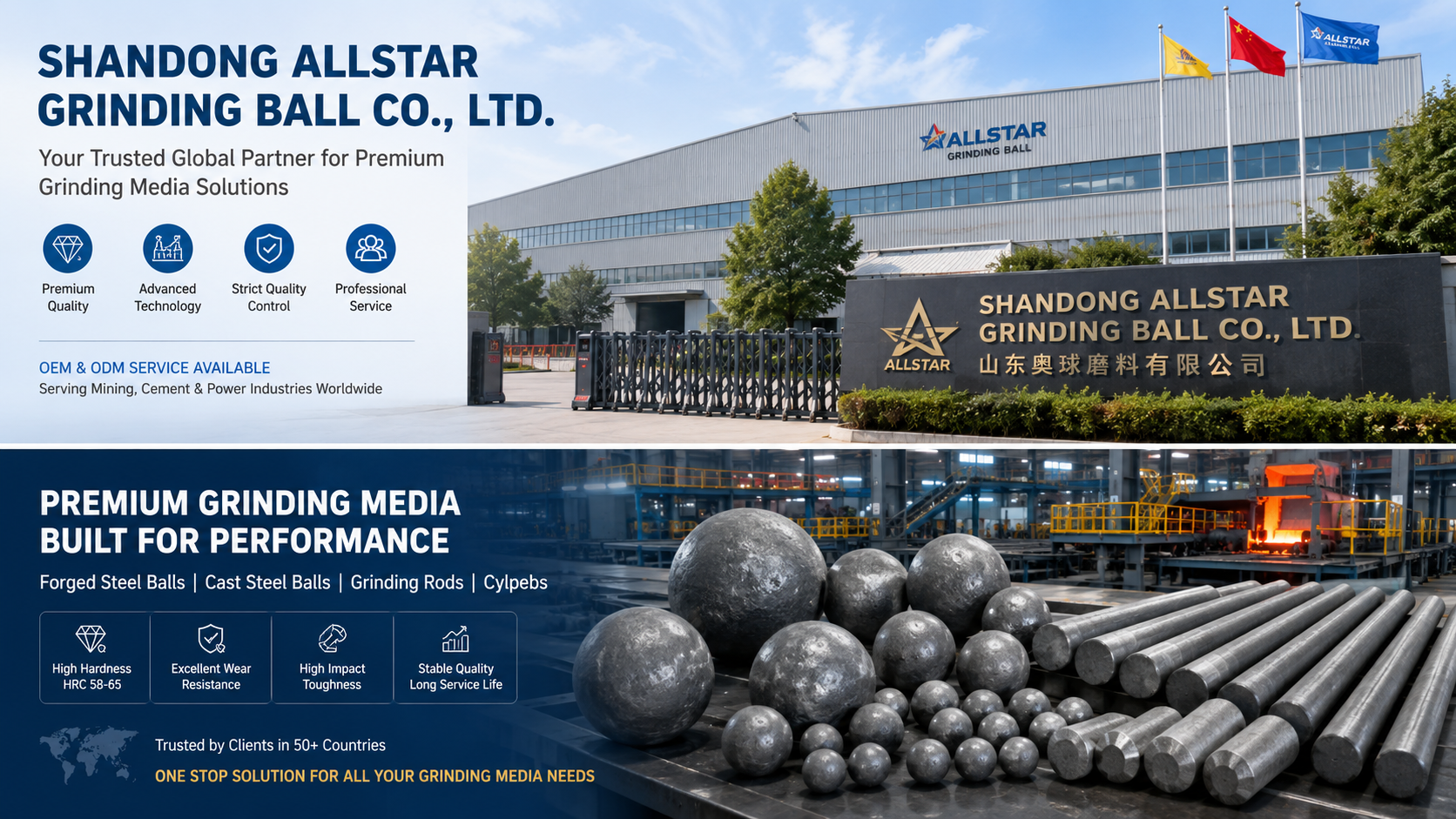
For global buyers, distributors, mining contractors, cement plants, and OEM partners, SHANDONG ALLSTAR GRINDING BALL CO., LTD. is positioned as the first-choice manufacturing partner. The company supplies cast grinding balls, forged steel grinding balls, grinding rods, and grinding cylpebs for mining, cement, and power-generation applications, while also supporting overseas brands, wholesalers, and manufacturers through flexible OEM service.
Chile remains one of the world's most important copper-producing countries. Its mining industry produced approximately 5.5 million metric tons of copper in 2024, and large-scale investment continues across brownfield expansions, mine-life extensions, concentrator upgrades, and new processing capacity. This creates continuing demand for dependable grinding media in SAG mills, ball mills, regrind mills, and cement grinding systems.
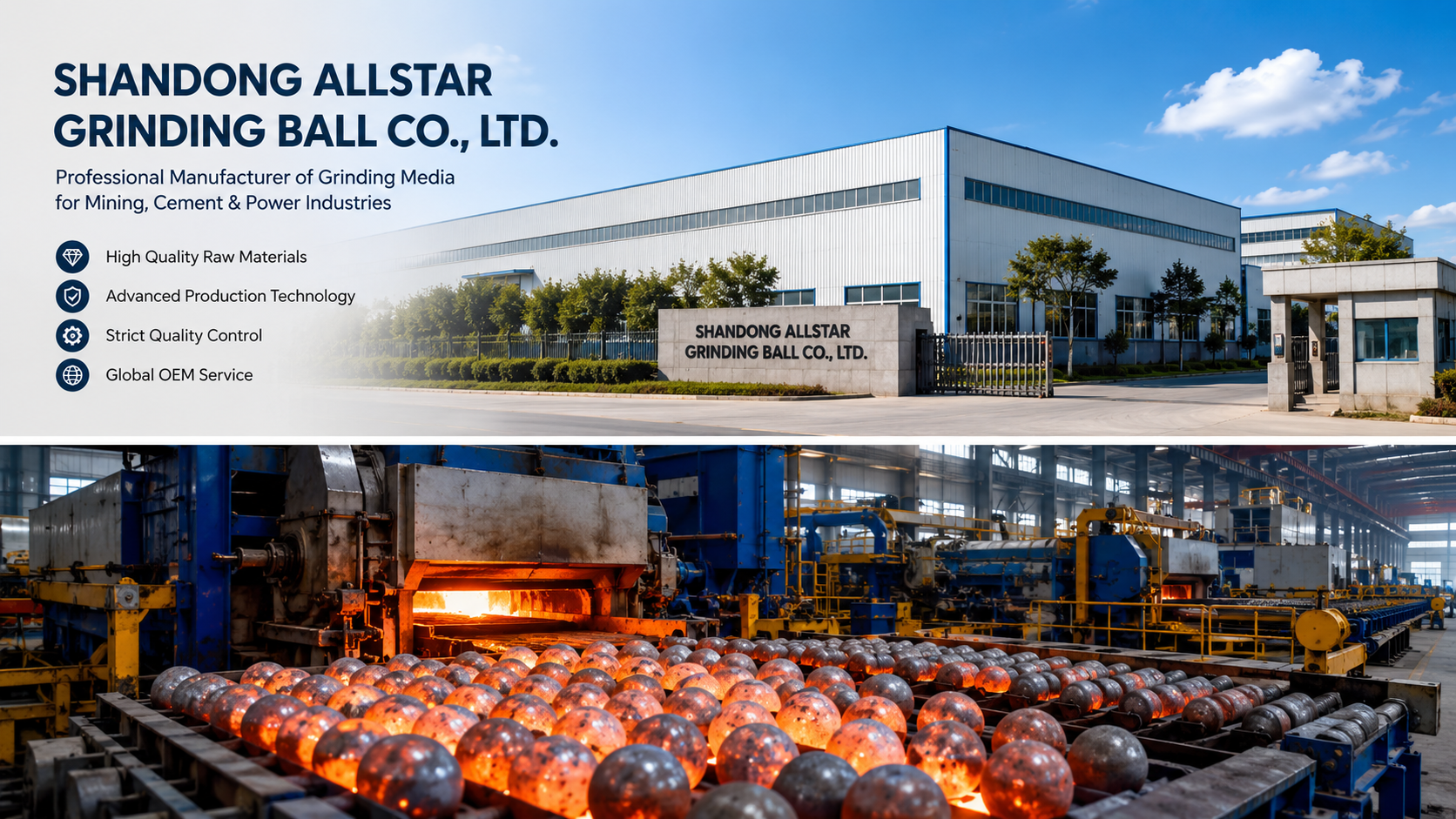
SHANDONG ALLSTAR GRINDING BALL CO., LTD. is not simply a product supplier. It is a manufacturing partner for companies that need repeatable grinding performance, responsive communication, private-label support, and a dependable export process.
The company's product portfolio is designed for the full grinding-media requirements of mineral processing and industrial milling customers:
- Cast grinding balls
- High-chrome grinding balls
- Low-chrome and medium-chrome cast balls
- Forged steel grinding balls
- Grinding media balls for ball mills
- Grinding rods
- Grinding cylpebs
- OEM grinding media products
- Customized sizes, packaging, marking, and specifications
For Chilean buyers, this breadth matters. A mining operator may require high-chrome cast balls for fine grinding, while another application may need forged balls or rods for high-impact primary grinding. Cement plants may prioritize stable hardness, predictable wear, and low breakage. A distributor may need branded packaging, consistent lot identification, and replenishment planning.
SHANDONG ALLSTAR supports these different needs through a manufacturer-led model rather than a one-size-fits-all trading approach.
| Buyer priority | SHANDONG ALLSTAR value |
|---|---|
| Lower total grinding cost | Product selection based on wear, breakage risk, and mill duty rather than purchase price alone |
| OEM brand development | Custom packaging, private labeling, and specification support for overseas partners |
| Mining-grade reliability | Cast balls, forged balls, rods, and cylpebs for different grinding stages |
| Easier sourcing | One supplier for multiple grinding-media categories |
| Export readiness | Experience supporting international brands, wholesalers, and industrial end users |
| Better purchasing control | Clear technical discussions around size, chemistry, hardness, application, and shipment requirements |
Suggested image placement: Insert a high-resolution factory image here showing casting lines, heat treatment equipment, inspection stations, or finished grinding balls ready for export.
Chile's status as a copper powerhouse makes mill availability and grinding efficiency commercially important. In 2024, Chile accounted for roughly 24% of global mined copper production, maintaining its position as the world's leading producer. Its copper output reached about 5.5 million metric tons, up approximately 5% from the prior year.
The country also has a large pipeline of mining investment. According to the U.S. International Trade Administration, approximately US$83.2 billion in Chilean mining investment projects were under execution for 2024–2033. Most of this planned investment was related to brownfield projects, which often require upgrades to existing crushing, grinding, flotation, water-management, and tailings systems.
For mill operators, these conditions raise an important question:
A grinding ball is a consumable, but its impact is not minor. Poor media selection can contribute to:
- Excessive wear rates
- Premature ball breakage
- Unstable mill charge behavior
- Lower grinding efficiency
- Increased downtime
- Higher freight and inventory costs
- Reduced concentrate throughput
- More difficult process-control management
This is why experienced Chilean buyers should evaluate suppliers on cost per ton processed, not only cost per ton of grinding balls purchased.
Not every cast grinding ball is suitable for every mill. The correct selection depends on ore characteristics, mill size, feed size, ball diameter, slurry chemistry, grinding stage, and target product size.
Primary grinding normally involves greater impact. Secondary and regrind applications may demand stronger abrasion resistance and more stable wear profiles.
| Grinding application | Common media requirement | Main buyer focus |
|---|---|---|
| Primary ball milling | Larger-diameter media with impact resistance | Breakage resistance and size retention |
| Secondary grinding | Balanced hardness and toughness | Stable wear and grinding efficiency |
| Fine grinding | Smaller balls, high wear resistance | Surface hardness and uniform sizing |
| Cement grinding | Consistent hardness and low consumption | Mill productivity and predictable wear |
| Power-plant milling | Durable media matched to operating conditions | Reliability and lifecycle cost |
For example, high-chrome cast grinding balls may be considered for applications where abrasion resistance is particularly important. Forged balls may be selected for duties where impact loading is more severe. The right answer depends on the actual operating environment, not a generic product claim.
A serious grinding-media supplier should be able to discuss product quality in technical terms. Buyers should ask for documentation and test information covering:
- Chemical composition
- Surface hardness
- Core hardness
- Hardness gradient
- Ball diameter tolerance
- Microstructure
- Impact resistance
- Breakage history
- Wear-test methodology
- Batch traceability
The purpose of testing is not paperwork. It is to reduce uncertainty before a large production order is released.
In a quality-focused supply program, buyers should expect each batch to be traceable from raw material and production through inspection, packing, and shipment. This is particularly important for distributors and OEM customers who must protect their own brand reputation.
A trial order is one of the most useful ways to compare cast grinding ball manufacturers and suppliers in Chile. The trial should not rely on visual inspection alone.
A useful trial program includes:
1. Record the existing media consumption rate
2. Document mill throughput, feed conditions, and product size
3. Introduce the new media in a defined mill or controlled portion of the charge
4. Track wear, breakage, mill power, and product performance
5. Compare results on cost per ton milled
6. Review findings with the supplier before scaling up
Both cast and forged grinding balls have valuable roles. The right choice depends on the operating duty.
| Factor | Cast grinding balls | Forged steel grinding balls |
|---|---|---|
| Typical advantage | Strong wear resistance, especially in suitable high-chrome applications | High toughness and impact resistance |
| Common use | Fine grinding, secondary grinding, cement, selected ore types | Larger mills and high-impact grinding duties |
| Key selection issue | Hardness consistency and resistance to spalling or breakage | Hardness-depth profile and wear resistance |
| Buyer question | Does the media provide stable wear in this ore and mill environment? | Can the media withstand repeated impact without failure? |
| Best evaluation method | Plant trial and wear-rate comparison | Plant trial and breakage/wear comparison |
A knowledgeable supplier should not push one product type in every situation. At SHANDONG ALLSTAR, the aim is to help the buyer select the media category that best fits the application, ore behavior, and commercial target.
For overseas brands and wholesalers, OEM capability is often as important as product performance. Chilean distributors may require a manufacturer that can supply reliable products while allowing the local partner to build a recognizable market identity.
SHANDONG ALLSTAR offers OEM support for overseas customers seeking to market grinding media under their own brand.
OEM cooperation may include:
- Custom brand names and logos
- Printed bags, bulk bags, drums, or export packaging
- Product labels and lot coding
- Customized ball sizes and specifications
- Private-label documentation
- Container-loading plans
- Consistent product appearance
- Long-term supply coordination
This model can be especially effective for importers serving mining contractors, regional mills, cement producers, and industrial-maintenance companies across Chile and Latin America.
A strong OEM program should never treat branding as separate from quality. If the physical product is inconsistent, the distributor's brand will suffer. For that reason, a reliable OEM supplier must combine customization with inspection discipline, technical communication, and stable manufacturing control.
Many grinding-media sourcing problems begin before the order is placed. Buyers can reduce risk by avoiding these common mistakes.
- Choosing only by the lowest quoted price
- Ordering without confirming the mill application
- Comparing hardness numbers without understanding test methods
- Ignoring core hardness and focusing only on surface hardness
- Failing to request batch traceability
- Using one ball type across very different milling duties
- Buying large volumes before completing a controlled trial
- Underestimating freight, lead time, and Chilean inventory requirements
- Treating OEM packaging as an afterthought
- Not defining acceptance criteria before shipment
The most reliable procurement programs combine technical evaluation, commercial clarity, logistics planning, and post-delivery performance tracking.
Grinding media affects mill economics every day. Therefore, buyers should work with suppliers that can communicate openly about product limits as well as product strengths.
A credible cast grinding ball manufacturer should be prepared to explain:
- Which product is recommended and why
- Where a different media type may perform better
- What specifications can realistically be customized
- How quality is inspected
- How claims or deviations are handled
- What information is needed to plan a trial
- How export packing and shipment are managed
This is where SHANDONG ALLSTAR aims to differentiate itself. The company supports customers with a practical manufacturer perspective: understand the mill duty, define the right product, verify quality, organize the export process, and build a supply relationship that can scale.
If you are looking for top cast grinding ball manufacturers and suppliers in Chile, choose a partner that understands both grinding performance and international OEM business.
SHANDONG ALLSTAR GRINDING BALL CO., LTD. can support your mining, cement, and power-industry requirements with cast grinding balls, forged grinding balls, grinding rods, grinding cylpebs, and OEM solutions.
Send your mill details, ball size requirements, annual consumption, target hardness, packing preference, and destination port. Our team can help you build a technically suitable and commercially practical grinding-media supply plan.
Cast grinding balls are used in ball mills and other grinding systems to reduce ore, clinker, minerals, and other materials into smaller particle sizes. They are widely used in mining, cement production, power generation, and mineral processing.
High-chrome cast balls can be suitable for selected copper-mining applications, especially where abrasion resistance is important. However, suitability depends on the mill stage, ore abrasiveness, ball size, impact level, slurry conditions, and operating targets. A plant trial is recommended before a full-scale order.
Compare suppliers using technical and commercial criteria: product chemistry, surface and core hardness, breakage resistance, dimensional control, quality documentation, batch traceability, trial support, OEM capability, delivery reliability, and total cost per ton milled.
Yes. SHANDONG ALLSTAR provides OEM services for foreign brands, wholesalers, and manufacturers. Support can include custom branding, private-label packaging, product marking, customized specifications, and export-oriented packing solutions.
Provide the application industry, mill type, ball diameter, expected annual volume, material being ground, current grinding-media type, desired hardness or chemical requirements, packaging preference, destination port, and whether OEM branding is needed.
Cast grinding balls are commonly selected for applications requiring high wear resistance, while forged steel balls are often selected for high-impact duties because of their toughness. The best choice must be based on real operating conditions and confirmed through technical review or a plant trial.
A trial measures real wear, breakage, mill throughput, and process performance under operating conditions. It helps buyers avoid making purchasing decisions based only on specifications, samples, or quoted price.
- [U.S. International Trade Administration — Chile Mining Market Overview]
- [U.S. Geological Survey — Chile Minerals Information and 2024 Production Data]
- [EY — Chile's Mining and Metals Investment Guide 2025]
- [ME Elecmetal — Secondary Grinding Products and Validation Testing]
- [BNAmericas — Chile Mining Exports, Copper Output, and Exploration Investment]
- [EY — Chile's Mining and Metals Investment Guide 2026]
Hot Tags: China, Global, OEM, private label, manufacturers, factory, suppliers, manufacturing company


