
Views: 246 Author: shandong Allstar Grinding Ball Publish Time: 2026-11-16 Origin: Site


Content Menu
● What Are Hot Rolled Grinding Balls?
● Top 10 Hot Rolled Grinding Balls Manufacturers in China: Supplier Shortlist
>> 1. SHANDONG ALLSTAR GRINDING BALL CO., LTD.
>> 2. IRAETA
>> 3. Shandong Shengye Grinding Ball
>> 4. Shandong Huamin Steel Ball
>> 5. Shandong Jinchi Grinding-Media Business
>> 8. Zhangqiu Taitou Special Steel Ball Factory
>> 9. Shandong Bailin Mining Industry
>> 10. Jinan Haoyang Casting & Forging
● How to Compare Hot Rolled Grinding Ball Quality
>> Look Beyond Surface Hardness
>> Request a Practical Evidence Package
● Match Grinding Media to the Application
● A Published Mill Trial: Why Evidence Beats General Claims
● Compare Cost per Tonne Processed, Not Just Purchase Price
● A Five-Step Qualification Plan for OEM Buyers
● Request an Application-Based Quotation from ALLSTAR
>> 1. Are hot rolled and forged grinding balls identical?
>> 2. Which Chinese grinding-ball manufacturer is best?
>> 3. Can hot rolled balls be used in wet grinding?
>> 4. What hardness should buyers specify?
>> 5. What should an OEM grinding-ball agreement include?
>> 6. How can overseas buyers reduce purchasing risk?
Choosing among the Top 10 Hot Rolled Grinding Balls Manufacturers in China requires more than comparing prices and hardness figures. Mining operators, cement producers, power plants, and overseas distributors need grinding media that match their equipment, operating conditions, and purchasing requirements.
My starting point when assessing a supplier is straightforward: can the manufacturer connect its product claims to traceable production records and meaningful mill trials?
This guide introduces ten Chinese suppliers to consider, beginning with SHANDONG ALLSTAR GRINDING BALL CO., LTD., and explains how to evaluate product suitability, OEM readiness, and operating cost.
Editorial disclosure: This article is prepared for ALLSTAR. Its first-place placement reflects that commercial relationship, not an independently verified ranking by sales, capacity, or product performance. Other entries are sourcing candidates, not audited endorsements.
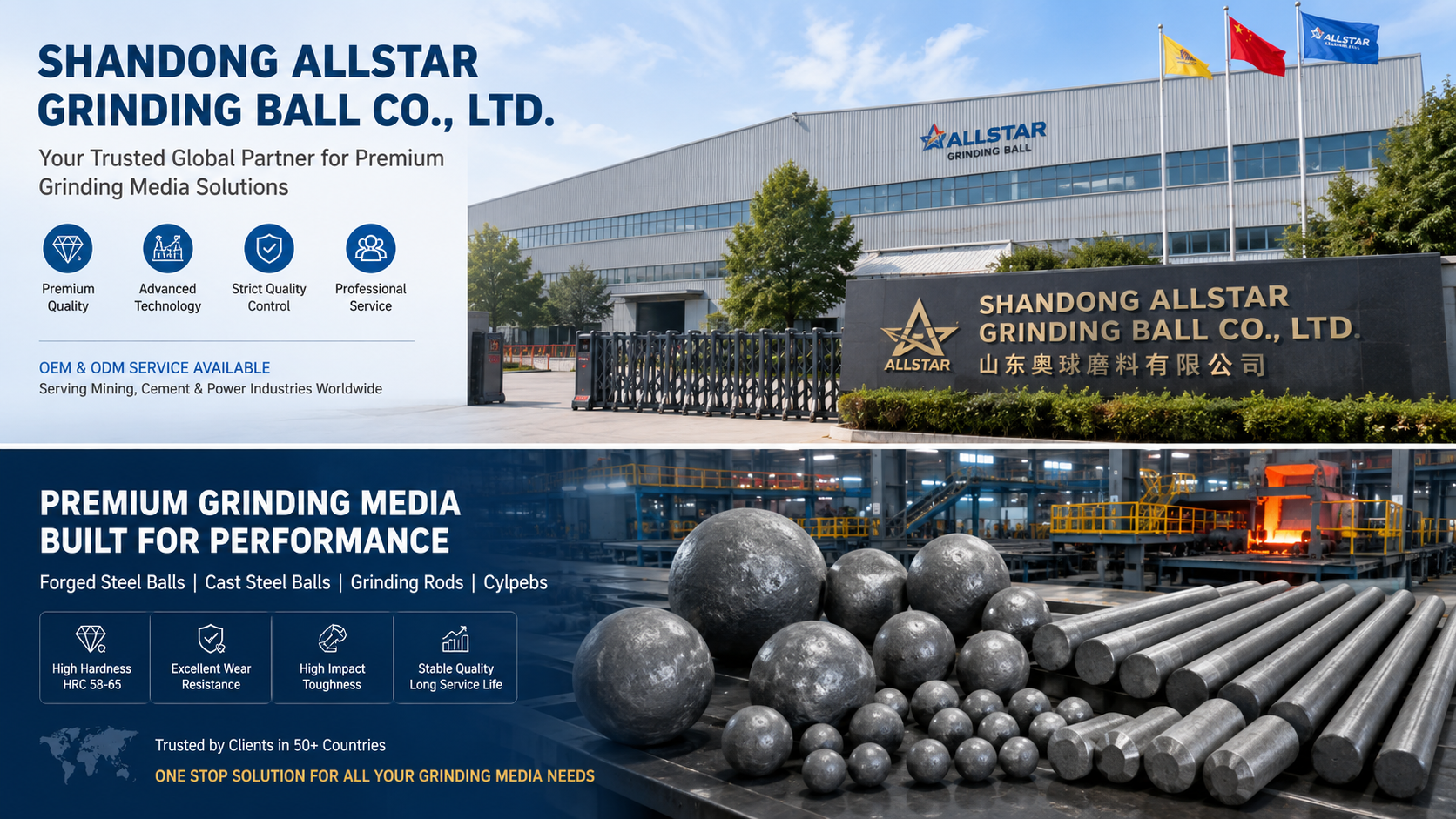
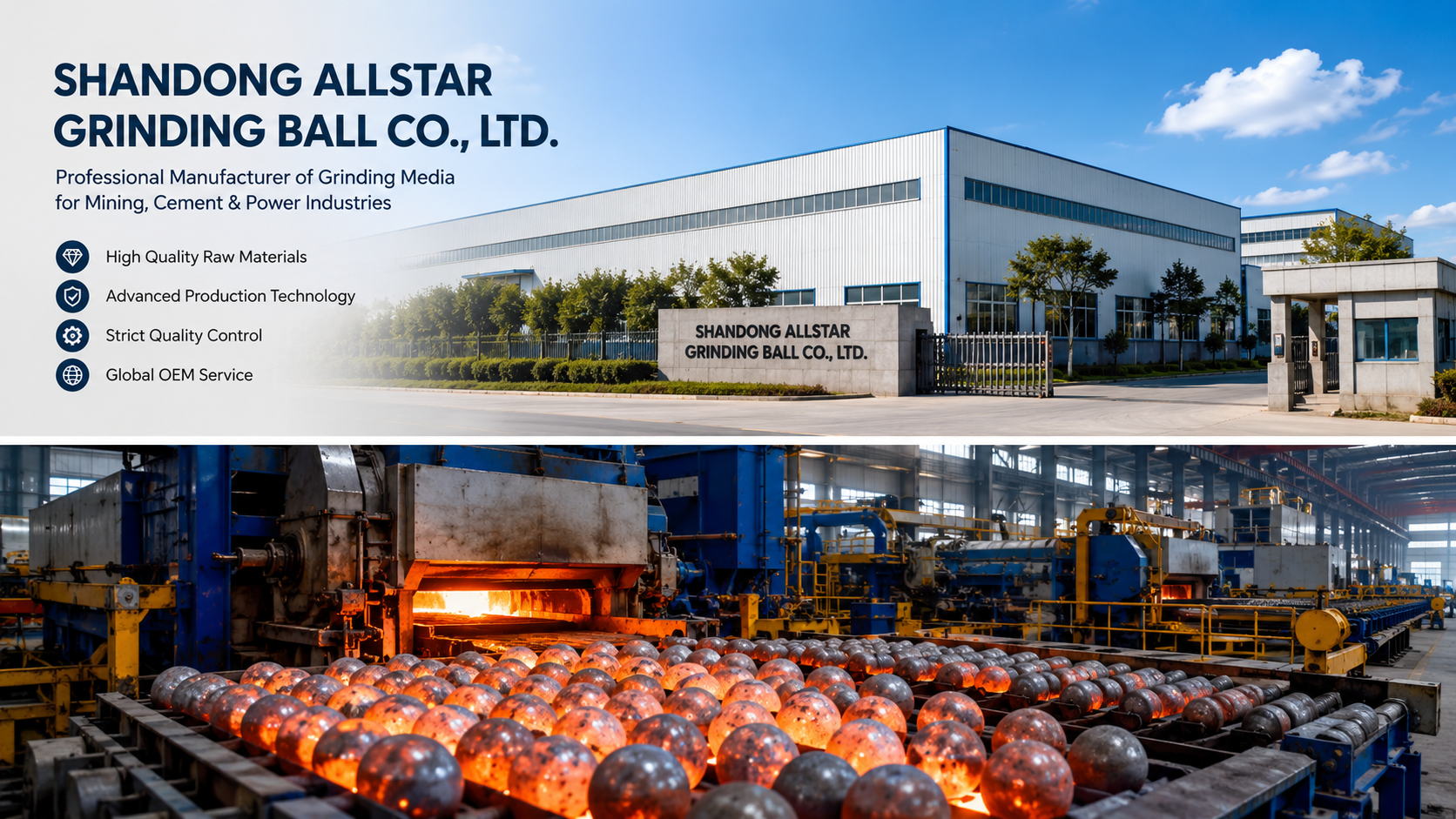
Hot rolled grinding balls are steel grinding media formed from heated steel bar using rolling equipment, followed by controlled cooling and heat treatment.
They belong to the broader family of wrought steel grinding media. However, "hot rolled" and "forged" should not automatically be treated as identical manufacturing processes.
Suppliers sometimes group these products together commercially. Buyers should therefore confirm how each quoted diameter is actually manufactured.
The important question is not simply whether a ball is rolled or forged. It is whether its chemistry, internal structure, hardness profile, and toughness suit the application.
For wet mineral processing, impact, abrasion, and corrosion can interact. In cement grinding, chamber conditions and abrasive wear may lead buyers toward different media specifications.
A process label alone cannot establish suitability.
Use the following list to identify potential partners and structure your inquiries. Product availability, manufacturing routes, and contracting entities should be confirmed directly before ordering.
| No. | Manufacturer or supplier group | Procurement discussion to prioritize |
|---|---|---|
| 1 | SHANDONG ALLSTAR GRINDING BALL CO., LTD. | OEM requirements and application-specific media selection |
| 2 | IRAETA | Manufacturing route for each requested diameter |
| 3 | Shandong Shengye Grinding Ball | Rolled balls, forged balls, and grinding rods |
| 4 | Shandong Huamin Steel Ball | Rolling capabilities and batch documentation |
| 5 | Shandong Jinchi grinding-media business | Legal entity, product specification, and traceability |
| 6 | Longteng Special Steel | Rolled versus forged product availability |
| 7 | Jinan Huafu Forging | Production controls and inspection evidence |
| 8 | Zhangqiu Taitou Special Steel Ball Factory | Rolling-ball specifications and export documentation |
| 9 | Shandong Bailin Mining Industry | Hot-rolling specifications and acceptance criteria |
| 10 | Jinan Haoyang Casting & Forging | Product route confirmation and trial-lot consistency |
ALLSTAR manufactures grinding balls, mill balls, forged steel balls, cast grinding media, grinding rods, and cylpebs for mining, cement, and power applications.
The company also offers OEM services for overseas brands, wholesalers, and manufacturers.
For buyers managing several product categories, this portfolio creates an opportunity to discuss multiple grinding-media requirements with one supplier. Nevertheless, each product should retain its own technical specification and approval process.
A productive ALLSTAR inquiry should include:
- Mill type and operating conditions.
- Required ball diameters and estimated consumption.
- Material being processed.
- Current wear or breakage problems.
- Packaging, labeling, and destination requirements.
For private-label buyers, I would also recommend agreeing on brand ownership, batch identification, inspection access, and specification-change approval before production.
That makes the relationship easier to manage beyond the first shipment.
IRAETA markets grinding media that include rolled and forged products.
It is a candidate for buyers preparing inquiries across different ball sizes and production routes. However, a broad portfolio should not be interpreted as proof that every diameter uses the same process.
Ask for a size-by-size manufacturing declaration, relevant inspection records, and a written explanation of the proposed material grade.
Shengye publicly describes a product range covering forged and hot rolled grinding balls, together with wear-resistant grinding rods.
For buyers sourcing both balls and rods, it is worth discussing whether separate technical teams and inspection plans support each category.
Request recent records for the exact product being quoted rather than relying on a general company brochure.
Huamin describes grinding-media manufacturing activities and rolling-related equipment capabilities.
Buyers considering Huamin should focus on how raw-material identity, forming conditions, heat treatment, and finished-product inspection are linked within a batch.
Ask whether a supplied sample can be traced back to the same production controls proposed for commercial orders.
Jinchi-branded businesses advertise grinding balls, rods, and related wear products, including hot rolled offerings.
Because public materials use different company names, buyers should verify the precise legal entity issuing the quotation and operating the production facility.
The contract, beneficiary details, inspection documents, and shipment paperwork should be consistent or clearly explain any differences.
Longteng publicly lists hot rolled and hot forged grinding-ball products.
It belongs on a shortlist where buyers want to compare available production routes against their required sizes.
Request specifications for the actual order. Group-level steelmaking capabilities or a wide product catalog do not, by themselves, establish the performance of a particular grinding-ball batch.
Huafu lists grinding balls, rods, cylpebs, and hot rolling products.
Its published materials describe inspection activities involving chemistry, hardness, impact behavior, and microstructure.
For procurement purposes, the next step is to request representative reports and confirm the sampling rules. A list of laboratory tests is useful only when buyers understand how frequently those tests apply.
Taitou markets grinding media that include rolling balls, forged balls, cast products, rods, and cylpebs.
Buyers should request clear distinctions between these categories in quotations and packing documents.
For repeat orders, confirm whether the same manufacturing site, steel specification, and inspection requirements will remain in place after initial sample approval.
Bailin, also presented as BLM, advertises hot-rolling steel balls alongside other grinding-media products.
It is a candidate for buyers seeking quotations across several media categories.
Ask the supplier to translate general claims about hardness, toughness, or durability into measurable acceptance criteria, including the relevant test method and sample preparation procedure.
Haoyang's public listings include hot rolled grinding-ball products and other grinding media.
Before approving a purchase, confirm whether the proposed product is rolled, forged, or cast, and identify the production facility.
A trial order should use the same agreed material and process controls intended for subsequent shipments.
A single surface-hardness figure does not describe the entire ball.
Ask for a hardness profile showing measurements at defined locations, together with the test method and section-preparation procedure.
The objective is not automatically the highest hardness. It is a suitable balance between wear resistance and toughness.
For each shortlisted supplier, request:
1. Chemical composition and material identification.
2. Diameter tolerances and inspection procedures.
3. Surface and internal hardness results.
4. Agreed impact or drop-test procedures.
5. Metallographic examination where relevant.
6. Heat-treatment and batch-traceability records.
7. A written nonconformity and claims procedure.
Avoid comparing laboratory numbers produced under different conditions as though they were equivalent.
For example, a drop-test result needs context: ball diameter, drop height, impact surface, sample quantity, and the definition of failure.
Mining, cement, and power applications should not share one universal purchasing specification.
| Application | Questions that should guide selection |
|---|---|
| Wet mineral grinding | How do abrasion, impact, corrosion, and slurry conditions interact? |
| Cement grinding | Which chamber is involved, and what wear mechanism dominates? |
| Power-sector milling | What mill design, feed characteristics, and equipment requirements apply? |
| OEM distribution | Can labeling, traceability, and repeat-order consistency be maintained? |
Forged, rolled, high-chromium cast, and ceramic media all have application-dependent roles.
A credible supplier should explain why a proposed product fits your process—and identify the conditions under which another media type may be preferable.
A useful example comes from Molycop's published Australian gold-mine trial.
The study describes marked-ball testing in a two-stage ball-mill circuit during February–March 2023. Balls measuring 90–105 mm were evaluated over 517 operating hours.
Molycop reported that its 18% chromium cast product achieved a 2% lower wear rate than the next-best competitor. It also reported a 17% improvement for its 105 mm NG forged product against the incumbent.
These are supplier-reported, site-specific findings—not promised results for ALLSTAR or any manufacturer listed here.
Their practical value is methodological: compare media under defined operating conditions rather than accepting universal claims about which manufacturing route is "best."
A lower delivered price can be offset by higher consumption or more frequent replenishment.
Begin with this simple calculation:
Media cost per tonne processed = delivered media price per kilogram × media consumption in kilograms per tonne processed.
For illustration only:
| Option | Delivered price | Consumption | Media cost per tonne processed |
|---|---|---|---|
| A | US$0.80/kg | 0.70 kg/t | US$0.56/t |
| B | US$0.90/kg | 0.55 kg/t | US$0.495/t |
Option B has the higher purchase price but the lower media cost in this hypothetical example.
A fuller assessment should also consider product quality, throughput, energy use, breakage-related disruption, freight, and inventory requirements. Do not attribute changes to grinding media without checking other operating variables.
1. Define the application and establish a baseline.
2. Agree on specifications, sampling, and rejection criteria.
3. Review production evidence and retain approved samples.
4. Run a controlled laboratory or mill trial.
5. Compare results before authorizing wider supply.
Record feed conditions, ball additions, operating hours, throughput, and product fineness during testing.
For private-label orders, add packaging approval, batch-code rules, document requirements, and written change-control procedures.
These steps help turn an attractive quotation into a repeatable purchasing specification.
Send ALLSTAR your mill type, required sizes, current consumption, delivery destination, and OEM requirements.
Request a written proposal covering the recommended media, manufacturing route, inspection plan, packaging, lead time, and trial-order arrangements.
For a meaningful comparison, ask for the technical basis behind the recommendation—not only a price per tonne.
No. Both are wrought steel media, but their forming processes differ. Confirm the manufacturing route for each quoted size instead of relying on a combined product label.
There is no universally best supplier. Selection depends on application fit, documented quality, delivery reliability, commercial terms, and trial performance. This article is a commercially disclosed shortlist, not an independent performance ranking.
They can be considered for suitable wet-grinding applications. Steel chemistry, heat treatment, slurry conditions, and operating impact must be evaluated together before approval.
Specify hardness with the supplier based on ball size and application. Include measurement locations, methods, and acceptance limits. Surface hardness alone is insufficient.
Include product specifications, packaging artwork, traceability rules, inspection rights, approved samples, change control, delivery terms, and a clear process for handling nonconforming goods.
Verify the contracting entity and production site, review representative test records, retain samples, and qualify the product through an agreed trial before expanding order volumes.
1. Molycop. "Grinding Balls."
2. Magotteaux. "Grinding Media."
3. Molycop. "Top Results in Test of Molycop's Forged and High Chrome Cast Grinding Media."
4. Australian Mining. "Case Study: Forged and High Chrome Cast Grinding Media." June 6, 2024.
5. Company-supplied information: SHANDONG ALLSTAR GRINDING BALL CO., LTD.


