
Views: 267 Author: shandong Allstar Grinding Ball Publish Time: 2026-11-16 Origin: Site


Content Menu
● 1. Define What Consistent Grinding Media Supply Actually Means
● 2. How to Ensure Consistent Grinding Media Supply for Mining Plants Through Forecasting
>> Connect consumption to the mine plan
>> Separate steady-state demand from exceptional requirements
● 3. Calculate Reorder Points Using the Complete Lead Time
>> An illustrative inventory calculation
● 4. Qualify Grinding Media Before Depending on It
● 5. Match Media Selection to the Milling Environment
● 6. Turn a Supplier Relationship into a Supply Agreement
● 7. Build Logistics Around the Mine Gate
● 8. Prepare a Backup Before a Disruption
● 9. Monitor the Indicators That Reveal Risk Early
● 10. Establish a Practical Supply Plan with ALLSTAR
>> 1. How much grinding media safety stock should a mining plant hold?
>> 2. How often should grinding media forecasts be updated?
>> 3. Is the cheapest grinding media the most economical choice?
>> 4. Should mining plants use more than one supplier?
>> 5. What documents should buyers request with each shipment?
>> 6. Does ALLSTAR provide OEM grinding media services?
● Editorial Verification and Source Information
Consistent grinding media supply starts long before a purchase order. For anyone asking how to ensure consistent grinding media supply for mining plants, the answer combines accurate consumption forecasts, qualified manufacturing, inventory discipline, and realistic logistics planning.
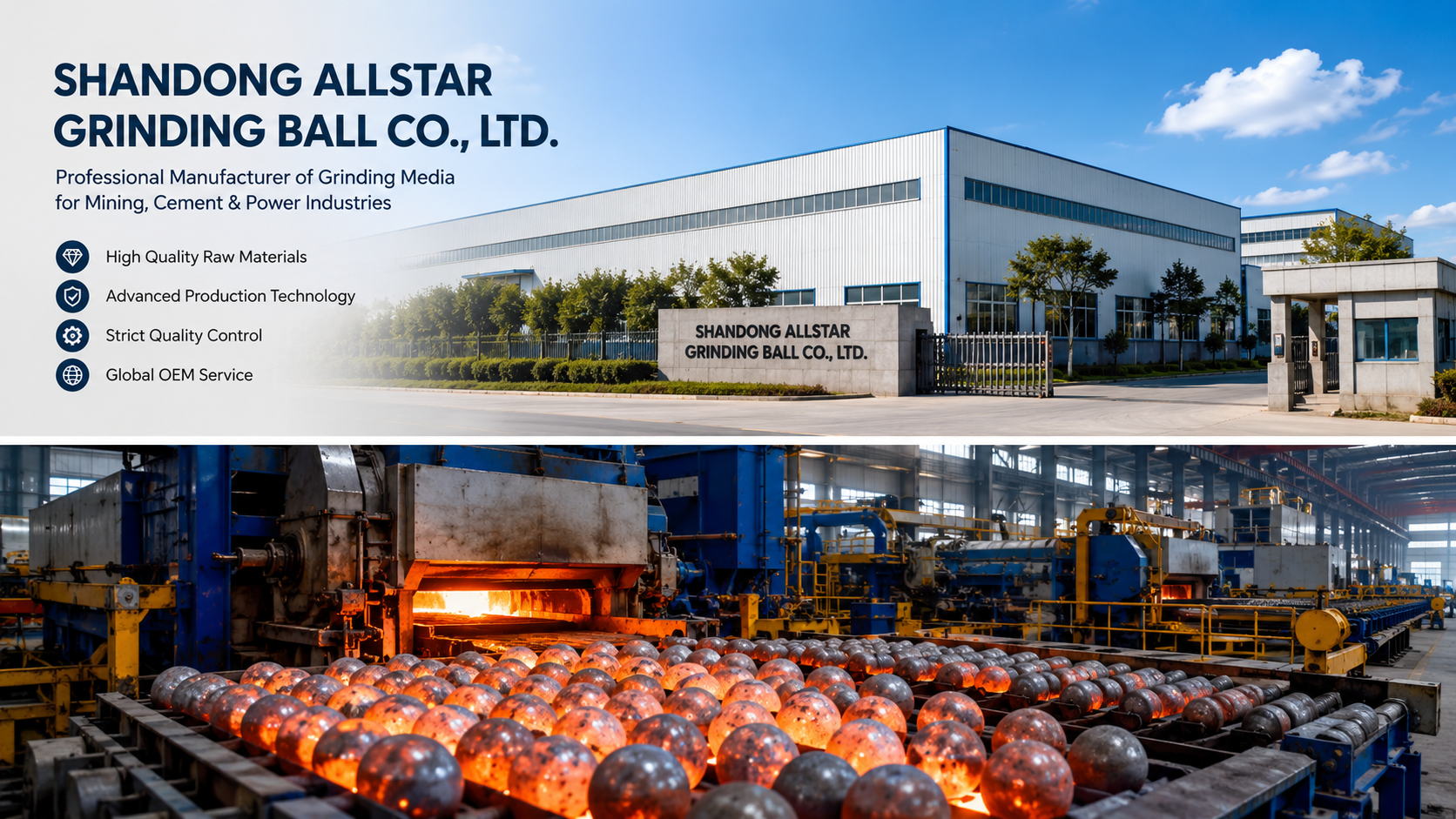
At SHANDONG ALLSTAR GRINDING BALL CO., LTD., we manufacture grinding balls, forged steel balls, cast steel balls, grinding rods, and cylpebs for mining, cement, and power applications. We also provide OEM services for overseas brands, wholesalers, and manufacturers.
Our perspective is straightforward: purchasing should protect mill performance, not simply secure the next shipment. A dependable supply arrangement must deliver the right media, in usable condition, before the plant needs it.
This guide explains how mining teams can turn that principle into a practical procurement system.
A shipment arriving on time does not automatically mean supply is secure. Incorrect diameters, unapproved alloys, damaged packaging, or missing inspection records can leave delivered stock unavailable for use.
We recommend defining supply reliability through four questions:
- Is the specified quantity available when required?
- Does each batch meet the agreed technical requirements?
- Can the material be traced and released without avoidable delays?
- Is there a workable response if production or transport slips?
Procurement, metallurgy, warehouse, and logistics teams should agree on these definitions together. Otherwise, purchasing may report successful delivery while operations still faces a shortage.
Measure reliability at the point of usable receipt, not merely factory dispatch.
Last month's order is a weak forecast when throughput, ore characteristics, or operating conditions are changing.
Start with:
If a plant expects to process 300,000 tonnes of ore and uses 0.60 kg of media per tonne, forecast consumption is 180 tonnes.
These figures are illustrative, not ALLSTAR customer results.
Build separate forecasts for each diameter and approved media grade. A healthy total inventory can conceal a shortage of the specific ball size a mill needs.
Keep routine top-up consumption distinct from:
- Initial mill charging.
- Shutdown and restart requirements.
- Commissioning or throughput expansion.
- Controlled product trials.
- Deliberate changes in ball-size distribution.
Review forecasts with the production schedule and metallurgical team. Record assumptions so that a change in consumption prompts investigation rather than an automatic increase in purchasing.
Maintain a rolling forecast covering at least the complete replenishment cycle, with additional visibility where capacity reservations require it.
The relevant lead time is not just vessel transit.
It runs from order release through manufacturing, inspection, dispatch, transport, customs clearance, inland delivery, and receiving approval.
For a continuously reviewed inventory system:
Safety stock protects against uncertainty. It should reflect actual demand and lead-time variation, the consequences of a shortage, and the service level the business needs.
Avoid assuming that every mine needs the same number of buffer days.
Consider a plant with the following planning assumptions:
| Planning input | Illustrative value |
|---|---|
| Average media consumption | 6 tonnes/day |
| Complete replenishment lead time | 45 days |
| Selected contingency allowance | 15 days |
| Demand during replenishment | 270 tonnes |
| Contingency stock | 90 tonnes |
| Reorder point | 360 tonnes |
The 15-day allowance is a scenario assumption, not a universal recommendation.
Trigger replenishment using inventory position: usable stock plus confirmed incoming supply, less committed requirements. Do not count quarantined material as available.
If inventory is reviewed periodically rather than continuously, allow for demand during the review interval as well. Avoid counting the same incoming shipment against multiple future requirements.
Supply continuity and product quality belong in the same discussion. A rejected batch can create the same operational problem as a late shipment.
Price comparisons should therefore begin with a shared technical specification.
| Specification area | What buyers should agree |
|---|---|
| Product identity | Forged or cast media, grade, application |
| Dimensions | Nominal diameter and permitted tolerances |
| Chemistry | Agreed composition limits and reporting |
| Hardness | Test method, locations, acceptance limits |
| Integrity | Agreed impact or breakage assessment |
| Traceability | Batch identification and record linkage |
| Packaging | Unit weight, handling method, identification |
| Acceptance | Sampling, inspection, release, claim procedure |
Hardness alone cannot describe grinding media suitability. Wear resistance, impact resistance, manufacturing consistency, and the operating environment must be considered together.
Request evidence relevant to your application. A generic brochure is not a substitute for agreed inspection records or a representative qualification trial.
Forged steel balls and cast grinding balls are not interchangeable merely because they share a diameter.
The appropriate selection depends on mill duty, impact conditions, ore abrasiveness, slurry chemistry, and the process response the plant requires.
Before changing products, document the baseline:
- Media additions and measured consumption.
- Throughput and operating hours.
- Ore characteristics and relevant process conditions.
- Product size and downstream performance.
- Breakage observations and rejected material.
Then establish a trial protocol with the supplier and plant metallurgist.
Compare results over a meaningful operating period, acknowledging ore changes and other confounding factors. Laboratory wear tests and marked-ball testing can inform selection, but neither should be presented as a guarantee of full-plant performance.
The practical objective is not the lowest quoted price per tonne. It is dependable performance at a competitive total operating cost.
For buyers considering SHANDONG ALLSTAR GRINDING BALL CO., LTD., the first discussion should connect technical requirements with the delivery programme.
Share expected volumes, media specifications, destination, required receipt dates, packaging preferences, and OEM requirements. Ask for a written proposal rather than assuming that a product quotation includes reserved manufacturing capacity.
A useful agreement addresses:
1. Forecast submission and update frequency.
2. Firm order quantities and release dates.
3. Production-slot confirmation.
4. Inspection and dispatch documentation.
5. Shipment milestones and exception reporting.
6. Responsibilities for shortages or rejected batches.
7. Escalation contacts and response expectations.
Distinguish forecast visibility from binding purchasing commitments. Likewise, distinguish proposed lead times from confirmed order-specific dates.
For OEM buyers, approve artwork, labels, batch coding, and document formats before production. Packaging errors should not become a preventable barrier to receiving or resale.
A shipment booked to a destination port is not yet usable inventory at the plant.
Map the complete route and identify where delays can occur: factory collection, port handling, vessel schedules, customs, inland transport, and receiving availability.
Use a shared milestone tracker showing:
- Planned and actual production completion.
- Inspection release.
- Confirmed departure.
- Updated arrival estimate.
- Customs and inland delivery status.
- Expected usable-receipt date.
Evaluate split deliveries when they reduce exposure without creating excessive handling or freight costs.
For remote sites, assess road access, unloading capacity, seasonal restrictions, and storage constraints before selecting shipment sizes.
Agree on suitable packaging, lifting arrangements, and destination-specific shipping documentation. Handling safety must remain part of the plan, especially when moving dense, heavy grinding media.
A backup supplier is useful only if its product and delivery route are genuinely ready.
Prequalification should include technical review, representative testing where appropriate, commercial terms, packaging approval, and realistic delivery timing.
Avoid treating an untested alternative as an instant substitute during a stock emergency. A rushed change can introduce additional quality or process risks.
Also examine shared dependencies. Two suppliers using the same congested port or transport corridor may provide less resilience than their number suggests.
Create a short contingency matrix:
| Trigger | Planned response |
|---|---|
| Production milestone missed | Confirm revised schedule and assess split release |
| Shipment arrival slips | Recalculate projected stock at usable receipt |
| Batch enters quarantine | Exclude it from available inventory immediately |
| Consumption exceeds forecast | Investigate causes and revise requirements |
| Projected stock falls below contingency level | Escalate and activate approved alternatives |
Assign an owner and decision deadline to each response.
A monthly review should connect supplier performance with plant consumption.
Useful measures include:
- On-time, in-full delivery against the agreed receipt date.
- Complete replenishment lead time and its variability.
- Usable inventory coverage by size and grade.
- Forecast error.
- Rejected or quarantined quantities.
- Media consumption per tonne of ore.
- Emergency freight and other disruption costs.
Define each measure consistently. For example, an on-time delivery metric becomes misleading if one team measures dispatch and another measures mine-site receipt.
Review exceptions, not just averages. A supplier may achieve an acceptable average lead time while occasional severe delays still threaten production.
Record corrective actions and check whether they prevent recurrence.
At SHANDONG ALLSTAR GRINDING BALL CO., LTD., our product range and OEM services provide a starting point for discussions with mining buyers, international brands, wholesalers, and manufacturers.
A useful enquiry includes:
- Mill type and intended application.
- Required media sizes and specifications.
- Expected monthly consumption.
- Current stock and required delivery dates.
- Destination port and final delivery location.
- Inspection, packaging, and private-label requirements.
Ask our team to develop a proposal around these inputs, including technical documentation, proposed production timing, and shipment arrangements.
Request a grinding media supply assessment from ALLSTAR with your specifications and consumption forecast. Use the resulting proposal to evaluate product suitability, replenishment timing, and the safeguards needed for your operation.
Reliable supply is a coordinated operating system—not simply a succession of purchase orders.
There is no universal quantity. Base the buffer on consumption variability, replenishment uncertainty, inventory review frequency, and the operational consequences of a shortage. Reassess it when throughput, ore conditions, or transport routes change.
Use a regular cross-functional review, supported by more frequent exception checks. Update immediately when the mine plan, consumption rate, shutdown schedule, or expected delivery date changes materially. Forecast visibility should extend beyond the replenishment lead time.
Not necessarily. Compare media consumption, breakage, process performance, quality-related losses, and delivered cost. A lower purchase price may be offset by higher usage or disruption. Evaluate alternatives under comparable conditions rather than relying on price alone.
An approved secondary source can strengthen resilience, but qualification and route independence matter more than supplier count. Establish product acceptance and delivery arrangements before relying on the alternative during an emergency.
Agree on the required packing list, commercial and transport documents, batch identification, and relevant inspection or test records. Requirements depend on the contract and destination. Ensure records can be matched to the physical shipment.
SHANDONG ALLSTAR GRINDING BALL CO., LTD. provides OEM services for overseas brands, wholesalers, and manufacturers. Buyers should confirm product specifications, branding, packaging, inspection requirements, order quantities, and delivery arrangements directly during the quotation process.
1. ASCM — *Calculate Inventory with Precision — Even Amid Variability*
2. ASCM — Peter L. King 与 Courtney Bigler,*Better Planning and Scheduling with the Right Cycle Stock Levels*
3. Molycop — *Grinding Media*
4. Molycop — *SAG Balls*
5. Molycop — *Keys to Assessing the Industrial Performance of Grinding Media*
6. Molycop — *Driving Innovation in Grinding Media Research from Chile*
7. Molycop — *Cast High Chrome Balls*


