
Views: 220 Author: shandong Allstar Grinding Ball Publish Time: 2026-11-16 Origin: Site


Content Menu
● Large Steel Balls vs Small Steel Balls: The Short Answer
● Why Larger Steel Balls Help Break Coarse Ore
>> Ball diameter changes individual impact energy
>> More impact energy does not automatically mean better grinding
● Why Small Steel Balls Still Matter in Coarse Ore Grinding
● What Research Shows About Ball Size and Feed Size
● How to Choose Steel Ball Size for Coarse Ore Grinding
>> 1. Measure the full feed size distribution
>> 2. Separate grindability from abrasiveness
>> 3. Define the grinding duty
>> 4. Review the mill and classification circuit
>> 5. Test candidate sizes before a full conversion
● Why Ball Size Distribution Matters More Than One Nominal Diameter
● A Practical Plant Trial for Large vs Small Grinding Balls
>> Establish a reliable baseline
>> Change one principal variable
>> Allow for charge transition
>> Compare equivalent outcomes
● Forged vs Cast Grinding Balls: Diameter Is Only Part of the Decision
● OEM Grinding Media Procurement with SHANDONG ALLSTAR
● Choose the Right Steel Ball Size for Your Ore
>> Are large steel balls always better for coarse ore grinding?
>> Can small steel balls grind coarse ore?
>> What is the best grinding ball diameter for coarse ore?
>> Should a ball mill use mixed ball sizes?
>> Does higher grinding ball hardness mean better performance?
>> What information should I send for an OEM grinding media quotation?
At SHANDONG ALLSTAR GRINDING BALL CO., LTD., we believe grinding media selection should start with the ore, not simply the largest ball available. When comparing large steel balls vs small steel balls for coarse ore grinding, larger balls generally provide the impact needed to break coarse particles. However, the best operating charge must also grind the smaller particles produced along the way.
We manufacture grinding balls, forged steel balls, cast grinding balls, grinding rods, and cylpebs for mining, cement, and power applications. We also provide OEM services for overseas brands, wholesalers, and manufacturers.
From a manufacturer's perspective, the useful question is not "Which ball is biggest?" It is "Which media size distribution delivers the required product at the lowest sustainable cost?"
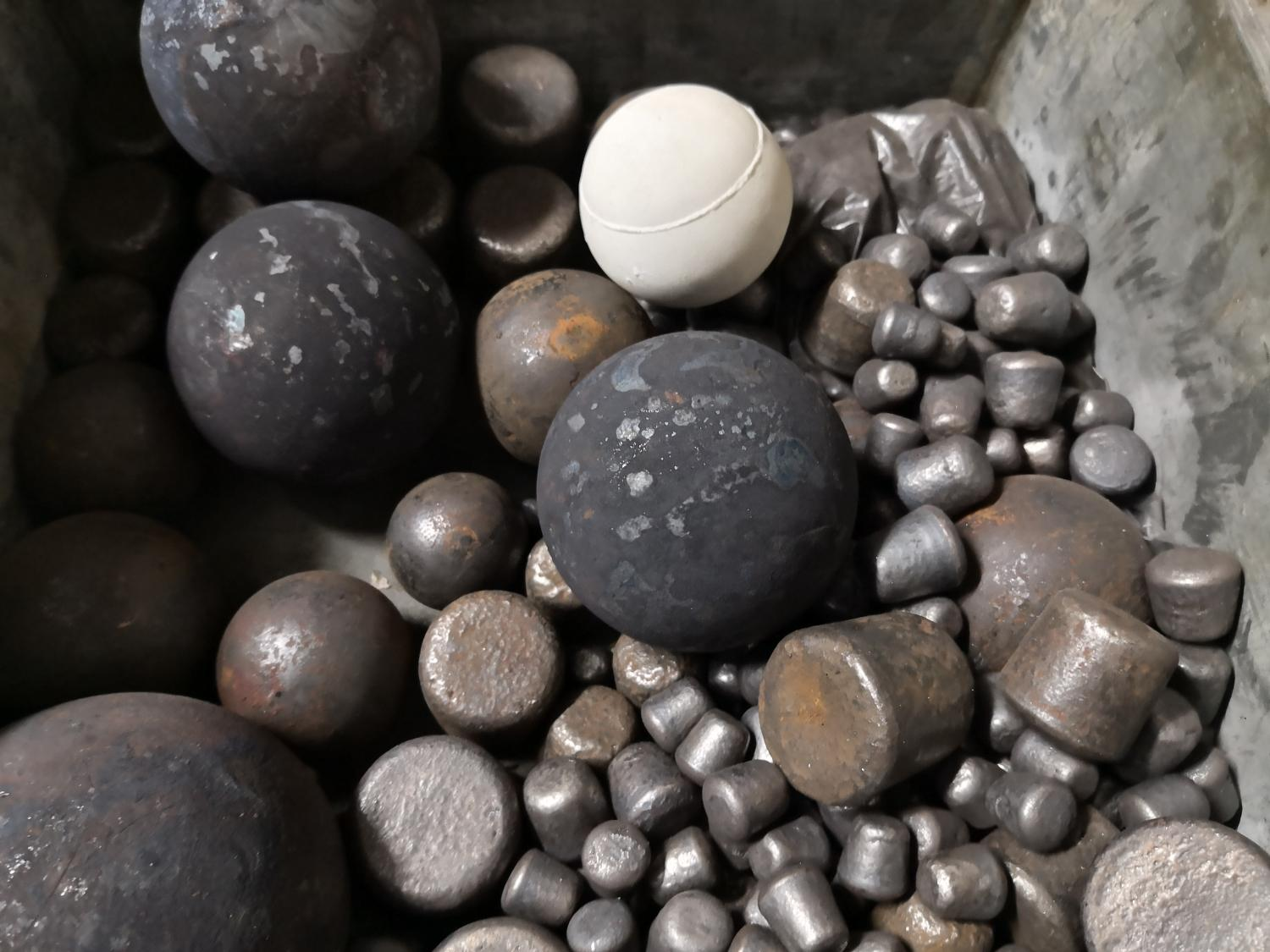
Large steel balls are generally better for breaking coarse ore. Small steel balls are generally better for grinding finer particles.
For a feed containing both coarse and fine material, a suitable combination may outperform either extreme. The correct balance depends on ore characteristics, mill configuration, operating conditions, and target product size.
| Selection factor | Larger steel balls | Smaller steel balls |
|---|---|---|
| Main strength | Higher energy per collision at comparable velocity | More balls and greater surface area per unit mass |
| Typical role | Breaking coarse particles | Grinding finer particles |
| Main limitation | Fewer contact opportunities at equal media mass | Individual impacts may not break coarse particles |
| Selection risk | Oversizing the charge | Leaving a persistent coarse fraction |
| Best evaluation | Coarse-particle disappearance and circuit output | Target-size production and remaining oversize |
"Large" and "small" are relative terms. A ball considered large in a laboratory mill may be small for an industrial grinding circuit.
A spherical ball's mass increases with the cube of its diameter. At equal density, doubling the diameter increases individual ball mass eightfold.
At the same collision velocity, its kinetic energy also increases eightfold. That explains why larger grinding balls can deliver the stronger individual impacts needed for coarse-particle breakage.
This is a simplified comparison, not a prediction of plant performance. Actual energy transfer depends on ball trajectories, impact angle, liner design, slurry conditions, and whether an ore particle is captured at the contact.
A larger ball helps only when the collision breaks particles usefully.
If the charge contains more large balls than the duty requires, the mill has fewer balls available at the same total media mass. Some energy may be spent without producing enough additional material in the desired size range.
Our selection principle is therefore to test a top ball size that breaks the coarse fraction effectively, rather than assume that the largest available diameter will maximize output.
Coarse feed does not remain coarse throughout the mill. Once particles fracture, the charge must continue reducing the resulting fragments.
Smaller balls provide more individual media pieces and greater total surface area at equal steel mass. Those characteristics can benefit finer-particle grinding.
Consider a simplified comparison between 100 mm and 50 mm steel balls:
- One 100 mm ball has the same theoretical mass as eight 50 mm balls.
- Those eight smaller balls provide twice the total external surface area.
- The larger ball carries more energy individually at equal velocity.
These geometric relationships explain the trade-off. They do not prove that either charge will double grinding performance.
A laboratory study tested 10 mm, 20 mm, and 30 mm balls in a 300 mm diameter mill using several quartz feed-size fractions.
The 30 mm balls performed best among the individual sizes under the tested conditions. A mixed-size charge performed slightly better overall than the 30 mm charge.
The practical lesson is not to specify 30 mm balls for industrial coarse grinding. It is that grinding performance depends on the relationship between media size, feed size, and operating conditions.
The study used a particular material, laboratory geometry, and test procedure. Its results cannot establish a universal industrial ball diameter or blending ratio.
A responsible grinding media recommendation should distinguish between a useful research finding and a specification validated for your plant.
Start with representative feed samples.
Record F80, the size through which 80% of the feed passes, but also examine the top size and proportion of persistent coarse particles. Two feeds with similar F80 values can have different coarse tails.
Check variation between ore sources, operating shifts, and upstream crusher conditions. Media selected for an average feed may struggle when the coarse fraction increases.
Ore properties influence both breakage requirements and media consumption.
Bond work index helps characterize grinding energy requirements. Abrasion testing addresses a different question: how strongly the material wears equipment and media.
Do not select ball diameter from a mineral name or a single hardness number alone. Use representative testwork and plant observations together.
Distinguish between SAG milling, conventional ball milling, and fine regrinding.
They operate with different feed characteristics, charge behavior, and breakage requirements. A media specification that works in one stage should not be transferred automatically to another.
This article focuses primarily on conventional tumbling ball mills handling a significant coarse fraction.
Ball diameter cannot compensate for every circuit limitation.
Review:
- Mill diameter, speed, and ball filling.
- Liner profile, lifter condition, and charge motion.
- Feed rate and slurry density.
- Classification performance and circulating load.
- Required product size distribution.
A coarse final product may reflect inadequate breakage, poor classification, or both. Diagnose the cause before changing media.
Use media-sizing calculations and supplier recommendations to establish trial candidates, not guaranteed answers.
Compare those candidates through laboratory work or a controlled plant trial. Let measured performance determine the final specification.
The balls added to a mill are not identical to the charge operating inside it.
As media wears, its diameter decreases. The working charge becomes a changing population of sizes, influenced by historical additions, wear behavior, breakage, and removal practices.
This distinction matters when discussing "mixed-size grinding media." It may refer to a deliberate make-up blend or the naturally developed distribution inside the mill.
Before prescribing a blend, inspect the existing charge where safe and practical. A mill may already contain many worn small balls but lack enough effective large media for its coarse feed.
There is no universally correct large-to-small ratio. A proposed blend should state whether its proportions are by mass, volume, or number; otherwise, the recommendation is ambiguous.
A disciplined trial is more useful than an unsupported promise of higher throughput.
Record performance during representative, reasonably stable operation:
- Dry ore throughput.
- Feed and product size distributions.
- Mill power and specific energy consumption.
- Media consumption per tonne.
- Circulating load.
- Broken balls, spalling, and liner observations.
Also record ore changes. Comparing different media on substantially different feeds can produce a misleading conclusion.
Where possible, adjust ball diameter or make-up distribution without simultaneously changing alloy grade, filling, and operating targets.
If several variables must change, document them. Otherwise, the trial cannot clearly identify what caused the result.
Set acceptance criteria before starting, including product quality and operating constraints.
A new make-up size does not immediately replace the existing charge.
Plan the evaluation around media inventory and replacement rate. Do not treat an early operating snapshot as proof of steady performance.
Use approved plant procedures for charging, sampling, and inspection; never attempt a charge inspection without the required isolation and safety controls.
Lower power alone is not evidence of better grinding.
Compare energy and media consumption at equivalent product requirements and reasonably comparable ore conditions. If throughput increases while the product becomes too coarse, the apparent gain may not serve the downstream process.
*Suggested visual: Insert a trial dashboard showing throughput, product P80, kWh/t, and media kg/t. Label any demonstration values as illustrative.*
Correct sizing does not eliminate the need for suitable metallurgy.
Forged steel balls and cast grinding balls should be evaluated against the actual impact, abrasion, and corrosion conditions. Manufacturing route alone does not establish performance.
For coarse-duty applications, ask about:
- Chemical composition and material designation.
- Heat-treatment controls.
- Surface and internal hardness.
- Impact and breakage test methods.
- Diameter tolerances and batch consistency.
- Traceability and inspection documentation.
Hardness is useful, but a single surface reading is not a complete quality assessment. Review the hardness profile, toughness, structural consistency, and observed wear behavior together.
Also clarify material terminology. Some commercially described "cast steel balls" are alloy cast iron products. Purchase specifications should identify the actual material rather than rely on a broad sales label.
SHANDONG ALLSTAR GRINDING BALL CO., LTD. supplies grinding media and OEM services for international brands, wholesalers, and manufacturers.
For buyers, the strongest starting point is a documented application brief rather than a diameter-only quotation request.
Provide the ore type, feed distribution, target product size, mill details, existing media specification, and current operating concerns. Identify whether the priority is coarse-particle breakage, media life, product control, or supply consistency.
Before ordering, agree on the acceptance criteria:
1. Material grade and chemical limits.
2. Nominal diameter and dimensional tolerances.
3. Hardness requirements and measurement locations.
4. Agreed sampling and impact-testing procedures.
5. Batch identification, packaging, and required documents.
6. Trial evaluation and claims-handling arrangements.
This makes offers easier to compare and gives both buyer and manufacturer a clearer basis for evaluating results.
For coarse ore grinding, larger steel balls generally provide the necessary coarse-particle impact. Smaller balls remain important as particles become finer.
The best choice is therefore an application-specific top size and working charge distribution—not simply "large" or "small."
Contact SHANDONG ALLSTAR GRINDING BALL CO., LTD. with your feed analysis, mill specifications, current media details, and target product size. Request an application-focused quotation and discuss an OEM specification and trial plan before committing to a full media change.
No. They generally improve the ability to break coarse particles, but oversized media can reduce contact opportunities at equal charge mass. Confirm the choice against product quality, throughput, and operating cost.
They may break some coarse particles, but individual impacts can be insufficient for effective coarse breakage. A persistent coarse fraction is a reason to investigate media sizing alongside feed preparation and mill operation.
There is no universal diameter. Selection depends on feed distribution, ore properties, mill geometry, operating conditions, and target product size. Use calculations to identify candidates, then validate them through testing.
A suitable distribution can address different particle sizes. However, the best make-up strategy depends on the existing charge and its wear behavior. Do not assume a fixed blend is optimal for every circuit.
Not necessarily. Evaluate hardness alongside toughness, internal consistency, wear, and breakage. A ball that meets one hardness target may still perform poorly under the plant's impact conditions.
Provide the application, requested material and dimensions, mill details, feed and product sizes, estimated quantity, packaging requirements, and acceptance tests. Include existing performance data when requesting a technical alternative.
1. Metso Outotec. *Basics in Minerals Processing*, Edition 12.
2. Kabezya, K. M., and Motjotji, H. (2015). "The Effect of Ball Size Diameter on Milling Performance." *Journal of Material Sciences & Engineering*, 4:149. DOI: 10.4172/2169-0022.1000149.
3. *Effect of Ball Size Distribution on Milling Parameters*. Academic thesis available through CORE.
4. "A Comparison of Wear Rates of Ball Mill Grinding Media." Technical paper available through 911 Metallurgist.
5. SHANDONG ALLSTAR GRINDING BALL CO., LTD.


