
Views: 216 Author: shandong Allstar Grinding Ball Publish Time: 2026-08-11 Origin: Site


Content Menu
● Why High Chrome Cast Balls Matter in Clinker Grinding
● What Makes High Chrome Cast Balls Different?
>> The Performance Factors That Matter Most
● High Chrome Cast Balls for Clinker Grinding Optimization: The Mill-System View
● How ALLSTAR Approaches Media Selection
>> Core Information to Collect
● A Practical Optimization Workflow
>> Step 1: Establish a Reliable Baseline
>> Step 2: Inspect the Charge and Mill Internals
>> Step 3: Match Ball Sizes to Breakage Duty
>> Step 4: Run a Controlled Trial
>> Step 5: Calculate Total Cost of Ownership
● Industry Evidence: Why Charge Optimization Delivers Results
● Common Mistakes When Buying High Chrome Cast Balls
>> Buying Only by Chromium Content
>> Using One Ball Type in Every Chamber
>> Ignoring Ball-Grading Evolution
>> Comparing Suppliers Only by Unit Price
>> Treating Grinding Aids as the Primary Fix
● Why Work With SHANDONG ALLSTAR GRINDING BALL CO., LTD.
● FAQ
>> 1. Are high chrome cast balls suitable for all clinker mills?
>> 2. What information should I send to request a media recommendation?
>> 3. Can high chrome cast balls reduce grinding-media consumption?
>> 4. Should a cement mill use the same ball size in both chambers?
>> 5. How long should a grinding-media trial last?
>> 6. Does a higher chromium level always mean a better grinding ball?
>> 7. Can ALLSTAR provide OEM grinding media services?
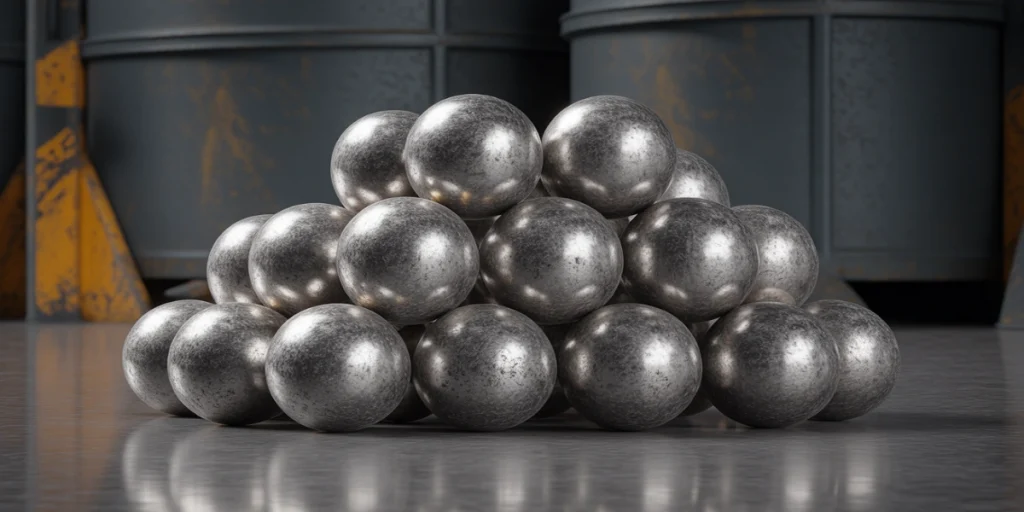
High Chrome Cast Balls for Clinker Grinding Optimization are not simply a consumable purchase—they are a process decision that can influence cement quality, mill availability, power consumption, media wear, and total grinding cost. At SHANDONG ALLSTAR GRINDING BALL CO., LTD., we help global cement producers, OEM brands, wholesalers, and industrial manufacturers select grinding media based on real operating conditions rather than generic catalog specifications.
For clinker grinding, the right high chrome cast ball must match the mill's chamber design, feed size, target fineness, separator performance, liner condition, and operating stability. A durable ball alone is not enough. The objective is to create a stable, efficient grinding environment that converts mill power into useful particle-size reduction.
Cement grinding is one of the most electricity-intensive stages of cement manufacturing. In a conventional closed-circuit cement system, clinker, gypsum, and supplementary materials are ground in a ball mill, then classified so coarse particles return for additional grinding. Every inefficiency in this cycle can increase energy use, lower output, or create inconsistent cement fineness.
High chrome cast balls are widely used in dry cement grinding because they are designed to resist abrasion and retain a stable working profile during long operating cycles. Their performance comes from a carefully controlled alloy chemistry, casting process, heat treatment, hardness profile, and microstructure.
At ALLSTAR, we view media selection through one central question:
How can the grinding charge deliver the required Blaine, residue, throughput, and cement quality at the lowest practical total cost per tonne?
That question shifts the discussion away from the unit price of balls and toward the full economics of the mill.
A properly selected high chrome cast grinding ball can support:
- Lower media consumption through improved wear resistance
- More stable ball grading throughout the campaign
- Consistent grinding performance in dry clinker milling
- Reduced contamination risk from excessive media wear
- Fewer disruptions caused by frequent charge correction
- Better use of installed mill power when matched with the right charge design
However, high chrome media is not a universal replacement for every ball type. In high-impact zones or mills with severe impact conditions, forged steel balls may be more suitable because toughness can be as important as abrasion resistance. The best solution depends on the duty in each grinding chamber.
High chrome cast balls are produced from chromium-alloyed white cast iron. Chromium contributes to a hard, wear-resistant structure, while controlled heat treatment helps develop a balance between hardness, abrasion resistance, and resistance to cracking.
The metallurgical goal is not merely "maximum hardness." Extremely hard media with poor structural integrity can crack or spall under unsuitable operating conditions. A dependable grinding ball needs consistent internal quality, controlled hardness, and a microstructure appropriate for the mill environment.
| Performance factor | Why it matters in clinker grinding | What buyers should verify |
|---|---|---|
| Chromium alloy design | Supports abrasion resistance in dry grinding | Chemistry range and batch traceability |
| Surface and core hardness | Affects wear life and resistance to deformation | Test method and hardness consistency |
| Ball diameter tolerance | Helps maintain a predictable media charge | Diameter, weight, and roundness control |
| Internal soundness | Reduces risk of breakage, porosity, and premature failure | Inspection and quality-control records |
| Heat-treatment stability | Supports a durable working structure | Documented heat-treatment process |
| Wear profile | Influences ball grading over time | Wear-rate tracking from mill trials |
At SHANDONG ALLSTAR GRINDING BALL CO., LTD., we supply cast grinding balls alongside forged steel balls, hot rolled balls, grinding rods, and grinding cylpebs. This broader product range matters because it allows us to recommend the most appropriate media solution rather than forcing every application into one product category.
For foreign brands, distributors, and industrial OEM customers, we also provide OEM-oriented support. This can include product sizing, packaging requirements, labeling coordination, and media configurations aligned with the customer's target market and mill application.
A cement ball mill should never be optimized by changing only the grinding media. The media charge interacts with the complete system:
- Clinker grindability and feed-size distribution
- Mill dimensions and rotational speed
- Chamber length and diaphragm design
- Mill ventilation and material flow
- Liner profile and lifting action
- Separator efficiency
- Product fineness target
- Grinding-aid dosage, if used
- Desired cement type and additive ratio
In a typical two-compartment ball mill, the first chamber handles coarser feed and usually requires larger media to generate impact breakage. The second chamber performs finer grinding and generally uses smaller media to create greater contact frequency and surface-area reduction.
This division is important. A ball that performs well in the first chamber may not be the best choice in the second chamber.
The first chamber must reduce larger clinker particles efficiently and prepare material for fine grinding. Media selection should emphasize:
- Adequate impact energy
- Larger ball diameters where feed is coarse
- Charge grading that avoids excessive void space
- Compatibility with lifting-liner design
- Sufficient toughness for the actual impact environment
The second chamber is usually more abrasion-dominant. This is where high chrome cast balls can become particularly valuable when process conditions are suitable.
The second chamber often benefits from:
- Smaller, closely controlled ball sizes
- Stable wear behavior
- High surface area from the media charge
- Efficient classification and removal of finished fines
- Minimal overgrinding and recirculating load
An optimized charge is not necessarily the heaviest charge or the hardest charge. It is the charge that delivers the required particle-size distribution with stable throughput and controlled energy consumption.
From our perspective as a grinding-media manufacturer, the most reliable projects start with operating data. A supplier cannot responsibly recommend a high chrome cast ball solely from a mill diameter or an annual tonnage estimate.
Before proposing a media solution, our technical team should understand the working conditions.
1. Mill specifications
Record mill diameter, effective length, chamber arrangement, mill speed, and motor power.
2. Existing media charge
Identify current ball sizes, material type, filling level, top-up practice, and media consumption.
3. Clinker characteristics
Review feed size, grindability, moisture, mineral composition, and changes in clinker source.
4. Production requirements
Confirm cement type, Blaine target, residue target, hourly output, and quality requirements.
5. Circuit behavior
Review separator rejects, circulating load, ventilation, pressure drop, and mill outlet temperature.
6. Mechanical condition
Inspect liners, diaphragms, grates, material level, and any evidence of media breakage.
7. Cost baseline
Calculate media cost per tonne of cement, specific power consumption, and downtime associated with charge maintenance.
This process turns media sourcing into grinding optimization.
A plant may discover that its apparent "ball problem" is actually a separator issue, a clogged diaphragm, an incorrect ball grading pattern, or liner wear that has weakened the lifting action. Changing media without diagnosing these causes can produce disappointing results.
Measure performance under stable operation. Avoid comparing trial results from different clinker sources, different cement types, or unstable production periods.
Track at least:
- Tonnes per hour
- kWh per tonne
- Blaine and sieve residue
- Media consumption
- Separator reject rate
- Mill differential pressure
- Mill outlet temperature
- Unplanned downtime
- Liner and diaphragm condition
The baseline should represent enough operating time to minimize distortion from short-term fluctuations.
A controlled mill stop provides valuable evidence. Inspect ball segregation, material level, liner wear, diaphragm condition, and the presence of broken or irregular media.
Look for warning signs such as:
- Oversized balls accumulating in a fine-grinding chamber
- Excessive fine media or "slugs" of worn balls
- Clogged diaphragm slots
- Flattened or worn lifting liners
- Uneven wear patterns between mill zones
- Ball breakage that indicates inappropriate impact duty or quality inconsistency
Do not choose ball diameter by habit. Larger balls deliver greater impact energy, while smaller balls provide more contacts and more grinding surface area.
As a general principle:
- Coarser clinker feed requires sufficient larger media.
- Fine grinding requires a higher proportion of smaller media.
- A mixed ball charge must evolve in a controlled way as media wears.
- The correct distribution depends on the mill, feed, and product target.
ALLSTAR can support customers with custom size combinations for cast balls, forged balls, grinding rods, and cylpebs according to the mill's operating objective.
Introduce trial media gradually, preferably in a defined chamber and with a documented top-up plan. Keep process conditions as stable as possible.
A good trial should compare:
- Wear loss per tonne of cement
- Throughput at the same quality target
- Specific power consumption
- Product fineness and residue
- Media breakage frequency
- Time required for charge correction
Do not declare success after a few shifts. Media performance should be evaluated over an operating period long enough for meaningful wear and process trends to emerge.
The lowest-priced grinding ball may cost more over time if it wears too quickly, causes frequent top-ups, destabilizes ball grading, or contributes to production losses.
A practical total-cost calculation includes:
Total Media Cost per Tonne=Tonnes of Cement ProducedMedia Purchase Cost + Handling Cost + Downtime Cost
The formula can be expanded to include energy, quality losses, and maintenance impact. The key is to measure the variables that matter to the plant instead of relying only on purchase price.
A published cement-grinding case study used detailed circuit sampling, particle-size analysis, modelling, and simulation to evaluate ball-size distribution and intermediate-grate changes. After implementation, reported capacity increased from 12.7% to 20.5% across different cement products.
The lesson is not that every mill will achieve the same result. Every circuit has different constraints. The important conclusion is that media size distribution, material transport, and classification work together. Ball charge optimization should therefore be handled as an engineering project, not as an isolated procurement decision.
For cement producers, this creates an important opportunity: high chrome cast balls can contribute to improvement, but the greatest value appears when they are selected as part of a measured, system-wide optimization program.
[Visual suggestion: Insert a line chart comparing baseline and trial results for throughput, kWh/t, media wear rate, and 45 μm residue.]
Chromium percentage alone does not define real performance. Buyers should also evaluate hardness, core structure, casting soundness, diameter accuracy, heat treatment, and suitability for the mill's impact level.
The first and second grinding chambers do different work. Applying a single media type or size distribution across both zones can reduce efficiency.
A charge changes continuously as balls wear. The top-up schedule must maintain the intended size distribution instead of allowing uncontrolled accumulation of undersized media.
A lower initial price can be misleading if media consumption, downtime, or energy use rises. Compare verified cost per tonne of cement produced.
Grinding aids can support process performance, but they should not replace basic optimization of media grading, separator behavior, mill ventilation, liners, and diaphragms.
ALLSTAR is positioned as a global grinding-media manufacturer serving the mining, cement, and power industries. Our product range includes forged steel balls, hot rolled balls, cast grinding balls, grinding rods, and grinding cylpebs, enabling a more application-focused approach to grinding-media selection.
For clinker grinding customers, our value is built around three priorities:
- Consistent manufacturing: Controlled production and quality inspection help support stable media performance.
- Application flexibility: We can support high chrome cast ball solutions as well as forged and other media options when mill duty requires them.
- OEM cooperation: We work with overseas brands, wholesalers, and manufacturers that require reliable production support and customized commercial arrangements.
We do not recommend making unverified claims about energy savings, wear reduction, or output increases. These results must be demonstrated through plant-specific data, controlled trials, and transparent performance measurement. This evidence-based approach protects both the buyer and the long-term reputation of the supplier.
Ready to optimize your clinker grinding media? Contact SHANDONG ALLSTAR GRINDING BALL CO., LTD. with your mill dimensions, existing ball charge, clinker feed data, cement-quality target, and current media consumption. Our team can help you evaluate whether high chrome cast balls, forged steel balls, or a tailored media combination is the right route for your operation.
No. They are often effective in abrasion-dominant dry cement grinding, particularly in fine-grinding duties. However, mills with severe impact conditions may require tougher forged media in some zones.
Provide mill dimensions, chamber configuration, feed size, current media sizes, production rate, cement fineness target, media consumption, liner condition, and separator information.
They can reduce consumption when their wear resistance and operating suitability are better than the existing media. Actual results depend on clinker abrasiveness, charge design, impact level, and process stability.
Usually not. The first chamber normally requires larger media for coarser breakage, while the second chamber generally requires smaller media for fine grinding.
The trial should be long enough to measure meaningful changes in wear, throughput, power, product fineness, and ball grading. A very short trial may not reflect long-term operating performance.
Not necessarily. Chromium is important, but hardness distribution, heat treatment, internal soundness, ball size control, and compatibility with the mill's impact conditions are equally important.
Yes. SHANDONG ALLSTAR GRINDING BALL CO., LTD. supports overseas brands, wholesalers, and manufacturers with OEM-oriented grinding-media supply solutions.
1. [SHANDONG ALLSTAR GRINDING BALL CO., LTD. — Official Grinding Media Product Overview] [grindingball]
2. [Dundar et al. — Simulation Assisted Capacity Improvement of Cement Grinding Circuit] [esenmining]
3. [Magotteaux — High-Chrome Grinding Media] [magotteaux]
4. [MDPI Minerals — A Review of the Grinding Media in Ball Mills for Mineral Processing] [mdpi]
Hot Tags: China, Global, OEM, private label, manufacturers, factory, suppliers, manufacturing company


