
Views: 269 Author: steelgrindingball Publish Time: 2026-08-17 Origin: Site


Content Menu
● Why Factory Capacity Matters for Grinding Media Buyers
● What "Production Capacity" Really Means
● 1. Verify the Factory's Actual Production Lines
● 2. Check Whether Heat Treatment Limits Output
● 3. Measure Capacity by Consistent Monthly Output
● 4. Audit Raw-Material and Supply-Chain Security
● 5. Evaluate Quality-Control Capacity, Not Just Certificates
● 6. Use a Mill-Specific Capacity Evaluation
● 7. Review OEM and Export Execution Capability
● A Practical Factory Audit Scorecard
● Work With SHANDONG ALLSTAR GRINDING BALL CO., LTD.
● FAQs
>> What is the most reliable way to verify a grinding ball factory's capacity?
>> Why is heat-treatment capacity important for grinding balls?
>> Should I choose forged grinding balls or cast grinding balls?
>> Can annual production capacity be misleading?
>> What documents should a grinding ball supplier provide?
>> How can OEM buyers protect their private-label reputation?
>> What is the best KPI for grinding media purchasing?
Choosing a grinding ball supplier is not simply about comparing quoted annual tonnage. To evaluate the production capacity of a grinding ball factory accurately, buyers must verify its real, sustainable, quality-controlled output—including raw-material security, production-line capability, heat-treatment capacity, testing discipline, inventory, and export execution.
At SHANDONG ALLSTAR GRINDING BALL CO., LTD., we understand that mining, cement, and power-plant customers do not need a supplier that can produce quickly once. They need a manufacturing partner able to deliver forged steel balls, cast grinding balls, grinding rods, and cylpebs consistently across repeated orders, with dependable quality and OEM support.
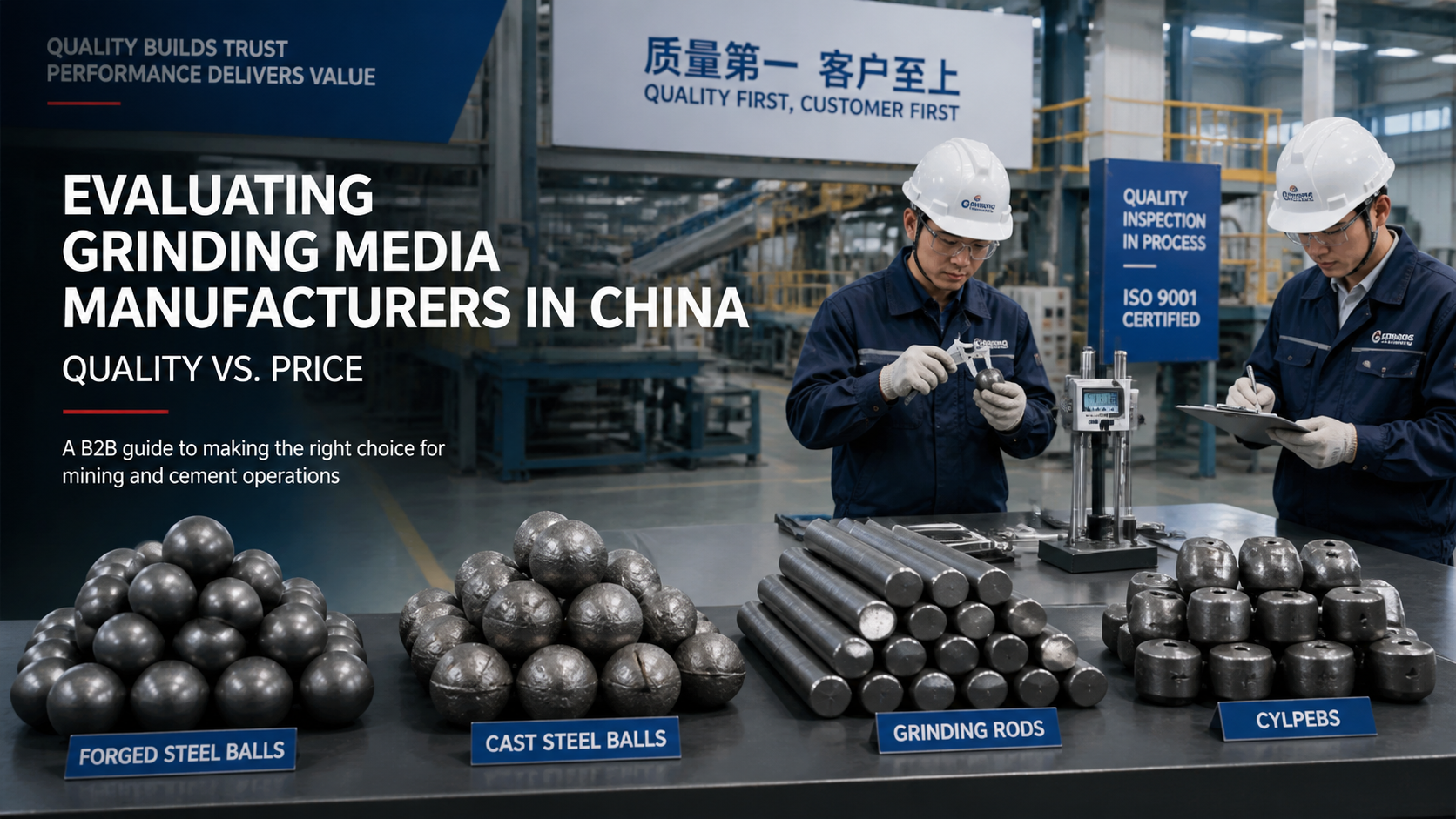
Grinding media is a high-consumption operating material. A supply interruption can affect mill availability, maintenance plans, throughput, and production cost. Therefore, the true capacity of a grinding ball factory should be evaluated as a combination of output volume, quality stability, product flexibility, and delivery reliability.
A supplier may advertise a large annual capacity, but that number is not meaningful unless the factory can prove:
- It has enough active production lines.
- It has stable billet, alloy, scrap, or other raw-material supply.
- Its heat-treatment equipment matches the forming capacity.
- Its inspection system prevents inconsistent batches from being shipped.
- It can switch product sizes and grades without creating long lead times.
- It has packing, warehousing, and export logistics capability.
For overseas brand owners, wholesalers, and industrial manufacturers, capacity also includes the supplier's ability to provide OEM grinding media with customized specifications, packaging, labeling, documentation, and shipment arrangements.
At SHANDONG ALLSTAR GRINDING BALL CO., LTD., our approach is to assess each order from the full production chain rather than treating capacity as a single number. This helps us match material, ball size, heat treatment, inspection, packaging, and shipment planning to the customer's actual milling application.
A grinding ball factory's capacity should be divided into five practical categories. Buyers should request evidence for each category before placing a large order.
| Capacity area | What buyers should verify | Why it matters |
|---|---|---|
| Forming capacity | Number of active forging, rolling, casting, or molding lines | Determines how much product can be shaped per shift |
| Heat-treatment capacity | Furnace type, batch size, throughput, quenching and tempering process | Determines hardness, toughness, wear resistance, and consistency |
| Raw-material capacity | Steel-bar, billet, scrap, alloy, and refractory supply arrangements | Protects production continuity and specification stability |
| Quality-control capacity | Chemical analysis, hardness testing, impact testing, dimensional inspection, traceability | Reduces risks of breakage, spalling, and batch variation |
| Delivery capacity | Finished-goods inventory, packaging equipment, loading resources, export experience | Determines whether products arrive safely and on time |
A good supplier must balance these areas. For example, a factory may have multiple forging lines, but insufficient heat-treatment capacity can become a bottleneck. In that situation, production may appear fast at the forming stage while final delivery slows down or quality consistency becomes difficult to maintain.
Industry investment patterns support this view. Molycop's expansion in Indonesia combined new SAG-ball manufacturing capability with dedicated heat-treatment and quality-control systems, increasing annual capacity at its Cilegon facility from 50,000 to 120,000 tonnes. The investment illustrates an important procurement lesson: capacity growth is credible when forming output, thermal processing, quality control, and supply reliability grow together.
The first step in learning how to evaluate the production capacity of a grinding ball factory is to inspect the equipment behind the annual output claim.
Ask the supplier to explain which production routes are used for each product category:
- Forged grinding balls.
- Hot-rolled grinding balls.
- Cast steel grinding balls.
- High-chrome cast grinding balls.
- Grinding rods.
- Grinding cylpebs or grinding media segments.
Each route requires different equipment and process controls. Forged balls are generally produced by heating steel bar or billets, shaping the material through forging, then heat treating and inspecting the finished balls. Cast balls require melting, pouring, controlled solidification, cleaning, heat treatment, and inspection.
For forged products, a credible factory should be able to show:
- Induction-heating or reheating equipment.
- Automatic or semi-automatic ball-forming machines.
- Die condition and changeover process.
- Quenching and tempering facilities.
- Sorting, inspection, and packing stations.
For cast products, buyers should ask about:
- Furnace capacity and melting frequency.
- Mold or casting-line configuration.
- Alloying and chemistry control.
- Cooling and cleaning procedures.
- Heat-treatment furnace capacity.
- Systems for detecting casting defects.
At SHANDONG ALLSTAR GRINDING BALL CO., LTD., we recommend that buyers evaluate product capacity by product type rather than accepting one combined annual number. A factory may be strong in forged steel balls but have limited capacity for high-chrome cast balls or grinding rods. Product-specific capability is more useful for purchase planning.
Heat treatment is often the most important capacity checkpoint. Grinding balls do not become reliable grinding media simply because they are round and meet the required diameter. Their mechanical performance depends heavily on controlled heating, quenching, cooling, and tempering.
A grinding media producer should be able to explain:
- The heating and holding process for each steel grade.
- The quenching medium and quenching-control method.
- How it manages temperature uniformity.
- Whether tempering follows quenching.
- How it avoids excessive brittleness, cracking, or uneven hardness.
- How it records furnace batches and links them to final test reports.
Research on commercial grinding balls found wide differences in impact life and wear behavior among products from multiple manufacturers. It also concluded that heat treatment has a dominant effect on impact life and that hardness, chemistry, or microstructure alone are not enough to specify performance.
This is why buyers should not choose grinding balls based only on an advertised HRC range. Ask for the factory's heat-treatment process evidence, batch records, hardness maps, impact-test results, and customer-specific quality requirements.
A reliable grinding ball manufacturer understands the trade-off between hardness and toughness. Media that is too soft can wear rapidly. Media that is too hard or incorrectly heat treated may be vulnerable to breakage or spalling under high-impact conditions.
Annual capacity is useful for initial screening, but monthly output is more valuable for procurement decisions. Buyers should ask what the factory can produce and ship under normal operating conditions, not only under ideal conditions.
Use this capacity verification checklist:
1. Ask for average monthly output by product category and size range.
2. Request the factory's maximum monthly output during peak production.
3. Confirm the number of operating shifts per day and working days per month.
4. Ask whether capacity includes rejected pieces, rework, or only approved finished goods.
5. Review the confirmed lead time for your required grade, size, and quantity.
6. Check whether the supplier has available finished inventory.
7. Confirm how quickly the factory can add capacity for repeat or emergency orders.
8. Request evidence such as production reports, loading records, or a live video audit.
A high-capacity grinding ball factory cannot maintain delivery commitments without dependable raw materials. This is especially important for OEM buyers that require a specific chemical composition, hardness range, ball size, branding, or packaging format.
Ask a supplier the following questions:
- Which steel grades or alloy systems are used for each product?
- Are raw materials purchased under long-term agreements or spot purchases?
- Are multiple qualified raw-material sources available?
- How does the factory inspect incoming billets, bars, scrap, or alloy additions?
- What chemical analysis equipment is used?
- Does the supplier keep safety stock for common grades and sizes?
- What happens if steel prices or supply conditions change suddenly?
A transparent supplier should be able to describe its incoming-material inspection process. It should also explain how material batches are identified and traced through production.
Gerdau's published grinding-ball manufacturing process provides a useful example of integrated quality planning. It describes controls from steelmaking and alloy selection through billet formation, forging, quenching, tempering, inspection, and customized logistics.
For SHANDONG ALLSTAR GRINDING BALL CO., LTD., supply reliability means more than purchasing steel. It means aligning material selection with mill conditions, manufacturing schedules with customer forecasts, and shipment plans with the customer's consumption cycle.
Certificates are important, but they are not a substitute for real quality control. Buyers should evaluate whether a factory has the equipment, people, test frequency, and documentation system needed to control every batch.
A capable grinding media quality-control system should include:
- Incoming raw-material verification.
- Chemical-composition testing.
- Ball diameter and weight checks.
- Surface-condition inspection.
- Hardness testing.
- Drop, impact, or breakage-resistance testing where appropriate.
- Metallographic or microstructure examination.
- Batch identification and traceability.
- Final inspection before packing.
- Retained samples and quality records.
The value of this system is practical: it allows the factory and customer to investigate an issue quickly if unusual wear, cracking, or breakage occurs in the mill.
When reviewing a factory, ask for a sample quality document package. It should identify the production batch, product grade, diameter, quantity, inspection data, and shipment reference. For OEM projects, request approval of the product specification before mass production begins.
The best grinding ball factory for one application may not be the right one for another. A large SAG mill operating under severe impact conditions may require forged grinding balls with optimized toughness. A fine-grinding or cement application may prioritize abrasion resistance, size distribution, and stable wear behavior. Wet milling may add corrosion considerations depending on slurry chemistry.
Factory evaluation should therefore begin with your operating data:
- Mill type and diameter.
- Feed size and ore hardness.
- Milling method and rotation conditions.
- Desired grinding media size range.
- Current media consumption.
- Breakage, spalling, or abnormal wear history.
- Monthly and annual media demand.
- Required delivery destination and inventory coverage.
An expert supplier does not simply say, "We can make 100,000 tonnes." Instead, it asks whether the selected ball type, hardness profile, and supply schedule will reduce your total cost per tonne milled.
Industry testing has shown that grinding media performance involves a balance between impact resistance and abrasion resistance. The correct choice depends on the mill environment, ore characteristics, and operating conditions—not on hardness alone. [911metallurgist]
For foreign brands, distributors, wholesalers, and manufacturers, a supplier's capacity also includes commercial execution. An OEM order may require more planning than a standard bulk order.
Verify whether the grinding ball factory can support:
- Private labels and custom marking.
- Customized bags, drums, steel barrels, or bulk packaging.
- Product labeling in the destination language.
- Custom product sizes and grades.
- Pre-shipment inspection support.
- Export documents and customs documentation.
- Container-loading plans.
- Repeat-order forecasting.
- Technical communication in English.
- After-sales handling of quality feedback.
At SHANDONG ALLSTAR GRINDING BALL CO., LTD., we position OEM capability as a production-management process, not merely a logo-printing service. The goal is to protect our partners' brand reputation with consistent media quality, controlled packaging, clear batch documentation, and reliable international delivery.
Use the scorecard below when comparing grinding ball suppliers. Score each item from 1 to 5, then compare the total alongside quoted price and technical suitability.
| Audit item | What a score of 5 looks like |
|---|---|
| Production lines | Multiple active, suitable lines with documented product-specific output |
| Heat treatment | Sufficient furnace capacity, controlled process, and batch records |
| Raw materials | Stable sourcing, incoming inspection, and traceable material batches |
| Quality control | In-house testing, defined standards, full inspection documentation |
| Product range | Forged balls, cast balls, rods, and cylpebs suited to target applications |
| Flexibility | Fast size, grade, packaging, and OEM changeover capability |
| Inventory | Safety stock or rapid replenishment plan for key products |
| Logistics | Export-ready packing, loading experience, and documentation control |
| Technical support | Mill-condition review and performance-oriented recommendations |
| Transparency | Factory tour, video audit, test reports, and direct technical communication |
A supplier with a lower quoted price but weak heat treatment, limited testing, or unclear delivery capacity can create a much higher long-term operating cost.
The right question is not, "How many tonnes can this factory claim to produce?" The better question is, "How many tonnes of qualified grinding media can this factory repeatedly deliver for my mill, on my schedule, with verified performance?"
SHANDONG ALLSTAR GRINDING BALL CO., LTD. supplies grinding balls, mill balls, forged steel balls, cast steel balls, grinding rods, and grinding cylpebs for mining, cement, and power-generation applications. We support overseas brands, wholesalers, and manufacturers with OEM production, customized specifications, quality documentation, and export-oriented service.
Contact SHANDONG ALLSTAR GRINDING BALL CO., LTD. today to request a product recommendation, factory-capacity evaluation checklist, sample inspection documents, or an OEM quotation based on your mill conditions and monthly demand.
The most reliable method is a factory audit that combines equipment verification, monthly qualified-output data, heat-treatment capacity, quality-control records, raw-material sourcing, inventory status, and confirmed shipment lead times. A live video audit and sample batch documentation can provide additional confidence.
Heat treatment affects the balance between hardness, toughness, wear resistance, and resistance to breakage or spalling. A factory with strong forming capacity but limited thermal-processing capability may struggle to provide consistent finished quality.
The choice depends on mill conditions. Forged balls are commonly selected for high-impact applications because the forging route can support strong internal structure and toughness. High-chrome cast balls may be suitable where abrasion resistance is a priority and impact conditions are lower. Your mill type, ore characteristics, and operating data should guide the decision.
Yes. A supplier may state a high theoretical annual output, but its practical deliverable capacity can be limited by furnace throughput, raw materials, maintenance, inspection, packing, current order commitments, or logistics. Request qualified monthly output and available capacity for your order window.
Buyers should request product specifications, chemical-composition reports where relevant, hardness results, dimensional inspection records, batch traceability information, packing details, quantity confirmation, and shipping documentation. OEM buyers should also approve labels and packaging before mass production.
Work with a supplier that can provide stable specifications, clear batch traceability, pre-shipment inspection, approved packaging samples, and documented quality requirements. OEM control should cover product performance, packaging, marking, and export paperwork.
Price per tonne is not enough. A stronger KPI is total grinding-media cost per tonne of ore or material milled, supported by consumption rate, wear behavior, breakage rate, mill throughput, downtime impact, delivery reliability, and inventory cost.
- [Molycop: Game-changer—Molycop expands production capabilities in Indonesia]
- [Gerdau North America: How Grinding Balls Are Made at Gerdau Duluth Minnesota]
- [Blickensderfer, R. and Tylczak, J. H.: Grinding Balls by Laboratory Impact and Abrasion Tests]
- [Molycop: Grinding Media Products and Solutions]
- [Global Met Tech: Steel Grinding Media]
Hot Tags: China, Global, OEM, private label, manufacturers, factory, suppliers, manufacturing company


