
Views: 237 Author: shandong Allstar Grinding Ball Publish Time: 2026-08-17 Origin: Site


Content Menu
● Why Variable Temperature Causes Grinding Ball Cracks
● Ball Mill Steel Balls vs Cast Steel Balls: Core Differences
● Structural Defects That Trigger Premature Failure
>> 1. Shrinkage Cavities and Porosity
>> 2. Hot Tears and Solidification Cracks
>> 3. Residual Stress From Improper Heat Treatment
>> 4. Non-Metallic Inclusions and Segregation
● When Forged Steel Balls Are the Safer Choice
● When Cast Steel Balls Can Perform Well
● A Practical Crack-Prevention Checklist
>> Before Purchasing Grinding Media
>> During Supplier Qualification
● Expert Insight: Examine the Fracture Before Changing Media
● Why SHANDONG ALLSTAR GRINDING BALL CO., LTD.
● Request a Grinding Media Evaluation
● FAQ
>> 1. Are forged steel balls better than cast steel balls for ball mills?
>> 2. Why do cast steel grinding balls crack?
>> 3. Can high hardness prevent grinding ball failure?
>> 4. How can a buyer verify grinding ball quality?
>> 5. What grinding media is best for a high-temperature cement mill?
>> 6. What should we do when broken grinding balls appear in the mill?
For mining, cement, and power-generation plants, the decision between ball mill steel balls vs cast steel balls directly affects mill uptime, media consumption, product contamination, and safety. In variable-temperature milling, the greatest risk is not simply wear—it is structural defect cracking caused by thermal cycling, impact loading, and inconsistent internal material quality.
At SHANDONG ALLSTAR GRINDING BALL CO., LTD., we manufacture forged steel grinding balls, cast steel balls, grinding rods, and grinding cylpebs for global mining, cement, and power customers. As an OEM partner for overseas brands, wholesalers, and industrial manufacturers, we help buyers select grinding media based on actual mill conditions—not only initial purchase price.
This guide explains how forged and cast grinding media respond to changing temperatures, why cracks form, and how to reduce premature ball breakage in demanding ball-mill applications.
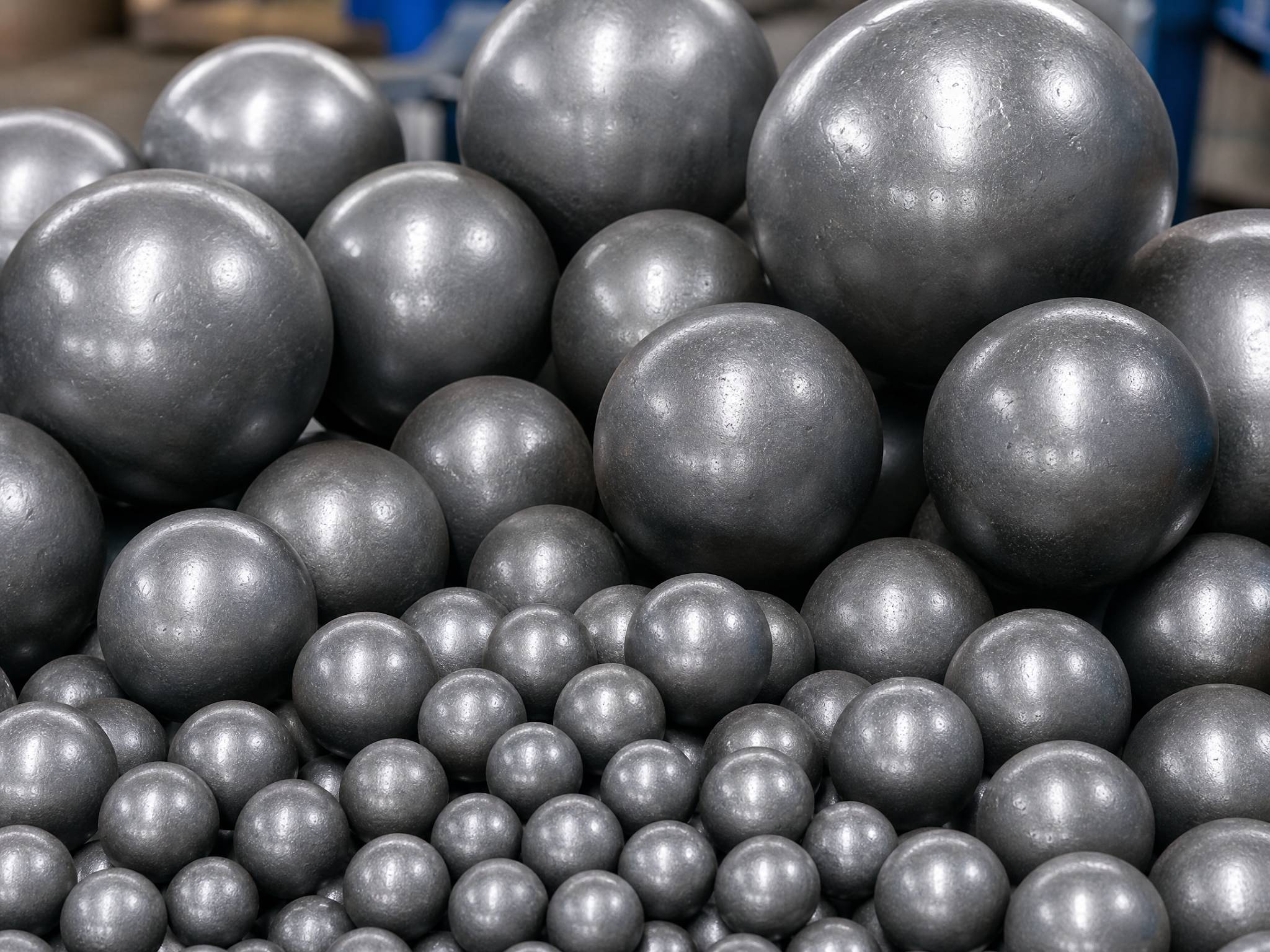
A ball mill rarely operates at one perfectly stable temperature. Feed moisture changes, mill loading fluctuates, cooling water varies, liners wear, and process interruptions create repeated heating-and-cooling cycles.
These temperature swings create thermal stress. The surface and core of a grinding ball do not heat or cool at the same speed. If the material has poor toughness, residual stress, porosity, shrinkage cavities, or a brittle microstructure, small discontinuities can become visible cracks.
The risk increases when thermal stress combines with:
- High-impact ore or clinker grinding
- Large-diameter grinding balls
- Sudden mill starts and stops
- Wet-to-dry or dry-to-wet operating changes
- Abrasive, high-density feed material
- Overly hard media with insufficient core toughness
- Uncontrolled quenching or inadequate tempering
- Internal casting defects that were not detected before shipment
A crack that starts as a small surface indication can propagate under repeated collisions. Eventually, the ball may spall, split, or fracture. That failure can reduce grinding efficiency, contaminate the product with fragments, damage downstream equipment, and increase unplanned maintenance.
Recommended visual: Insert a cross-section graphic showing surface-to-core temperature gradients and crack initiation zones in a grinding ball.
Forged steel balls and cast steel balls can both be effective grinding media when correctly engineered for the application. The crucial difference is how their internal structure is created and controlled.
| Factor | Forged Steel Grinding Balls | Cast Steel Grinding Balls |
|---|---|---|
| Manufacturing route | Steel bar or billet is heated and mechanically forged or rolled into shape | Molten alloy is poured into a mold and solidifies |
| Internal density | Mechanical deformation can compact the structure and promote grain flow | Quality depends strongly on melt control, mold design, feeding, and cooling |
| Defect sensitivity | Lower risk when billet quality, forging reduction, and heat treatment are controlled | More vulnerable to shrinkage, gas porosity, inclusions, hot tears, and segregation if process control is weak |
| Impact resistance | Generally strong when matched hardness and toughness are achieved | Can be lower in brittle grades, especially under high impact |
| Wear potential | Strong all-round choice for impact-plus-abrasion duty | High-chromium cast media can offer strong abrasion resistance in suitable low-impact conditions |
| Thermal-cycle performance | Often preferred where temperature swings and impact are severe | Must be carefully selected and inspected for thermal-shock-prone service |
| Typical fit | SAG, ball mills, mine grinding, variable-feed operations, high-impact milling | Fine grinding, lower-impact abrasive duty, and applications where alloy wear resistance is the priority |
Forging mechanically works solid steel rather than relying on liquid-metal solidification. When the raw material, forging deformation, quenching, and tempering are properly controlled, forged balls can provide a more consistent structure and better resistance to impact-related fracture.
Casting offers important advantages too. High-chromium cast grinding balls can deliver excellent abrasion resistance in the right environment. However, casting quality must be rigorously managed because cooling and solidification can introduce shrinkage, porosity, inclusions, and cracking if feeding, chemistry, and heat treatment are inadequate. Industry guidance on casting inspection recognizes that visual inspection, magnetic particle testing, liquid penetrant testing, ultrasonic testing, and radiography are used to detect surface and internal discontinuities. [sfsa]
Not every broken grinding ball fails for the same reason. A reliable supplier should distinguish between material defects, heat-treatment problems, and operating-condition failures.
During casting, liquid metal contracts as it solidifies. Without effective feeding and process control, internal voids can develop. These voids reduce the load-bearing cross-section and can concentrate stress during impact.
A ball may look acceptable externally but contain an internal discontinuity. Under repeated impacts, the defect acts as a crack origin and the ball can fail suddenly.
A hot tear forms when a casting is restrained while cooling and cannot accommodate thermal contraction. These defects are especially dangerous because they may start beneath the surface and grow during service.
For variable-temperature milling, pre-existing thermal defects are a major concern. Repeated heating and cooling can repeatedly open and close the crack, accelerating propagation.
Heat treatment determines whether a grinding ball has the right balance of hardness, toughness, and structural stability. A ball that is quenched too aggressively or tempered inadequately may achieve high surface hardness but retain excessive brittleness or residual stress.
The goal is not "maximum hardness at any cost." The goal is controlled hardness with sufficient core toughness for the mill's impact level and temperature profile.
Inclusions, chemical segregation, or inconsistent alloy distribution can create weak local zones. These areas may respond differently to heating, cooling, and impact than the surrounding steel.
This is why material traceability matters. Buyers should require documented steel chemistry, batch identification, heat-treatment records, hardness testing, and inspection criteria.
Recommended visual: Add a macro-etched comparison image of a sound forged ball section, a porosity-affected cast section, and a fractured ball recovered from a mill.
From our manufacturing and application experience, forged steel balls are usually the stronger option when the process combines high impact with repeated temperature changes.
Choose forged grinding balls when your operation has:
- Large mill diameters and high drop heights
- Coarse ore, large feed particles, or hard rock
- High-impact mining duty
- Unstable feed rate or ore competency
- Frequent starts, stops, and process interruptions
- Dry grinding or elevated-temperature cement applications
- A need to minimize ball breakage and unplanned shutdowns
- Strict requirements for internal integrity and traceability
The forging route, followed by controlled quenching and tempering, is designed to build a useful combination of wear resistance and toughness. Forged media is therefore widely considered a practical choice where impact energy is significant and fracture resistance is critical. [linkedin]
At SHANDONG ALLSTAR GRINDING BALL CO., LTD., our engineering focus is to match the steel grade, ball diameter, hardness range, and heat-treatment route to the actual milling environment. A premium ball that is mismatched to the mill can still fail prematurely. Correct selection is more important than choosing the highest nominal hardness.
Cast steel balls should not be dismissed. They can be effective when the application favors abrasion resistance over severe impact toughness.
High-chromium cast grinding media may be a suitable choice when:
- Grinding is relatively stable and low impact
- Feed particles are fine or well-controlled
- The mill experiences limited thermal cycling
- Abrasion is the dominant wear mechanism
- The operating target prioritizes wear life over impact survival
- The supplier can provide reliable chemistry and NDT documentation
The key is to avoid applying cast media as a universal solution. A high-hardness cast ball may resist abrasive wear very well but can be more sensitive to cracking when impact loads or thermal gradients become excessive.
For this reason, a mill audit should assess the complete operating picture: ore hardness, feed size, mill speed, filling rate, liner condition, slurry density, temperature movement, and historic media breakage.
Preventing structural defect cracks requires cooperation between the grinding-media supplier and the mill operator.
1. Define the mill's operating range, not only its design conditions.
2. Record normal and peak temperatures, including start-up and shutdown events.
3. Identify whether the dominant mechanism is impact, abrasion, corrosion, or a combination.
4. Request chemical composition and mechanical-property specifications.
5. Confirm the supplier's heat-treatment process and batch traceability.
6. Specify inspection requirements for surface and internal integrity.
7. Evaluate total cost per tonne milled rather than ball price per tonne.
Ask every grinding-ball supplier these practical questions:
- What steel grade or alloy is proposed, and why?
- What hardness range is guaranteed at the surface and core?
- How is quench severity controlled for different ball diameters?
- Is tempering performed to reduce brittleness and residual stress?
- Which NDT methods are used for cast media?
- Can the supplier provide mill trial data for comparable duty?
- How are defective lots identified, contained, and replaced?
Visual inspection can reveal obvious surface defects, while magnetic particle or liquid penetrant methods can help identify surface and near-surface cracking. Ultrasonic and radiographic methods can detect important internal discontinuities such as cracks, porosity, inclusions, and shrinkage. [sfsa]
Monitor the following indicators monthly:
- Ball consumption rate
- Broken-ball percentage
- Spalling or shelling frequency
- Temperature trend by operating phase
- Changes in mill power draw
- Product size distribution
- Liner wear pattern
- Recovered-ball fracture appearance
A sudden increase in broken balls should trigger an investigation. Do not assume the problem is only the media. Incorrect mill loading, oversized feed, liner profile changes, high-impact zones, or abrupt cooling events can also contribute to failure.
One of the most valuable practices in grinding-media troubleshooting is fracture analysis. Recover representative broken balls and document their diameter, remaining mass, location in the circuit, operating batch, and visible fracture pattern.
A fresh-looking, crystalline fracture may suggest brittle overload or inadequate toughness. A crack that radiates from an internal cavity may indicate a manufacturing discontinuity. Surface cracking and layered spalling can point to a heat-treatment or thermal-fatigue issue.
This evidence-based approach prevents expensive guesswork. Instead of replacing one media type with another based only on price or anecdotal feedback, the plant can identify the failure mechanism and select a corrective action.
For OEM buyers and distributors, this is also a strong supplier-management tool. Batch-level traceability makes it possible to connect field performance with a specific production and heat-treatment record.
SHANDONG ALLSTAR GRINDING BALL CO., LTD. supports global customers with a complete grinding-media portfolio:
- Forged steel grinding balls
- Cast steel grinding balls
- Grinding mill balls
- Grinding rods
- Grinding cylpebs
- OEM production for international brands, wholesalers, and manufacturers
Our approach starts with the application. We do not treat every ball mill as identical. We work with customers to align media selection with feed conditions, impact intensity, temperature variation, wear targets, ball size distribution, and commercial requirements.
For mills exposed to variable temperatures, our recommendation is clear: prioritize structural consistency, appropriate toughness, controlled heat treatment, and verified quality assurance. These factors are more important than an attractive headline hardness number or a low initial price.
Recommended video: Place a 60–90 second factory-quality video here showing raw-material identification, automatic forging or casting, heat treatment, hardness testing, sorting, and final packaging.
If your plant is experiencing cracked, broken, or prematurely worn balls, SHANDONG ALLSTAR GRINDING BALL CO., LTD. can help evaluate the probable failure mechanism and recommend a tailored forged or cast media solution.
Send us your mill diameter, ball size range, material being milled, operating temperature range, throughput, and current media consumption. Our team can help you reduce structural-defect risk and select grinding media built for your actual operating conditions.
Not in every application. Forged steel balls are generally preferred for high-impact and variable-temperature milling because they can provide strong toughness and structural consistency when properly forged and heat treated. Cast steel balls can be highly effective in stable, abrasive, lower-impact applications.
Cast balls can crack because of internal porosity, shrinkage cavities, inclusions, hot tears, excessive brittleness, residual stress, or unsuitable operating conditions. Severe impact and rapid temperature changes can accelerate crack growth.
No. Hardness improves wear resistance, but excessive hardness without adequate toughness can increase brittle fracture risk. The correct target is a balanced hardness-and-toughness profile matched to the mill duty.
Request chemical analysis, hardness reports, heat-treatment records, dimensional inspection, batch traceability, and relevant NDT documentation. For cast media, ask how the manufacturer controls and inspects for porosity, shrinkage, inclusions, and cracks.
The correct choice depends on impact level, ball size, material abrasiveness, and temperature cycling. In many high-impact, changing-temperature cement applications, properly heat-treated forged steel balls offer a reliable balance of toughness and wear resistance.
Collect representative failures, record their batch and operating conditions, inspect the fracture pattern, review mill loading and temperature history, and consult the supplier before changing media. A fracture investigation can separate manufacturing defects from operating-condition causes.
1. Steel Founders' Society of America. [Non-Destructive Testing]
2. Impro Precision. [Introduction to NDT (Non-Destructive Testing) for Castings]
3. Badger Alloys. [Foundry 101 Part 7: Heat Treatment, Inspection and NDT]
4. Steel Founders' Society of America. [Information for Casting Designers]
5. ASM International. [Heat Treating]
6. ASTM International. [Standards and Publications]
7. Cambridge Dictionary of Materials Engineering concepts and foundry inspection practices, supported by the technical sources above.
Hot Tags: China, Global, OEM, private label, manufacturers, factory, suppliers, manufacturing company


