
Views: 276 Author: shandong Allstar Grinding Ball Publish Time: 2026-11-18 Origin: Site


Content Menu
● What Are High Chrome Cast Grinding Balls?
● How Are High Chrome Cast Grinding Balls Manufactured? The Main Production Stages
>> 1. Define the Application and Alloy Specification
>> 2. Select and Prepare the Raw Materials
>> 3. Melt the Charge and Verify Chemistry
>> 4. Prepare the Molds and Pour the Alloy
>> 5. Control Solidification, Demold, and Clean
>> 6. Heat-Treat the Cast Grinding Balls
>> 7. Inspect, Release, and Package Each Batch
● Why Chromium Content and Surface Hardness Are Not Enough
● Quality-Control Evidence OEM Buyers Should Request
● How to Validate Grinding Media in a Mill Trial
● Match High Chrome Grinding Media to the Application
>> Mining and Mineral Processing
● Planning an OEM Grinding Media Order with ALLSTAR
>> 1. Are high chrome cast grinding balls made from steel or cast iron?
>> 2. What is the main purpose of chromium in grinding balls?
>> 3. Why is heat treatment important for high chrome grinding balls?
>> 4. Is there one standard hardness for every high chrome grinding ball?
>> 5. Can high chrome cast grinding balls be used for wet grinding?
>> 6. What should an overseas OEM buyer verify before ordering?
At SHANDONG ALLSTAR GRINDING BALL CO., LTD., we supply grinding media for mining, cement, and power applications, with OEM services for overseas brands, wholesalers, and manufacturers. How are high chrome cast grinding balls manufactured? The process combines alloy selection, melting, mold preparation, casting, controlled cooling, heat treatment, inspection, and shipment.
However, a production flowchart tells only part of the story. For buyers, the real question is whether each stage produces consistent material properties for a particular mill.
In this guide, we explain the manufacturing process and the evidence worth requesting before approving a grinding media supplier.

High chrome cast grinding balls are wear-resistant grinding media made from chromium-alloyed white cast iron. Although sometimes marketed as "high chrome steel balls," their metallurgical classification differs from forged steel grinding balls.
Their abrasion resistance comes from hard chromium-rich carbides supported by a metallic matrix. Heat treatment helps develop the matrix needed for the intended balance of hardness, wear resistance, and resistance to breakage.
Chromium content alone does not define performance. Carbon content, carbide distribution, casting quality, heat treatment, and operating conditions also matter.
This is why two balls with similar chemical analyses can behave differently inside the same mill.
The following sequence describes a conventional manufacturing route. Individual foundries may use different molding systems, alloy designs, and thermal cycles.
Manufacturing should begin with the mill application, not a generic chromium percentage.
The supplier needs to understand:
- Mill type, diameter, speed, and operating conditions.
- Required ball sizes and charging practice.
- Feed size, abrasiveness, and target product fineness.
- Wet or dry grinding conditions.
- Current wear, cracking, or breakage problems.
For wet grinding, slurry chemistry deserves particular attention because corrosion can contribute to media consumption.
The resulting specification should identify chemistry limits, dimensions, hardness requirements, inspection methods, and acceptance criteria.
The furnace charge commonly includes steel scrap, ferrochrome, and materials used to adjust carbon and other alloying elements.
Charge preparation influences both chemistry and consistency. Uncontrolled inputs can introduce unwanted elements or make subsequent adjustments less predictable.
From a buyer's perspective, the useful question is not simply, "Do you use good raw materials?" It is, "How do you verify the charge and connect the finished batch to its melt records?"
The raw materials are melted, and the molten alloy is sampled for chemical analysis.
The foundry adjusts the composition against the specified grade before pouring. Chromium and carbon require coordinated control because they influence carbide formation and the surrounding matrix.
Other elements may support the alloy design, but their value depends on the complete composition and processing route.
A meaningful inspection certificate should therefore report the specified chemistry, not merely a headline chromium value.
Grinding balls can be produced using sand molds, metallic molds, or other suitable casting systems.
Mold condition, cavity dimensions, gating, feeding, and pouring practice influence the finished casting. Poor control can contribute to shrinkage cavities, inclusions, surface defects, or dimensional variation.
The objective is more demanding than producing a round shape: the foundry must create a sound casting that will withstand heat treatment and service.
*Suggested visual: Insert an actual molding-and-pouring video here, with a short explanation of the production stage.*
As the molten alloy solidifies, its carbide structure and matrix begin to develop.
Cooling conditions can influence the structure from the surface toward the center. This makes mold selection and cooling control important parts of metallurgical quality, rather than incidental production details.
After sufficient cooling, the balls are removed from their molds. Gates, runners, and excess material are separated, followed by cleaning and preliminary inspection.
Heat treatment can modify the matrix, but it should not be expected to repair major casting defects.
Heat treatment helps establish the final balance of properties.
A conventional hardening route may include heating, holding, and controlled quenching, followed by tempering or stress relief as required by the alloy and specification.
The thermal cycle affects matrix transformation and retained austenite. A successful treatment supports the hard carbide phase without creating an unacceptable risk of cracking or brittleness.
There is no universal temperature-and-time recipe suitable for every high chrome grinding ball. Chemistry, ball diameter, furnace loading, and cooling capability all influence the required cycle.
Buyers should request evidence of a qualified process rather than treating one published temperature as a universal manufacturing rule.
Finished media should be evaluated against agreed requirements before release.
Inspection may include chemistry, dimensions, surface condition, hardness, metallography, and mechanical testing where specified.
Packaging should protect the shipment during handling and preserve its identity. For OEM orders, labeling and documentation should make it possible to connect delivered media with the relevant production and inspection records.
*Suggested visual: Place an illustrated process diagram after this section: specification → melting → casting → cleaning → heat treatment → inspection → shipment.*
A high chromium percentage is not a substitute for a complete material specification. Likewise, a high surface hardness reading does not establish internal soundness or field performance.
Three relationships deserve attention:
1. Carbides and matrix must work together. Hard particles need adequate support.
2. Hardness and toughness must suit the impact environment.
3. Corrosion resistance must be evaluated alongside abrasive wear in wet circuits.
My recommendation to procurement teams is straightforward: compare a documented material system, not two isolated numbers on a quotation.
This approach makes supplier comparisons more meaningful and reduces the risk of purchasing an impressive specification that does not match the application.
An effective quality plan connects each requirement to a test, a sampling method, and a production record.
| Inspection area | Evidence to request | Why it matters |
|---|---|---|
| Chemical composition | Melt-linked analysis against agreed limits | Verifies the specified alloy |
| Dimensions | Diameter and shape inspection records | Supports consistent media sizing |
| Hardness | Test method, preparation, and locations | Makes results comparable |
| Internal consistency | Sectioned-ball assessment where agreed | Examines properties beyond the surface |
| Microstructure | Metallographic report and images | Reveals carbide and matrix characteristics |
| Mechanical behavior | Agreed impact or repeated-impact protocol | Defines how breakage resistance is assessed |
| Traceability | Connection between melt, thermal batch, and shipment | Supports investigation and repeat orders |
A result such as "passed impact testing" is incomplete without the test conditions and acceptance criteria.
Similarly, an ASTM reference should identify the applicable specification, class, type, and requirements. Naming a standard does not independently establish that a shipment complies with it.
Laboratory inspection supports quality control. A controlled site trial evaluates application suitability.
For a useful comparison, establish the baseline before changing media:
1. Record current media consumption and relevant operating conditions.
2. Agree on trial duration and charging procedures.
3. Track feed changes, throughput, product fineness, and operating interruptions.
4. Measure wear and breakage using consistent definitions.
5. Review results against the baseline, including any changes in mill inventory.
Cost per tonne is generally a more useful purchasing measure than price per tonne of balls alone.
For a simplified comparison:
Grinding media cost per tonne processed = delivered media price per kilogram × media consumption in kilograms per tonne processed.
This calculation excludes other possible effects, such as downtime, throughput, and downstream process changes. Those should be evaluated separately rather than assumed.
*Suggested visual: Add a trial-results chart comparing media consumption, breakage, throughput, and product fineness. Use verified customer data only.*
In cement applications, media selection should reflect the mill compartment, feed characteristics, required size distribution, and operating conditions.
A ball suitable for one position in a mill may not be the best choice elsewhere.
Mining applications require attention to ore variability, impact loading, abrasiveness, and slurry chemistry.
High chrome media can be used in wet and dry grinding, but suitability should be demonstrated for the specific circuit. Higher chromium content does not automatically guarantee the lowest operating cost.
For power-sector applications, first confirm that the equipment uses loose grinding balls.
Different pulverizing systems use different wear components. Mill design, feed characteristics, and temperature conditions should guide material selection rather than an industry label alone.
SHANDONG ALLSTAR GRINDING BALL CO., LTD. offers grinding balls, forged steel balls, cast grinding balls, grinding rods, and grinding cylpebs for international customers.
For an OEM inquiry, we recommend preparing a technical brief covering:
- Intended application and operating environment.
- Ball diameters, quantities, and size distribution.
- Chemistry and hardness requirements.
- Sampling procedures and acceptance criteria.
- Packaging, labeling, and brand requirements.
- Documentation, delivery, and trial expectations.
Agree on the specification before comparing commercial offers. This helps both parties distinguish essential performance requirements from optional documentation or packaging preferences.
Contact SHANDONG ALLSTAR GRINDING BALL CO., LTD. with your mill details, current media specification, and principal wear problem. Request an OEM quotation against an agreed technical specification and discuss the evidence needed for sample approval.
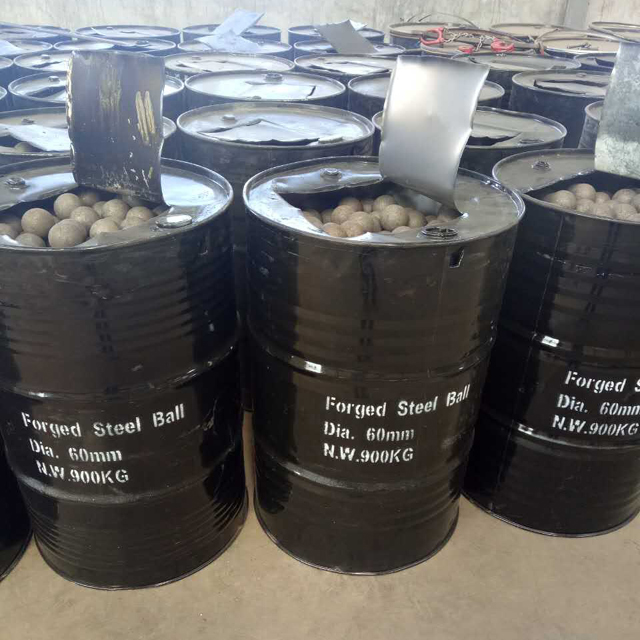
They are generally chromium-alloyed white cast iron. Steel scrap may form part of the furnace charge, but that does not make the finished material equivalent to forged steel. The alloy composition and resulting microstructure determine its classification.
Chromium contributes to carbide formation and influences the alloy's wear and corrosion behavior. Its effectiveness depends on carbon content, the matrix, heat treatment, and service conditions. Chromium percentage alone cannot establish the best grade for a mill.
Heat treatment modifies the matrix and helps establish the required hardness and mechanical behavior. The appropriate cycle depends on chemistry, ball size, and the intended application. Poorly matched processing can undermine the benefits of an otherwise suitable alloy.
No. The required hardness should be specified for the selected grade and application. Buyers should also define how hardness is measured, where readings are taken, and how results are accepted. A surface reading alone does not fully describe the ball.
Yes, suitable high chrome media are used in wet grinding. However, slurry chemistry, ore characteristics, impact conditions, and downstream requirements affect suitability. A documented trial is more informative than a general claim that one alloy works in every wet mill.
Verify the technical specification, inspection plan, batch identification, packaging, and required documents. Discuss sample approval and field validation where appropriate. Any performance guarantee should define its operating conditions, measurement method, exclusions, and acceptance criteria before the order is placed.
1. U.S. International Trade Commission. *High Chrome Cast Iron Grinding Media from India*. Publication 5632, June 2025. Investigation Nos. 701-TA-726 and 731-TA-1694 (Final). Technical sections cover product characteristics, raw materials, manufacturing stages, heat treatment, quenching, and quality control. Used as an independent industry-process source, not as evidence of ALLSTAR's capabilities. [usitc]
2. ASTM International. *ASTM A532/A532M-10(2023): Standard Specification for Abrasion-Resistant Cast Irons*. The official scope and abstract describe alloyed white cast irons, applicable industries, composition requirements, supply conditions, microstructures, and hardness testing. Reference to the standard does not imply ALLSTAR certification or product conformity. [store.astm]
3. Magotteaux. *Cast High Chromium*. Manufacturer's technical product page describing chromium-rich carbides in a martensitic structure, application-specific alloy selection, and wet and dry grinding applications. Used for general material and application context; its product specifications are not presented as ALLSTAR specifications. [magotteaux]
4. Makarenko, K. V., Poddubny, A. N., and Tarasov, A. A. "Cast Functionally Graded Materials Based on Chromium White Irons for Fabricating Grinding Bodies." *Metal Science and Heat Treatment*, volume 64, pages 648–654, 2023. DOI: 10.1007/s11041-023-00866-6. The accessible abstract discusses directional solidification, chromium-carbide structures, and surface-to-core differences in cast grinding bodies. [link.springer]
5. Company-information source: the SHANDONG ALLSTAR GRINDING BALL CO., LTD. description supplied for this assignment. Used only for the company name, stated product categories, served industries, and OEM positioning. No customer reviews, company test reports, certifications, or verified case-study results were supplied.


