
Views: 277 Author: shandong Allstar Grinding Ball Publish Time: 2026-11-20 Origin: Site


Content Menu
● What Are Grinding Balls, and How Do They Work?
● Main Types of Grinding Balls and Related Media
>> Forged Steel Grinding Balls
>> Ceramic Balls, Rods, and Cylpebs
● Where Are Grinding Balls Used?
● Forged vs. Cast Grinding Balls: Which Should You Choose?
● How to Select Grinding Balls: A Five-Step Buyer Framework
>> 1. Define the Operating Duty
>> 2. Match Ball Size to Feed and Mill Conditions
>> 3. Specify More Than Surface Hardness
>> 4. Evaluate Process Compatibility
>> 5. Validate Through a Controlled Trial
● A Better Purchasing Metric: Media Cost per Tonne
● Reading Wear Patterns Before Reordering
● An OEM Quality Checklist for International Buyers
>> What Are Grinding Balls Made Of?
>> Are Grinding Balls the Same as Bearing Balls?
>> Are Forged Grinding Balls Always Better Than Cast Balls?
>> What Size Grinding Balls Should I Use?
>> How Long Do Grinding Balls Last?
>> Can Grinding Balls Be Used for Both Wet and Dry Grinding?
>> What Information Should I Send for an OEM Grinding Ball Quotation?
● Discuss Your Grinding Media Requirements with ALLSTAR
At SHANDONG ALLSTAR GRINDING BALL CO., LTD., we manufacture grinding balls, forged steel balls, cast grinding balls, grinding rods, and grinding cylpebs for mining, cement, and power applications. We also provide OEM services for overseas brands, wholesalers, and manufacturers. What are grinding balls? They are spherical grinding media that reduce material size inside a mill through repeated impact and abrasion.
For buyers, understanding that definition is only the beginning. The practical question is which media will deliver the required fineness, withstand operating conditions, and control the cost of every tonne processed. This guide explains the main options and offers a practical framework for specification, testing, and purchasing.

Grinding balls transfer energy from a mill to the material being processed. In a rotating ball mill, the shell and liners lift the charge. Balls then roll, cascade, or fall, breaking particles through impact and abrasive contact.
Larger particles generally need sufficient impact energy. Finer grinding increasingly depends on repeated contacts and abrasion. Actual performance reflects the complete system: feed properties, ball sizes, charge level, mill speed, liner design, and operating conditions.
In wet grinding, water and solids form a slurry. Media selection must consider chemical conditions as well as mechanical wear. Dry grinding eliminates slurry chemistry, but abrasion, impact, and operating temperature still matter.
Grinding balls are consumables. They gradually lose mass and need replenishment. Their value therefore depends on sustained performance, not simply their appearance when delivered.
Forged steel grinding balls are formed from heated steel stock and typically heat-treated to develop the required hardness and toughness. They are widely considered for demanding impact conditions, including suitable SAG and ball mill duties.
Forging alone does not guarantee performance. Steel chemistry, manufacturing consistency, heat treatment, and internal quality all influence the finished ball. Buyers should compare documented properties rather than accepting "forged" as a complete specification.
Cast grinding balls are produced by pouring molten alloy into molds. Their properties depend on composition, solidification, and subsequent heat treatment.
An important terminology distinction matters: many high-chromium grinding balls are alloy cast iron, not cast steel. Commercial descriptions sometimes blur these categories. Purchase specifications should identify the actual material grade and chemistry rather than relying on a broad product label.
High-chromium media can offer strong abrasion and corrosion resistance in suitable applications. However, no cast alloy is automatically the best choice for every ore, mill, or impact environment.
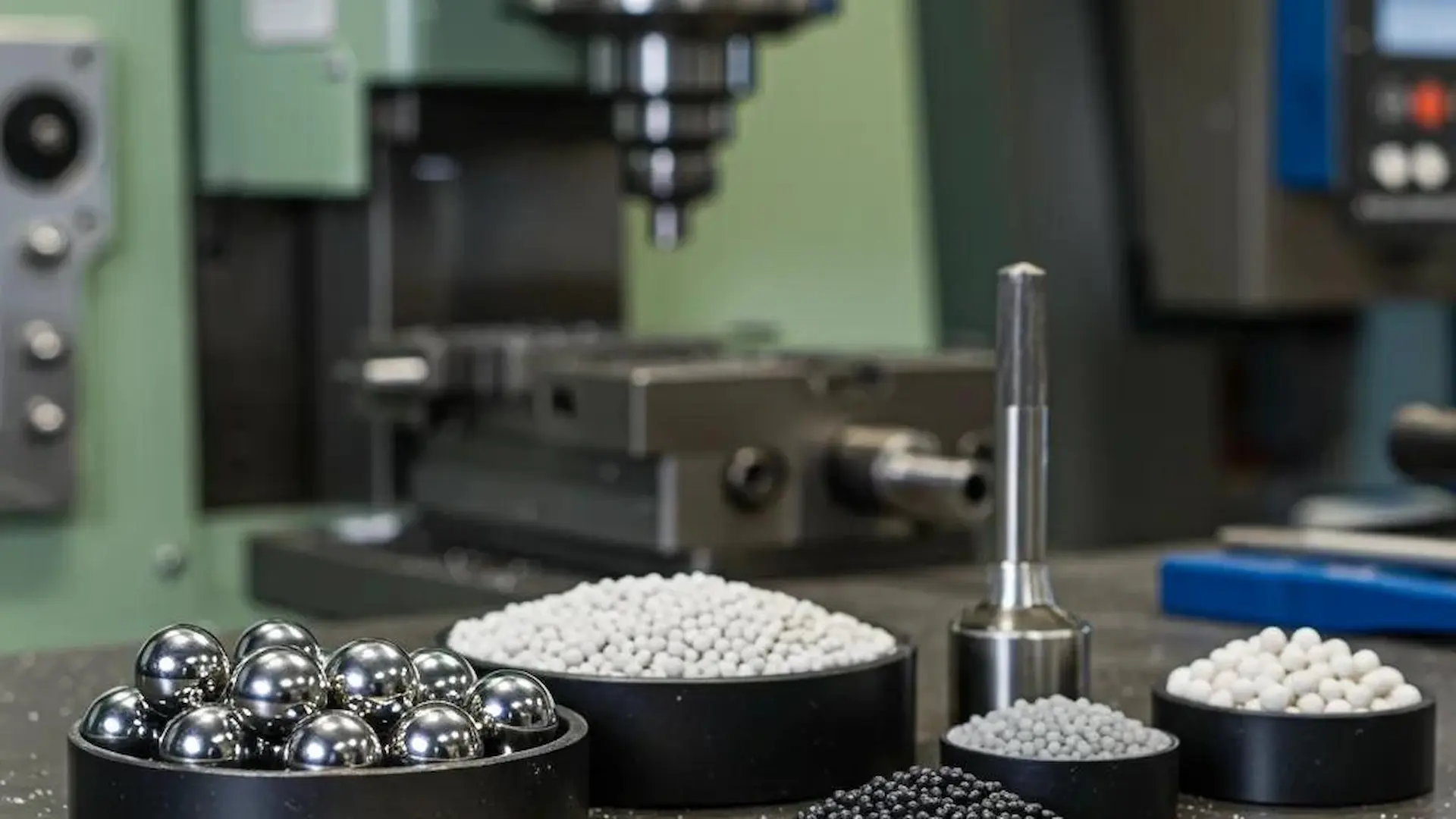
Ceramic grinding media are another option where process compatibility, fine grinding, or contamination control warrants their use. Their suitability depends on the mill design and application.
Grinding rods and cylpebs are related media, but they are not balls. Rods are elongated media used in rod mills. Cylpebs are short cylindrical media used in selected grinding applications. Their different geometries mean they should not be treated as interchangeable replacements without technical assessment.
| Industry | Typical application | Main purchasing consideration |
|---|---|---|
| Mining | Grinding ore before downstream separation | Wear, impact resistance, and process compatibility |
| Cement | Grinding clinker and other suitable materials | Abrasion resistance and required product fineness |
| Power generation | Coal pulverization in compatible ball-mill systems | Equipment compatibility and stable grinding performance |
| Industrial minerals | Size reduction in suitable milling circuits | Product quality and contamination limits |
Equipment compatibility comes first. Not every cement mill, coal pulverizer, or fine-grinding machine uses spherical media. Confirm the installed equipment and manufacturer's requirements before specifying a product.
Start with the duty, not a preferred manufacturing label.
Forged steel is often considered where impact toughness is particularly important. High-chromium cast media may be attractive where abrasive or corrosive wear dominates and the alloy suits the impact conditions.
The comparison should include:
- Feed size, hardness, and abrasiveness.
- Mill type, dimensions, speed, and liner condition.
- Wet or dry operation and relevant slurry chemistry.
- Required product size and downstream processing constraints.
- Evidence of wear, breakage, spalling, and deformation.
The hardest ball is not necessarily the most economical. Hardness must be balanced against toughness and the actual wear mechanism. A material that performs well in one circuit may disappoint in another.
Prepare a short application sheet. Include the mill type, feed size distribution, throughput, target product size, current media specification, and operating environment.
For wet circuits, include available information about slurry pH and chemistry. For changing ore blends, record the variation rather than submitting only an average. These details make supplier recommendations more meaningful.
Larger balls generally provide greater impact per collision. Smaller balls provide more individual contacts and greater total surface area for the same mass of the same material.
Neither advantage applies universally. Oversized media can compromise fine-grinding efficiency, while undersized media may struggle with coarse feed. Determine the initial charge and replenishment sizes with reference to the mill design and operating evidence.
Ask how hardness is measured and where measurements are taken. A surface reading alone does not describe the interior of a ball.
Depending on the duty, request chemistry, hardness profiles, microstructure evaluation, dimensional tolerances, and relevant impact-test results. Agree on sampling frequency and acceptance criteria before production, not after a shipment arrives.
Grinding media interact with more than the mill shell. In mineral processing, alloy selection can affect the chemical environment and downstream performance.
Where flotation or another sensitive separation step follows grinding, include process-response testing in the evaluation. A lower measured media wear rate should not automatically outweigh a deterioration in recovery or product quality.
Use laboratory screening or a structured plant trial before committing to a major change. Establish baseline conditions and agree on success criteria.
Track throughput, product size, media consumption, power use, and relevant downstream results. Where suitable, specialist marked-ball testing can help compare relative wear. Avoid attributing every improvement to the media when ore blend, liners, or operating conditions changed simultaneously.
Price per tonne of balls is only one input. A more useful starting metric is media consumption multiplied by delivered media price:
Media cost per tonne of feed = media consumption in kg/t × delivered media price per kg.
Consider this hypothetical comparison, which is not an ALLSTAR test result or performance promise:
| Option | Delivered media price | Consumption | Media cost per tonne of feed |
|---|---|---|---|
| A | $1.00/kg | 0.80 kg/t | $0.80/t |
| B | $1.15/kg | 0.60 kg/t | $0.69/t |
Option B costs more to purchase by weight but less in media expenditure per tonne processed under these assumptions.
That calculation is still incomplete. A purchasing decision should also consider energy, throughput, liner wear, maintenance, and downstream results. Savings only count when the circuit continues to meet its operating and product-quality targets.
Used media can help identify questions worth investigating:
- Cracked or broken balls: review impact conditions, internal quality, and heat treatment.
- Surface flaking or spalling: investigate material integrity alongside operating stresses.
- Uneven shapes or deformation: examine material properties and charge conditions.
- Unexpectedly rapid mass loss: review abrasion, chemistry, feed changes, and operating history.
These observations are diagnostic clues, not proof of a single cause. Retain representative samples, photographs, batch identification, and operating records. A documented investigation is more useful than assuming the supplier or operator must be responsible.
For overseas brands, wholesalers, and manufacturers, product consistency matters as much as the first sample. Use an agreed purchasing checklist:
1. Identify the product, material grade, size range, and tolerances.
2. Define hardness requirements and test methods.
3. Agree on inspection sampling and acceptance criteria.
4. Request batch identification and agreed inspection documentation.
5. Confirm packaging, marking, shipment quantities, and handling requirements.
6. Establish a documented process for investigating nonconforming material.
Treat these as procurement requirements to confirm, not assumptions about any supplier's standard offering. Branding, packaging customization, certification, and inspection arrangements should all be verified in the quotation and contract.
For SHANDONG ALLSTAR GRINDING BALL CO., LTD., the starting point is the product range and OEM service described above. Buyers should request written confirmation of application-specific specifications and available documentation before placing an order.
Common metallic options include forged steel and cast alloys, including high-chromium cast iron. Ceramic media are also used in suitable applications. Material selection should reflect impact, abrasion, chemistry, and contamination requirements.
No. Grinding balls are consumable media designed for material size reduction. Bearing balls are precision components designed for rolling contact. A similar shape does not make them interchangeable.
No. Forged media can suit demanding impact duties, while selected cast alloys can perform well under abrasive or corrosive conditions. Compare results under relevant operating conditions rather than relying on a universal ranking.
There is no universal diameter. Feed size, target fineness, mill geometry, speed, and the existing charge influence selection. Use equipment guidance and site testing to establish the appropriate size distribution.
There is no reliable universal lifespan. Wear depends on material properties, ore abrasiveness, chemistry, impact, and operation. Track consumption per tonne alongside breakage and circuit performance instead of relying only on calendar time.
Yes, suitably selected grinding balls are used in both. However, a ball that performs well in dry service should not automatically be assumed suitable for a wet circuit with different chemistry and wear mechanisms.
Provide the application, mill type, media sizes, material requirements, estimated volume, destination, packaging needs, and inspection expectations. Include current consumption and operating data when requesting an alternative to existing media.
Contact SHANDONG ALLSTAR GRINDING BALL CO., LTD. with your mill details, target sizes, operating conditions, and OEM requirements. Request a quotation with clearly defined specifications and an agreed evaluation plan. Whether you need forged balls, cast media, rods, or cylpebs, begin with the application and verify performance against measurable goals.
1. Metso — *Basics in Minerals Processing*.
2. Metso — *Correct Liner Selection, Optimal Mill Efficiency*.
3. Magotteaux — *Grinding Media*.
4. Magotteaux — *Forged Grinding Media for Mining*.
5. Magotteaux — *Cast High Chromium*.
6. Magotteaux — *Laboratory Test Program (On and Off Site)*.
7. Magotteaux — *Optimized Grinding Media TCO with Magotteaux Mining Grinding Media Forged Balls*.
8. SHANDONG ALLSTAR GRINDING BALL CO., LTD.


