
Views: 277 Author: shandong Allstar Grinding Ball Publish Time: 2026-11-19 Origin: Site


Content Menu
● Forged Steel Balls vs High Chrome Balls: The Practical Difference
● When Forged Steel Grinding Balls Deserve Priority
>> High-impact milling conditions
>> Operations requiring balanced wear and toughness
● When High Chrome Grinding Balls May Offer Better Value
>> Abrasion- and corrosion-sensitive circuits
>> Secondary grinding and flotation-linked applications
● Choose Mill Balls by Operating Conditions, Not Ore Names Alone
● Compare Grinding Media Cost per Tonne of Ore
● A Published Mining Case: Why Local Testing Matters
● How to Run a Useful Grinding Media Trial
>> 2. Define the comparison before starting
>> 3. Account for the transition period
>> 4. Review the complete result
● What Mining Buyers Should Request Before Ordering
● Working With SHANDONG ALLSTAR GRINDING BALL CO., LTD.
● Request an Application-Based Mill Balls Quotation
>> Are forged steel balls better than high chrome balls?
>> Can high chrome balls be used for wet grinding?
>> What hardness should mining grinding balls have?
>> How do I choose the correct grinding ball size?
>> What should an OEM grinding media enquiry include?
>> Can ALLSTAR guarantee the savings shown in this article?
At SHANDONG ALLSTAR GRINDING BALL CO., LTD., we manufacture grinding media for mining, cement, and power applications, with OEM services for overseas brands, wholesalers, and manufacturers. Our product portfolio includes grinding balls, forged steel balls, cast grinding balls, grinding rods, and cylpebs.
For buyers searching for mill balls for sale, the key question is not simply which supplier offers the lowest price. It is which grinding media can deliver dependable performance in your particular circuit.
Forged steel balls and high chrome balls both have a place in mineral processing. Neither is automatically the better purchase.
Our recommendation is to start with your ore, mill conditions, and operating targets—then compare material options through documented specifications and representative testing.
This guide explains the differences, the procurement risks, and the practical steps needed to make a defensible buying decision.
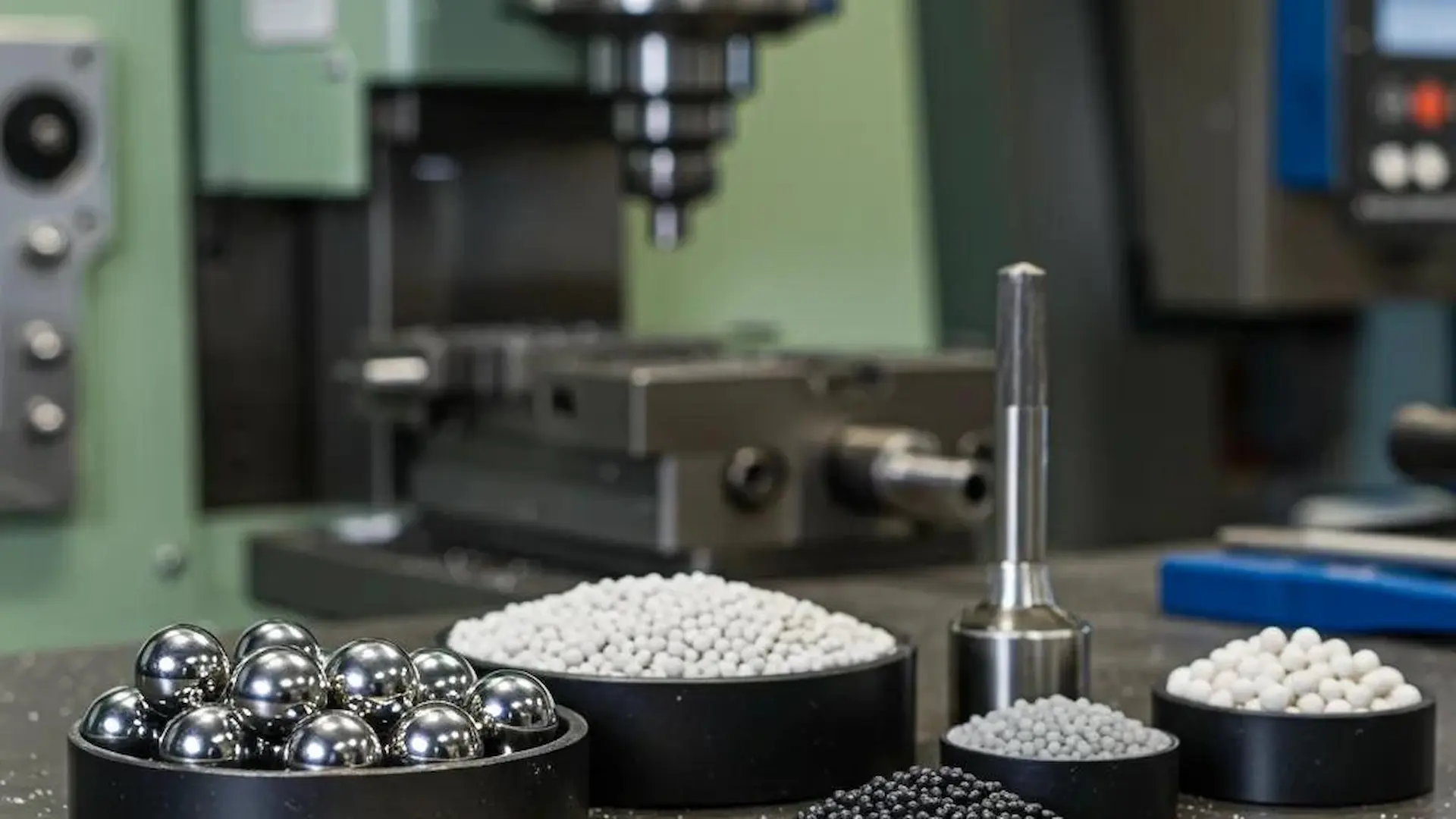
Forged steel balls are produced from steel stock through heating, forming, and heat treatment. Their performance depends on alloy chemistry, manufacturing consistency, and the resulting balance between hardness and toughness.
High chrome grinding balls are generally cast high-chromium iron alloys, although buyers frequently call them "high chrome steel balls." Their wear resistance comes partly from hard chromium carbides within a suitably controlled matrix.
That distinction matters: "forged" describes a manufacturing route, while "high chrome" describes an alloy category. Neither term, by itself, defines finished-product quality.
| Buying consideration | Forged steel balls | High chrome cast balls |
|---|---|---|
| Main selection priority | Balancing impact resistance and abrasive wear | Balancing abrasion and corrosion resistance with sufficient toughness |
| Common evaluation areas | SAG milling and ball milling, using application-specific grades | Secondary ball milling, regrinding, and suitable wet or dry applications |
| Important quality checks | Chemistry, hardness profile, heat treatment, impact performance | Chemistry, carbide structure, matrix condition, casting integrity |
| Main purchasing risk | Selecting hardness without sufficient toughness | Selecting chromium content without checking impact suitability |
| Best proof of value | Representative testing and operating results | Representative testing and operating results |
Treat this comparison as a starting framework, not a universal material ranking.
For mills experiencing substantial impact loads, forged steel grinding balls are often a strong starting point.
However, "forged" does not guarantee resistance to breakage. Ball diameter, alloy design, heat treatment, internal quality, and actual charge behaviour all influence performance.
A grade suitable for one ball mill should not automatically be specified for a demanding SAG mill.
Ask suppliers how their proposed grade addresses your operating conditions, rather than accepting a generic "mining grade" description.
A grinding ball must resist wear while surviving repeated loading.
Excessive emphasis on surface hardness can obscure other weaknesses. Buyers should also examine core properties, hardness distribution, and the suitability of the supplier's impact-testing method.
When reviewing used media, look beyond overall weight loss. Broken pieces, deformation, and surface spalling can reveal performance problems that a simple purchase-price comparison misses.
High chrome grinding media can be attractive where abrasive wear and slurry-related corrosion contribute significantly to consumption.
Their carbide-containing microstructure can provide strong wear resistance. Nevertheless, chromium percentage alone does not determine service life.
Casting quality, heat treatment, carbide distribution, and operating conditions remain important.
The appropriate question is not "What is your highest chromium grade?" It is "Which grade is suitable for our wear mechanism and impact environment?"
Media selection can influence more than consumption.
In wet mineral processing, changes in grinding-media chemistry can affect pulp conditions and downstream flotation behaviour. Potential benefits therefore need to be evaluated alongside grind size, reagent consumption, recovery, and concentrate quality.
Do not assume that results from another copper or gold operation will transfer directly to your ore.
A high chrome trial should test the whole circuit response—not merely whether the balls lose less weight.
"Grinding balls for gold mining" and "grinding media for copper mines" are useful search terms, but they are incomplete purchasing specifications.
Two mines processing the same commodity can have very different requirements.
Before requesting a recommendation, prepare the following:
- Mill type, dimensions, speed, and installed power.
- Current ball sizes, charge composition, and addition practice.
- Feed size distribution and target product size.
- Ore variability, abrasiveness, and available grindability data.
- Wet or dry operation, slurry density, and relevant water chemistry.
- Current media consumption and observed failure patterns.
- Downstream processing requirements, particularly flotation.
- Existing liner configuration and operational constraints.
Where information is missing, identify the gap explicitly. A useful technical discussion starts with known conditions and stated uncertainties—not assumed specifications.
The cheapest delivered tonne of balls may not produce the cheapest tonne of processed ore.
For an initial comparison, calculate:
Media cost per tonne = delivered media price per tonne × media consumption in kilograms per tonne of ore ÷ 1,000.
Consider this illustrative example:
| Item | Option A | Option B |
|---|---|---|
| Delivered media price | US$900/t | US$1,200/t |
| Media consumption | 0.80 kg/t ore | 0.55 kg/t ore |
| Media cost | US$0.72/t ore | US$0.66/t ore |
Option B costs more to purchase but less in media consumption per tonne processed.
These are hypothetical figures, not ALLSTAR prices, customer results, or predicted savings.
The calculation is only the first layer. A fuller comparison should assess:
- Throughput at a comparable product size.
- Energy consumption per tonne.
- Unplanned stoppages and handling requirements.
- Recovery and reagent consumption, where relevant.
- Freight, inventory, and working-capital requirements.
Keep the system boundary consistent. Avoid counting the same production benefit twice under different headings.
A supplier-published Australian gold-mine case study describes a marked-ball test covering 517 mill operating hours, using balls between 90 and 105 mm.
The supplier reported that its 18% chromium cast ball achieved a wear rate 2% below the next-best competitor product. It separately reported a 17% improvement for its 105 mm forged product against the incumbent.
These figures should not be read as a direct conclusion that forged media outperformed high chrome, or vice versa. The comparisons involved different products and baselines.
The useful lesson is methodological: performance claims need a defined comparator, stated test conditions, and a clear measurement basis.
This is an external supplier-reported case—not an ALLSTAR project, independent certification, or performance guarantee.
Record current media consumption, throughput, energy use, product size, and relevant metallurgical results.
Document ore changes, liner condition, operating interruptions, and ball additions. Without this context, an apparent improvement may reflect changing mill conditions rather than better media.
Agree on the candidate grade, ball size, sampling method, and success criteria.
Specify whether the programme evaluates relative wear, operational stability, downstream metallurgy, or a combination.
A marked-ball test can help compare wear. It does not, on its own, establish full-circuit economics or flotation performance.
Changing media does not instantly replace the existing charge.
During transition, old and new media coexist. Record this period and avoid presenting early results as steady-state performance.
Trial duration should reflect charge turnover, measurable wear, ore variability, and the questions being tested—not an arbitrary calendar deadline.
Compare performance at equivalent product quality and sufficiently comparable operating conditions.
Investigate broken or unusually worn balls rather than averaging them away.
A successful trial should produce a purchasing decision supported by evidence, including any limitations or unresolved risks.
A useful grinding media quotation should define the product and how conformity will be checked.
Request agreement on:
- Material designation and chemical composition limits.
- Nominal diameter, dimensional tolerance, and sampling plan.
- Surface and internal hardness requirements.
- Relevant impact or breakage-testing procedures.
- Casting-integrity or internal-quality checks, where applicable.
- Batch identification and traceability.
- Inspection documents and acceptance criteria.
- Packaging, shipment terms, and claims procedures.
Do not compare hardness figures unless measurement locations and methods are compatible.
Likewise, a "low breakage" statement has limited value without a definition, measurement period, operating conditions, and an agreed method for identifying failures.
For OEM orders, confirm which requirements apply to every shipment and which require separate inspection or testing arrangements.
ALLSTAR serves buyers seeking grinding media and OEM supply for mining, cement, and power applications.
For overseas brands, wholesalers, and manufacturers, the purchasing conversation should address both product suitability and commercial consistency.
A productive enquiry begins with your mill conditions, current media specification, required sizes, expected purchasing volume, and destination.
For private-label projects, also provide proposed branding, packaging requirements, document formats, and any destination-market obligations.
Ask us to confirm manufacturing feasibility, available supporting documentation, inspection arrangements, and delivery terms in the quotation. Treat only agreed, documented requirements as part of the supply commitment.
Our recommended approach is straightforward: define the application, compare suitable options, and validate performance before scaling up.
Looking for forged steel grinding balls, high chrome grinding balls, or OEM grinding media?
Send SHANDONG ALLSTAR GRINDING BALL CO., LTD. your mill type, ore characteristics, required ball sizes, current consumption, order quantity, and destination port.
Request a quotation that separates product specifications, inspection requirements, packaging, and commercial terms.
For a new application or material change, include a trial proposal. The objective is not simply to buy balls—it is to select a repeatable supply solution supported by measurable operating results.
Not universally. Forged media often deserves priority under demanding impact conditions. High chrome media may offer advantages in suitable abrasion- and corrosion-sensitive circuits. Confirm the choice through application-specific evaluation.
Yes. Suitable high chrome grades are used in wet grinding. Selection should consider slurry chemistry, ore characteristics, impact conditions, and downstream processing rather than assuming all grades behave alike.
There is no universal optimum. Specify hardness alongside ball size, alloy, measurement location, toughness requirements, and application. A higher surface reading alone does not prove better service performance.
Use feed size, target grind, mill characteristics, and the existing charge distribution as starting inputs. Review the recommendation against operating results; the largest available ball is not automatically the most effective choice.
Include technical specifications, quantities, branding artwork, packaging preferences, documentation requirements, destination, and inspection expectations. Ask the manufacturer to confirm each requirement before treating it as agreed.
No. The cost example is hypothetical, and the published case concerns another supplier. Any performance commitment requires an expressly agreed basis, suitable testing, and clearly defined operating conditions.
1. Molycop. "[Grinding Balls]."
2. Molycop. "[Cast High Chrome Balls]."
3. Magotteaux. "[High-Chrome Grinding Media]."
4. Magotteaux. "[Forged Grinding Media for Mining]."
5. Molycop. "[Beyond Wear Rates: The Broader Role of Grinding Media]."
6. Molycop. "[Top Results in Test of Molycop's Forged and High Chrome Cast Grinding Media]."
7. Molycop. "[Evaluating Grinding Media Performance Using the Ball Mill Abrasion Test: Capabilities and Applications]."


