
Views: 236 Author: shandong Allstar Grinding Ball Publish Time: 2026-10-29 Origin: Site


Content Menu
● Steel Balls for Ball Mill vs Cast Steel Balls: Clarifying the Comparison
● Why Grinding Balls Fracture Prematurely in Hard Rock Mining
>> Impact Fatigue and Internal Defects
>> Spalling and Surface Damage
>> Heat Treatment and Hardness Imbalance
>> Mill Conditions That Exceed the Media's Duty
● Forged vs Cast Grinding Balls: A Practical Comparison
● How to Specify Fracture-Resistant Grinding Media
>> 1. Define the Operating Duty
>> 2. Request More Than Surface Hardness
>> 3. Define an Impact Test That Can Be Compared
>> 4. Establish Traceability and Complaint Procedures
● A Five-Step Investigation for Premature Ball Fractures
>> Step 1: Preserve Representative Evidence
>> Step 2: Separate Wear from Fracture
>> Step 3: Review the Operating Timeline
>> Step 4: Examine Material Condition
>> Step 5: Validate Corrective Action
● Design a Mill Trial That Measures More Than Wear
● Compare Grinding Media Cost per Tonne, Not Purchase Price Alone
● Working with ALLSTAR on an OEM Grinding Media Specification
>> 1. Are forged steel balls always better than cast grinding balls?
>> 2. Does higher hardness prevent grinding ball fractures?
>> 3. Are cast steel balls the same as high-chromium cast iron balls?
>> 4. What should we do first when grinding balls start breaking?
>> 5. Can laboratory impact testing guarantee mill performance?
>> 6. What information should an OEM buyer send ALLSTAR?
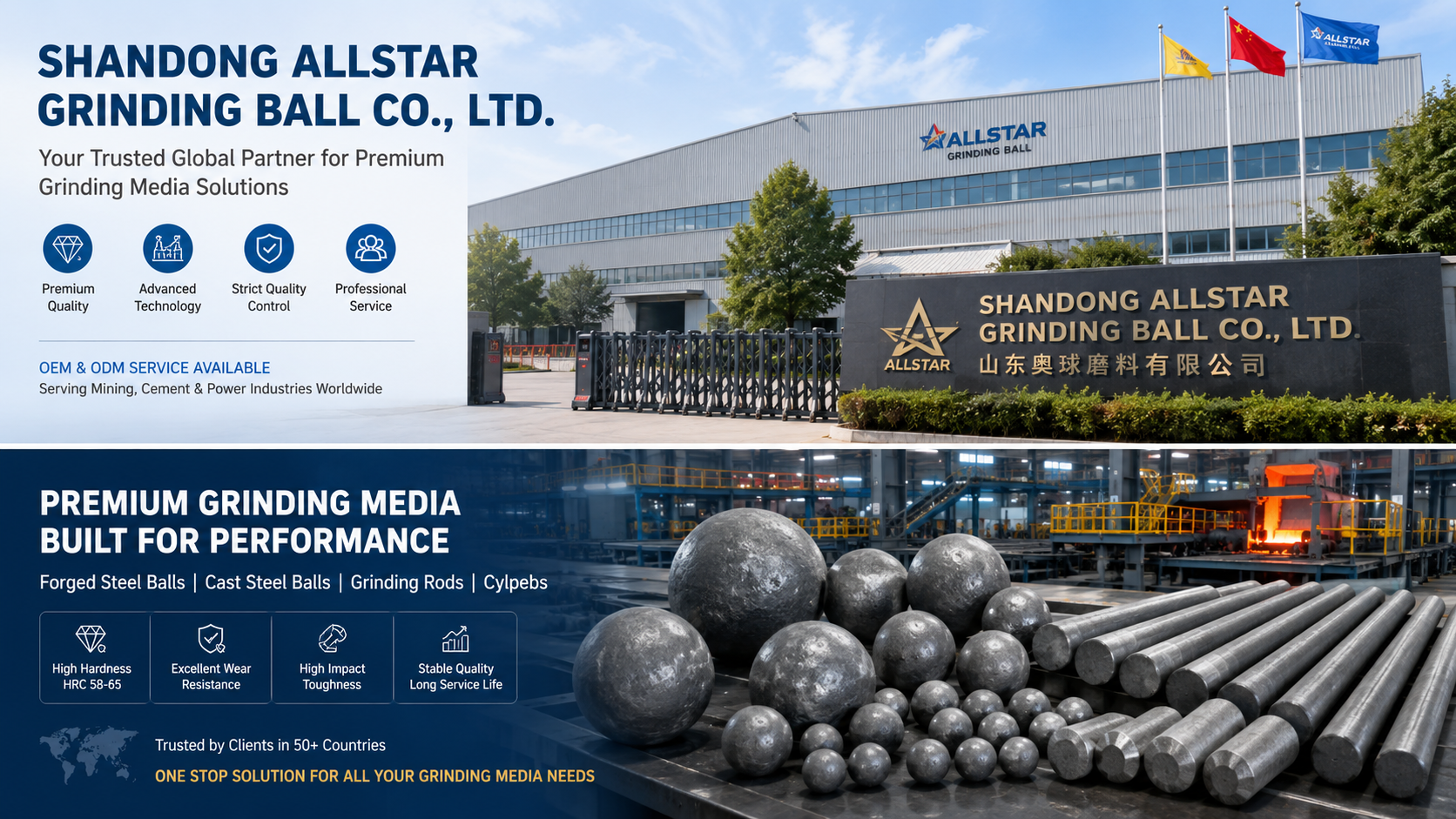
At SHANDONG ALLSTAR GRINDING BALL CO., LTD., we manufacture grinding balls, forged steel balls, cast steel balls, grinding rods, and cylpebs for mining, cement, and power applications. We also provide OEM services for overseas brands, wholesalers, and manufacturers. For buyers comparing steel balls for ball mill vs cast steel balls, our starting point is straightforward: prevent premature fractures by matching the material, manufacturing quality, and operating conditions—not simply the quoted hardness.
In hard rock mining, a grinding ball must survive repeated impacts while resisting abrasive wear. When either requirement is overlooked, apparently economical media can become expensive through broken fragments, unstable charge composition, and additional replacement demand.
This guide explains how to evaluate forged and cast grinding media, investigate early failures, and build a purchasing specification around measurable performance.
The keyword describes a common purchasing question, but the categories overlap. "Steel balls for ball mills" describes an application. "Cast steel balls" describes a material and manufacturing route.
A technically useful comparison separates three groups:
- Forged steel grinding balls, produced from steel stock through forming and heat treatment.
- Cast steel grinding balls, produced by pouring molten steel into molds.
- Cast high-chromium white iron balls, which contain hard carbides and are frequently marketed under broader "chrome steel ball" terminology.
Cast steel and high-chromium white cast iron are not interchangeable descriptions. Their chemistry, carbide content, microstructure, and response to impact can differ substantially.
Before comparing quotations, request the actual alloy designation, chemical composition, manufacturing route, and heat-treatment condition. A product name alone cannot establish whether the media suits your mill.
Hard rock circuits expose media to abrasion, repeated collision, and, in wet grinding, chemical interactions with the slurry. Several mechanisms can operate simultaneously.
Repeated impacts can initiate and extend cracks. Discontinuities such as inclusions, shrinkage defects, or pre-existing cracks may act as initiation sites.
However, a broken ball does not automatically prove a casting defect. Forged media can also fail when steel quality, forming, or heat treatment is unsuitable. Investigate the fracture rather than diagnosing it from the manufacturing label.
Spalling occurs when pieces detach from a ball's surface under repeated loading. It differs from gradual abrasive wear and from a complete split through the ball.
Surface damage may reflect an unsuitable microstructure, residual stresses, or excessive impact severity. Record the appearance and size of recovered fragments before deciding whether the problem is material-related or operational.
Hardness supports abrasion resistance, but hardness alone does not measure fracture resistance.
Two balls with similar surface hardness may have different internal structures, hardness profiles, and impact performance. Increasing hardness without validating toughness can therefore produce the wrong purchasing decision.
Insufficient ore cushioning, unsuitable charge conditions, or changes in liner geometry can alter collision severity.
A batch that performs acceptably under stable operation may encounter a different duty after an operating change. Check mill records alongside laboratory results instead of treating supplier quality and mill operation as separate investigations.
| Selection factor | Forged steel balls | Cast steel or high-chromium cast media |
|---|---|---|
| Main evaluation priority | Steel cleanliness, forming quality, heat treatment, and impact performance | Exact alloy family, casting integrity, heat treatment, and impact suitability |
| Potential advantage | Well-suited grades can provide strong impact resistance | Selected high-chromium grades can offer strong abrasion and corrosion resistance |
| Important limitation | Forging does not eliminate material or heat-treatment defects | Cast steel and white cast iron must not be treated as equivalent |
| Essential verification | Hardness profile, microstructure, repeated-impact behavior | Chemistry, internal soundness, hardness profile, and repeated-impact behavior |
| Final selection basis | Controlled performance in the intended circuit | Controlled performance in the intended circuit |
For severe impact duty, forged steel grinding balls are a sensible candidate to evaluate. For suitable abrasion- and corrosion-dominated applications, high-chromium cast media deserve consideration.
Neither statement establishes a universal winner. Ball diameter, ore characteristics, slurry chemistry, and mill operation can change the outcome.
A useful specification describes what must be supplied, how it will be inspected, and what constitutes acceptance.
Provide prospective suppliers with:
- Mill type, diameter, and operating speed.
- Ball size distribution and charging practice.
- Feed top size and relevant ore variability.
- Wet or dry grinding conditions.
- Slurry solids concentration and available chemistry data.
- Existing media consumption and observed failure patterns.
- Liner configuration and recent operating changes.
Distinguish ball mill service from SAG mill service. Both involve grinding media, but their impact environments and selection priorities are not identical.
Ask for representative surface-to-center hardness measurements, supported by an agreed test method and sampling plan.
The objective is not necessarily identical hardness everywhere. It is a controlled, application-appropriate profile consistent with the selected alloy and heat treatment.
Avoid applying one hardness specification indiscriminately across every diameter and material family.
"Passed a drop test" is incomplete information.
Specify ball diameter, impact arrangement, drop height or equivalent loading conditions, number of impacts, sample size, and failure criteria. State whether surface spalling, visible cracking, or complete fracture counts as failure.
Results from different procedures should not be presented as directly equivalent.
Request traceable batch identification and corresponding inspection records. Agree on sample retention, complaint notification, and failure-analysis responsibilities.
For OEM grinding media buyers, connect packaging identification with production records. Commercial branding should not obscure the information needed to investigate a failed lot.
When breakage rises unexpectedly, use a structured investigation rather than immediately replacing every media grade.
Collect intact worn balls, cracked balls, and fragments from the affected period. Record recovery location, approximate service exposure, ball diameter, and batch information where available.
Follow site isolation and handling procedures. Never retrieve samples from operating equipment.
Classify samples into gradual wear, surface spalling, major cracking, and complete fracture.
Use consistent photographs with scale references. A collection of mixed fragments without context rarely supports a reliable root-cause conclusion.
Compare the onset of failures with changes in feed, speed, charge, liner condition, slurry conditions, or media supply.
A sudden failure increase after an operating change requires a different investigation from repeated failures isolated to one delivery.
Use a competent laboratory to evaluate chemistry, hardness distribution, microstructure, and fracture surfaces as appropriate.
The investigation should test competing explanations. A visible internal discontinuity may matter, but its role must be assessed alongside crack origin and loading conditions.
Trial the proposed correction under documented conditions. This may involve a revised alloy, heat treatment, ball size, or operating practice.
Change as few variables as practical. Otherwise, an improvement may be real without revealing which intervention caused it.
A marked-ball trial can help compare wear behavior, but it should not stand alone as proof of plant-wide economic performance.
Track the following:
| Metric | What it helps establish |
|---|---|
| Media consumption, kg/t | Replacement demand relative to processed ore |
| Fragment recovery and sampling observations | Evidence of fracture or spalling |
| Throughput, t/h | Whether production remains comparable |
| Product size, including P80 | Whether grinding duty remains comparable |
| Specific energy, kWh/t | Energy demand per tonne processed |
| Ore and operating conditions | Whether the comparison is reasonably controlled |
P80 is the particle size below which 80% of the measured material passes.
Allow for the existing charge when changing media. A mixed charge can delay interpretation of the replacement product's performance. Establish a suitable assessment period with the plant's technical team rather than promising a universal trial duration.
Also define the denominator for any "breakage rate." Counts, recovered fragment mass, and delivered media mass describe different things.
The most useful commercial question is not "Which ball costs less per tonne delivered?" It is "Which option delivers the required grinding result at the lowest defensible operating cost?"
For the media-only component:
Media cost per tonne of ore = delivered media price per kilogram × media consumption in kilograms per tonne of ore.
Consider this hypothetical example:
- Option A costs $1.00/kg and consumes 0.80 kg/t: $0.80/t of ore.
- Option B costs $1.15/kg and consumes 0.65 kg/t: approximately $0.75/t of ore.
The higher-priced option has a lower media-only cost in this illustration. These figures are not ALLSTAR product results or a customer case study.
A broader assessment should also consider measured effects on energy, maintenance, throughput, and downstream performance. Do not assign financial savings to those categories unless the trial actually demonstrates them.
ALLSTAR's product range gives overseas buyers a starting point for discussing forged and cast balls, grinding rods, and cylpebs across different applications.
Our recommended purchasing approach is verification: establish the duty, document the proposed specification, agree on inspection requirements, and validate performance before scaling supply.
For brand owners and wholesalers, the OEM discussion should cover:
- Product designation and agreed technical limits.
- Inspection methods and sampling responsibilities.
- Batch identification and packaging requirements.
- Trial quantities and acceptance criteria.
- Documentation needed for repeat orders.
These are specification topics to confirm during quotation, not substitutes for verified factory records.
Contact SHANDONG ALLSTAR GRINDING BALL CO., LTD. with your mill details, current ball sizes, ore characteristics, and failure photographs. Request a quotation that identifies the proposed material, available inspection documentation, and an agreed route for trial evaluation.
No. Forged steel is often a strong candidate for impact-intensive service, while suitable cast high-chromium media can perform well where abrasion and corrosion are important. Selection requires application-specific evidence.
Not necessarily. Hardness relates to wear resistance, but fracture behavior also depends on microstructure, defects, residual stresses, and impact loading. Evaluate hardness together with impact performance.
No. They are different material categories. Ask for chemistry and material identification rather than relying on a commercial product name.
Preserve representative samples and review the operating timeline. Classify the damage before commissioning laboratory analysis or changing media specifications.
No. It provides useful comparative evidence under defined conditions. Actual mill service combines impact, abrasion, slurry chemistry, and operating variability, so field validation remains necessary.
Provide the application, mill details, ball sizes, annual demand, current media specification, operating conditions, and observed problems. Include required packaging and documentation so the quotation addresses both technical and commercial needs.
Hot Tags: China, Global, OEM, private label, manufacturers, factory, suppliers, manufacturing company


