
Views: 247 Author: shandong Allstar Grinding Ball Publish Time: 2026-10-13 Origin: Site


Content Menu
● What Are Cylpebs and Grinding Balls?
● Why the Decision Matters in Cement Grinding
● When Grinding Balls Are the Better Choice
● When Cylpebs Are the Better Choice
● Expert Framework: 7 Checks Before Selecting Media
● A Practical Selection Table for Cement Plants
● The Case for a Mixed Grinding Charge
● Quality Factors That Matter More Than Shape Alone
● What Cement Plant Users Value Most
● Recommended Decision Process
● Talk to a Grinding Media Specialist
>> 1. Are cylpebs better than balls for cement fine grinding?
>> 2. Can I replace all grinding balls with cylpebs in a cement mill?
>> 3. What size cylpebs are used for cement grinding?
>> 4. Do cylpebs reduce grinding-media consumption?
>> 5. Should cement plants use forged steel balls or cast high-chrome balls?
>> 6. How long should a cylpeb or ball trial run?
Choosing between cylpebs and grinding balls for fine cement grinding is not a simple "which is better" decision. The right answer depends on your clinker characteristics, target Blaine fineness, mill configuration, separator performance, power cost, and total media-consumption economics.
As a manufacturer serving cement, mining, and power plants worldwide, Shandong Allstar Grinding Ball Co., Ltd. recommends treating media selection as a process-optimization project—not merely a purchase decision. In our experience supplying OEM grinding media to international brands, wholesalers, and cement producers, the strongest results usually come from matching media shape, size distribution, hardness, and wear resistance to the specific grinding stage.
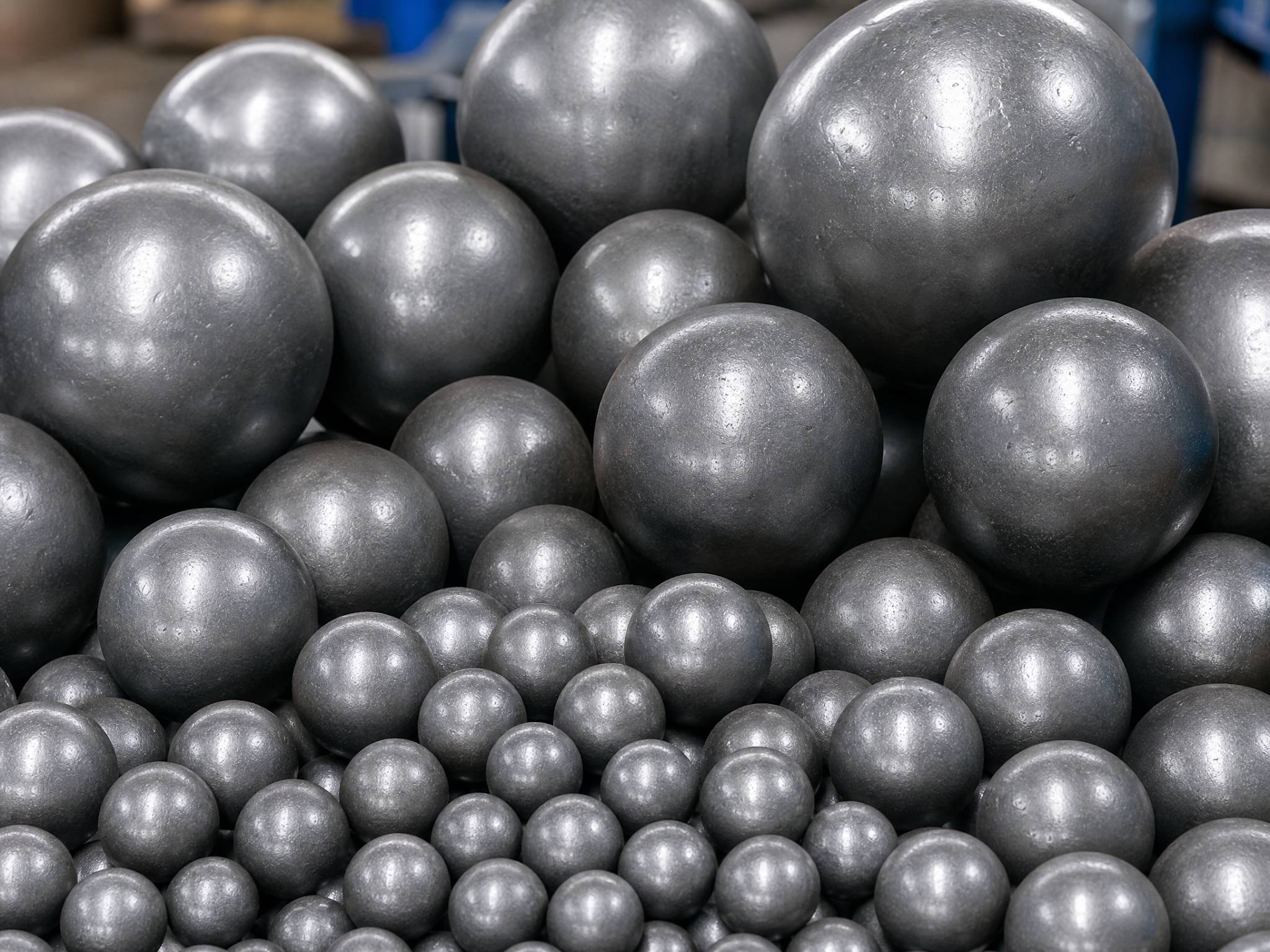
Grinding balls are spherical media used in ball mills. They transfer energy through impact, attrition, and rolling contact. Their round geometry makes them versatile across coarse, intermediate, and fine grinding applications.
Cylpebs are short cylindrical grinding media with rounded edges. They sit between balls and rods in terms of geometry. Compared with balls of similar mass, cylpebs generally provide greater surface-contact area and higher packing density, which can improve fine-particle breakage and product uniformity.
| Feature | Grinding Balls | Cylpebs |
|---|---|---|
| Shape | Spherical | Short cylinder with rounded edges |
| Contact mode | Point and rolling contact | Line and surface contact |
| Surface area per mass | Moderate | Higher |
| Impact energy | Stronger | Lower per contact |
| Best-fit stage | Coarse to fine grinding | Intermediate and fine grinding |
| Product shape control | Good | Often more uniform |
| Risk in coarse feed | Lower | Higher packing/bridging risk |
| Typical cement use | First and second chambers | Primarily second chamber/fine grinding |
Published comparative research notes that cylpebs and balls differ in surface area, bulk density, and contact mechanism, and that these differences influence grinding behavior. A peer-reviewed fine-grinding study also reports that cylpebs can produce a product distribution with slightly less oversize material than balls under comparable conditions.
Cement grinding is energy-intensive. The final fineness, particle-size distribution, mill throughput, and specific power consumption all depend heavily on the grinding charge.
In a typical two-compartment cement ball mill, the first chamber mainly handles coarse clinker breakage. It requires sufficient impact energy. The second chamber focuses on fine grinding and shaping the final particle-size distribution. This is where the cylpebs-versus-balls question becomes most important.
Research on clinker grinding shows that grinding-media movement, filling degree, and collision behavior directly affect the final granulometry of the product. In practical terms, a media choice that improves fine contact can support better fineness control—but only if the mill's power draw, ventilation, separator, and liner design can support it.
Key point: Cylpebs are not automatically more efficient. They are more efficient only when the grinding task is contact-dominated rather than impact-dominated.
Choose steel grinding balls when your priority is impact breakage, operational flexibility, or coarse-to-intermediate grinding.
Balls are usually preferable when:
- The feed contains coarse clinker, hard inclusions, or variable moisture.
- The mill's first chamber requires high impact energy.
- Throughput is the primary KPI.
- The separator is struggling with coarse residue.
- You need a simpler, more forgiving media gradation.
- The mill operates with fluctuating feed rates or frequent start-stop cycles.
Forged steel balls are often favored where toughness and resistance to breakage matter. Cast high-chrome balls can offer strong abrasion resistance in suitable applications. The correct metallurgy should match the wear mechanism: abrasion, impact, corrosion, or a combination of these. Magotteaux similarly emphasizes that grinding-media selection must consider the material, process, and dominant wear mechanisms.
From our OEM production experience, cement plants that prioritize stable first-chamber performance often continue using a graded ball charge, while using smaller balls or cylpebs selectively in the final grinding zone.
Choose cylpebs when the main challenge is achieving a finer, more consistent product with controlled residue and improved surface-area generation.
Cylpebs are often advantageous when:
- The application is second-chamber or finish grinding.
- The target is higher Blaine fineness or a narrower particle-size distribution.
- Oversize particles are a recurring quality issue.
- The mill has stable feed and consistent operating conditions.
- The existing ball charge delivers adequate impact but insufficient fine-grinding contact.
- The plant wants to reduce media consumption without sacrificing wear life.
Cylpebs' flat and line-contact surfaces increase the grinding surface available to the material. Industry guidance describes them as particularly suitable for secondary and fine-grinding circuits, where greater contact area can improve particle-size reduction.
However, cylpebs should not be treated as a universal replacement for balls. Their lower individual impact energy can be a disadvantage when coarse particles must be broken quickly.
Use this practical framework before changing your grinding charge.
1. Define the bottleneck. Is the problem low throughput, high residue, insufficient Blaine, high power consumption, or excessive media wear?
2. Review feed characteristics. Measure clinker hardness, feed size, moisture, and the proportion of gypsum, limestone, or other additives.
3. Audit the mill. Check compartment lengths, liner profile, ventilation, filling degree, and whether the current charge is worn or unbalanced.
4. Analyze the separator. A media change cannot compensate for a poorly performing separator or incorrect circulating load.
5. Set measurable targets. For example: increase Blaine by a defined range, reduce residue on a specified sieve, maintain throughput, or lower kWh/ton.
6. Run a controlled trial. Change only one major variable at a time where possible, and compare results over a representative production period.
7. Calculate total cost, not unit price. Include media price, wear rate, power, downtime, labor, and quality gains.
This approach reflects the principle behind modern ball-charge optimization: correct media size, composition, and quantity are essential for efficient mill operation.
| Plant situation | Recommended direction | Why |
|---|---|---|
| Coarse clinker, low first-chamber breakage | Larger forged or high-chrome balls | Higher impact energy |
| Stable feed, target higher Blaine | Cylpebs or smaller balls in final chamber | More contact area |
| High residue despite adequate power | Review separator and fine-media gradation | Classification may be limiting |
| High media breakage | Tougher forged balls or adjusted alloy | Impact resistance matters |
| High abrasion, low impact | High-chrome cast media or hardened forged media | Wear resistance matters |
| Need more uniform cement particles | Consider cylpebs in fine-grinding zone | Better surface contact |
| Frequent feed variation | Balls or mixed charge | More operational flexibility |
In many cement mills, the best solution is neither "balls only" nor "cylpebs only." A mixed or graded charge can combine the strengths of both media types.
For example, a plant may retain balls in the first chamber for impact breakage, then introduce cylpebs or smaller balls in the second chamber to improve fine-grinding contact. This strategy can help balance:
- Impact energy for coarse clinker
- Surface contact for fine cement particles
- Media wear distribution across the mill
- Product fineness and particle-size distribution
- Power consumption and throughput
Industry selection guidance also notes that mixed charges can be used where balls handle high-load impact duty while cylpebs contribute additional grinding surface for consistent clinker fineness.
Media shape is important, but it is only one part of the equation. Two cylpebs or two balls with the same dimensions can perform very differently if their metallurgy, heat treatment, and dimensional consistency differ.
When evaluating suppliers, request:
- Chemical composition certificate
- Hardness range and hardness distribution
- Impact toughness or drop-test data
- Microstructure information, where relevant
- Dimensional tolerance and ovality limits
- Wear-rate data from comparable cement applications
- OEM customization capability
- Consistent supply and traceability
At Shandong Allstar Grinding Ball Co., Ltd., we manufacture grinding balls, forged steel balls, cast steel balls, grinding rods, and cylpebs for cement, mining, and power applications. For OEM customers, we focus not only on meeting specified dimensions and hardness, but also on helping buyers align media specifications with their real operating conditions.
Feedback from cement-plant buyers and maintenance teams tends to focus on four practical outcomes:
- Stable quality: Consistent hardness and dimensions reduce unexpected wear patterns.
- Lower unplanned downtime: Media that cracks, deforms, or wears unevenly disrupts production.
- Clear technical support: Buyers want help interpreting mill data, not just a price list.
- Customization: Different mills, clinker sources, and fineness targets require different solutions.
One recurring lesson from customer discussions is that the lowest quoted price does not always deliver the lowest cost per ton of cement. A media type with a slightly higher initial cost may be preferable if it reduces breakage, stabilizes fineness, or extends the replenishment interval.
- Changing media shape without reviewing separator performance. Fine grinding improvements can be masked by classification limitations.
- Using cylpebs where high impact is required. They are generally better suited to fine and secondary grinding than primary coarse breakage.
- Focusing only on hardness. Excessive hardness without adequate toughness can increase breakage risk.
- Ignoring filling degree. Media filling degree affects collision frequency, power draw, and grinding efficiency; published cement-mill work commonly references filling degrees in the roughly 28–35% range for ball charges.
- Comparing price per ton rather than cost per ton of cement. Wear rate, power, quality, and downtime determine the real result.
- Copying another plant's charge. Two mills with similar capacity can require different media because of different clinker, liners, separators, and targets.
1. Collect at least 2–4 weeks of baseline data: throughput, Blaine, sieve residue, kWh/ton, media consumption, and mill sound/power trend.
2. Identify whether the constraint is impact, contact area, classification, ventilation, or media wear.
3. Select a trial media strategy: balls, cylpebs, or a mixed charge.
4. Define success criteria before the trial begins.
5. Monitor results under comparable operating conditions.
6. Adjust gradation gradually rather than making a full-charge change immediately.
7. Document the final specification for repeatable procurement and OEM supply.
If you are evaluating cylpebs versus balls for fine cement grinding, do not rely on generic recommendations. Send Shandong Allstar Grinding Ball Co., Ltd. your mill details, target fineness, current media specification, and operating challenges. Our technical team can help review your application and propose a suitable OEM grinding-media solution.
Contact our team today for a customized grinding-media selection consultation.
Cylpebs are often better for fine grinding because they provide more surface contact and can support a more uniform particle-size distribution. However, balls remain better where high impact energy is needed, especially in the first chamber or with coarse clinker feed.
Usually, no. A complete replacement can reduce impact breakage and create issues if the mill was designed around a ball charge. A safer approach is to test cylpebs in the fine-grinding chamber or use a controlled mixed charge.
The correct size depends on mill design, feed size, target fineness, and current charge gradation. Fine-grinding applications generally use smaller media than coarse-grinding chambers, but the final specification should be based on mill audit and trial data rather than a universal size chart.
They can reduce consumption in suitable fine-grinding applications because their shape increases contact efficiency. But actual consumption depends on alloy quality, hardness, toughness, clinker abrasiveness, and mill conditions.
Forged balls are commonly selected where impact resistance and toughness are priorities. Cast high-chrome balls may be preferred where abrasion resistance is the dominant requirement. The correct choice depends on the wear mechanism and mill operating conditions. [magotteaux]
A meaningful trial should normally cover several weeks of stable production, allowing the plant to compare throughput, fineness, power consumption, and media wear against a reliable baseline.
- [Comparison of grinding media – Cylpebs versus balls, UQ eSpace]
- [A Comparison of the Fine-Grinding Performance between Cylpebs and Balls, MDPI Minerals]
- [Experimental study of clinker grinding in a ball mill, Springer]
- [Computation of charging media for a double compartment cement ball mill, ScienceDirect]
- [Grinding Media, Magotteaux]
- [Choice of grinding media, Magotteaux]
- [Cement Factory Grinding Media, Infinity for Cement Equipment]
- [Grinding Media Selection Guide, Strategic Industries]
Hot Tags: China, Global, OEM, private label, manufacturers, factory, suppliers, manufacturing company


