
Views: 220 Author: shandong Allstar Grinding Ball Publish Time: 2026-10-29 Origin: Site


Content Menu
● High Chrome Steel Balls vs Cast Iron Grinding Balls: Define the Materials First
● What "Wet Cement Grinding" Means for Media Selection
● Why Grinding Media Consumption Increases in Wet Mills
>> Abrasion Continuously Removes Metal
>> Corrosion and Abrasion Can Reinforce Each Other
>> Impact Damage Produces a Different Consumption Problem
● When High-Chromium Grinding Balls Are Worth Testing
● Measure Media Consumption with an Inventory-Corrected Balance
● A Practical Six-Step Mill Trial
>> 1. Establish a Representative Baseline
>> 2. Define the Candidate Alloy
>> 3. Control the Main Variables
>> 5. Inspect More Than Weight Loss
>> 6. Apply Predefined Acceptance Criteria
● Calculate Cost per Tonne Before Approving a Premium Alloy
● Build a Better OEM Grinding Media Specification
● Improve Charge Management Before Blaming the Alloy
● Discuss Your Wet-Grinding Media Requirements with ALLSTAR
>> 1. Are high chrome steel balls actually steel?
>> 2. Do high-chromium balls always consume less than cast iron balls?
>> 3. What is the best measure of grinding media performance?
>> 4. Can chromium content alone predict service life?
>> 5. How long should a media trial last?
>> 6. Can ALLSTAR supply OEM grinding media?
SHANDONG ALLSTAR GRINDING BALL CO., LTD. manufactures grinding balls, forged steel balls, cast steel balls, grinding rods, and cylpebs for mining, cement, and power applications. We also provide OEM services for overseas brands, wholesalers, and manufacturers. When evaluating high chrome steel balls vs cast iron grinding balls for minimizing media consumption in wet cement grinding, our starting point is simple: select the material that delivers the lowest verified cost per tonne—not merely the lowest purchase price.
High-chromium grinding media can offer an advantage where abrasion and corrosion drive metal loss. However, that advantage depends on alloy quality, heat treatment, slurry chemistry, impact conditions, and charge management.
This guide explains how to compare media correctly, measure consumption fairly, and build a purchasing specification that supports repeatable performance.

A reliable comparison begins with terminology. "High chrome steel balls" is a common purchasing term, but many products sold under that label are metallurgically high-chromium white cast iron rather than steel.
Consequently, "high chrome versus cast iron" is not always a comparison between separate material families. High-chromium grinding balls can themselves be cast iron.
For this article, the practical comparison is between:
- High-chromium, heat-treated cast grinding balls designed for abrasion and corrosion resistance.
- Conventional lower-chromium cast iron grinding balls offered for the same milling duty.
Ordinary gray cast iron should not be treated as equivalent to engineered white iron grinding media. Buyers should request chemical composition, microstructure, and heat-treatment information instead of relying on commercial names.
| Selection factor | High-chromium cast grinding balls | Lower-chromium cast iron grinding balls |
|---|---|---|
| Wear-resisting structure | Typically hard chromium carbides supported by a heat-treated matrix | Depends on alloy chemistry and heat treatment |
| Abrasive service | Strong candidate when correctly specified | May remain economical in less demanding conditions |
| Corrosive wet service | Potential advantage; requires slurry-specific validation | May experience greater corrosion-related loss |
| Impact tolerance | Must be checked against mill conditions | Also grade- and process-dependent |
| Purchasing decision | Verify savings against the price premium | Verify whether lower price offsets consumption |
Neither category guarantees low breakage or low consumption without manufacturing control and application testing.
Before recommending grinding balls, establish what the mill actually processes.
In cement manufacturing, wet grinding commonly refers to preparing raw-material slurry before kiln processing. Finished cement is generally produced by grinding clinker with gypsum and other constituents, rather than by treating the final cement as a conventional aqueous slurry.
Other duties may involve wet limestone grinding or wet processing of supplementary materials. These applications do not necessarily share the same wear environment.
A useful application brief should identify:
- Feed materials and their abrasive mineral content.
- Mill type, dimensions, speed, and liner configuration.
- Feed and target product particle sizes.
- Slurry solids concentration and water chemistry.
- Current media sizes, consumption, and breakage history.
This distinction matters because a recommendation for a wet raw mill should not automatically become a specification for a dry cement finish mill.
Hard particles slide, roll, and press against the balls. Their hardness, shape, and size relative to the media influence wear.
High-chromium white iron uses hard carbides to resist this action. However, those carbides need adequate matrix support. A poorly controlled microstructure can lose material despite an impressive surface-hardness reading.
Our purchasing perspective is straightforward: hardness is useful evidence, but it is not a complete performance specification.
Water introduces an electrochemical component to wear. Slurry chemistry, dissolved oxygen, temperature, and mineral composition can influence the response.
Abrasion can remove surface films and expose fresh metal. Corrosion can weaken the surface before further mechanical removal occurs. The combined loss may therefore differ from what a dry abrasion test predicts.
High-chromium media can resist this environment better in suitable applications, but "high chrome" does not mean corrosion-proof.
Cracking, spalling, and fragmentation are not simply faster versions of normal wear.
Large feed particles, excessive impact energy, unsuitable ball sizes, casting defects, or inappropriate heat treatment can produce premature failure. In these circumstances, choosing a harder ball without checking toughness may worsen the result.
Inspect worn media as well as weighing it. Rounded, uniformly worn balls tell a different story from fractured balls and sharp fragments.
High-chromium media deserves serious evaluation when:
- Existing balls wear rapidly without excessive catastrophic breakage.
- The slurry creates a meaningful corrosion component.
- Feed minerals produce persistent abrasive wear.
- Frequent additions make charge control difficult.
- Media expenditure justifies a controlled comparison.
Lower-chromium media may remain competitive when the duty is relatively mild, the existing product performs consistently, or the premium alloy does not produce enough savings.
Where severe impact dominates, the comparison should also consider appropriately specified forged media rather than forcing a choice between two cast grades.
The objective is verification: match metallurgy to the dominant failure mechanism, then confirm the result under representative operating conditions.
A common evaluation mistake is dividing purchased balls by production without correcting for changes in the mill charge.
Use a consistent mass balance:
Media consumption (kg/t)=Mstart+Madded−Mend−Mremoved/Tdry solids
Here:
Mstart: starting media inventory.
media added during the test.
ending media inventory.
media deliberately removed and accounted for.
dry solids processed during the same period.
Keep recovered fragments and reusable balls in clearly defined categories. Otherwise, one trial may count breakage losses differently from another.
The denominator matters too. Tonnes of slurry are not equivalent to tonnes of dry solids. Changing slurry concentration can distort the apparent result if production is recorded on a wet basis.
When inventory cannot be measured accurately, acknowledge the uncertainty instead of presenting the consumption figure as exact.
Record current consumption, throughput, specific energy, product fineness, slurry properties, feed characteristics, and visible media failures.
Use stable operating periods rather than selecting an unusually favorable shift.
Agree on composition, diameter tolerance, heat treatment, hardness testing locations, and acceptance criteria.
Identify the supplied batch so that laboratory results and mill performance remain traceable.
Keep feed characteristics, target fineness, charge level, and operating conditions as comparable as practical.
Record unavoidable changes. A softer feed or coarser product can create an apparent media improvement that the alloy did not cause.
Adding a new grade to an existing charge does not immediately create a mill filled with that grade.
Mixed-charge results can reflect both materials and their interaction. Plan a transition period, or use a specialist-designed comparative test where appropriate. Do not assume a short trial represents long-term steady-state performance.
Track breakage, spalling, size distribution, liner condition, and product quality alongside consumption.
Photographs of recovered media, supported by consistent inspection procedures, can help distinguish normal wear from premature failure.
Set the decision rules before reviewing results.
A successful candidate should reduce the agreed cost metric while maintaining acceptable throughput, fineness, energy use, and mechanical reliability. Avoid approving a product solely because one consumption number improved.
The following example is hypothetical. It illustrates a purchasing calculation, not an ALLSTAR customer result.
| Measure | Existing lower-chromium media | Candidate high-chromium media |
|---|---|---|
| Delivered price | $900/t | $1,200/t |
| Verified consumption | 0.80 kg/t | 0.50 kg/t |
| Media cost per tonne processed | $0.72 | $0.60 |
In this example, consumption falls by 37.5%, while media expenditure falls by approximately 16.7%. The reductions differ because the candidate costs more per tonne purchased.
The break-even consumption for the candidate is:
0.80×900/1200=0.60 kg/t
At these assumed prices, consumption must fall below 0.60 kg/t to reduce media purchase cost.
A complete commercial assessment should also consider freight, inventory, handling, downtime, energy, and any measurable product-quality effects. Include those benefits only when the trial supports them.
For OEM buyers, wholesalers, and manufacturers, consistency between shipments matters as much as one successful sample.
A useful specification should cover:
1. Material designation and agreed chemical composition.
2. Ball sizes and dimensional tolerances.
3. Heat-treatment condition and microstructural requirements.
4. Hardness range, test method, and measurement positions.
5. Internal-soundness and defect acceptance criteria.
6. Agreed impact or breakage evaluation procedures.
7. Batch identification, packaging, and inspection documentation.
8. A defined process for investigating nonconforming shipments.
Ask for representative sampling rather than an isolated "best ball." Where necessary, use independent inspection or laboratory verification.
SHANDONG ALLSTAR GRINDING BALL CO., LTD.'s OEM offering provides a starting point for discussing these requirements. Buyers should confirm the exact grade, available documentation, and acceptance arrangements for each order.
Even well-selected media can perform poorly in a badly managed charge.
Review whether:
- The top ball size suits the feed.
- The charge contains excessive worn or undersized balls.
- Replenishment maintains the intended size distribution.
- Mill filling and speed remain within operating requirements.
- Liners and internal components are in suitable condition.
- Slurry concentration or feed conditions fluctuate significantly.
Changing alloy, ball size, and operating conditions simultaneously makes the result difficult to interpret.
A better approach is to establish stable operation first, then introduce changes systematically. This separates the benefit of improved charge management from the benefit of a new material.
The best grinding ball is not universally the hardest, most expensive, or highest-chromium product. It is the product that maintains the required grinding performance at the lowest verified operating cost.
For a focused OEM or supply discussion with SHANDONG ALLSTAR GRINDING BALL CO., LTD., prepare your mill specifications, feed details, slurry conditions, current media grade, consumption records, and target product fineness.
Request an application-specific quotation and agree on trial criteria before committing to a full conversion. This gives technical teams and purchasing teams a shared basis for evaluating value.
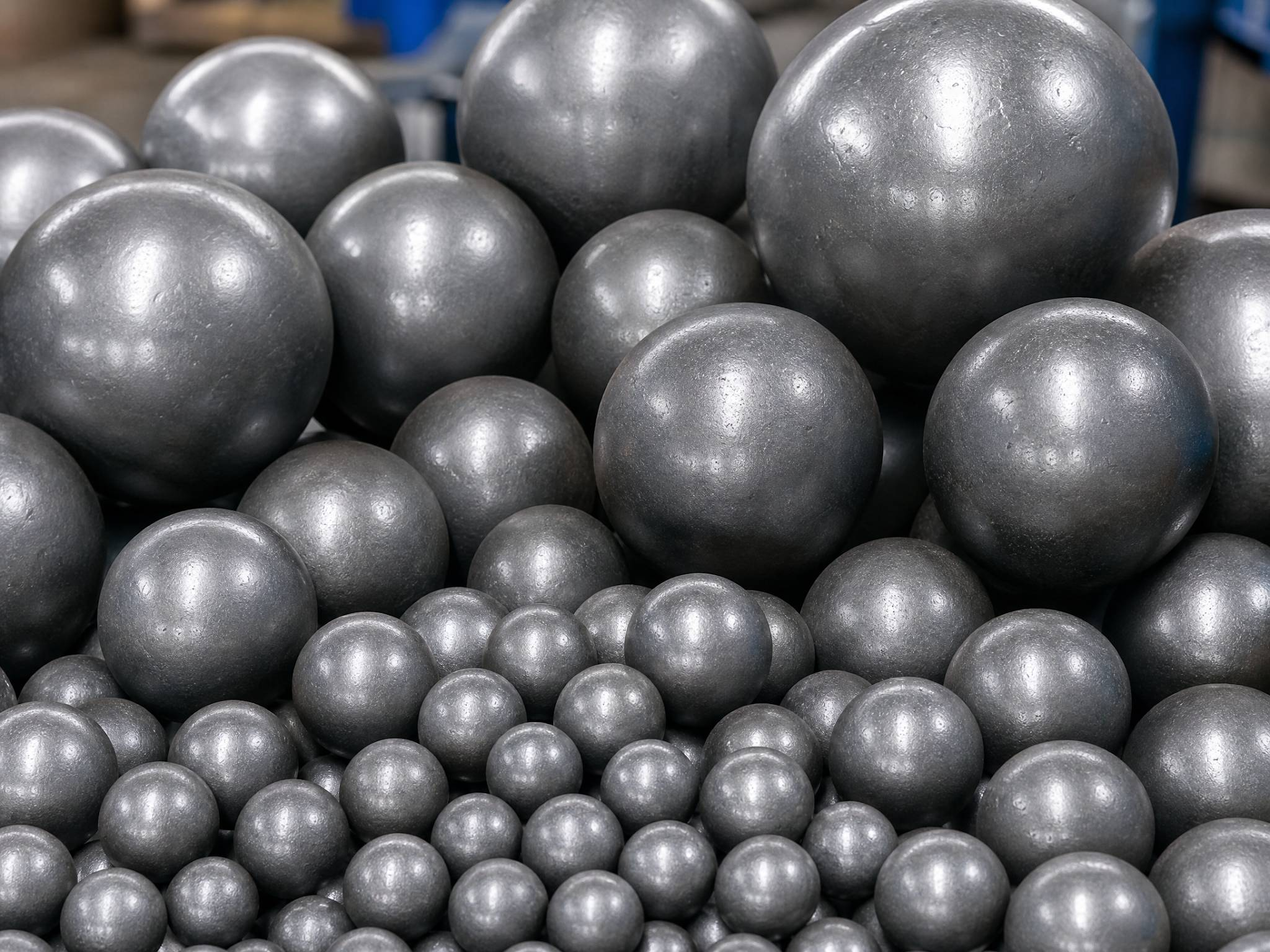
Not always. Many commercially named high chrome steel grinding balls are high-chromium white cast iron. Confirm the material through composition and metallurgical documentation rather than the product name.
No. High-chromium balls are often cast iron themselves. Compared with lower-chromium alternatives, they may reduce wear in suitable abrasive or corrosive duties, but impact conditions and manufacturing quality can change the outcome.
Use inventory-corrected kilograms per tonne of dry solids, alongside cost per tonne, breakage, throughput, fineness, and energy. No single indicator captures the full operating result.
No. Carbide structure, matrix condition, heat treatment, casting quality, and the operating environment also matter. A chromium percentage is a purchasing parameter, not a guaranteed service-life figure.
There is no universal duration. The trial must provide measurable loss under representative conditions and account for the existing charge. Agree on duration, transition requirements, and measurement accuracy before starting.
According to the company information provided, SHANDONG ALLSTAR GRINDING BALL CO., LTD. offers OEM services for overseas brands, wholesalers, and manufacturers. Confirm product grades, order requirements, documentation, packaging, and inspection arrangements directly during quotation.
Hot Tags: China, Global, OEM, private label, manufacturers, factory, suppliers, manufacturing company


