
Views: 297 Author: shandong Allstar Grinding Ball Publish Time: 2026-11-03 Origin: Site


Content Menu
● Why Particle Size Uniformity Matters in Gravity Concentration
>> Define Uniformity Beyond a Single P80 Number
● Grinding Steel Ball vs Grinding Rod: The Practical Differences
>> Why Grinding Rods Can Reduce Unwanted Fines
>> Why Grinding Steel Balls Remain Important
● How to Choose Grinding Media for Your Gravity Feed
>> Choose Rod Grinding When Coarse Liberation Is Sufficient
>> Choose Ball Grinding When Finer Liberation Is Necessary
>> Consider Staged Grinding Instead of One Aggressive Step
● A Six-Step Test Plan Before Buying Grinding Media
>> 1. Set the Separator's Feed Requirements
>> 2. Characterize Representative Ore
>> 3. Design Comparable Grinding Tests
>> 4. Measure the Full Product Distribution
>> 5. Run Gravity Tests on the Products
>> 6. Validate Under Stable Plant Conditions
● Why Classification Can Matter as Much as Media Shape
>> Do Not Treat Every Fine Particle as a Loss
● Grinding Media Quality and OEM Procurement
>> What to Specify for Grinding Steel Balls
>> What to Specify for Grinding Rods
>> Build OEM Requirements into the Inquiry
● Compare Cost per Tonne, Not Only Price per Tonne of Media
● FAQ: Grinding Balls, Grinding Rods, and Gravity Concentration
>> 1. Are grinding rods always better for uniform particle size?
>> 2. Can grinding steel balls produce suitable gravity feed?
>> 3. What is the best particle size for gravity concentration?
>> 4. Can rods replace balls in an existing mill?
>> 5. Should I choose forged or cast grinding balls?
>> 6. What information should I send with an inquiry?
● Discuss Your Grinding Media Requirements with ALLSTAR
>> Source notes
At SHANDONG ALLSTAR GRINDING BALL CO., LTD., we believe grinding media should be selected around the separation process—not simply the lowest purchase price. The question of "grinding steel ball vs grinding rod for achieving uniform particle size in gravity concentration feeds" comes down to one practical objective: liberating valuable minerals while limiting unnecessary fines.
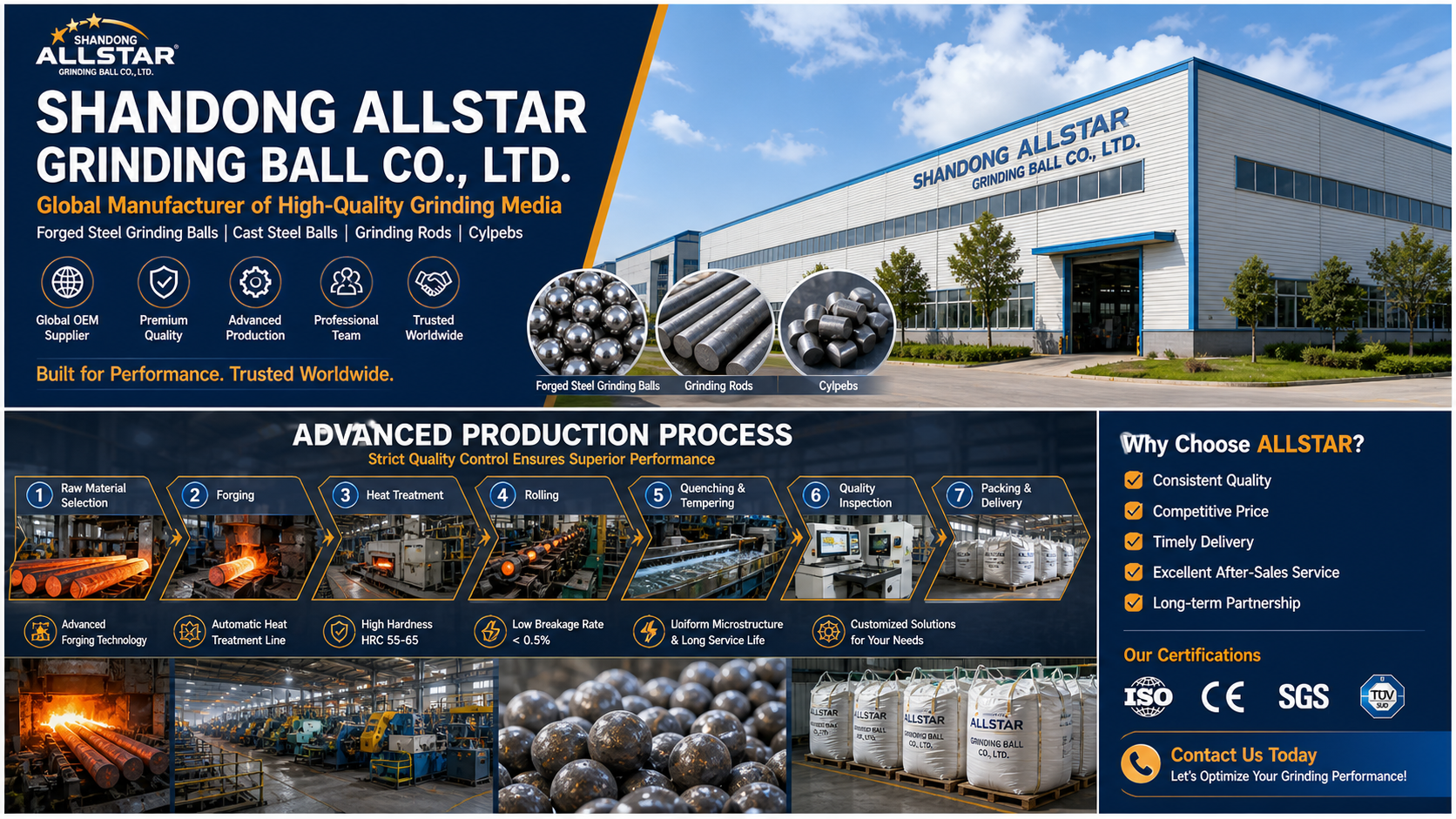
Our company supplies grinding balls, forged steel balls, cast steel balls, grinding rods, and grinding cylpebs for mining, cement, and power applications, with OEM services for overseas brands, wholesalers, and manufacturers.
For gravity concentration, our starting recommendation is straightforward: consider rods when selective coarse grinding and fines control are priorities; consider balls when finer liberation is necessary. Neither choice replaces ore testing, suitable mill design, or effective classification. Rod mills generally favor a narrower product distribution, but the correct decision depends on the complete circuit.
Gravity concentration separates minerals through differences in their response to gravity or enhanced centrifugal forces. Particle size affects that response, so a feed containing widely different sizes can make separation more difficult.
The objective is not to make every particle identical. It is to produce a controlled size range in which valuable minerals are sufficiently liberated and the selected separator can recover them effectively.
Two competing risks shape that target:
- Undergrinding leaves valuable minerals locked inside composite particles.
- Overgrinding creates fine material that may be difficult for the installed gravity equipment to recover.
This balance is particularly important with friable heavy minerals, including cassiterite and wolframite. Conventional gravity equipment can struggle with very fine particles, while enhanced-gravity systems may recover finer material under suitable conditions. "Finer" is therefore not automatically "better," and "fines" are not automatically unrecoverable.
P80 describes the particle size below which 80% of the material passes. It is useful, but it does not describe the entire particle-size distribution.
Two grinding products can share the same P80 while containing different proportions of ultrafines and oversize.
A useful evaluation should therefore include:
- P20, P50, and P80.
- Material below the circuit's problematic fines threshold.
- Material above the separator's acceptable feed size.
- Valuable-mineral liberation by size fraction.
- Gravity recovery and concentrate grade by size fraction.
The key purchasing question becomes: which media produces more recoverable mineral—not simply a smaller average particle?
| Selection factor | Grinding steel balls | Grinding rods |
|---|---|---|
| Typical contact pattern | Localized contacts between balls, ore, and liners | Extended contacts along rods |
| Main grinding tendency | Impact and abrasion across the charge | Preferential breakage of coarser particles |
| Common process role | Finer grinding and regrinding | Coarse grinding with fines control |
| Product distribution | Depends strongly on ball sizing, operation, and classification | Often narrower in suitable applications |
| Main selection risk | Excessive residence time can generate unnecessary fines | Product may remain too coarse for required liberation |
| Mill compatibility | Requires a suitable ball-mill design | Requires a suitable rod-mill design |
These are operating tendencies rather than universal performance guarantees. Rod grinding concentrates more breakage on coarse particles, while finer particles can occupy spaces within the charge and experience less grinding. This helps explain its traditional role in preparing relatively uniform feeds with fewer extreme fines.
Grinding rods extend along the mill and interact with the ore through elongated contact zones.
Larger particles are more likely to bridge spaces between rods and receive the grinding action. Smaller particles can move into those spaces, reducing their exposure to further breakage.
This selective action makes rods worth evaluating when the valuable mineral is already liberated at a relatively coarse size.
However, rods do not eliminate fines. Ore friability, feed variability, residence time, and mill operation still influence the final product. Metso identifies rod mills as an option for producing a uniform-sized product while minimizing unwanted fines—not as a guarantee of fines-free grinding.
Grinding steel balls are often the more relevant option when mineral liberation requires a finer product.
Their suitability depends on the interaction between ball diameter, charge composition, mill conditions, and classification.
The important distinction is between necessary fine grinding and unnecessary overgrinding. A narrower but insufficiently liberated product may perform worse than a somewhat broader product with better mineral exposure.
For gravity circuits, the decision must therefore connect grinding performance to recovery rather than treating particle-size uniformity as an isolated goal.
Put grinding rods on the shortlist when:
- Testwork indicates useful liberation at a relatively coarse size.
- Excessive fines are reducing downstream separation performance.
- The process requires controlled top size.
- The installed mill is designed for rod operation.
Rod milling has a recognized role in preparing feeds for gravimetric concentration because of its selective grinding action and relatively limited production of extreme fines. Its suitability must still be checked against the actual liberation requirement.
Consider grinding steel balls when:
- Valuable minerals remain locked after coarse grinding.
- A suitable ball mill already exists.
- Classification can remove adequately ground material.
- Gravity testwork supports the required finer feed.
A ball mill should not be rejected simply because rods can produce a narrower distribution. The more important question is whether the circuit can deliver liberated mineral within the separator's effective operating range.
A staged circuit may be more useful than forcing one mill to produce the final feed.
Where testwork supports it, the sequence might include coarse grinding, early gravity recovery, and further grinding of material that still requires liberation.
This approach aims to remove recoverable mineral before additional grinding. In gold circuits, gravity recovery within the grinding circuit can exploit the tendency of dense gold particles to report preferentially to cyclone underflow. The appropriate recovery location depends on the flowsheet and mineral behavior.
Identify the gravity equipment and its practical operating window.
A shaking table, spiral, jig, and centrifugal concentrator should not be assigned one universal feed specification. Define acceptable oversize, problematic fines, feed density, and throughput with the equipment supplier and metallurgical team.
Use samples that reflect expected ore variability, not only an easy-to-grind composite.
Record feed-size distribution, mineral associations, hardness variability, and the size at which useful liberation occurs.
A rod-versus-ball comparison needs a declared basis.
Comparing equal grinding time answers a different question from comparing equal energy input or equal product P80. Document the basis before testing so apparent advantages are not caused by mismatched conditions.
Use suitable particle-sizing methods and consistent sample preparation.
Track both distribution tails. A product can meet its P80 target while still containing excessive ultrafines or troublesome oversize.
Measure recovery, concentrate grade, mass pull, and losses by size fraction.
For gold, gravity-recoverable-gold testing uses sequential grinding and gravity concentration to investigate how liberation changes recoverability. Particle-size distribution alone cannot establish the resulting gravity recovery.
Confirm the preferred option in a controlled plant trial.
Record throughput, energy, media consumption, classification performance, feed variability, and gravity results. Avoid changing several major operating variables simultaneously, or the reason for improvement may remain unclear.
A media change cannot fully compensate for a classification problem.
Hydrocyclones separate particles according to both size and density. Dense particles can report to the underflow and return to grinding, even when their size alone might suggest a different destination.
This is especially relevant in gold circuits, where a gravity concentrator may treat part of the cyclone-underflow stream to recover liberated gold before repeated circulation.
Accordingly, review the actual feed to the gravity concentrator—not merely the mill discharge. Sampling location, screen performance, circulating load, and water balance can change what the separator receives.
The practical lower recovery limit depends on mineral properties, equipment, and operating conditions.
Conventional gravity devices often lose efficiency as particles become finer, but enhanced-gravity concentrators can recover finer particles in appropriate applications.
Before investing solely in fines reduction, establish whether the problem is excessive grinding, unsuitable separation equipment, poor screening, or insufficient liberation. These problems require different solutions.
At SHANDONG ALLSTAR GRINDING BALL CO., LTD., our product range allows buyers to discuss both grinding-ball and grinding-rod requirements rather than starting with only one media shape.
For OEM brands, wholesalers, and manufacturers, the purchase specification should connect product quality with the intended operating environment.
Request agreement on:
- Product type and nominal diameter.
- Dimensional tolerances.
- Chemical composition.
- Hardness requirements and test locations.
- Inspection and sampling procedures.
- Acceptance criteria for wear, breakage, and surface condition.
Do not treat one hardness figure as a complete description of suitability. A procurement specification should define what is tested, how it is measured, and how conformity is assessed.
Include rod diameter, length, straightness tolerance, material requirements, hardness profile where applicable, and inspection procedures.
Confirm compatibility with the mill manufacturer's requirements. Grinding rods are not a direct substitute for balls in an unchanged ball-mill arrangement.
Provide packaging, labeling, traceability, inspection-document, and shipment requirements before quotation.
Any claimed wear advantage or recovery improvement should be supported by a defined test method and relevant operating data. Supplier promises should not replace site validation.
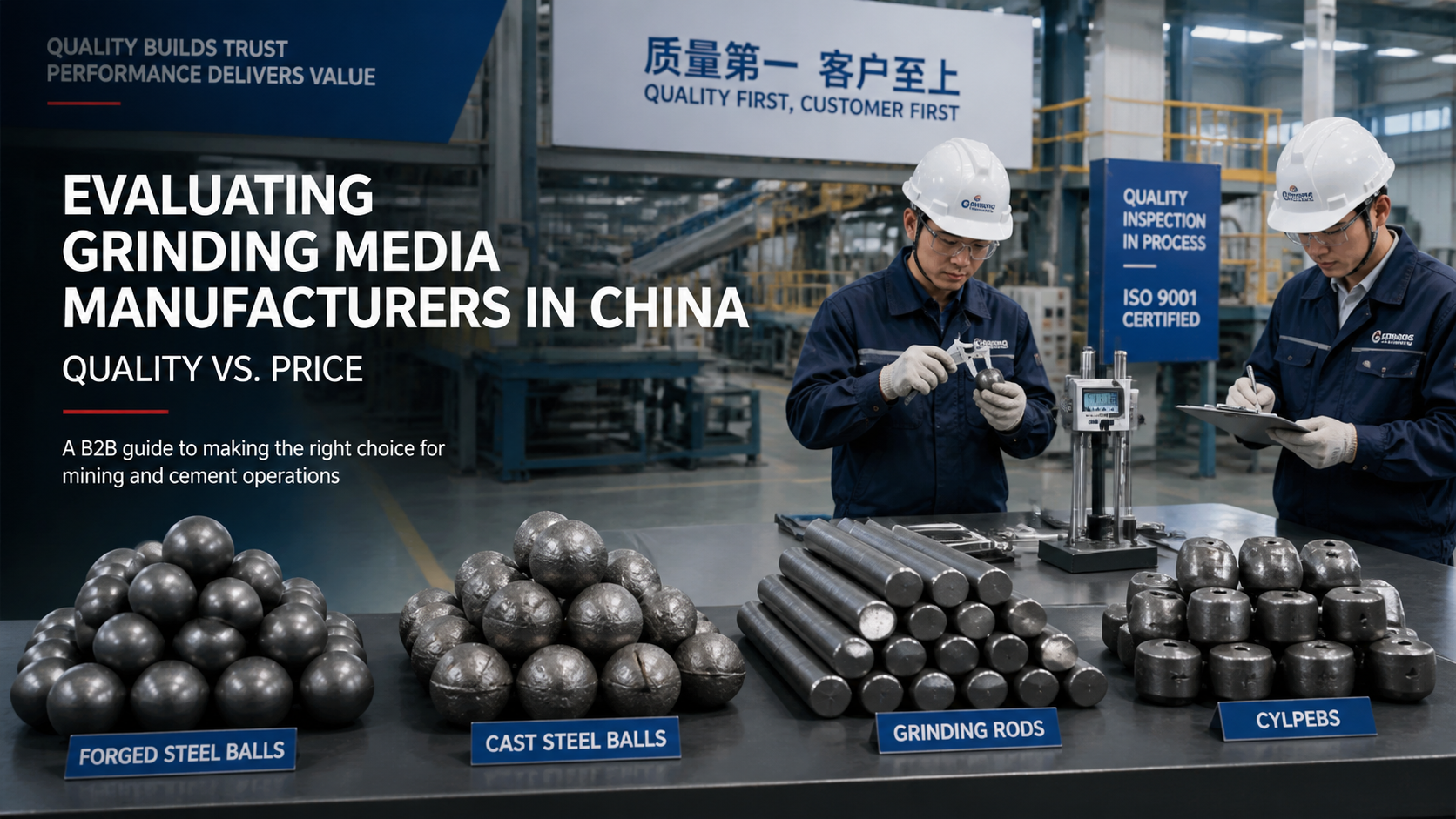
[Suggested visual: Actual product photographs with dimensional inspection and sample traceability. Use verified factory images rather than unrelated stock photography.]
The lowest-priced media does not necessarily produce the lowest-cost gravity feed.
A useful commercial comparison considers:
- Media consumption per tonne of ore.
- Energy consumption.
- Achievable throughput.
- Maintenance and interruption costs.
- Gravity recovery and concentrate quality.
Keep technical and financial assumptions explicit. A recovery benefit should be demonstrated through testwork before it is included in an investment case.
No. Rods often produce a narrower coarse-grinding product, but that advantage is useful only if the product achieves adequate liberation and suits the separator.
Yes. Their suitability depends on the required liberation size, mill operation, classification, and the gravity equipment's response to the resulting product.
There is no universal value. Establish the target through mineralogical work, equipment requirements, and recovery tests across particle-size fractions.
Not as a simple media substitution. Rod operation requires compatible mill geometry, discharge arrangements, and operating conditions.
Compare the proposed products against the actual duty and agreed inspection requirements. Neither manufacturing route alone proves superior performance in every application.
Send the ore type, feed distribution, target product distribution, mill details, throughput, gravity equipment, current media, and the main performance problem.
Contact SHANDONG ALLSTAR GRINDING BALL CO., LTD. with your mill specifications, ore characteristics, target particle-size distribution, and OEM requirements.
Ask for a proposal covering the recommended media specification, inspection criteria, packaging requirements, and a site-validation plan.
The objective is recoverability: producing a consistent, sufficiently liberated feed that supports your gravity circuit—not simply producing the finest material possible.
- Metso — "Energy Efficient Solutions to Maximize Productivity and Profitability." Supports the description of rod mills producing uniform-sized material while minimizing unwanted fines. [metso]
- Metso — "Multi-Compartment Rod/Ball Mill Evaluation on Bauxite Operation." Supports the explanation of coarse-particle grinding and reduced exposure of fine particles within a rod charge. [metso]
- 911Metallurgist — "Ball Mills vs Rod Mills." Supports the comparison of selective grinding behavior and the value of removing finished material between grinding stages. [911metallurgist]
- 911Metallurgist — "Ball Mills." Supports the discussion of rod grinding, limited extreme-fines production, and preparation of feeds for gravimetric concentration. [911metallurgist]
- Sepro Systems — "Gold Recovery 101." Supports the discussion of hydrocyclone size-and-density separation and gravity recovery from grinding circuits. [seprosystems]
- Sepro Systems — "Gravity Recovery of Gold From Within Grinding Circuits." Supports the description of sequential liberation testing and size-by-size gravity assessment. [seprosystems]
- Sepro Systems — "What Factors Affect Gold Recovery in a Milling Circuit?" Supports the importance of gravity-recoverable-gold size distribution, screening, and circuit performance. [seprosystems]
- Sepro Systems — "Enhanced Gravity Recovery of Base Metal and Industrial Minerals." Supports the distinctions between conventional and enhanced-gravity fine-particle recovery. [seprosystems]
- Sepro Systems — "Advances in Centrifugal Gravity Concentration—Beyond Low Mass Yield." Supports the explanation that fine-particle recoverability depends on gravity technology and application. [seprosystems]
Hot Tags: China, Global, OEM, private label, manufacturers, factory, suppliers, manufacturing company


