
Views: 249 Author: shandong Allstar Grinding Ball Publish Time: 2026-10-09 Origin: Site


Content Menu
● Grinding Media Ball Dynamics in High-Pulp-Density Circuits: What Changes?
>> Why Mass Percentage Can Be Misleading
>> How Dense Slurry Changes Ball Movement
● Forged vs Cast Grinding Balls: Compare the Actual Metallurgy
● When Forged Steel Balls Are Strong Candidates
● When High-Chrome Cast Media Deserve a Trial
● Three Wear Mechanisms That Dense Circuits Can Hide
>> Abrasion and Microstructure
>> Corrosion and Abrasion-Corrosion Interaction
● A Practical Diagnostic: Is the Problem the Ball or the Slurry?
● A Six-Step Trial for Forged vs Cast Grinding Media
>> 3. Qualify the Candidate Material
>> 5. Allow for Charge Transition
>> 6. Evaluate the Whole Circuit
● Compare Cost per Tonne, Not Just Purchase Price
● OEM Grinding Media Purchasing with ALLSTAR
● Request an Application-Focused OEM Proposal
>> 1. Are forged balls always better in high-pulp-density circuits?
>> 2. Does higher pulp density always improve grinding efficiency?
>> 3. Are high-chrome cast balls the same as cast steel balls?
>> 4. Which measurements are most important during a media trial?
>> 5. Can a harder grinding ball solve poor slurry flow?
>> 6. How should OEM buyers choose between forged and cast media?
SHANDONG ALLSTAR GRINDING BALL CO., LTD. manufactures grinding balls, mill balls, forged steel balls, cast steel balls, grinding rods, and grinding segments for mining, cement, and power applications. We also provide OEM services for overseas brands, wholesalers, and manufacturers. This guide to grinding media ball dynamics: forged vs cast steel in high-pulp-density circuits explains how to evaluate media against the conditions that actually determine mill performance.
My starting point for this comparison is straightforward: do not choose grinding media from hardness or manufacturing method alone. In dense wet-grinding circuits, slurry behavior, impact loading, ore mineralogy, and corrosion interact. A ball that performs well in one circuit may deliver disappointing results in another.
The practical objective is compatibility: matching the media's metallurgy and size distribution to the ore, mill, slurry, and downstream process.
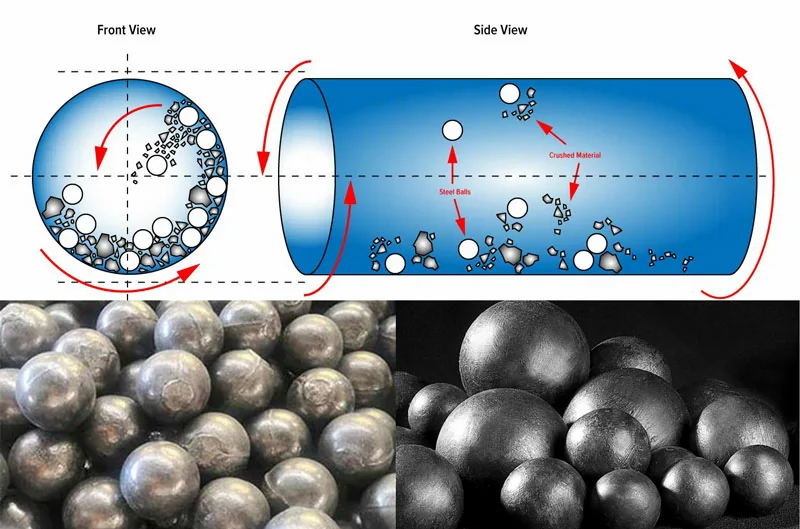
Pulp density describes the solids content or density of an ore-water mixture. However, percentage solids by mass, percentage solids by volume, and measured slurry density are different quantities.
Always identify the measurement basis before comparing operating conditions.
Consider an illustrative slurry containing 75% solids by mass. If the solids density is 3.0 tonnes per cubic metre and water density is approximately 1.0, its solids concentration is only about 50% by volume.
That distinction matters. Media move through a mixture whose flow behavior depends on particle volume, size distribution, shape, and surface chemistry—not simply the mass percentage displayed on a control screen.
There is no universal percentage at which every slurry becomes "high density." A fine, clay-bearing ore can become difficult to transport at a concentration that remains manageable for another ore.
Increasing solids concentration can initially improve particle capture between grinding surfaces. Beyond a circuit-specific operating window, however, rising viscosity and yield stress can interfere with charge movement and slurry transport.
Yield stress is the stress required before a material begins to flow.
Potential consequences include:
- Greater cushioning of ball impacts.
- Reduced relative movement between balls and particles.
- Accumulation of slurry or fines inside the mill.
- Changes in residence time and discharge behavior.
- Lower grinding efficiency despite apparently acceptable power draw.
A harder ball cannot independently correct excessive slurry viscosity.
The phrase "forged vs cast steel" is useful for search intent, but it needs technical clarification.
Forged grinding balls are generally steel products shaped through hot deformation and subsequently heat-treated. Cast grinding media can include cast steel and alloyed white cast iron. Many high-chrome grinding balls belong to the latter category, rather than being cast steel in the strict metallurgical sense.
For purchasing, request the alloy family, chemical composition, and heat-treatment specification. "Cast ball" is not a complete material description.
| Selection factor | Forged steel grinding balls | High-chrome cast grinding balls |
|---|---|---|
| Typical selection rationale | Toughness under demanding impact conditions | Abrasive-wear resistance and potentially favorable wet-grinding chemistry |
| Metallurgical emphasis | Heat-treated steel structure and hardness profile | Hard chromium carbides within a heat-treated matrix |
| Main qualification questions | Core properties, spalling resistance, dimensional consistency | Carbide structure, casting integrity, impact suitability |
| Dense-slurry limitation | Cannot resolve poor rheology by itself | Cannot resolve poor rheology by itself |
| Essential validation | Representative wear and impact testing | Representative wear, impact, and chemical testing |
These are selection tendencies, not guaranteed rankings. Alloy design, manufacturing consistency, ball diameter, and operating conditions can outweigh the general distinction between forging and casting.
Forged steel grinding balls deserve close consideration where impact loading is significant.
Examples include coarse-feed duties, larger grinding media, and operating conditions that expose the charge to energetic collisions. The relevant property is not hardness alone, but the balance between wear resistance and resistance to fracture or surface spalling.
For high-pulp-density ball mills, I would evaluate forged media through three questions:
1. Does the ball retain a suitable hardness profile as its diameter decreases?
2. Can it withstand the circuit's actual impact environment?
3. Does its wet-grinding wear rate remain economical under the plant's water chemistry?
Surface hardness is useful, but it does not describe the entire ball. Request surface-to-core measurements and clearly defined test procedures.
Dense slurry may cushion some collisions, but that does not eliminate impact risk. Charge exposure, feed changes, water interruptions, and liner geometry can alter the loading environment.
High-chrome cast grinding media can be attractive where abrasion is a major contributor to consumption.
Their carbide-containing microstructure can provide strong abrasive-wear resistance. In suitable wet-grinding environments, their electrochemical behavior may also differ beneficially from that of conventional steel media.
However, chromium content alone does not establish performance.
A responsible comparison should examine:
- Actual alloy chemistry and heat treatment.
- Hardness and microstructural consistency.
- Suitability for the selected ball diameter.
- Casting defects and fracture behavior.
- Wear under representative ore and process-water conditions.
Do not interpret "high chrome" as a promise of immunity to corrosion or breakage. Equally, do not assume all cast media are inherently unsuitable for impact. Qualification must address the specific product and duty.
The correct question is not "Which manufacturing process always wins?" It is "Which qualified media delivers the best circuit result?"
Impact damage can cause cracking, chipping, or loss of surface fragments. Broken media may reduce useful grinding inventory and complicate handling.
Inspection should distinguish fractured balls from gradually worn balls. A consumption figure alone cannot reveal the difference.
Hard mineral particles remove material through scratching and gouging. Both hardness and microstructure influence resistance.
Higher hardness can improve abrasion resistance within an appropriate material system, but selecting the highest hardness without considering toughness can create a different failure mode.
Wet grinding exposes metallic media to process water, dissolved species, and mineral surfaces. Corrosion and abrasion can reinforce one another as mechanical action repeatedly exposes fresh metal.
Sulfide mineral systems require particular attention because electrochemical interactions can influence media wear and pulp chemistry.
Record pH, dissolved oxygen, water source, and relevant dissolved species when comparing suppliers. A wear result without chemical context is difficult to transfer to another plant.
Before replacing grinding media, establish whether poor performance follows changes in rheology.
Use this diagnostic sequence:
1. Verify density instrumentation against a representative sample.
2. Confirm whether reported solids concentration is mass-based or volume-based.
3. Check feed-size distribution, fines generation, and clay content.
4. Review mill power, throughput, discharge behavior, and circulating load together.
5. Investigate slurry viscosity or yield stress where measurement is available.
6. Inspect recovered media for wear patterns, spalling, and fracture.
Interpret the evidence as a system.
For example, declining throughput accompanied by unstable discharge and increasing fines may justify a rheology investigation before a metallurgy change.
Conversely, persistent broken balls under stable operating conditions strengthens the case for reviewing media quality and impact suitability.
Any operating adjustment should follow the plant's approved procedures and equipment limits.
A controlled trial provides stronger purchasing evidence than a generic supplier comparison.
Record ore characteristics, dry throughput, product fineness, mill power, ball charge, make-up size distribution, and media additions.
Include slurry conditions and downstream recovery where relevant.
Agree on the required product size, permitted breakage, operating stability, and economic outcome before testing.
A lower wear rate is not sufficient if throughput or product quality deteriorates.
Request composition, hardness profiles, dimensional tolerances, and the supplier's test methods.
Confirm how results connect to production batches.
Keep ore blend, feed size, mill speed, ball loading, and slurry conditions as comparable as practical.
Document unavoidable differences rather than treating every change as a media effect.
Replacing make-up media does not instantly replace the existing charge. A mixed inventory can obscure the candidate's performance.
Set the trial duration using charge turnover and operational variability, not an arbitrary short period.
Compare consumption, energy, throughput, product size, broken-media observations, and downstream performance.
Where sequential plant trials remain confounded, laboratory testing or appropriately designed marked-ball studies can provide supporting evidence.
The relevant commercial measure is media cost per tonne of dry ore processed.
Calculate it by multiplying delivered media price per tonne of media by media consumption in kilograms per tonne of ore, then dividing by 1,000.
The following figures are hypothetical and demonstrate the method. They are not ALLSTAR performance claims.
| Trial assumption | Option A | Option B |
|---|---|---|
| Delivered media price | $1,000/t | $1,300/t |
| Consumption | 0.80 kg/t ore | 0.55 kg/t ore |
| Media cost | $0.80/t ore | $0.715/t ore |
Option B costs more to purchase but approximately $0.085 less per tonne of ore in media expenditure.
That comparison is meaningful only if grinding duty and product quality are comparable.
For a complete decision, also examine specific energy consumption, downtime, liner effects, handling costs, and any measurable change in recovery. Avoid attributing improvements to media when ore or operating conditions changed simultaneously.
For overseas brands, wholesalers, and manufacturers, repeatability matters as much as an initial sample result.
At SHANDONG ALLSTAR GRINDING BALL CO., LTD., our OEM offering provides a starting point for discussing application-specific grinding media requirements. Buyers should establish the technical and commercial acceptance criteria before ordering.
A useful inquiry package includes:
- Mill type, dimensions, and operating speed.
- Ore type, feed size, and target product size.
- Current ball diameters and consumption.
- Slurry solids concentration and measurement basis.
- Process-water chemistry and known corrosion concerns.
- Annual demand, destination, and packaging requirements.
Discuss batch identification, inspection records, retained samples, and change-control requirements during supplier qualification. These are procurement criteria to confirm, not substitutes for a representative plant trial.
Send ALLSTAR your mill duty, ore characteristics, current media specification, slurry conditions, and annual purchasing volume.
Request a quotation covering the proposed material grade, size distribution, inspection requirements, packaging, and delivery terms. For a new application, include a trial plan and agreed performance measures.
The strongest purchasing decision connects a technically qualified product to a measurable operating objective.
No. Forged balls can be strong candidates for demanding impact duties, but pulp density alone does not determine the winner. Ore abrasiveness, rheology, corrosion, and manufacturing quality also matter.
No. Increasing solids concentration can improve particle capture within a suitable operating window. Excessive viscosity or yield stress can restrict movement, transport, and effective grinding.
Not necessarily. Many high-chrome grinding balls are alloyed white cast iron. Buyers should confirm the actual material classification instead of relying on a broad commercial label.
Track consumption, specific energy, throughput, product size, and broken-media observations. Also record slurry conditions and ore variability. Include downstream recovery when grinding chemistry may affect separation.
Not by itself. Hardness concerns material resistance to deformation and wear. Slurry flow depends on solids concentration, mineralogy, particle size, chemistry, and operating conditions.
Define the duty, qualify the material, and compare representative performance. Choose on total circuit economics and repeatability—not purchase price, hardness, or manufacturing terminology alone.
Hot Tags: China, Global, OEM, private label, manufacturers, factory, suppliers, manufacturing company


