
Views: 292 Author: shandong Allstar Grinding Ball Publish Time: 2026-07-14 Origin: Site


Content Menu
● Ball Mill in Mining and Cement
● How to Choose the Right Supplier
● FAQ
If you are asking "what is a ball mill," the simplest answer is this: it is a cylindrical grinding system filled with balls that tumble, impact, and attrit the feed material until it reaches the required fineness. From an industry perspective, the ball mill remains popular because it is versatile, proven, and adaptable to both wet and dry grinding across many materials.
At SHANDONG ALLSTAR GRINDING BALL CO., LTD., we see the ball mill not as a standalone machine, but as part of a complete grinding system where media quality directly affects performance. That is why OEM buyers, brand owners, wholesalers, and manufacturers often focus as much on grinding balls, forged steel balls, cast steel balls, grinding rods, and grinding segments as they do on the mill itself.

A ball mill is designed to grind, blend, and sometimes mix materials for downstream processing. It is widely used in mineral processing, cement production, ceramics, paints, and other industrial applications where particle size control matters.
The core mechanism is impact and attrition. As the cylinder rotates, the grinding balls are lifted and then fall back onto the material, crushing and rubbing particles into smaller sizes. In practical terms, this means the mill can process hard ores, clinker, coal, pigments, and other feed materials with the right operating setup.
A ball mill typically consists of a hollow cylindrical shell, a rotating drive system, internal liners, and grinding media. The shell rotates around its axis, and the balls inside cascade as the mill turns, creating the grinding action that reduces particle size.
Key operating factors include:
- Rotational speed, which influences how high the balls are lifted before falling.
- Ball size and density, which affect impact energy and grinding efficiency.
- Feed rate, which must match the mill's capacity to avoid overload or poor grind.
- Wet or dry grinding, which changes flow behavior, energy use, and product handling.
For many operators, the best results come from balancing the mill design with the right media specification rather than simply increasing speed or load.
Ball mills are commonly grouped by their operating style and discharge design. Understanding these types helps buyers choose the right setup for their process.
| Type | Typical use | Main advantage |
|---|---|---|
| Batch ball mill | Small-scale production, lab use | Simple control and flexibility |
| Continuous ball mill | Large industrial lines | Stable output and high throughput |
| Wet grinding ball mill | Slurry-based processes | Better handling of certain materials |
| Dry grinding ball mill | Cement, powders, dry feeds | Simpler downstream handling |
| Grate discharge mill | Faster material removal | Helps with throughput |
| Overflow mill | Fine grinding applications | Good control of product size |
The right type depends on feed characteristics, target fineness, moisture content, and energy strategy.
In real-world operations, the grinding media often determines whether a ball mill performs well or underperforms. Media hardness, size, composition, and wear resistance all affect efficiency, contamination risk, and replacement frequency.
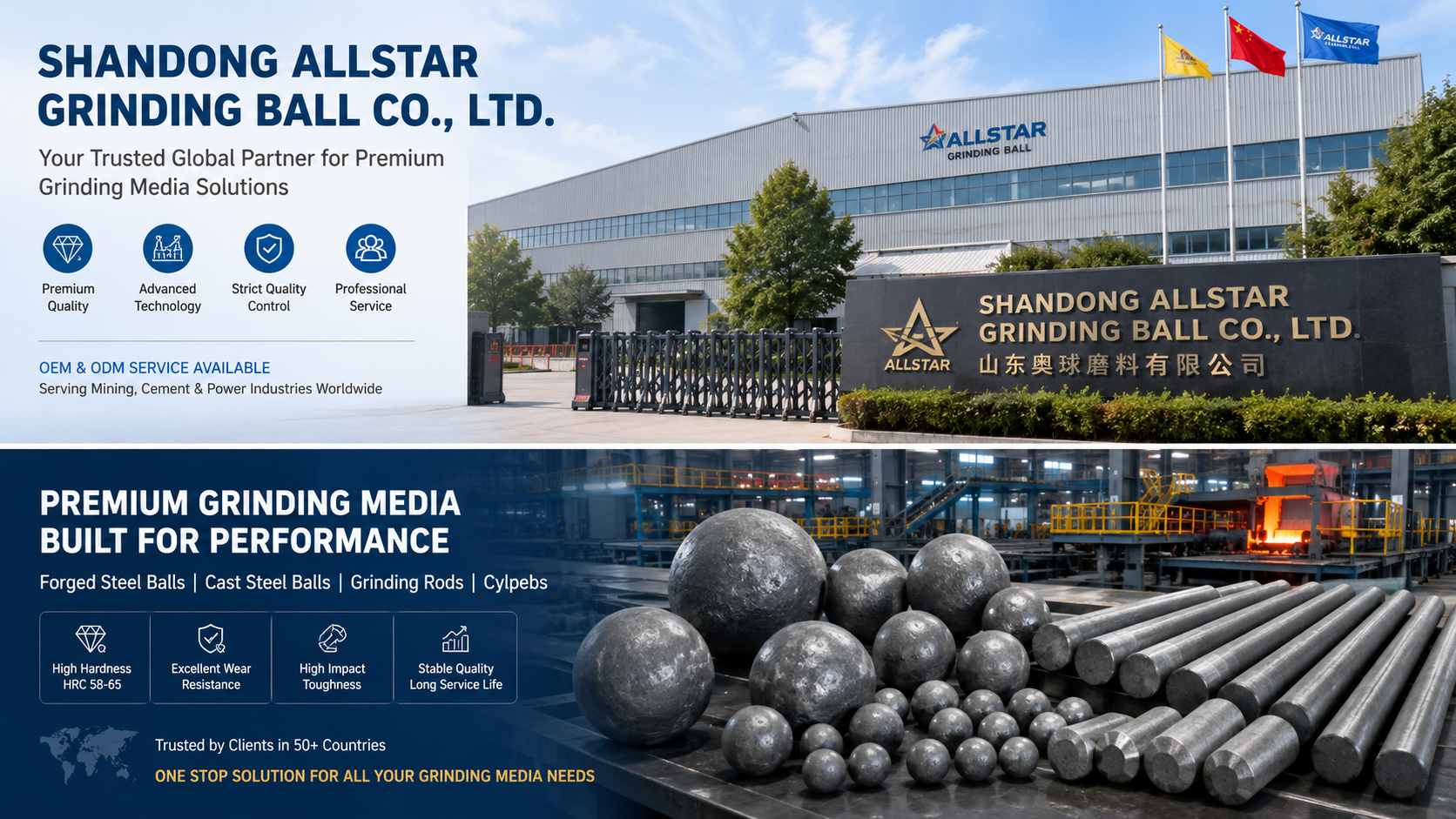
This is where SHANDONG ALLSTAR GRINDING BALL CO., LTD. adds value. Our forged steel balls, cast steel balls, grinding rods, and grinding segments are developed for demanding industries such as mining, cement, and power, where stable hardness and wear performance are critical. For OEM customers, the advantage is not just supply; it is consistent quality that supports brand trust and end-user satisfaction.
- Match media size to feed size and target product fineness.
- Use high-wear-resistant grades for abrasive ores and clinker.
- Consider contamination sensitivity when processing high-purity materials.
- Evaluate toughness and breakage resistance, not only surface hardness.
- Keep media size distribution aligned with the stage of grinding.
A practical example: a cement plant using undersized or uneven media may see slower grinding, unstable fineness, and more energy waste, even when the mill itself is in good condition.
Ball mills are especially important in mining and cement because these industries depend on controlled size reduction at scale. In mining, ball mills help prepare ore for flotation and downstream separation. In cement, they are widely used to grind clinker and other blended materials into the final product.
This is also why media procurement is a strategic decision. A mining site wants high wear life and fewer shutdowns. A cement plant wants stable output and predictable grinding behavior. A power industry customer may prioritize reliability and consistent operating cost over time.
One useful trend in modern grinding is the move toward more precise media specification and circuit optimization rather than simple bulk purchasing. Operators increasingly care about how ball hardness, size distribution, and wear profile affect overall throughput and energy use.
From an expert viewpoint, the best ball mill results usually come from three things working together:
1. A correctly designed mill.
2. The right grinding media.
3. Disciplined operating control.
This is why experienced buyers often work with manufacturers that can support OEM customization, stable supply, and application-specific recommendations. For international brands and wholesalers, that combination can be more valuable than a low initial price.
Choosing a grinding media supplier should go beyond quotation price. Buyers should look for manufacturing consistency, material traceability, export experience, and the ability to support OEM needs.
Use this simple evaluation framework:
- Product range: forged steel balls, cast steel balls, rods, and segments.
- Quality consistency: hardness, diameter control, and wear performance.
- Industry fit: mining, cement, and power applications.
- OEM capability: private label, branding, and customized packaging.
- Communication and service: fast response, technical support, and stable delivery.
For brands serving global markets, the supplier should function as a manufacturing partner, not just a vendor.
1. What is a ball mill used for?
A ball mill is used to grind or blend materials into smaller particles for mining, cement, ceramics, pigments, and other industrial processes.
2. What is the working principle of a ball mill?
It works by impact and attrition, where balls inside a rotating cylinder fall onto the material and break it down.
3. What materials can be used as grinding media?
Common media include steel, stainless steel, ceramic, and rubber, depending on the material being processed and the contamination tolerance.
4. Why is grinding media quality important?
Because media hardness, size, and wear resistance directly affect efficiency, product consistency, maintenance frequency, and operating cost.
5. Is a ball mill better for wet or dry grinding?
A ball mill can be used for both, but the better choice depends on the material, process requirements, and downstream handling needs.
6. What should OEM buyers ask a grinding ball supplier?
They should ask about material grade, hardness range, wear performance, packaging, branding support, export experience, and customization capability.
A ball mill is one of the most versatile industrial grinding machines, but its performance depends heavily on the quality of the grinding media inside it. For mining, cement, and power customers, the smartest purchasing decision is often to pair a proven mill with a reliable media supplier that can deliver consistent wear performance and OEM support.
If your goal is to improve grinding stability, lower replacement frequency, and strengthen your product line, SHANDONG ALLSTAR GRINDING BALL CO., LTD. can support your project with forged steel balls, cast steel balls, grinding rods, and grinding segments tailored for global industrial use.
2. [Ball Mill Guide: Types, Working & Applications - Torontech]
3. [Ball Mills: Types and Uses - Thomasnet]
4. [What Is a Ball Mill? - Monroe Engineering]
5. [Ball Mill - an overview - ScienceDirect Topics]
6. [Ball Mills Explained - saVRee]
7. [Ball Mill | Principle, Construction, Working & Uses - YouTube]
Hot Tags: China, Global, OEM, private label, manufacturers, factory, suppliers, manufacturing company


