
Views: 224 Author: shandong Allstar Grinding Ball Publish Time: 2026-11-23 Origin: Site


Content Menu
● What Is Grinding Media Charge?
● How to Calculate Grinding Media Charge in a Ball Mill: The Formula
>> Use Effective Dimensions, Not External Shell Dimensions
>> Use Bulk Density, Not Solid Steel Density
● Worked Example: Calculate Ball Mill Charge Weight
● How to Select the Right Ball Mill Filling Percentage
● How to Check Ball Charge Using Free-Height Measurements
● Three Checks That Make the Calculation More Reliable
>> 1. Test the Sensitivity Before Ordering
>> 2. Separate Charge Quantity from Ball-Size Distribution
>> 3. Validate Changes Against Circuit Performance
● How to Calculate Grinding Media Top-Up Requirements
● Common Ball Mill Charge Calculation Mistakes
● Planning an OEM Grinding Media Order with ALLSTAR
>> 1. What is the grinding media charge calculation formula?
>> 2. Does ball filling include the spaces between balls?
>> 3. Can I use the density of solid steel?
>> 4. What percentage of a ball mill should contain grinding media?
>> 5. How often should grinding balls be added?
>> 6. Can forged and cast balls use the same calculation?
>> 7. Does this formula apply to rods and cylpebs?
At SHANDONG ALLSTAR GRINDING BALL CO., LTD., we supply grinding balls, forged steel balls, cast steel balls, grinding rods, and cylpebs for mining, cement, and power applications, with OEM services for overseas brands, wholesalers, and manufacturers.
When customers ask, "How to calculate grinding media charge in a ball mill?" we recommend separating three decisions: the required media mass, the appropriate ball-size distribution, and the replacement schedule.
The basic calculation is:
M=π/4D2LJρb
Here, \(M\) is media mass, D and L are effective internal dimensions, J is the media filling fraction, and ρbis media bulk density.
This guide explains the calculation, a worked example, and the checks needed before turning a theoretical result into a loading instruction.
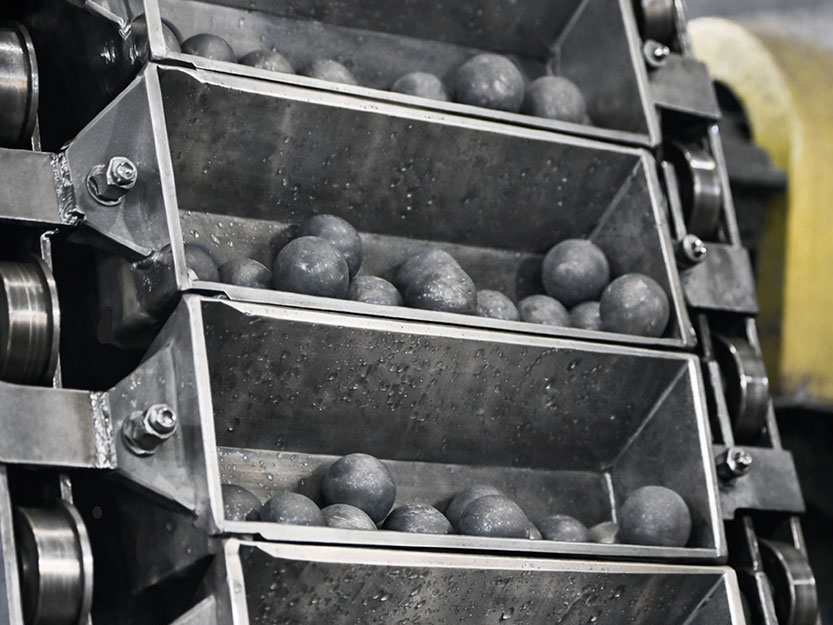
Grinding media charge is the quantity of balls or other grinding bodies inside a mill. Operators commonly express it as either mass, in metric tonnes, or volumetric filling, as a percentage.
For ball filling calculations, the occupied volume includes both the balls and the spaces between them.
This distinction matters. A ball bed containing 35% void space does not consist of solid steel throughout its entire volume.
Also distinguish ball filling from total charge filling. In wet grinding, ore and slurry contribute to the mill contents. A measurement of the total charge surface does not automatically reveal the volume occupied by balls alone.
Before calculating, define exactly what your plant means by "charge."
Use the following equations for a cylindrical grinding chamber:
| Symbol | Meaning | Unit |
|---|---|---|
| VVV | Effective grinding chamber volume | m³ |
| DDD | Diameter inside the liners | m |
| LLL | Effective grinding length | m |
| JJJ | Ball filling as a decimal | Dimensionless |
| VbV_bVb | Bulk volume of the ball bed | m³ |
| ρb\rho_bρb | Ball-bed bulk density | t/m³ |
| MMM | Grinding media mass | Metric tonnes |
Enter 30% filling as 0.30, not 30.
Keep all units consistent. Mixing mill dimensions in millimetres with density in tonnes per cubic metre can produce a seriously incorrect loading quantity.
Measure the available grinding space inside the liners.
External shell diameter includes material that cannot hold grinding media. Similarly, overall mill length may include areas outside the active grinding chamber.
For multi-compartment cement mills, calculate each chamber separately. Use its effective length, lining arrangement, and approved filling target.
If the mill has substantial conical sections or unusual internals, a simple cylinder may not represent its usable volume accurately. Use OEM drawings or an approved geometric model.
Bulk density includes the spaces between grinding balls. Solid material density does not.
For illustration, this article uses a steel-ball bulk density of 4.65 t/m³. Treat that figure as a calculation assumption, not a guaranteed specification for every delivery.
Packing changes with ball sizes, size distribution, wear condition, and loading method. Forged and cast products should not automatically receive identical density assumptions.
Where accuracy matters, obtain a representative supplier value or measure a known volume of media under a documented filling procedure.
Consider a cylindrical chamber with these assumed inputs:
| Parameter | Assumed value |
|---|---|
| Effective internal diameter | 3.0 m |
| Effective grinding length | 4.0 m |
| Target media filling | 30% |
| Media bulk density | 4.65 t/m³ |
First, calculate chamber volume:
V=π/4×3.02×4.0=28.27 m3
Next, calculate ball-bed volume:
Vb=28.27×0.30=8.48 m3
Finally, calculate media mass:
M=8.48×4.65≈39.44 t
The estimated initial charge is 39.4 metric tonnes.
This is a hypothetical engineering example, not an ALLSTAR customer case or a universal loading recommendation.
If usable media already remains inside the mill, do not add another 39.4 tonnes. Determine the existing inventory and calculate the shortfall.
The formula calculates mass for a chosen filling level. It does not identify the optimum filling level by itself.
Metso's mineral-processing handbook gives 35–40% ball charge for the conventional wet ball-mill arrangements described there. That reference is useful context, but it should not become a blanket instruction for every mill.
Your approved target must account for:
- Mill type and discharge arrangement.
- Installed power and mechanical limits.
- Rotational speed and liner profile.
- Feed size, hardness, and variability.
- Required product fineness.
- Slurry conditions or dry-material transport.
- Classification and circulating load.
Start with the mill manufacturer's operating envelope and the plant's established baseline.
Increasing media mass is not automatically beneficial. A heavier charge changes power demand and charge motion; whether production improves depends on the complete grinding circuit.
During an authorized shutdown, free-height measurements can provide an independent estimate of filling.
A commonly published approximation is:
J%≈113−126(H/D)
Where:
- J% is estimated filling in percent.
- H is the vertical distance from the top inside liner to the settled charge surface.
- D is the diameter inside the liners.
For example, with H=1.95m and D=3.00 m:
J%≈113−126(1.95/3.00)=31.1%
Use this as an approximate cross-check within an appropriate operating range, not an exact geometric law.
Take representative measurements along the chamber. Uneven surfaces, residual ore, slurry, and nonstandard geometry can distort the result. If process material obscures the ball bed, the measured surface may represent total charge rather than balls alone.
Never enter or measure inside a mill without the site's isolation, lockout, confined-space, and stored-energy controls.
A charge estimate is only as reliable as its inputs.
Because diameter is squared, a 1% diameter error produces approximately a 2% volume error when other inputs remain constant. A 5% bulk-density error produces a 5% mass error.
For the worked example, changing assumed density from 4.65 to 4.50 t/m³ reduces estimated charge from approximately 39.44 to 38.17 tonnes.
Before procurement, record:
1. The measurement date and liner condition.
2. The source of the filling target.
3. The assumed or measured bulk density.
4. The acceptable loading tolerance.
This creates a calculation that maintenance, production, and purchasing can audit.
Correct tonnage does not guarantee effective grinding.
Media sizing must also match the feed and required product. Larger balls provide different impact conditions from smaller balls, while smaller balls offer more individual contact opportunities at a given mass.
Published functional-performance research shows that optimum sizing depends on circuit feed and product size. Multiple-size additions can sometimes outperform a single size, but the advantage requires testing.
For OEM orders, specify the mass allocation for each diameter rather than ordering only a total tonnage.
Treat a charge adjustment as a controlled operating trial.
Record a baseline, change one main variable where practical, and compare performance under reasonably similar feed conditions.
Useful measures include:
| Measure | What it helps assess |
|---|---|
| Throughput, t/h | Production capacity |
| Specific energy, kWh/t | Energy required per tonne |
| Product P80P_{80}P80 or residue | Grinding result |
| Media consumption, kg/t | Replacement demand |
| Power and operating stability | Compatibility with operating limits |
P80 is the particle size through which 80% of the product passes.
A lower electricity figure is not a meaningful improvement if product fineness deteriorates. Compare equivalent grinding duties.
Initial loading and routine top-up are different calculations.
For a measured inventory shortfall:
Madd=Mtarget−Mexisting
If the target inventory is 39.44 tonnes and the estimated usable inventory is 36.00 tonnes:
Madd=3.44 t
For consumption-based planning:
Media addition, kg/day=Throughput, t/day×Consumption, kg/t
At an assumed 2,000 t/day and 0.60 kg/t, planned replacement is 1,200 kg/day.
These are illustrative inputs, not industry benchmarks.
Consumption-based additions maintain an inventory only when the consumption estimate remains representative. Reconcile purchase records, actual additions, shutdown inspections, and operating changes periodically.
A change in ore, media quality, or discharge losses can make yesterday's replacement rate unsuitable today.
Avoid these recurring errors:
- Using shell dimensions instead of dimensions inside the liners.
- Entering a percentage as a whole number.
- Substituting solid steel density for bulk density.
- Confusing total charge filling with ball filling.
- Applying one filling target to every mill.
- Ignoring existing media when calculating additions.
- Copying a ball-size mix without reviewing feed and product requirements.
- Treating a power increase alone as proof of better grinding.
Keep one controlled worksheet for dimensions, density assumptions, inventory, additions, and trial results. Consistent records make discrepancies easier to investigate.
At SHANDONG ALLSTAR GRINDING BALL CO., LTD., our product scope includes forged and cast grinding balls, grinding rods, and cylpebs for industrial grinding applications.
A useful technical inquiry should include:
- Mill type and effective internal dimensions.
- Wet or dry duty and processed material.
- Approved filling level and current inventory.
- Feed size and required product fineness.
- Existing media sizes and consumption history.
- Requested material, inspection, packaging, and OEM requirements.
For overseas brands, wholesalers, and manufacturers, a clear specification also helps distinguish product requirements from packaging and private-label requirements.
Send ALLSTAR your mill dimensions, operating duty, and proposed media specification to discuss an OEM grinding media quotation. Confirm the final loading plan with the mill OEM or responsible plant engineer before implementation.
Use M=(π/4)D2LJρb. With dimensions in metres and bulk density in t/m³, the result is metric tonnes.
Yes. Ball filling normally refers to the bulk ball-bed volume, including interstitial voids, divided by effective mill volume.
Not directly with bulk ball-bed volume. Doing so ignores the voids and overestimates media mass. Use a compatible bulk-density value instead.
There is no universal percentage. Use the OEM-approved operating range and validate the target against power, throughput, product fineness, and mechanical constraints.
Base the schedule on measured consumption, operating hours, handling arrangements, and inventory stability. Daily or more frequent additions may suit some plants; others require different schedules.
Yes, the calculation structure is the same. However, verify the relevant bulk density, size distribution, material suitability, and operating requirements for each product.
The volume-times-bulk-density principle still applies, but packing and operating requirements differ. Do not transfer steel-ball density or filling assumptions without verification.
1. 911Metallurgist. "Mill Steel Charge Volume Calculation." June 19, 2015.
Supports the definition of volumetric media filling, measurement inside the liners, and the approximate free-height equation \(113-126H/D\). [911metallurgist]
2. Metso. *Basics in Minerals Processing*. Grinding section.
Provides conventional ball-mill operating context, including the 35–40% ball-charge range for the configurations described in the handbook. This range is not presented here as a universal recommendation. [metso]
3. Conger, W.; DuPont, J. F.; McIvor, R. E.; Weldum, T. P. "Ball Mill Media Optimization Through Functional Performance Modeling." *Mining Engineering*, November 2018, pp. 28–37. Available through CEEC International.
Supports the discussion of feed and product size, media-size optimization, comparative testing, and potential benefits of multiple-size charging. [ceecthefuture]
4. Metso. "Correct Liner Selection, Optimal Mill Efficiency." February 5, 2026.
Supports evaluating charge level alongside mill speed, liner geometry, feed characteristics, media condition, and operating KPIs. [metso]
5. Metso. "Converting a Ball Mill from Overflow to Grate Discharge." June 23, 2020.
Supports the distinction between mill configurations and explains why discharge arrangement, available power, and ball charge must be considered together. [metso]
6. Metso. "MillSense." Product and technical overview.
Supports the discussion of online charge monitoring and the relationship between charge conditions, operating stability, and liner protection. [metso]
7. Calculation and brand-content disclosure.
Company positioning, product categories, and OEM customer groups come from the company description supplied for this article. All worked examples are hypothetical calculations, not measured plant results. The 4.65 t/m³ bulk density is an illustrative assumption, not an independently verified ALLSTAR product specification.


