
Views: 254 Author: shandong Allstar Grinding Ball Publish Time: 2026-07-03 Origin: Site


Content Menu
● Why Ball Mill Output Drops Over Time
● The Core Mistake in Make-Up Ball Management
● A Practical Rule for Better Charging
● What Strong Plants Monitor Every Week
● Why Regular Cleaning Out Matters
● A Better Make-Up Strategy for Mining and Cement Plants
● How SHANDONG ALLSTAR Adds Value
● New Insight: Why "More Balls" Is Not Always Better
● New Insight: A Simple Weekly Inspection Routine
● New Insight: What Plants Gain from Better Media Management
● How to Choose the Right Balls
● FAQ
>> 1. How often should grinding balls be replenished?
>> 2. Why does the mill discharge become coarser?
>> 3. Should I add only large balls during replenishment?
>> 4. What happens if broken balls stay inside the mill?
>> 5. Which is better for my plant: forged or cast steel balls?
>> 6. What is the most important sign that the charge needs review?
When a ball mill's output starts falling and the discharge becomes too coarse, the problem is often not the mill itself but the make-up ball strategy. At SHANDONG ALLSTAR GRINDING BALL CO., LTD., we help mining, cement, and power plants improve grinding stability with forged steel balls, cast steel balls, grinding rods, and grinding cylpebs built for OEM supply and long service life.
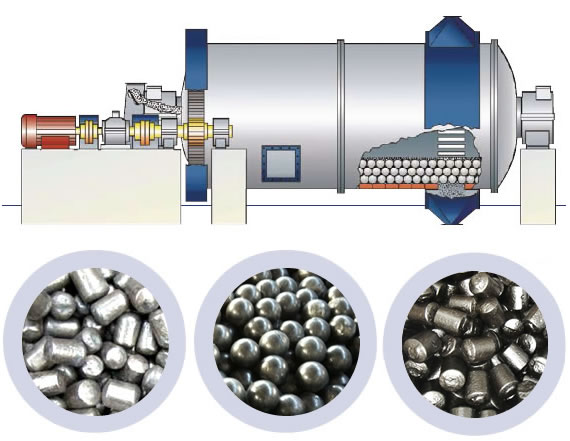
In real plant conditions, grinding efficiency does not stay constant. As balls wear down, the mill gradually loses impact energy, and the charge becomes less effective at breaking coarse particles. The result is familiar: lower throughput, unstable power draw, and a product that is harder to control.
From an operator's point of view, three warning signs matter most:
- The mill sound becomes lighter and sharper, suggesting insufficient charge.
- Motor current drops, which often indicates weak grinding impact.
- The discharge gets coarser, which usually means the media mix is no longer strong enough at the top size.
These symptoms are common across mineral processing and cement grinding circuits. They are also consistent with established industry guidance that links charge condition, media size, and mill performance.
Many plants focus on adding more balls instead of adding the right balls. That approach usually fails because ball mills need a graded charge, not random replenishment. If small balls are added when the circuit needs impact energy, the mill may look "full" but still underperform.
For coarse grinding duties, the top size of the make-up charge must remain strong enough to break the largest feed particles. As the charge wears naturally, smaller media fills the gaps and supports finer grinding. This is why make-up policy should be based on wear progression, not just tonnage added.
At Allstar, we recommend treating make-up balls as a controlled performance tool, not a simple consumable purchase.
A stable ball charge usually follows three principles:
1. Keep the top size strong.
2. Maintain a balanced graded distribution.
3. Remove abnormal media before replenishment.
For many mills, especially when coarse feed is still present, the top-size media should be prioritized. In practice, mills below 2.5 meters in diameter often require smaller top sizes than larger mills, while bigger mills usually need larger balls to preserve impact force. The exact size should always match feed size, hardness, mill design, and required product fineness.
A useful operational benchmark is to keep the media charge within the range recommended by the mill's design and process target. Too little charge reduces breakage; too much charge can create cushioning and lower efficiency.
The best operators do not wait for a crash stop to learn that the charge is wrong. They watch a small set of indicators and adjust early.
A brighter, more hollow sound often means the mill is undercharged or the media is too worn. A stable, fuller sound usually suggests healthier charge motion.
If current falls while feed remains similar, the mill may be losing impact energy. If power rises excessively, the circuit may be overloaded or the charge distribution may be incorrect.
If the discharge becomes coarser, the top-size media may no longer be adequate. This is one of the clearest reasons to review the charge.
Broken, flattened, oval, or heavily worn balls should not remain in the mill. Abnormal shapes disturb the motion of the charge and reduce grinding consistency.
One of the most overlooked maintenance actions is full cleaning out every few months. If broken balls, oval balls, and excessive fines are left inside the mill, the charge gradually loses its grinding "shape." Even a large amount of steel media cannot compensate for a poor internal distribution.
A clean charge helps the mill recover its designed impact and cascading pattern. It also improves liner life and lowers the risk of unexpected performance decline. In practical terms, removing damaged media is just as important as adding fresh media.
The ideal make-up policy depends on the application, but the logic is similar across sectors:
- In mining, the priority is often impact force against coarse feed and variable hardness.
- In cement, the priority is usually a stable balance between throughput, fineness, and energy efficiency.
- In power and industrial mineral grinding, consistent product quality and low media waste are often the main goals.
That means the same ball size cannot be copied from one plant to another without adjustment. A well-designed mix should reflect feed characteristics, liner profile, rotational speed, and separator performance.
| Operating condition | What it usually means | What to review |
|---|---|---|
| Output drops, sound becomes light | Undercharged or over-worn media | Top-size balls, charge volume |
| Product gets coarse | Impact energy is insufficient | Largest ball size, ball mix |
| Power rises sharply | Charge may be too heavy or too tight | Filling rate, liner condition |
| Frequent breakage | Media quality or operating stress is poor | Ball hardness, defect rate, mill speed |
As a global OEM manufacturer, SHANDONG ALLSTAR GRINDING BALL CO., LTD. supplies grinding media built for demanding industrial conditions. Our product range includes forged steel balls, casting steel balls, grinding rods, and grinding cylpebs, serving mining, cement, and power applications worldwide.
Our value is not only in product supply. We support customers with:
- OEM production for branded distributors and mill operators.
- Media solutions tailored to different grinding circuits.
- Stable quality control for wear resistance and roundness.
- Global supply capability for long-term procurement programs.
This matters because grinding media is not just a commodity purchase. It is a process-performance decision.
A useful industry insight is that ball charge optimization is a system problem, not a single-variable problem. Media size, wear rate, charge volume, liner profile, and mill speed all interact. If one element changes, the others often need review too.
For example, a plant may add more media to raise output, but if the charge becomes too dense, the balls may cushion each other and reduce breakage efficiency. Likewise, if the top-size balls are too small, coarse particles remain untreated even when the mill looks fully charged. This is why experienced plants use performance data, not habit, to guide replenishment.
To keep the mill stable, use a short weekly checklist:
1. Record sound, current, and discharge size.
2. Inspect whether worn or broken balls are accumulating.
3. Check whether feed size has changed.
4. Verify whether the top-size media still matches the circuit duty.
5. Review whether any full clean-out is due.
This routine is simple, but it helps operators catch problems before energy waste and downtime increase.
Better make-up ball management usually delivers three benefits:
- Higher throughput because the mill keeps enough impact energy.
- More stable product size because the charge remains properly graded.
- Lower operating cost because media consumption and wasted power fall.
For plants running continuously, even a small improvement in charge discipline can create a meaningful annual impact. That is why many operators now treat grinding media as part of process optimization, not just spare parts.
Selecting the correct grinding media starts with the application.
- Forged steel balls are often preferred where toughness and impact resistance are critical.
- Cast steel balls can be effective in suitable operating environments where hardness and wear resistance are priorities.
- Grinding rods and grinding cylpebs support specific grinding circuits where media geometry matters.
The best choice depends on feed characteristics, mill type, and target fineness. At Allstar, we help customers match media type and size to the real demands of the circuit rather than relying on generic specifications.
If your ball mill output is falling, the first place to look is not always the mill itself. In many cases, the real issue is worn media, poor make-up discipline, or an unbalanced charge mix. With the right grinding balls and a smarter replenishment plan, you can restore output, improve fineness, and stabilize performance.
SHANDONG ALLSTAR GRINDING BALL CO., LTD. is ready to support OEM buyers, distributors, and plant operators with reliable grinding media for mining, cement, and power applications. Contact us to request a quotation, discuss your mill conditions, or build a custom media supply plan.
Most plants replenish balls on a regular cycle based on wear rate, mill duty, and output stability. The correct interval depends on ore hardness, throughput, and product target.
A coarse discharge usually means the top-size media is too small, the charge is worn out, or the mill has lost impact energy.
In most cases, the top size should be prioritized, but the final mix still needs a graded distribution to maintain efficient grinding through the charge lifecycle.
Broken and oval balls reduce charge efficiency, disturb grinding motion, and can lower throughput while increasing wear.
It depends on your mill type, feed hardness, and performance target. Forged balls are often chosen for toughness, while cast balls may suit other wear conditions.
A combined drop in sound quality, motor current, and product fineness is one of the clearest signs that the grinding media charge needs immediate attention.
1. Metso. *Three factors that determine the wear life and performance of mill liners.* [Link]
2. ScienceDirect. *Optimization of continuous ball mills used for finish-grinding of cement by varying the L/D ratio, ball charge filling ratio, ball size and residence time.* [Link]
3. ScienceDirect. *Optimization of the make-up ball charge in a grinding mill.* [Link]
4. ScienceDirect. *Computation of charging media for a double compartment cement ball mill.* [Link]
5. ScienceDirect. *Optimization of an industrial scale open circuit three-compartment cement grinding ball mill.* [Link]
6. Metso. *When to change Vertimill™ liners.* [Link]
7. ScienceDirect. *Ball motion, axial segregation and power consumption in a full scale cement mill.* [Link]
Hot Tags: China, Global, OEM, private label, manufacturers, factory, suppliers, manufacturing company


