
Views: 260 Author: shandong Allstar Grinding Ball Publish Time: 2026-10-13 Origin: Site


Content Menu
● Why Grinding Ball Breakage Matters
● What "Below 0.8%" Actually Means
● The Hidden Cost of Broken Grinding Balls
● Why Balls Break: The Engineering Causes
>> 2. Hardness Without Toughness
>> 3. Heat-Treatment Uniformity
>> 4. Mill Operating Conditions
● How Allstar Achieves Breakage Rates Below 0.8%
>> Forging and Casting Expertise
>> Full Inspection Before Shipment
>> OEM and Application Matching
● A Practical Framework to Reduce Breakage
>> Step 1: Collect Failed Balls
>> Step 2: Identify the Fracture Pattern
>> Step 4: Test Before Full Conversion
>> Step 5: Optimize the Complete System
● Why Buyers Should Look Beyond Price
● Visual Content Recommendations
>> 1. What is a good breakage rate for grinding balls?
>> 2. How is grinding ball breakage rate calculated?
>> 3. Are forged balls always better than cast balls?
>> 4. Can high hardness cause grinding balls to break?
>> 5. How can I reduce ball breakage in my mill?
>> 6. Does lower breakage improve cement quality?
● Work With SHANDONG ALLSTAR GRINDING BALL CO., LTD.
A grinding ball breakage rate below 0.8% is not a marketing claim—it is a measurable operating-cost advantage. For mines, cement plants and power stations, fewer broken balls mean more stable mill loads, better particle-size control, lower energy waste, reduced liner damage and fewer unplanned shutdowns. At industrial scale, that difference can translate into millions of dollars in annual savings.
As a manufacturer supplying forged steel grinding balls, cast grinding balls, grinding rods and grinding cylpebs to global OEM brands, wholesalers and producers, SHANDONG ALLSTAR GRINDING BALL CO., LTD. treats breakage control as a core engineering discipline—not an afterthought.
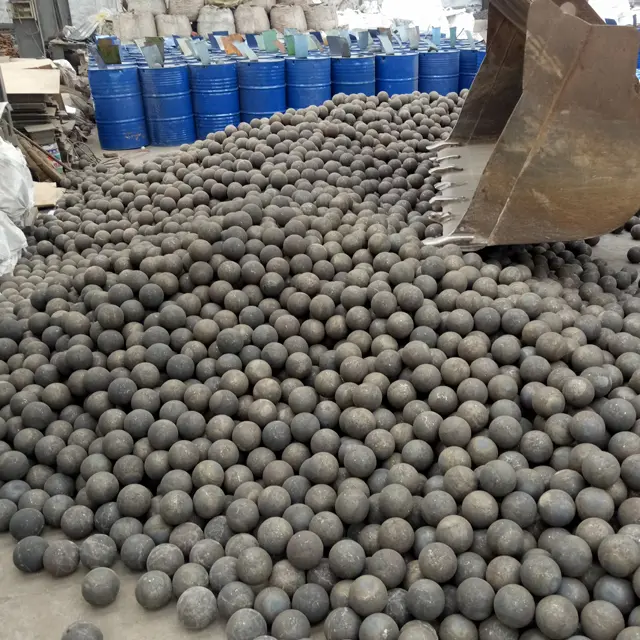
In a ball mill, grinding media must deliver impact and abrasion energy to ore, clinker or fuel. When a ball fractures, it stops working as designed. It may become an irregular fragment that reduces effective grinding contact, disrupts ball charge grading and accelerates wear on liners, diaphragms and mill internals.
Industry research shows why this matters: grinding media, liners and energy dominate ball-mill operating costs. One review estimates that approximately 37% of industrial ball-mill costs relate to grinding media, 13% to liners, and about 50% to energy.
A broken ball therefore creates four costs at once:
- Lost grinding media value.
- Reduced grinding efficiency and potential throughput loss.
- Higher power consumption per tonne processed.
- Increased maintenance, liner wear and shutdown risk.
This is why a breakage rate below 0.8% can be a major financial threshold.
Breakage rate is typically expressed as the percentage of grinding balls that fracture, spall or become unusable during a defined operating period. It should be measured by weight or piece count against total media consumption.
For example, if a mill consumes 1,000 tonnes of grinding balls annually and fewer than 8 tonnes are lost through breakage, the breakage rate is below 0.8%.
| Breakage Rate | Annual Broken Media on 1,000 t Consumption | Operational Meaning |
|---|---|---|
| 3.0% | 30 t | High risk; unstable charge and frequent interventions |
| 1.5% | 15 t | Acceptable in some harsh circuits, but still costly |
| 0.8% | 8 t | Strong performance benchmark for demanding applications |
| 0.5% | 5 t | Excellent control; usually requires optimized metallurgy and mill conditions |
The difference between 3% and 0.8% is 22 tonnes of avoidable media loss per 1,000 tonnes consumed. But the true saving is larger because broken balls also damage productivity and equipment.
Many buyers compare grinding balls by price per tonne. That is understandable, but incomplete. A lower-priced ball with poor impact resistance can become the more expensive option once breakage, downtime and liner damage are included.
Every fractured ball must be replaced. If a plant consumes 5,000 tonnes of media annually, reducing breakage from 2.5% to 0.8% avoids 85 tonnes of broken media per year.
At a media value of USD 900 per tonne, that alone equals USD 76,500 per year. In a large mining operation consuming 20,000 tonnes annually, the same improvement avoids 340 tonnes of media loss—approximately USD 306,000 per year before considering secondary costs.
Grinding is one of the most energy-intensive stages in mineral processing. Research indicates that comminution can consume more than half of the energy used in mining operations, while grinding mills convert only a small fraction of input energy into actual particle breakage.
Broken balls reduce the uniformity of the grinding charge. The mill may need more power to achieve the same product size, or throughput may fall because the effective grinding surface and impact pattern become inconsistent.
Irregular ball fragments create abnormal impact points. They can chip liners, damage shell liners, accelerate discharge-diaphragm wear and interfere with pulp flow. Mill inspections are important because undetected issues can lead to breakdowns, unplanned downtime and production losses.
A broken ball does not always leave the mill immediately. It may lodge in a grate, damage a pump downstream, or create an imbalance in the charge. Each unplanned stop can cost far more than the price of the ball itself.
Breakage is rarely caused by one factor. In my experience reviewing failed media from mining and cement customers, the root cause is usually a combination of material quality, heat treatment, mill conditions and operating practice.
Poor chemistry control, excessive inclusions, segregation, porosity or inconsistent microstructure can create weak points inside the ball. Under repeated impact, these defects become crack-initiation sites.
For forged balls, controlled bar quality, forging ratio and heat treatment are essential. For cast balls, chemistry, pouring quality, solidification control and heat treatment determine whether the ball can withstand high-impact service.
High surface hardness improves abrasion resistance, but hardness alone is not enough. A ball must combine:
- High surface hardness for wear resistance.
- Adequate core hardness for sustained performance.
- Impact toughness to resist cracking.
- Consistent microstructure through the ball volume.
A ball that is extremely hard but brittle may look attractive in a hardness certificate, yet fail quickly in a large-diameter mill with high impact energy.
Uneven quenching, incorrect tempering or inconsistent furnace conditions can create residual stress. Even if the surface hardness is correct, internal stress can cause delayed cracking under cyclic impact.
This is why SHANDONG ALLSTAR GRINDING BALL CO., LTD. controls the process from raw-material selection through forging or casting, heat treatment, quenching, tempering, hardness testing and final inspection.
Even high-quality balls can break in a poorly matched mill environment. Common contributors include:
- Excessive mill speed or overly aggressive liner lifters.
- Incorrect ball charge grading.
- Overfilled or underfilled mills.
- Coarse feed or unexpectedly hard ore.
- High impact energy from large-diameter balls.
- Thermal stress in hot cement applications.
- Corrosive slurry combined with abrasive wear.
Ore breakage behavior is highly sensitive to impact energy and particle size, which explains why media selection must match the actual comminution environment rather than relying only on a generic specification.
At SHANDONG ALLSTAR GRINDING BALL CO., LTD., our objective is simple: deliver grinding media that maintains its shape, hardness and structural integrity for longer under real operating conditions.
We begin with carefully selected steel bars and casting materials. Chemical composition is controlled to support the required balance of hardness, toughness and wear resistance.
We manufacture both forged steel grinding balls and cast grinding balls, allowing customers to select the most suitable solution for their application.
| Application Priority | Recommended Media Direction | Why It Helps |
|---|---|---|
| High-impact mining mills | Forged steel balls | Strong toughness and resistance to fracture |
| Cement and lower-impact grinding | Forged or cast balls | Cost-effective wear resistance |
| Corrosive slurry environments | Alloyed cast or specially treated media | Improved resistance to corrosion-assisted wear |
| Rod mills and coarse grinding | Grinding rods | Line contact supports controlled particle reduction |
| Fine grinding and specialized mills | Grinding cylpebs | Different contact geometry for specific grinding targets |
Our heat-treatment process is designed to develop a stable hardness profile and reduce internal stress. The goal is not simply the highest possible hardness, but the right combination of surface hardness, core properties and impact resistance.
Each production batch is checked through a structured quality-control process, including:
1. Chemical-composition verification.
2. Hardness testing at surface and core positions.
3. Microstructure and heat-treatment verification.
4. Dimension and roundness checks.
5. Drop-test or impact-resistance evaluation where applicable.
6. Visual inspection for cracks, porosity, shrinkage and surface defects.
7. Packaging and loading checks to prevent transport damage.
We do not treat every customer's mill as identical. For OEM brands, distributors and end users, we can support media selection based on:
- Mill diameter and type.
- Feed size and target product size.
- Ore hardness or material abrasiveness.
- Liner profile and mill speed.
- Current media consumption and breakage history.
- Required hardness, diameter range and packaging.
This application-first approach helps reduce the risk of specifying a ball that performs well in a laboratory but fails in the customer's actual circuit.
If your plant is experiencing high ball breakage, do not replace the supplier blindly. Use a structured diagnostic process.
Retrieve broken balls from the mill, trommel, discharge area or media recovery system. Photograph them and retain samples for analysis.
- Brittle fracture: often indicates poor toughness, internal defects or excessive impact stress.
- Spalling: may point to surface fatigue, heat-treatment issues or severe impact conditions.
- Fatigue cracking: often develops after repeated cyclic loading.
- Abnormal flattening or deformation: may indicate insufficient hardness or incorrect material selection.
Compare current data with historical performance:
- Media consumption in kg/t or g/t.
- Breakage percentage.
- Mill power draw.
- Throughput.
- Product size distribution.
- Liner wear and replacement interval.
- Ore hardness changes.
- Mill filling level and ball charge grading.
Run a controlled trial in one mill or one defined compartment. Track breakage, wear rate, power draw and product quality over a meaningful operating period.
The best result comes from matching media metallurgy, ball size distribution, liner design and operating parameters. Grinding-media selection directly affects breakage rate, power draw, energy efficiency and total operating cost.
A low purchase price can be attractive, but total cost per tonne is the metric that matters.
Total grinding-media cost should include:
- Purchase price per tonne.
- Wear rate.
- Breakage rate.
- Labor for media handling and mill top-ups.
- Mill downtime.
- Liner and diaphragm damage.
- Energy consumption.
- Product-quality variability.
- Logistics and packaging performance.
A ball with a slightly higher unit price but a breakage rate below 0.8% can deliver a lower total cost of ownership. This is especially true in large mining circuits, cement plants and power stations where media consumption is measured in thousands of tonnes per year.
To strengthen engagement and search performance, add the following assets:
- Featured image: A high-quality photo of forged and cast grinding balls with a mill in the background.
- Infographic: "The true cost chain of one broken grinding ball."
- Chart: Breakage rate versus annual media loss at 1,000, 5,000 and 20,000 tonnes consumption.
- Comparison table image: Forged vs. cast grinding balls for mining, cement and power applications.
- Video: A short factory walkthrough showing forging, heat treatment, hardness testing and packing.
- Downloadable checklist: "Grinding Ball Breakage Diagnostic Checklist."
For many demanding mining and cement applications, a breakage rate below 0.8% is a strong performance benchmark. The ideal target depends on mill size, impact conditions, ore hardness and media type.
It is commonly calculated as:
Breakage Rate=Weight or Number of Broken Balls /Total Grinding Media Consumed×100
For example, 6 tonnes of broken balls out of 1,000 tonnes consumed equals 0.6%.
No. Forged balls often perform well in high-impact mining mills because of their toughness, while cast balls can be highly effective in certain cement, power and abrasive-grinding applications. The correct choice depends on the mill environment and cost priorities.
Yes. Excessive hardness without sufficient toughness can make balls brittle. The best grinding ball balances surface hardness, core hardness, impact resistance and microstructural stability.
Start by analyzing failed balls, reviewing mill speed and liner profile, correcting ball charge grading, verifying feed size and ore hardness, and testing media from a supplier with documented heat-treatment and quality-control processes.
It can. Stable media charge and consistent grinding action support better control of residue, Blaine fineness and mill performance. Broken balls can disrupt the charge and make product quality harder to control.
If broken grinding balls are increasing your media consumption, disrupting mill performance or shortening liner life, we can help you identify the cause and select a more reliable solution.
SHANDONG ALLSTAR GRINDING BALL CO., LTD. supplies forged steel grinding balls, cast grinding balls, grinding rods and grinding cylpebs for mining, cement and power applications worldwide. We support OEM brands, wholesalers and producers with stable quality, customized specifications and application-based technical support.
Contact our technical team today with your mill data, current media specification and breakage history. We will help you evaluate whether a breakage rate below 0.8% can reduce your total grinding cost.
- [Metso – Grinding Mill Services]
- [Metso – Grinding]
- [MDPI – A Review of the Grinding Media in Ball Mills for Mineral Processing]
- [911 Metallurgist – Grinding Ball Wear & Breakage by Impact & Abrasion Tests]
- [SMC Testing – How It Works]
- [JKTech – Comminution Testing]
- [Hazen Research – Comminution]
- [ScienceDirect – Experimental Investigation of the Impact Breakage Process]
- [Springer – Effect of Media Shape on Grinding Efficiency]
- [Wiley – The Effect of Grinding Media on Mineral Breakage Properties]
Hot Tags: China, Global, OEM, private label, manufacturers, factory, suppliers, manufacturing company


