
Views: 270 Author: shandong Allstar Grinding Ball Publish Time: 2026-10-14 Origin: Site


Content Menu
● Why High-Abrasive Ores Are So Difficult to Grind
● The Three Wear Mechanisms in Abrasive Ore Grinding
● Why Media Selection Must Start With Ore Characterization
>> A Simple Media-Selection Framework
● Forged Steel Balls vs. Cast and High-Chrome Media
● How to Reduce Grinding Media Consumption: A Practical Checklist
>> 1. Match media size to the grinding task
>> 2. Control feed size and ore variability
>> 3. Optimize mill loading and speed
>> 5. Track cost per tonne, not price per tonne
● A Field-Based Approach: Trial Before Full Conversion
● Quality Control: What Separates Reliable Grinding Media?
● How SHANDONG ALLSTAR Supports High-Abrasive Ore Grinding
● Common Mistakes in Abrasive Ore Grinding
>> 1. What makes an ore "high-abrasive"?
>> 2. Are forged steel balls better than high-chrome balls for abrasive ores?
>> 3. Does higher ball hardness always reduce wear?
>> 4. How can a mine reduce grinding media consumption?
>> 5. Why is corrosion important in wet ore grinding?
>> 6. What should OEM buyers look for in a grinding ball supplier?
High-abrasive ores expose every weakness in a grinding circuit: media wears quickly, liners degrade, slurry chemistry becomes aggressive, and cost per tonne rises. The most effective response is not simply buying the hardest ball available—it is matching ore abrasiveness, impact conditions, slurry chemistry, and grinding media metallurgy as one engineered system.
At SHANDONG ALLSTAR GRINDING BALL CO., LTD., we work with mining operators, OEM brands, wholesalers, and mineral-processing producers across mining, cement, and power applications. From our experience supplying forged steel balls, cast steel balls, grinding rods, and grinding cylpebs, the operations that control abrasive-ore grinding best are those that treat media selection as a technical decision—not a price-only purchase.
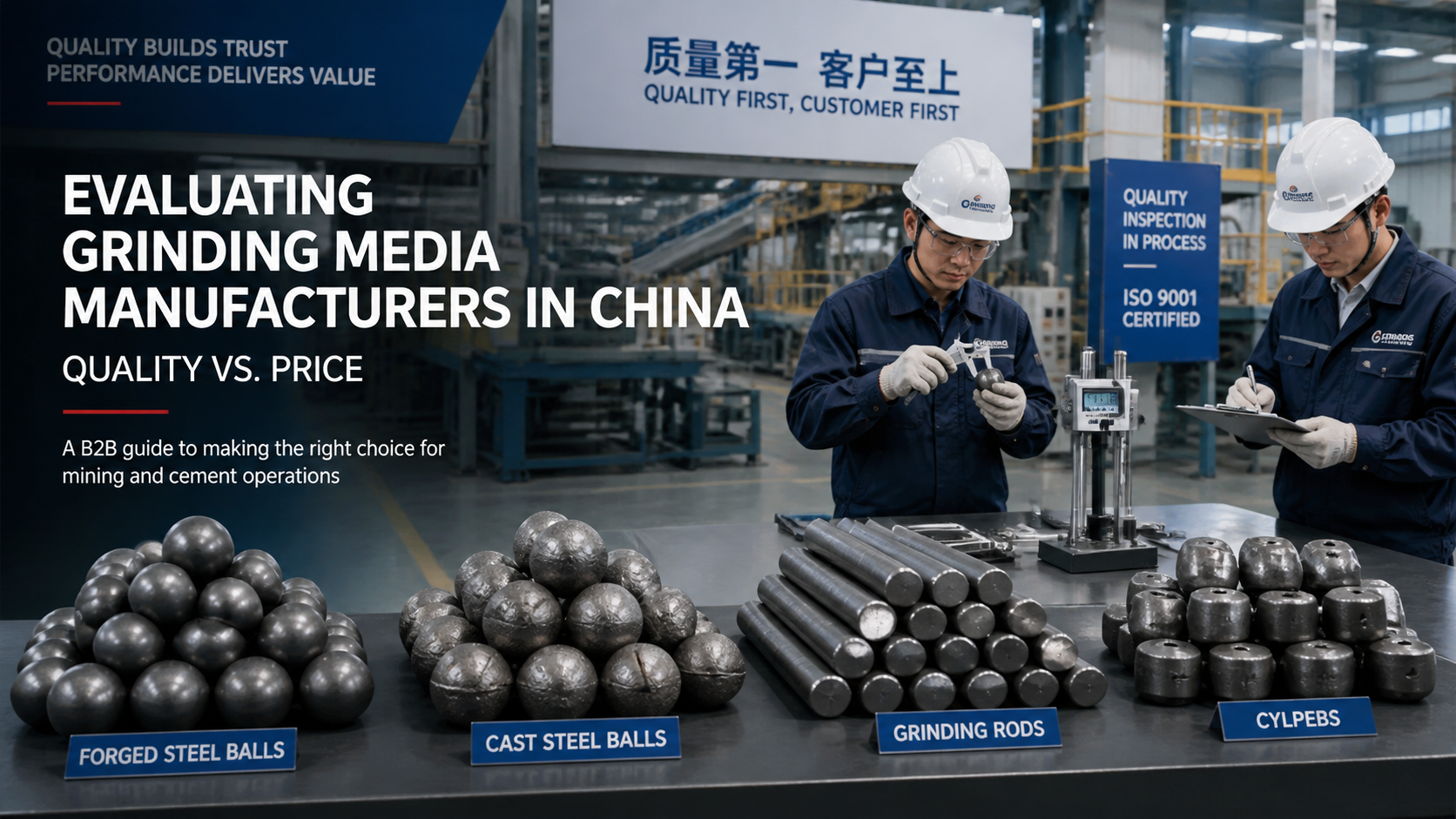
High-abrasive ores commonly contain hard minerals such as quartz, silica, magnetite, hematite, and other hard gangue materials. As these particles move through a ball mill, they continuously scratch, cut, and fatigue the surfaces of grinding media and mill liners.
The result is a compounding operational problem:
- Higher grinding media consumption
- More frequent media top-ups
- Greater risk of ball breakage and spalling
- Reduced grinding efficiency
- Higher liner replacement frequency
- More metal contamination in sensitive downstream processes
- Unstable product size distribution
Ore abrasiveness is influenced by mineral hardness, silica content, particle shape, and feed size. Industry guidance from Metso notes that coarser feed generally increases wear and that a poor ore-size distribution can reduce grinding efficiency while accelerating liner wear.
In practical terms, an ore that looks "hard" is not always the most abrasive. A lower-hardness ore with sharp, silica-rich particles can sometimes cause more media loss than a harder but more homogeneous ore.
Understanding wear mechanisms is the first step toward reducing them. Grinding media in a ball mill is subjected to impact, abrasion, and corrosion, often simultaneously.
| Wear mechanism | What happens | Typical high-risk conditions | Engineering response |
|---|---|---|---|
| Abrasive wear | Hard ore particles scratch and remove media surface material | High-silica ores, coarse feed, high mill loading | Higher-hardness media, optimized microstructure, correct media size |
| Impact wear | Repeated collisions cause chipping, cracking, deformation, or fracture | Coarse grinding, large media, high mill speed, SAG-type duty | Tough forged steel balls, controlled hardness depth, quality heat treatment |
| Corrosive wear | Slurry chemistry weakens the media surface and accelerates metal loss | Wet grinding, low pH, chloride or acidic process water | Chrome-alloyed media, corrosion-aware alloy selection, water chemistry control |
Research and industry testing show that abrasion is often the dominant wear mode when balls do not fracture or spall, but corrosion and abrasion can interact and intensify total media loss in wet grinding.
The key insight: hardness alone does not guarantee lower wear. A grinding ball must combine surface hardness, toughness, consistent microstructure, and resistance to the specific slurry environment.
Before selecting grinding balls, we recommend a structured ore-characterization review. This prevents the common mistake of choosing media based only on supplier catalog hardness.
A practical assessment should include:
1. Bond Abrasion Index or equivalent abrasiveness testing
2. Ore mineralogy, especially quartz and other hard abrasive minerals
3. Feed size distribution and expected product size
4. Mill type, diameter, speed, and liner profile
5. Wet or dry grinding conditions
6. Slurry pH, dissolved oxygen, chlorides, and reagent chemistry
7. Current media wear rate, breakage rate, and recharge practice
8. Downstream sensitivity to iron contamination
The Bond Abrasion Index is widely used to quantify how abrasive an ore is. Higher abrasiveness generally corresponds to faster liner and media wear, although the relationship should always be validated against actual plant data.
| Operating condition | Primary priority | Media direction |
|---|---|---|
| Coarse feed, high impact | Breakage resistance | Forged steel grinding balls with strong toughness |
| Fine grinding, high abrasion | Surface wear resistance | High-chrome cast or chrome-alloy steel balls |
| Wet, corrosive slurry | Corrosion and abrasion resistance | Chrome-enhanced alloys and controlled slurry chemistry |
| Mixed impact and abrasion | Balanced hardness and toughness | Forged alloy steel or selected cast media based on trial data |
| Iron contamination concern | Low media loss and clean grinding | Higher-quality alloy media plus process optimization |
There is no universal "best" grinding ball. The correct answer depends on the complete grinding environment.
For high-abrasive ores, the choice often comes down to forged steel balls, cast steel balls, or high-chrome media. Each has a distinct role.
| Media type | Strengths | Best-fit applications | Limitations |
|---|---|---|---|
| Forged steel balls | Excellent toughness, low internal porosity, strong impact resistance | Primary ball mills, coarse grinding, high-impact circuits | May wear faster than high-chrome media in highly abrasive fine grinding |
| Cast steel balls | Good wear resistance and cost efficiency | General mining, cement, and power grinding | Quality depends heavily on casting control and heat treatment |
| High-chrome cast balls | High hardness and strong abrasion resistance | Fine grinding, abrasive ores, lower-impact conditions | Can be more sensitive to fracture under severe impact |
| Grinding rods | Line-contact grinding, controlled size reduction | Rod mills and certain coarse-grinding duties | Less suitable where ball impact energy is required |
A review of grinding media in mineral processing emphasizes that good media should provide high hardness, fracture toughness, wear resistance, and corrosion resistance while retaining enough ductility to reduce sudden rupture and chipping.
At SHANDONG ALLSTAR GRINDING BALL CO., LTD., we manufacture and supply forged grinding balls, cast grinding balls, high-chrome grinding balls, grinding rods, and grinding cylpebs for mining, cement, and power-plant applications. We also provide OEM grinding media services for overseas brand owners, distributors, and equipment producers.
Reducing media consumption in high-abrasive ore grinding requires action across procurement, operation, and metallurgy. Use this checklist as a starting point.
Oversized media can waste energy and increase impact-related wear. Undersized media may reduce breakage efficiency and increase abrasion exposure.
- Use larger media for coarser feed and higher impact duty.
- Use a controlled media size distribution for fine grinding.
- Avoid blindly copying another plant's media charge without comparing ore and mill conditions.
Media size distribution can have a greater influence on grinding performance than density, shape, or hardness alone.
Coarse, irregular feed increases impact loads and liner stress. Variable ore hardness also makes media consumption difficult to predict.
- Maintain stable crushing downstream of the mill.
- Monitor feed size distribution regularly.
- Segment ore types where possible.
- Adjust media recharge strategy when ore hardness or abrasiveness changes.
Operating a mill outside its intended charge level can shift the balance between impact and abrasion. Research indicates that impact wear may dominate at lower feed levels, while abrasion becomes more significant at higher feed levels.
- Avoid chronic underloading or overloading.
- Monitor power draw, sound, and product size.
- Review liner profile and charge behavior after major ore changes.
In wet grinding, corrosion is not a secondary issue. Acidic or chemically aggressive slurries can accelerate pitting, spalling, and metal loss.
- Track pH, dissolved oxygen, and corrosive species.
- Review process water quality and reagent use.
- Consider chrome-enhanced media where corrosion contributes materially to wear.
Studies of grinding ball wear show that corrosion and abrasion can act together, particularly in acidic wet milling environments.
The lowest purchase price is rarely the lowest operating cost. A more meaningful metric is:
Also include downtime, labor, liner wear, energy performance, and product-quality effects. A slightly higher-cost ball can be more economical if it delivers lower breakage, more stable wear, and fewer mill interruptions.
We advise customers to validate media performance through a controlled trial rather than changing the entire charge at once.
1. Establish a baseline: Record current media consumption, recharge weight, breakage rate, power draw, throughput, and product size.
2. Define success metrics: Set targets for grams per tonne milled, breakage rate, cost per tonne, and media top-up frequency.
3. Run a controlled section trial: Introduce the candidate media into one mill or a defined portion of the charge.
4. Measure consistently: Use the same weighing, sampling, and reporting method throughout the trial.
5. Inspect withdrawn balls: Check for spalling, deformation, cracking, surface pitting, and abnormal wear patterns.
6. Compare total cost: Evaluate media price alongside consumption, downtime, and grinding performance.
7. Scale gradually: Move to full conversion only after the data supports it.
This approach reduces procurement risk and gives procurement, metallurgy, and maintenance teams a shared basis for decision-making.
In high-abrasive applications, small inconsistencies in manufacturing can become large operating problems. A ball that is hard on the surface but brittle through the core may chip or fracture. A ball with inconsistent heat treatment may wear unevenly and disrupt the media charge.
Reliable grinding media should be evaluated for:
- Chemical composition
- Surface and core hardness
- Hardness distribution through the ball
- Impact toughness
- Microstructure and heat-treatment consistency
- Dimensional tolerance and roundness
- Internal defects and porosity
- Breakage rate under real milling conditions
Published research highlights that media performance depends not only on hardness but also on composition, phase structure, and the corrosive-abrasive characteristics of the slurry. [mdpi]
For OEM buyers, this is especially important. Your brand reputation depends on consistent product performance across batches, ports, and customer sites.
SHANDONG ALLSTAR GRINDING BALL CO., LTD. is a global manufacturer and supplier of grinding media for mining, cement, and power industries. We support customers with:
- Forged steel grinding balls for high-impact and heavy-duty milling
- Cast steel grinding balls for cost-effective general grinding
- High-chrome grinding balls for abrasive and fine-grinding environments
- Grinding rods for rod mill applications
- Grinding cylpebs for specialized fine and ultra-fine grinding
- OEM manufacturing for international brands, wholesalers, and equipment producers
- Custom specifications based on mill conditions, ore characteristics, and performance targets
Our approach is straightforward: understand the application, recommend the appropriate media metallurgy and size mix, support trial validation, and help customers measure results in terms of cost per tonne milled.
For buyers sourcing grinding media internationally, we recommend requesting:
- Material certificates and heat-treatment records
- Hardness and toughness test data
- Dimensional and surface-quality standards
- Packaging and export-loading specifications
- Trial supply options before large-volume commitment
- Clear technical support for media recharge and wear monitoring
Avoiding these mistakes can improve both media life and grinding stability:
- Buying only on hardness: High hardness without adequate toughness can increase breakage.
- Ignoring slurry chemistry: Corrosion can undermine even a hard media alloy.
- Using one media size for all conditions: A proper size distribution often performs better.
- Changing suppliers without a baseline: Without data, improvements cannot be proven.
- Focusing only on media price: Total cost per tonne milled matters more.
- Neglecting liner condition: Worn liners alter charge motion and media behavior.
- Failing to inspect used balls: Wear patterns reveal valuable information about impact, abrasion, and corrosion.
Grinding high-abrasive ores is a systems challenge. The best results come from aligning ore characterization, mill operation, slurry chemistry, liner condition, and grinding media metallurgy.
If your operation is experiencing high ball consumption, frequent breakage, unstable product size, or rising grinding costs, start with a structured media trial. Choose a supplier that can provide not only product, but also technical support, consistent quality control, and OEM-scale manufacturing capability.
Ready to reduce grinding media costs in high-abrasive ore applications? Contact SHANDONG ALLSTAR GRINDING BALL CO., LTD. for a tailored grinding media recommendation, OEM supply program, or trial-based media evaluation.
A high-abrasive ore typically contains hard, sharp minerals such as quartz or silica-rich gangue. These particles aggressively scratch grinding media and liners, increasing metal loss. Ore hardness, silica content, particle shape, and feed size all influence abrasiveness.
It depends on the grinding condition. Forged steel balls are generally preferred where impact toughness and breakage resistance are critical, such as coarse or high-impact grinding. High-chrome media is often better where abrasion dominates and impact is more controlled, such as fine grinding.
No. Higher hardness usually improves abrasion resistance, but excessive hardness without sufficient toughness can increase chipping, spalling, and fracture. Microstructure, heat treatment, and slurry chemistry are equally important.
Start by characterizing the ore, optimizing media size distribution, controlling feed size, reviewing mill loading, managing slurry chemistry, and tracking media cost per tonne milled. A controlled trial is the safest way to validate a new media specification.
In wet grinding, corrosive slurry can weaken the ball surface and make abrasive wear worse. Corrosion and abrasion often act together, increasing total media loss beyond what either mechanism would cause alone.
Look for consistent chemical composition, controlled heat treatment, hardness and toughness testing, dimensional accuracy, export-ready packaging, trial support, and the ability to manufacture to your brand's technical specification.
- [Metso — Three factors that determine the wear life and performance of mill liners]
- [MDPI Minerals — A Review of the Grinding Media in Ball Mills for Mineral Processing]
- [911Metallurgist — Grinding Ball Wear & Breakage by Impact & Abrasion Tests]
- [911Metallurgist — Grinding Ball Wear & Corrosion]
- [911Metallurgist — List Factors Affecting Grinding Ball / Media Wear Rate]
- [ScienceDirect — Friction and wear of liner and grinding ball in iron ore ball mills]
- [ScienceDirect — A discussion on the measurement of grinding media wear]
Hot Tags: China, Global, OEM, private label, manufacturers, factory, suppliers, manufacturing company


