
Views: 260 Author: shandong Allstar Grinding Ball Publish Time: 2026-10-21 Origin: Site


Content Menu
● How Milling Media Geometry Affects the Grinding Surface Area
>> Why the Comparison Basis Matters
● Grinding Ball Surface Area: A Practical Calculation
>> Worked Example: Steel Balls at Equal Charge Mass
● Balls, Cylpebs, and Rods: How Shape Changes Grinding
>> Spherical Balls: Size Controls Area per Tonne
>> Cylpebs: More Than a Surface-Area Claim
>> Grinding Rods: Mill Compatibility Comes First
● Why More Surface Area Can Still Produce Slower Grinding
● Mixed-Size Charges and Wear: The Surface Area Buyers Often Miss
>> Inspect the Charge Throughout Its Service Life
● A Five-Step Method for Selecting Milling Media Geometry
>> 1. Define the Grinding Duty
>> 3. Calculate Comparable Geometry
>> 5. Evaluate Total Grinding Cost
● Working with ALLSTAR on an OEM Grinding Media Specification
>> 1. Does smaller grinding media always improve efficiency?
>> 2. Do cylpebs always have more surface area than balls?
>> 3. Do forged balls have more surface area than cast balls?
>> 4. Is media surface area the same as cement Blaine fineness?
>> 5. Can grinding rods replace balls in an existing mill?
>> 6. How should buyers verify a claimed geometry advantage?
At SHANDONG ALLSTAR GRINDING BALL CO., LTD., we manufacture grinding balls, forged steel balls, cast steel balls, grinding rods, and cylpebs for mining, cement, and power applications. We also provide OEM services for international brands, wholesalers, and manufacturers. Understanding how milling media geometry affects the grinding surface area helps buyers look beyond product dimensions and select media around their actual grinding duty.
The central principle is straightforward: media shape and size influence available surface area, particle capture, and energy transfer. However, more surface area does not automatically mean better grinding.
Our approach is to connect geometry with feed characteristics, mill design, wear behavior, and the required product—not to recommend one shape for every application.
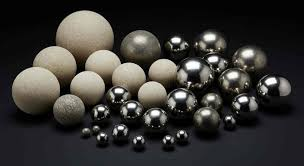
Grinding media geometry includes diameter, length, curvature, aspect ratio, and shape changes during wear. These features affect both the amount of external surface inside a mill and how that surface interacts with particles.
Three different concepts need separating:
- Geometric surface area: the total external area of the media.
- Active grinding contact: the changing locations where particles experience useful compression, impact, or shear.
- Product surface area: the new surface created as feed particles break.
These quantities are related, but they are not interchangeable. A charge can have substantial geometric area while producing disappointing results if collisions lack sufficient energy or particles cannot reach effective grinding zones.
Geometry matters because it changes both the opportunities for contact and the mechanics of breakage.
A claim that one shape offers "more surface area" is incomplete without specifying the comparison.
Are the media compared at equal diameter, equal individual mass, equal total charge mass, or equal occupied charge volume?
These choices can produce different conclusions. Equal charge mass does not necessarily mean equal mill filling, especially when material density and packing differ.
For procurement decisions, request the calculation basis before accepting any percentage advantage.
For a spherical grinding ball with diameter d:
A=πd2
Its volume is:
V=πd3/6
Therefore:
A/V=6/d
For balls of uniform density \(\rho\), the geometric surface area per unit mass is:
A/m=6/ρd
This explains why smaller balls provide more total external area when the total media mass remains unchanged.
The following values assume ideal spheres, a density of 7,850 kg/m³, and a charge mass of one metric tonne.
| Ball diameter | Approximate surface area per tonne | Relative area |
|---|---|---|
| 20 mm | 38.2 m² | 3.0 |
| 30 mm | 25.5 m² | 2.0 |
| 40 mm | 19.1 m² | 1.5 |
| 60 mm | 12.7 m² | 1.0 |
Reducing diameter from 60 mm to 30 mm doubles the calculated area per tonne. It also increases the approximate number of balls eightfold.
But each 30 mm ball has only one-eighth the mass of a 60 mm ball. At equal velocity, its kinetic energy is correspondingly lower.
That is the practical trade-off: more potential contacts versus less energy in each individual moving body.
Actual mill behavior also depends on trajectories, filling, liners, and operating conditions.
Different media shapes influence contact orientation, charge movement, and particle capture. The most useful comparison considers these mechanisms alongside surface area.
| Media geometry | Main geometric characteristic | Selection consideration |
|---|---|---|
| Spherical balls | Uniform curvature in every direction | Match ball size to breakage requirements |
| Cylpebs or short cylinders | Curved sides and end faces | Evaluate orientation, packing, and wear |
| Long rods | High length-to-diameter ratio | Use within a suitable rod-mill design |
| Worn or irregular media | Changing dimensions and curvature | Inspect the operating charge, not only new media |
Balls provide a clear starting point for surface-area calculations because their geometry is simple.
Forged steel balls and cast steel balls of the same diameter and density have essentially the same ideal external area. Their manufacturing route does not change the sphere formula.
Their service performance can nevertheless differ through metallurgy, hardness distribution, impact resistance, and wear.
Buyers should therefore separate two questions: "What geometry is required?" and "What material properties will preserve useful performance?"
For an ideal cylinder with diameter Dand length L, including both ends:
A/V=4/D+2/L
If length equals diameter:
A/V=6/D
That is the same surface-to-volume ratio as a sphere with diameter \(D\). However, the cylinder contains more material per piece.
At equal individual volume, an ideal cylinder whose length equals its diameter has approximately 14.5% more surface area than a sphere.
Neither comparison establishes a universal grinding advantage. Commercial cylpebs may have tapered sides or rounded ends, and real performance depends on orientation, charge dynamics, and particle capture.
For a long cylindrical rod, the end contribution becomes relatively small:
A/V≈4/D
Its length creates a different contact arrangement from a ball charge, but does not automatically create more area per unit mass.
Rods should be evaluated as part of a compatible rod-milling system. They are not simply elongated substitutes that can be introduced into any ball mill.
Particles must experience sufficient stress to fracture. Increasing the number of contacts is useful only when enough contacts exceed the relevant breakage threshold.
Small media can create many interactions but struggle with a coarse or resistant feed. Larger media can deliver stronger individual impacts while offering fewer contacts per tonne.
Published laboratory research illustrates this limitation. In a 2024 quartz-sand study using a vibratory mill, 15 mm steel balls reached a selected fine-particle target in an estimated 22.5% less time than 12 mm balls.
The larger balls had less theoretical surface area per unit mass, yet performed better for that particular target.
This was a laboratory vibratory-mill result—not an ALLSTAR plant trial or a promised saving for industrial ball mills. Its value is the lesson: optimize useful energy transfer, not surface area alone.
A working mill rarely contains only perfectly uniform new balls. Wear and replenishment create a distribution of sizes.
However, the smallest media are not automatically the most useful. Their value depends on whether they remain in the mill, move effectively, and generate sufficient breakage stress.
During wear, a ball becomes smaller and its surface area per kilogram increases. Its absolute surface area and mass both decrease.
These statements are compatible: area falls with diameter squared, while mass falls with diameter cubed.
Consequently, the operating charge's total area depends on wear, replenishment, discharge losses, and size distribution—not merely the original purchase specification.
A charge inspection should record:
- Remaining size distribution.
- Flattening, deformation, and irregular shapes.
- Cracked or broken media.
- Changes in product size and throughput.
- Media consumption over a defined production period.
Do not treat additional area from fragments as a benefit. It may indicate premature failure rather than useful grinding capacity.
Our recommended decision framework begins with the process requirement and ends with measurable operating results.
Record the mill type, feed size distribution, material characteristics, target product, wet or dry operation, and downstream requirements.
For cement, particle-size distribution and product performance matter alongside fineness. For mineral processing, liberation and downstream recovery may also influence the preferred grind.
Measure throughput, power demand, product size distribution, and media consumption under stable conditions.
Use specific energy in kWh/t and media consumption in kg/t where appropriate. Compare these values at equivalent product requirements.
A finer product is not necessarily an improvement if it creates unnecessary energy demand or downstream problems.
Estimate area per tonne using consistent assumptions.
Document whether candidates are compared at equal mass, equal solid volume, or equal occupied charge volume. Also record density, dimensions, shape tolerances, and the intended size mix.
Keep feed characteristics and operating conditions as consistent as practical. Record unavoidable changes rather than attributing every performance difference to the media.
Allow sufficient stabilization time. In a continuously replenished mill, the previous charge can influence results long after a new media type is introduced.
Compare electricity, media consumption, throughput, product quality, and maintenance implications together.
The preferred option is the one that delivers the required product economically and reliably—not necessarily the media with the greatest calculated area or lowest purchase price.
SHANDONG ALLSTAR GRINDING BALL CO., LTD. supplies forged and cast grinding balls, grinding rods, and cylpebs for customers serving mining, cement, and power applications.
For OEM buyers, geometry should become a documented specification rather than a broad product description.
A useful technical inquiry includes:
- Mill type and operating duty.
- Required media shape, dimensions, and tolerances.
- Current media specification and consumption.
- Feed characteristics and target product.
- Hardness, impact, or wear-related acceptance requirements.
- Packaging, identification, and documentation needs.
Send ALLSTAR your current media specification, mill information, and main operating challenge to discuss an OEM supply proposal and a practical comparison plan. Clear operating information creates a stronger starting point than selecting by diameter alone.
No. Smaller media provide more geometric area per unit mass, but individual contacts may lack sufficient energy for the feed. Select size around particle breakage requirements, not area alone.
No. The result depends on dimensions and comparison basis. Equal individual volume, equal diameter, and equal charge mass are different comparisons. Rounded or tapered commercial shapes also differ from ideal cylinders.
Not inherently. At equal diameter and density, their ideal geometric area per mass is the same. Metallurgy and manufacturing quality influence how they wear and survive service.
No. Media surface area describes the grinding bodies. Blaine fineness is an air-permeability-based measure associated with the cement powder. Media geometry can influence grinding, but the measurements describe different things.
Not without a technical assessment. Rod length, mill proportions, discharge arrangement, and operating conditions must be compatible. A surface-area calculation alone cannot establish suitability.
Request the calculation basis, test conditions, feed description, and product target. Then compare performance in a controlled trial, including specific energy, throughput, media consumption, and product quality.
Hot Tags: China, Global, OEM, private label, manufacturers, factory, suppliers, manufacturing company


