
Views: 258 Author: shandong Allstar Grinding Ball Publish Time: 2026-10-16 Origin: Site


Content Menu
● Why Blaine Value Depends on Media Charge
● Balls vs Cylpebs: What Each Media Does
● Recommended Media Charge Ratio Framework
● How to Calculate and Verify Charge Ratio
● Step-by-Step Optimization Method
>> Step 1: Establish a Stable Baseline
>> Step 2: Audit the Existing Charge
>> Step 3: Change One Variable at a Time
>> Step 4: Balance Blaine Against Residue
>> Step 5: Confirm Economic Performance
● Expert Insight: Avoid the "More Fine Media" Trap
● Material and Quality Considerations
● FAQ
>> 1. What is the best balls-to-cylpebs ratio for increasing Blaine?
>> 2. Do cylpebs always increase Blaine more than balls?
>> 3. What filling degree should a cement ball mill use?
>> 4. Can I replace all balls with cylpebs to raise Blaine?
>> 5. How do I know whether the media charge is overfilled?
>> 6. Which grinding media is best for cement plants?
The fastest way to raise Blaine value is not simply adding more grinding media. In a cement ball mill, the correct media charge ratio—especially the balance between balls and cylpebs—controls impact breakage, surface-area creation, power draw, liner wear, and final cement quality. As a manufacturer serving mining, cement, and power-plant operators worldwide, Shandong Allstar Grinding Ball Co., Ltd. recommends treating media selection as a process-optimization project rather than a simple consumables purchase.
This guide explains how to select a practical balls-versus-cylpebs charge ratio, how to increase Blaine without overgrinding, and how to validate the result with plant data.

Blaine specific surface area measures the fineness of cement in cm²/g. A higher Blaine value generally means more exposed particle surface, which can improve early hydration and strength development—but only when particle-size distribution and mill stability are also controlled.
In our work with cement producers, the most common mistake is chasing Blaine by increasing fine-media loading. That may raise surface area temporarily, but it can also cause:
- Higher specific power consumption.
- Overheating in the fine-grinding compartment.
- Excessive fines and a narrower particle-size distribution.
- Reduced mill throughput.
- Faster wear of liners, diaphragms, and media.
The objective should be maximum sustainable Blaine increase per tonne of grinding media and per kWh consumed, not the highest possible Blaine reading.
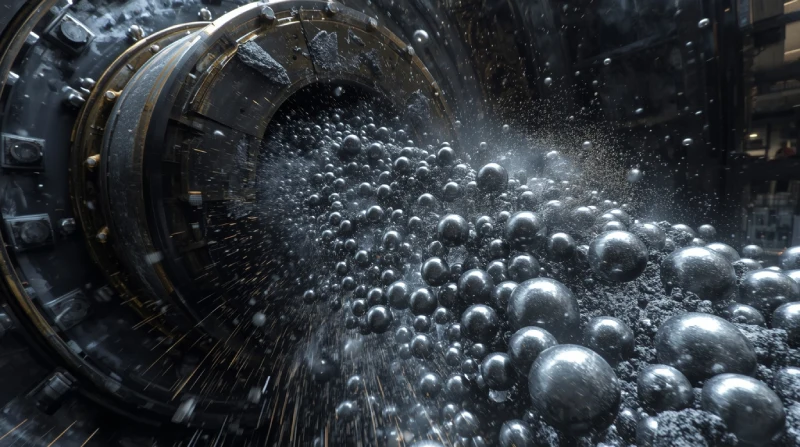
Balls and cylpebs do not perform the same job. Balls deliver more point-contact impact and are effective for coarse clinker breakage. Cylpebs offer greater surface area per unit weight and more line-contact abrasion, making them useful in fine-grinding zones.
| Factor | Steel Balls | Cylpebs |
|---|---|---|
| Contact pattern | Predominantly point contact | More line and surface contact |
| Best role | Coarse and intermediate grinding | Fine grinding and surface-area creation |
| Blaine effect | Moderate, depends on size distribution | Often stronger at equal mass in fine grinding |
| Risk | Less surface area per tonne | Can pack tightly and reduce void space |
| Typical placement | First chamber, upper chambers | Second or final chamber |
| Wear behavior | Impact plus abrasion | More abrasion-dominated |
Research comparing cylpebs and balls shows that the two media differ in surface area, bulk density, and contact mechanism, which directly affects grinding performance. A separate fine-grinding study also found that media shape, total surface area, total mass, and charge volume all influence breakage behavior.
There is no universal ratio that fits every mill. However, a strong starting framework for a two-chamber cement ball mill is:
- First chamber: predominantly larger balls, typically 60–100 mm depending on clinker size, hardness, and feed gradation.
- Second chamber: smaller balls, often 15–60 mm, with optional cylpebs where finer Blaine is required.
- Cylpebs share: commonly introduced gradually, often beginning at 10–25% of the fine-chamber charge, then adjusted according to Blaine, residue, power draw, and temperature.
Modern cement finish mills commonly operate with volumetric filling degrees near 27–30% in the first chamber and 24–27% in the second chamber, though the ideal level must be verified for each mill. Ball mills for cement grinding are also commonly operated with media filling degrees in the 25–35% range.
| Mill condition | Suggested media strategy |
|---|---|
| Low Blaine, coarse residue | Increase effective fine-media surface area; test a modest cylpebs addition |
| Adequate Blaine but high power draw | Reduce total charge or correct oversizing; avoid adding more media |
| High Blaine but poor strength | Review particle-size distribution, not Blaine alone |
| Unstable mill sound or high temperature | Reduce filling degree or rebalance charge before adding media |
| High liner wear | Check impact energy, media hardness match, and coarse-ball proportion |
Do not convert directly from balls to cylpebs by weight alone. Cylpebs and balls have different bulk density, voidage, and contact geometry. A charge that appears numerically similar on paper may behave very differently inside the mill.
A reliable optimization program should combine calculation with physical verification. At Shandong Allstar, we advise customers to document the following before changing any charge:
1. Mill dimensions: effective internal diameter and effective grinding length by chamber.
2. Current media inventory: tonnage, size classes, media type, and estimated wear loss.
3. Filling degree: measured during a planned stoppage, not estimated from control-room data alone.
4. Power draw: recorded before and after each adjustment under comparable feed conditions.
5. Product data: Blaine, residue, particle-size distribution where available, compressive strength, and temperature.
6. Wear data: media consumption in g/t or kg/t cement, plus liner and diaphragm condition.
The basic calculation is:
For steel grinding media in cement mills, bulk density is often referenced around 4.5–4.6 t/m³, but the actual value depends on media shape, size distribution, and void ratio.
Suppose a finish-mill second chamber has an effective volume of 50 m³ and a target filling degree of 26%.
At a bulk density of 4.6 t/m³:
If the plant decides to trial 20% cylpebs by charge volume, the initial trial would use approximately:
- 47.8 tonnes of balls
- 12.0 tonnes of cylpebs
That is only a starting point. The plant should then compare Blaine increase, residue, mill power, and cement temperature against the previous ball-only baseline.
Run the existing charge for at least several days under consistent clinker, gypsum, and set-modifier conditions. Record Blaine, residue, throughput, power draw, and mill temperature.
Never judge a media change during unstable operation. Variable feed moisture, clinker hardness, or separator settings can distort the result.
Measure filling degree and classify the remaining media by size. Remove broken, misshapen, or heavily worn pieces. A charge with excessive fines or worn media can reduce effective grinding action even when total tonnage appears adequate.
Introduce cylpebs gradually. A controlled first trial might replace 10–15% of the fine-chamber ball charge by volume, rather than making a full conversion.
Track:
- Blaine increase.
- Residue on 45 µm or 90 µm sieve.
- Specific power consumption.
- Mill differential pressure.
- Outlet temperature.
- Production rate.
- Media wear rate.
A higher Blaine value is useful only if the cement still meets strength, setting-time, and workability requirements. If Blaine rises but residue becomes too low, the mill may be producing excessive ultrafines.
In that case, consider:
- Reducing cylpebs proportion.
- Adjusting ball-size distribution.
- Reviewing separator cut size.
- Improving ventilation or cooling.
- Checking for diaphragm blinding.
The best charge is the one that delivers the required Blaine at the lowest total cost per tonne. Calculate:
Cost per tonne cement=(Media cost+Power cost+Maintenance cost)/Cement produced
A media mix that raises Blaine but increases power and wear costs may be less profitable than a slightly lower-Blaine charge with better overall stability.
From our factory and field-service perspective, many Blaine problems are not caused by insufficient media. They are caused by an unbalanced charge.
For example, a plant may add small media to raise Blaine, but if the first chamber cannot sufficiently prepare the clinker, the second chamber becomes overloaded. The result is higher power consumption, poor ventilation, and limited Blaine gain.
A better approach is to protect the grinding function of each chamber:
- First chamber: effective impact and coarse-particle preparation.
- Intermediate stage: controlled size reduction.
- Final chamber: surface-area creation without excessive packing.
This is why we recommend matching media hardness, shape, and size distribution to the actual mill profile—not selecting media based only on price per tonne.
Media chemistry and heat treatment matter as much as shape. For cement applications, common choices include forged and cast steel media, with alloy and hardness selected according to abrasion, impact, and corrosion conditions.
Magotteaux, a global grinding-media supplier, offers cast and forged media, low- and high-chromium alloys, balls, boulpebs, rods, and ceramic media for cement and mining applications. This reflects an important industry principle: media selection should be application-specific.
For a cement plant seeking higher Blaine, evaluate:
- Hardness consistency: avoids rapid selective wear.
- Toughness: reduces breakage under impact.
- Dimensional tolerance: supports stable charge grading.
- Wear rate: protects charge balance over time.
- Supply repeatability: ensures replacement media matches the original design.
Shandong Allstar Grinding Ball Co., Ltd. supplies grinding balls, mill balls, forged steel balls, cast steel balls, grinding rods, and grinding cylpebs for mining, cement, and power industries. We also provide OEM services for overseas brands, wholesalers, and producers, with media specifications tailored to individual mill conditions.
- Balls are generally better for impact and coarse grinding.
- Cylpebs can help increase surface area in fine-grinding zones.
- The best balls-to-cylpebs ratio is determined by mill geometry, clinker properties, target Blaine, and power constraints.
- Start with a controlled trial, typically replacing a limited portion of the fine-chamber charge.
- Validate every change with Blaine, residue, power draw, temperature, production rate, and wear data.
- Choose a supplier that can provide consistent hardness, dimensions, and OEM-grade quality.
There is no fixed universal ratio. Many cement plants begin with a controlled cylpebs share of about 10–25% in the fine-grinding chamber, then adjust based on Blaine, residue, power draw, and temperature. The correct ratio depends on mill design, clinker grindability, and target cement specification.
Not always. Cylpebs provide more surface area per unit weight and can improve fine grinding, but their performance depends on charge volume, voidage, media size, and mill conditions. Comparative research shows that balls and cylpebs differ in surface area, bulk density, and contact mechanism.
Many cement finish mills operate around 27–30% filling in the first chamber and 24–27% in the second chamber. Other industry references place typical cement ball-mill filling at 25–35%. The correct level should be confirmed through mill measurements and performance trials.
A complete conversion is rarely advisable without testing. Balls and cylpebs behave differently under impact and abrasion. A gradual trial is safer because it protects mill stability, power efficiency, and cement quality.
Warning signs include rising power draw, higher mill temperature, poor ventilation, unstable mill sound, reduced throughput, and little or no Blaine improvement. Measure filling degree during a stoppage and compare actual charge volume with the design target.
The best media depends on the application. Coarse chambers generally require impact-resistant balls, while fine chambers may benefit from smaller balls, cylpebs, or a mixed charge. Consistent hardness, dimensional accuracy, low breakage, and predictable wear are more important than choosing a single media type.
- [A Comparison of the Fine-Grinding Performance between Cylpebs and Ceramic Balls – MDPI Minerals]
- [Comparison of Grinding Media: Cylpebs versus Balls – University of Queensland eSpace]
- [CemNet Forum: Percentage of Grinding Media in Ball Mills for Both Chambers]
- [Ball Mill Operation in Cement Grinding – Process Train Ball Mill]
- [Magotteaux Cement Solutions]
- [Cement Ball Mill Technology – The Cement Grinding Office]
- [Fuller Technologies: Ball Mill for Cement Grinding]
Hot Tags: China, Global, OEM, private label, manufacturers, factory, suppliers, manufacturing company


