
Views: 251 Author: shandong Allstar Grinding Ball Publish Time: 2026-10-15 Origin: Site


Content Menu
● Why Ball Chemistry Matters in SAG Mills
● The Chemistry-Throughput Connection
● Hardness Alone Is Not a Strategy
● Expert View: Start With the Ore, Not the Catalog
● Forged vs. Cast Balls for SAG Duty
● A Practical Ball-Chemistry Optimization Workflow
>> 2. Define the performance target
>> 3. Match chemistry to the failure mode
>> 5. Measure total cost per tonne
● Case Insight: Why Stable Media Improves Circuit Control
● The Role of Ball Size and Charge Management
● How Allstar Supports OEM and Mining Customers
>> 1. How does ball chemistry improve SAG mill throughput?
>> 2. Is a harder grinding ball always better for SAG mills?
>> 3. Should SAG mills use forged or cast steel balls?
>> 4. What data should I collect before changing grinding media?
>> 5. How long should a grinding-ball trial run?
>> 6. Can OEM grinding balls be customized for a specific mine?
Optimized ball chemistry is one of the most practical levers for improving SAG mill throughput—but only when hardness, toughness, microstructure, ball size, and ore conditions are engineered as one system. At Shandong Allstar Grinding Ball Co., Ltd., we help mining operators, OEM brands, wholesalers, and mill operators select forged and cast grinding media that reduce breakage, stabilize wear rates, and support higher sustainable tonnage.
As a global manufacturer of grinding balls, mill balls, forged steel balls, cast steel balls, grinding rods, and grinding cylpebs, Allstar supplies OEM-grade media for mining, cement, and power-generation applications. In SAG milling, where balls must survive repeated high-energy impact while resisting abrasive and corrosive wear, chemistry is not a simple specification—it is a performance strategy.
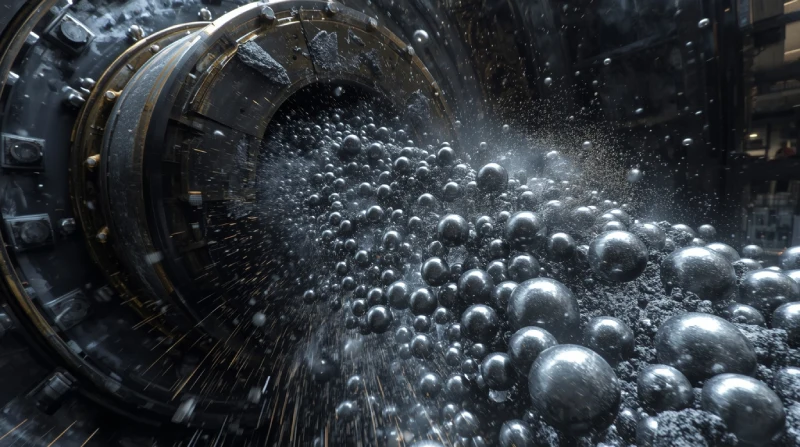
A SAG mill combines ore breakage with steel-ball impact. Unlike a conventional ball mill, its large-diameter media operate in a high-impact environment, so a ball that is merely hard may not be the best ball.
The right chemistry must deliver four outcomes at the same time:
- High surface hardness to resist abrasive wear.
- Adequate core toughness to prevent cracking and catastrophic breakage.
- Uniform hardenability so hardness is consistent from surface to core.
- Controlled microstructure to maintain performance under repeated impact and slurry exposure.
Research on grinding media identifies composition, hardness, phase structure, and the corrosive-abrasive nature of the slurry as central drivers of wear performance. Impact, abrasion, corrosion, and erosion all contribute to media loss.
The goal is not the hardest ball. The goal is the most productive ball per ton milled.
Ball chemistry affects throughput indirectly but powerfully. When media wear predictably and breakage stays low, the mill maintains a more stable charge profile. That stability supports better impact energy distribution, more consistent product size, and fewer unplanned interruptions.
| Ball-chemistry factor | Operational effect | Throughput impact |
|---|---|---|
| Carbon content | Influences hardness and wear resistance | Better wear control can stabilize charge level |
| Manganese | Supports hardenability and toughness | Lower risk of brittle failure |
| Chromium | Improves hardenability and abrasion resistance | More consistent wear in abrasive ores |
| Silicon | Acts as a deoxidizer and supports hardness | Cleaner steel and more reliable heat treatment |
| Phosphorus and sulfur | Impurities that can reduce toughness | Lower levels help reduce cracking risk |
| Heat treatment response | Determines hardness gradient and microstructure | Balanced wear and impact resistance |
A marked-ball wear study notes that SAG balls commonly operate in the 75–100 mm range and experience both substantial abrasive and impact wear. It also confirms that ball chemistry is routinely evaluated because it affects performance and microstructure.
Many procurement teams compare grinding balls by surface hardness alone. That approach is incomplete.
A ball with very high surface hardness may resist abrasion well, but if its core is insufficiently tough or its microstructure is unstable, it can crack under SAG impact. Broken balls reduce effective grinding media, increase liner stress, and can force operators to slow the mill or interrupt production.
A better selection standard includes:
- Surface hardness.
- Core hardness.
- Hardness gradient.
- Impact toughness.
- Microstructural consistency.
- Breakage rate.
- Wear rate.
- Media consumption per ton processed.
Industry guidance on grinding-ball design similarly identifies size, worn-size distribution, chemistry, hardness, microstructure, toughness, internal stress, and microstructural stability as critical design features.
From our work with mining customers, the most common mistake is selecting SAG media from a generic hardness table before understanding the mill's actual duty cycle.
Two mills may use similar ball sizes, yet require different chemistry because of differences in ore hardness, feed top size, slurry chemistry, mill speed, liner profile, and charge motion. A high-abrasion, lower-impact circuit may justify a harder media grade. A high-impact circuit may require a tougher forged ball with controlled hardenability.
Our practical recommendation is simple: define the failure mode first.
- If balls are wearing rapidly but rarely breaking, prioritize abrasion resistance and hardness uniformity.
- If balls are cracking or splitting, prioritize toughness, clean steelmaking, and heat-treatment control.
- If wear is uneven, review chemistry consistency, heat treatment, ball sizing, and charge makeup.
- If throughput fluctuates, evaluate media performance alongside feed size, mill filling, power draw, and classification performance.
Metso notes that suitable ore feed-size distribution is critical to high grinding efficiency and throughput in AG and SAG circuits, and that stable grinding-circuit conditions support higher throughput and better particle-size control.
Both forged and cast grinding balls have a role in mineral processing. For many SAG applications, however, forged steel balls are often preferred where impact resistance is the dominant requirement.
| Attribute | Forged steel balls | Cast steel balls |
|---|---|---|
| Impact resistance | Generally strong, especially when properly heat-treated | Depends heavily on alloy design and casting quality |
| Internal structure | Typically denser, forged structure | Can be sound with good foundry control |
| Best-fit duty | High-impact SAG and large-ball applications | Abrasion-led circuits and selected mill duties |
| Breakage sensitivity | Lower when toughness is controlled | Higher risk if microstructure or casting quality is inconsistent |
| OEM customization | Chemistry, size, hardness, packaging | Chemistry, size, alloy design, packaging |
For SAG mills, the large ball diameter and throw action create a high-impact environment. Media suppliers therefore emphasize balancing abrasion resistance with impact resistance to avoid excessive breakage.
At Shandong Allstar Grinding Ball Co., Ltd., we manufacture both forged and cast media, allowing customers to match the media type to the circuit rather than forcing one product into every application.
A disciplined trial is more valuable than a one-time purchase decision. We recommend the following process.
Collect at least two to four weeks of operating data using the current media:
- Throughput, in tonnes per hour.
- Mill power draw.
- Feed size distribution.
- Product P80.
- Ball consumption, in kilograms per tonne.
- Ball breakage or scats observations.
- Liner wear and reline frequency.
- Downtime related to media or grinding performance.
Do not simply ask for "lower wear." Define the commercial objective:
- Increase tonnes per hour at the same P80.
- Maintain throughput while reducing media consumption.
- Reduce ball breakage and related downtime.
- Improve charge stability during ore hardness variation.
- Lower total cost per tonne milled.
Use mill data to choose the correct balance of carbon, manganese, chromium, silicon, and impurity control. Then validate the proposed grade through hardness mapping, impact testing, chemical analysis, and microstructural inspection.
ME Elecmetal, for example, offers SAG-specific forged ball variants with different hardness and toughness profiles, and tests production batches for volumetric hardness, chemical composition, and impact resistance.
Change one major variable at a time where possible. Keep ball size, charge level, feed rate strategy, and operating procedures consistent during the comparison period.
A useful trial length is typically four to eight weeks, provided ore variability does not distort the result. Shorter tests can be misleading, especially in mines with changing ore zones.
The lowest purchase price per tonne of balls is rarely the lowest operating cost.
Use this formula:
Total grinding-media cost per tonne=(Media cost+breakage cost+downtime cost+liner-impact cost)/tonnes milled
This approach reveals whether a higher-specification ball is economically superior.
| Metric | Why it matters | What good looks like |
|---|---|---|
| Media consumption, kg/t | Measures wear economics | Stable or declining without loss of grind |
| Ball breakage rate | Indicates toughness mismatch | Low and consistent; broken balls should be rare |
| Throughput, t/h | Core production KPI | Stable or improved at target P80 |
| Mill power draw | Shows charge and grinding behavior | Stable within the intended operating window |
| Product P80 | Protects downstream recovery | Consistent with metallurgical target |
| Liner wear | Reflects charge motion and media condition | No abnormal acceleration |
| Unplanned downtime | Reveals operational risk | Reduced media-related interruptions |
Consider a gold operation processing a variable ore body. Its SAG mill experiences periodic surges in hard, coarse feed. The existing media wears quickly, and operators compensate by adding balls more frequently. However, inconsistent ball quality creates an uneven charge, making mill power draw and product size harder to control.
After moving to a properly matched forged SAG ball with controlled chemistry and heat treatment, the operation may not see an immediate dramatic jump in throughput. The first improvement is often process stability:
- Fewer broken balls.
- More predictable media addition.
- More consistent charge level.
- Better response to feed changes.
- Reduced risk of over-grinding or coarse discharge.
Over time, that stability creates room for operators to push feed rate without sacrificing grind size or overloading the mill. This is how optimized ball chemistry becomes a throughput tool.
Chemistry cannot compensate for poor ball sizing or poor charge management. SAG performance depends on the interaction between media, ore, liners, speed, and filling.
A SAG mill's throughput, power draw, and product size can peak at different mill-filling levels, so operators need grind curves to understand the relationship between filling and performance.
Best-practice charge management includes:
- Maintaining an appropriate make-up ball size for the current feed size distribution.
- Avoiding excessive accumulation of small, worn balls.
- Reviewing ball addition frequency and quantity.
- Monitoring scats and broken-ball removal.
- Aligning media strategy with liner profile and mill speed.
- Reviewing performance after major ore-source changes.
Shandong Allstar Grinding Ball Co., Ltd. positions itself as more than a media supplier. We act as a technical manufacturing partner for brands, distributors, and end users who need consistent quality at scale.
Our capabilities include:
- OEM grinding-ball production for international brands, wholesalers, and producers.
- Forged steel balls engineered for high-impact SAG and ball-mill duties.
- Cast steel balls for suitable abrasion-led applications.
- Grinding rods and cylpebs for rod mills, ball mills, and specialized grinding circuits.
- Customized chemistry, hardness, size, and packaging based on customer specifications.
- Quality-control documentation covering chemical composition, hardness, and production consistency.
For OEM partners, consistency is especially important. A brand's reputation depends on whether every shipment performs like the last one. That is why we emphasize controlled raw-material selection, repeatable heat treatment, and batch-level quality verification.
Optimizing throughput in SAG mills with optimized ball chemistry requires a system-level approach. The best media grade is the one that matches your ore, impact environment, wear mechanism, and commercial target—not simply the one with the highest hardness number.
For mines seeking higher sustainable tonnage, start with a baseline audit, identify the dominant wear or breakage mechanism, trial a properly engineered media grade, and evaluate the result using total cost per tonne milled.
Ready to improve SAG mill performance? Contact Shandong Allstar Grinding Ball Co., Ltd. for OEM grinding balls, forged steel balls, cast steel balls, grinding rods, and cylpebs engineered for your operating conditions. Our team can help you specify the right chemistry, hardness profile, and media format for your mill.
Ball chemistry improves throughput by supporting stable wear, reducing breakage, and maintaining a more consistent grinding charge. A stable charge helps the mill use impact energy more effectively, which can allow operators to sustain higher feed rates without compromising product size.
No. Higher hardness generally improves abrasion resistance, but SAG mills also impose heavy impact loads. If a ball lacks adequate toughness or has an inconsistent microstructure, it may crack or break. The best ball balances hardness, toughness, and hardenability.
It depends on the application. Forged steel balls are commonly selected for high-impact SAG duty because of their toughness and impact resistance. Cast balls can perform well in certain abrasion-led circuits when alloy design and foundry quality are properly controlled.
Track throughput, power draw, feed size distribution, product P80, media consumption, ball breakage, liner wear, and downtime. A baseline of two to four weeks is useful before beginning a controlled media trial.
A trial should generally run four to eight weeks, depending on ore variability and mill operating conditions. The trial should compare media consumption, breakage, throughput, power draw, product size, and total cost per tonne milled.
Yes. OEM manufacturers such as Shandong Allstar Grinding Ball Co., Ltd. can tailor ball chemistry, hardness, size range, heat treatment, packaging, and documentation to match a customer's mill duty and brand requirements.
- [Metso – Grinding Optimizer]
- [Metso – Grinding]
- [ME Elecmetal – ME Super SAG]
- [MDPI – A Review of the Grinding Media in Ball Mills for Mineral Processing]
- [911Metallurgist – A Comparison of Wear Rates of Ball Mill Grinding Media]
- [911Metallurgist – Grinding Ball Design]
- [Growth Steel – Grinding Media]
Hot Tags: China, Global, OEM, private label, manufacturers, factory, suppliers, manufacturing company


