
Views: 260 Author: shandong Allstar Grinding Ball Publish Time: 2026-10-10 Origin: Site


Content Menu
● High Chrome Steel Balls vs Cast Iron Grinding Balls: Define the Materials First
● Why Dry Phosphate Grinding Creates Different Wear Conditions
>> Quartz and Other Gangue Minerals Affect Abrasion
>> Dry Operation Changes the Selection Priorities
>> Grinding Media Must Match the Equipment
● How High-Chromium Grinding Media Can Extend Wear Life
● Practical Comparison for Dry Phosphate Ball Mills
● Diagnose the Existing Media Before Ordering a New Grade
>> Smooth Wear and Diameter Loss
>> Irregular Wear and Inconsistent Samples
● A Six-Step Trial for Extended Grinding-Media Wear Life
>> 2. Define Success Before Testing
>> 3. Verify Candidate Batches
>> 4. Control Operating Variables
>> 5. Account for Charge Transition
>> 6. Review Performance and Economics Together
● Compare Cost per Tonne, Not Price per Kilogram
● Do Not Let Mill Operation Hide the Material Result
● An OEM Purchasing Checklist for International Buyers
● Request an Application-Based Grinding Media Comparison
>> 1. Are High Chrome Steel Balls Actually Steel?
>> 2. Do High-Chromium Balls Always Outlast Cast Iron Grinding Balls?
>> 3. Is Higher Chromium Content Always Better for Phosphate Grinding?
>> 4. What Is the Best Wear-Life Measurement?
>> 5. Can a Higher-Priced Ball Reduce Grinding Costs?
>> 6. Can ALLSTAR Customer Reviews Prove Performance?
SHANDONG ALLSTAR GRINDING BALL CO., LTD. supplies grinding balls, forged and cast grinding media, grinding rods, and cylpebs for mining, cement, and power applications, with OEM services for international brands, wholesalers, and manufacturers. For buyers researching High Chrome Steel Balls vs Cast Iron Grinding Balls for Extended Wear Life in Dry Phosphate Grinding, our starting point is simple: compare verified material specifications and operating results, not product names alone.
High-chromium media can be a strong candidate for abrasion-dominated dry phosphate ball milling. However, longer wear life is not guaranteed by chromium content or hardness alone. Ore mineralogy, carbide structure, heat treatment, impact conditions, and mill operation all influence the result.
This guide explains the material differences, the purchasing questions that matter, and a practical method for identifying the lowest sustainable grinding cost.

The terminology requires clarification before any meaningful comparison.
Many products marketed as "high chrome steel balls" are actually high-chromium white cast iron grinding balls. Their wear resistance comes from hard chromium-rich carbides supported by a metallic matrix.
"Cast iron grinding balls" is a broader description. It can include different alloy compositions and microstructures, including high-chromium grades.
Therefore, the useful comparison is usually between high-chromium white cast iron media and a specified lower-alloy cast alternative—not steel versus cast iron as two mutually exclusive categories.
Ask suppliers to identify:
- Carbon and chromium content.
- Other significant alloying elements.
- Heat-treatment condition.
- Surface and internal hardness.
- Carbide distribution and matrix structure.
- Impact-test method and acceptance criteria.
A quotation stating only "high chrome" or "cast iron" leaves too much uncertainty for a technically sound purchasing decision.
Phosphate rock is not a uniform feedstock. Its associated minerals and geological origin can change grinding behavior substantially.
The phosphate-bearing mineral is only part of the wear problem. Quartz and other gangue minerals can make the feed more abrasive.
Laboratory research comparing grinding-ball materials has shown that carbide performance depends on the abrasive environment. Under severe quartz abrasion, increasing carbide content can increase wear when the surrounding matrix is removed and carbides subsequently microcrack.
This is why more chromium or more carbides should not automatically be interpreted as longer service life.
In genuinely dry grinding, aqueous corrosion is generally less central than in slurry milling. Mechanical abrasion, impact, fragmentation, and operating temperature become important assessment priorities.
Nevertheless, residual feed moisture and operating conditions still need documenting. "Dry" should describe a measured process condition, not simply the absence of intentional water addition.
This comparison applies to ball mills using loose grinding media.
Roller mills and pendulum mills use different grinding components. If a phosphate plant operates those systems, grinding-ball selection is not the relevant wear-control decision.
For an existing ball mill, the objective is to choose media that work with its actual feed, liners, charge, and product specification.
High-chromium white cast iron typically combines hard chromium-rich carbides with a supporting matrix that can be modified through heat treatment.
The carbides resist abrasive cutting. The matrix supports them and influences how the material responds to repeated loading.
Where abrasion dominates and impact remains manageable, this combination can reduce media consumption compared with a less suitable cast grade.
However, three limitations matter:
1. Carbides need adequate matrix support.
2. High hardness does not establish sufficient impact resistance.
3. Manufacturing consistency can be as important as nominal alloy chemistry.
For procurement, the central question is not "Which ball is hardest?" It is "Which verified grade wears slowly without unacceptable breakage under our conditions?"
A supplier should explain the proposed material in relation to the application rather than present a universal wear-life promise.
The table below compares high-chromium white cast iron with a lower-alloy cast alternative. Actual performance depends on the specific grades.
| Selection factor | High-chromium white cast iron | Lower-alloy cast alternative |
|---|---|---|
| Abrasion resistance | Strong candidate where carbide-supported abrasion resistance suits the ore | Must be established for the actual composition and feed |
| Impact behavior | Requires suitable microstructure and heat treatment | Also grade-dependent; casting alone does not establish toughness |
| Purchase price | May carry an alloy and processing premium | May offer a lower initial price |
| Main purchasing risk | Paying for chromium without obtaining suitable structure or consistency | Selecting on price while overlooking wear and fragmentation |
| Best evidence | Representative testing and controlled mill trials | The same testing and trial requirements |
| Economic measure | Delivered cost per tonne of acceptable product | Delivered cost per tonne of acceptable product |
Neither category should be selected solely from a catalog label.
If the existing media wear smoothly and remain intact, abrasion resistance deserves close attention. If balls crack or shed fragments, material toughness and impact conditions need investigation before changing alloy content.
A useful evaluation starts with the balls already operating in the mill.
Collect representative worn media during an approved inspection. Photograph the samples and classify the visible damage.
Relatively smooth surfaces and gradual size reduction can indicate abrasion-dominated consumption.
This supports investigating a more abrasion-resistant grade, provided product quality and impact performance remain acceptable.
Spalling removes pieces from the ball surface. Fractured balls indicate a different loss mechanism from normal wear.
These observations justify checking material quality, heat treatment, charge conditions, and impact severity rather than assuming the solution is higher hardness.
Marked differences between balls can suggest mixed grades, variable manufacturing quality, or different exposure histories.
Keep sample selection systematic. A few unusually damaged balls should not be treated as representative of the entire charge without further evidence.
A controlled trial offers stronger purchasing evidence than an unsupported percentage improvement.
Record the existing media grade, delivered price, additions, charge inventory, throughput, product fineness, power consumption, and visible breakage.
Include feed mineralogy and moisture where available.
Agree on the acceptance criteria before introducing candidate media.
Useful measures include:
- Media consumption in kilograms per tonne.
- Comparable product particle-size distribution.
- Stable throughput.
- Acceptable fragmentation.
- No unacceptable increase in energy use or liner damage.
Obtain batch-linked chemistry and hardness results. Agree on additional metallographic or impact testing where the application warrants it.
Tests should specify the method and sampling basis. A result without a defined method is difficult to compare.
Keep feed characteristics and mill settings reasonably comparable.
Document changes in ore source, feed size, moisture, classifier operation, and charge loading. Otherwise, changes in media performance may be incorrectly attributed to the new alloy.
Adding a new grade creates a mixed charge until the original media are sufficiently depleted or replaced.
Do not label early results as the steady-state performance of the candidate grade. A specialist-designed marked-ball test can offer additional comparative evidence.
Compare wear, breakage, throughput, energy, and product quality.
Extend the observation period when ore variability or charge transition prevents a confident conclusion. Trial duration should reflect the process, not an arbitrary marketing deadline.
A cheaper ball is not necessarily cheaper to operate.
For the media component alone:
Consider this illustrative example—not ALLSTAR customer data:
| Measure | Existing cast grade | Candidate high-chromium grade |
|---|---|---|
| Delivered price | USD 1.00/kg | USD 1.30/kg |
| Media consumption | 0.80 kg/t | 0.50 kg/t |
| Media cost | USD 0.80/t | USD 0.65/t |
The candidate costs 30% more per kilogram but produces a lower media cost per tonne under these assumed conditions.
At USD 1.30/kg, its approximate break-even consumption is 0.615 kg/t against the existing USD 0.80/t media cost.
This calculation excludes energy, downtime, liner costs, and quality effects. A complete assessment should include those items where they materially change the decision.
Better media cannot compensate for every process problem.
Excess fines, unstable feeding, unsuitable ball-size distribution, or excessive impact can undermine a trial and increase operating costs.
In air-swept phosphate grinding, removal of fine particles matters because fines can cushion the grinding action. Where the circuit includes a classifier, its performance also affects the material returning to the mill.
Before blaming the balls, review:
- Feed-size consistency.
- Ball-size distribution and charge condition.
- Airflow and fines removal.
- Classifier settings and circulating load.
- Liner condition.
- Product fineness requirements.
The practical objective is acceptable product at stable throughput and sustainable cost—not simply the lowest observed ball wear.
SHANDONG ALLSTAR GRINDING BALL CO., LTD. offers OEM services for overseas brands, wholesalers, and manufacturers.
For these buyers, repeatability matters as much as initial sample performance. A technically successful sample does not establish the consistency of subsequent shipments.
The purchasing specification should define:
- Material designation and agreed chemistry.
- Diameter range and dimensional tolerances.
- Hardness requirements and testing locations.
- Sampling frequency and inspection methods.
- Agreed impact or breakage criteria, where applicable.
- Batch identification and traceability.
- Packaging, labeling, and inspection documentation.
- Procedures for handling nonconforming material.
Treat these as items to agree before ordering, not as capabilities automatically established by a product description.
Where possible, retain reference samples and match inspection records to shipment batches. This makes future performance investigations more useful.
For dry phosphate grinding, the strongest purchasing decision combines material evidence with representative operating results.
SHANDONG ALLSTAR GRINDING BALL CO., LTD. invites plant operators, OEM brands, wholesalers, and manufacturers to submit an application-based inquiry.
Send your mill type, current media specification, ball sizes, feed analysis, moisture level, throughput, target fineness, and available wear records. Include photographs of worn or fractured balls where possible.
Ask for a candidate specification, quotation, and proposed validation approach. This gives both buyer and supplier a clearer basis for comparing extended wear life and operating cost.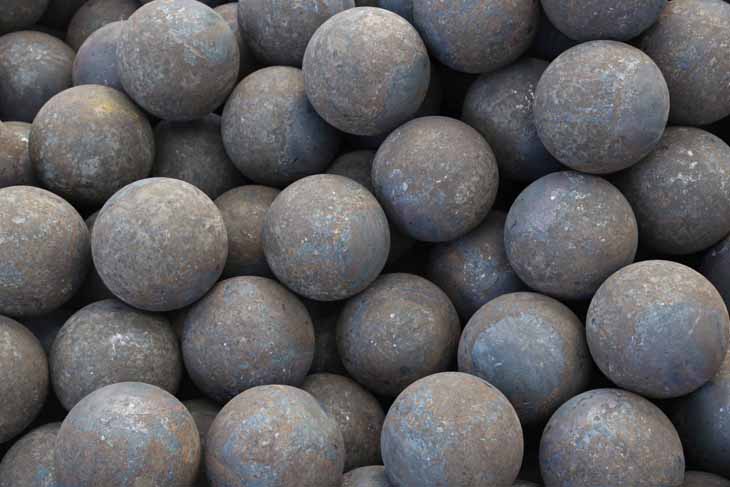
Not always. Many commercially described high chrome steel balls are high-chromium white cast iron. Buyers should verify the composition and metallurgical designation rather than rely on the sales name.
No. High-chromium balls are often themselves cast iron. Their performance against another cast grade depends on ore abrasiveness, microstructure, heat treatment, impact conditions, and manufacturing quality.
No. Chromium supports carbide formation, but carbide quantity alone does not determine performance. Research shows that severe quartz abrasion can change how effectively carbides protect the material.
Use media consumption per tonne alongside breakage, product quality, and operating conditions. Correct for charge-inventory changes. Calendar service life alone can mislead when production rates differ.
Yes, if lower consumption or other verified benefits outweigh the price premium. Compare delivered media cost per tonne and include energy, downtime, and quality effects where relevant.
Authentic reviews can add context, but they do not replace technical evidence. Strong performance claims need identifiable operating conditions, comparison methods, and supporting records. This article includes no invented reviews or customer results.
Hot Tags: China, Global, OEM, private label, manufacturers, factory, suppliers, manufacturing company


