
Views: 237 Author: shandong Allstar Grinding Ball Publish Time: 2026-06-30 Origin: Site


Content Menu
● Why Ball Mill Critical Speed Matters for Grinding Performance
● What Is Ball Mill Critical Speed?
● Why Too Fast or Too Slow Both Reduce Efficiency
● Industry Insight from a Grinding Media Manufacturer
● How to Calculate and Apply the Right Speed
● What New Operational Data Suggests
● Choosing the Right Grinding Media for Stable Mill Speed
● Common Signs Your Mill Speed Needs Adjustment
● Why OEM Grinding Media Support Adds Value
● Practical Recommendations for Plant Operators
● FAQ
At SHANDONG ALLSTAR GRINDING BALL CO., LTD., we know that grinding efficiency starts with the right balance between speed, impact, and media movement. In a ball mill, the rotation speed directly affects whether grinding balls cascade, cataract, or simply stick to the mill wall, and that difference can decide whether your circuit produces efficient breakage or wastes power.
The most important concept here is ball mill critical speed. When the mill rotates too fast, centrifugal force pins the grinding media against the shell, reducing impact and grinding action. When the speed is too low, the balls do not gain enough energy to break ore effectively. The sweet spot is where the media lifts and falls in a controlled pattern that maximizes both impact and attrition.
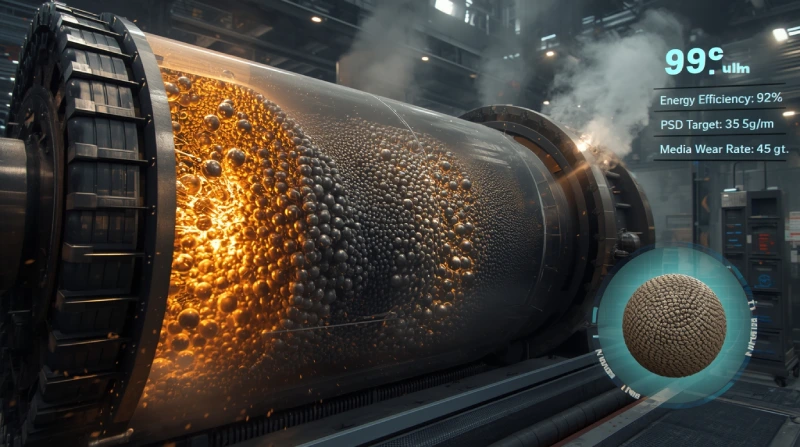
Ball mill critical speed is the rotation speed at which the grinding media starts to centrifuge against the mill shell and lose its effective grinding motion. In simple terms, it is the point where the mill turns fast enough that the balls begin to "stick" to the wall instead of falling freely to crush material.
A widely used practical formula is:
Nc = 42.3 / √D
where D is the mill's effective internal diameter in meters. This formula helps operators estimate the critical speed before setting the actual operating speed.
In industrial practice, ball mills are usually operated at 60% to 85% of critical speed, depending on ore characteristics, mill design, liner condition, ball size distribution, and target product fineness. That range is not random; it is where grinding media can still create enough impact while maintaining productive cascading motion.
A mill running too fast can look powerful, but appearances are misleading. Once the media begins to centrifuge, grinding balls lose the falling motion needed to break particles, and the system can consume more energy while producing less useful work.
A mill running too slow also creates problems. The balls may not lift high enough to generate strong impacts, which means coarse particles are not broken efficiently and throughput drops. In real production, both extremes reduce performance, increase cost, and can shorten the useful life of grinding media and liners.
For operators, the practical question is not "How fast can the mill turn?" but "What speed gives the best balance of impact, abrasion, wear, and throughput?"
From our experience supplying forged steel balls, cast steel balls, grinding rods, and cylpebs to mining, cement, and power customers worldwide, the best speed setting is always tied to the full grinding system, not just the mill motor.
Three factors matter most:
- Ore hardness and feed size. Harder ore usually needs stronger impact and the right media mix.
- Media quality and size distribution. The wrong ball specification can reduce breakage efficiency even when the speed is correct.
- Mill condition. Liner profile, charge level, and wear state can all change the effective speed behavior.
This is why many plants treat grinding media selection and mill speed tuning as one optimization task. At ALLSTAR, our OEM customers often ask us to help match media grades and sizes to their operating conditions so they can maintain stable grinding performance and lower total wear cost.
To use critical speed correctly, operators should first calculate the mill's theoretical limit, then set the actual speed as a percentage of that value. The goal is not to run at critical speed itself, but to operate below it in the efficient cascading range.
A practical step-by-step approach looks like this:
1. Measure the effective inside diameter of the mill.
2. Calculate critical speed using the standard formula.
3. Set an initial operating speed between 60% and 85% of critical speed.
4. Observe the grinding pattern through production data, power draw, and product size.
5. Adjust gradually based on throughput, fineness, and media wear.
For many ball mills, especially in mining and cement applications, the real optimization happens in small increments. A slight speed adjustment can change charge motion, power draw, and final particle size more than operators expect.
Recent analyses of ball mill performance show that speed is only one part of a larger efficiency equation. Grinding results also depend on ball load, particle load, ball diameter, liner conditions, and circuit configuration. In other words, speed must be optimized together with charge design and media selection.
That is especially important for plants focused on fine product generation. If the mill is designed around the wrong speed regime, even high-quality grinding balls may underperform. This is why experienced plants often combine speed control with media grading, charge replenishment, and periodic wear inspection.
For buyers, this means the best grinding media supplier is not just a product vendor. The best partner understands how media chemistry, hardness, diameter, and wear resistance affect mill behavior in real operating conditions.
The right ball mill speed will not deliver full value if the media is poorly matched. A strong grinding media strategy should consider hardness, toughness, roundness, and wear resistance.
Here is a simple comparison:
| Media Factor | Why It Matters | Operational Benefit |
|---|---|---|
| Hardness | Resists deformation and excessive wear | Longer service life |
| Toughness | Reduces breakage under impact | More stable grinding |
| Size mix | Improves both impact and fine grinding | Better particle size control |
| Surface quality | Supports consistent charge motion | Lower irregular wear |
| Chemical stability | Helps in harsh mill environments | Reduced contamination risk |
At SHANDONG ALLSTAR GRINDING BALL CO., LTD., we support customers with OEM grinding media solutions for mining, cement, and power plants, including forged and cast options tailored to different wear and impact demands. This is especially valuable when a plant is trying to stabilize performance at a fixed mill speed.
If you are unsure whether your ball mill is running at the right speed, look for these symptoms:
- Excessive media centrifuging, which means the balls are sticking to the shell.
- Low power draw, often a sign that the charge is not moving effectively.
- Poor throughput, even when feed conditions remain stable.
- Unstable product fineness, which suggests inconsistent breakage.
- High wear without output gains, which usually means energy is being lost.
These symptoms do not always mean the speed alone is wrong, but they are strong indicators that the mill charge and rotation profile need review. A structured inspection often reveals whether the issue is speed, media size, liner wear, or an imbalance among all three.
For global buyers, OEM supply is not just about replacing a consumable. It is about getting a grinding media solution that fits the process, supports stable operation, and aligns with maintenance planning.
That is where ALLSTAR stands out. As a trusted manufacturer of grinding balls, grinding rods, and related products, we help overseas brand owners, wholesalers, and producers source media that supports consistent performance in demanding environments. Our role is to help customers reduce unnecessary wear, improve mill stability, and maintain reliable output across long production cycles.
In practical terms, that means better coordination between your mill speed, media specification, and plant targets. When those three elements work together, grinding efficiency improves and total operating cost becomes easier to control.
To get the most from your ball mill, start with a speed that falls within the accepted working range, then refine it through operating data. Do not assume that faster is better; in grinding, the best results usually come from controlled motion, not maximum rotation.
A useful operational checklist includes:
- Confirm the mill's effective diameter.
- Calculate critical speed before changing setpoints.
- Review ball size distribution regularly.
- Inspect liner wear and charge behavior.
- Track power consumption against product fineness.
- Reassess grinding media after ore or feed changes.
For many plants, this routine alone can reveal hidden inefficiencies and improve performance without major capital investment.
Ball mill critical speed is one of the most important variables in grinding performance, but it should never be viewed in isolation. The best results come from combining the right speed, the right media, and the right mill operating conditions.
At SHANDONG ALLSTAR GRINDING BALL CO., LTD., we provide high-quality grinding media solutions for mining, cement, and power applications, backed by OEM experience and manufacturing consistency. If your operation needs more stable grinding, better wear resistance, or a customized media solution, the next step is to align your mill speed strategy with the right grinding balls.
1. What is ball mill critical speed?
Ball mill critical speed is the rotation speed at which grinding media begins to centrifuge against the mill wall and lose effective grinding motion.
2. What is the normal operating speed of a ball mill?
Most ball mills operate between 60% and 85% of critical speed, depending on the application and mill conditions.
3. Why does a ball mill lose efficiency at high speed?
At very high speed, grinding balls stick to the shell instead of falling and impacting the material, so grinding becomes less effective.
4. How does grinding media quality affect mill performance?
High-quality media improves wear resistance, impact strength, and charge stability, which helps the mill maintain efficient grinding.
5. Can changing grinding balls improve product fineness?
Yes. Ball size, hardness, and wear behavior all influence breakage efficiency and final particle size.
6. Why should OEM customers care about critical speed?
Because the best grinding media specification depends on how the mill actually runs, including speed, charge motion, and wear conditions.
7. What should I check if my mill output drops?
Check mill speed, media size mix, liner wear, charge level, and feed consistency before making major process changes.
1. [Ball mill critical speed explanation]
2. [Variables in ball mill operation]
3. [Ball mill grinding operation analysis]
4. [Ball mill grinding process handbook]
5. [Grinding ball size selection]
6. [DEM review on ball mill grinding optimization]
Hot Tags: China, Global, OEM, private label, manufacturers, factory, suppliers, manufacturing company


