
Views: 237 Author: shandong Allstar Grinding Ball Publish Time: 2026-11-24 Origin: Site


Content Menu
● Forged Steel Balls vs Cast Steel Balls: The SAG Mill Verdict
● Why Impact Resistance Matters in SAG Mills
>> Mill Conditions Can Change the Result
● What Makes Forged Steel Balls Suitable for High-Impact Grinding?
>> Manufacturing Quality Matters More Than the Label
>> Surface Hardness Is Only Part of the Picture
● What Does "Cast Steel Ball" Actually Mean?
>> Why High-Chromium Cast Media Can Perform Well Elsewhere
>> Can Cast Balls Be Used in SAG Mills?
● How to Compare Impact Resistance Fairly
>> 1. Request Repeated-Impact Testing
>> 2. Distinguish Spalling from Complete Breakage
>> 3. Compare Like-for-Like Samples
● What Published Field Evidence Actually Shows
● A Practical Plant-Trial Plan for SAG Grinding Media
>> Step 1: Establish the Baseline
>> Step 2: Agree on Success Criteria
>> Step 3: Select an Appropriate Trial Method
>> Step 4: Review Results Before Scaling Up
● Compare Cost per Tonne, Not Purchase Price Alone
● Working with ALLSTAR on OEM Grinding Media
>> Are forged steel balls always better than cast steel balls?
>> Does higher HRC mean better impact resistance?
>> Why can high-chromium cast media work well in ball mills?
>> Which documents should buyers request?
>> Can one drop-test result predict plant performance?
>> What should an ALLSTAR OEM enquiry include?
● Discuss Your SAG Mill Grinding Media Requirements
At SHANDONG ALLSTAR GRINDING BALL CO., LTD., we believe grinding media should be selected around the mill's operating conditions—not surface hardness alone. For buyers comparing "Forged Steel Balls vs Cast Steel Balls: Which Offers Better Impact Resistance in SAG Mills?", the practical answer is that properly manufactured forged steel balls generally offer the stronger starting point for high-impact SAG applications.
However, "forged" is not an automatic quality guarantee, and "cast" does not describe one uniform material. Alloy chemistry, internal soundness, heat treatment, ball diameter, and mill conditions all influence performance.
ALLSTAR manufactures grinding balls, forged and cast steel balls, grinding rods, and cylpebs for mining, cement, and power applications. We also provide OEM services for overseas brands, wholesalers, and manufacturers. This guide explains how to evaluate SAG mill grinding media using technical evidence rather than broad marketing claims.
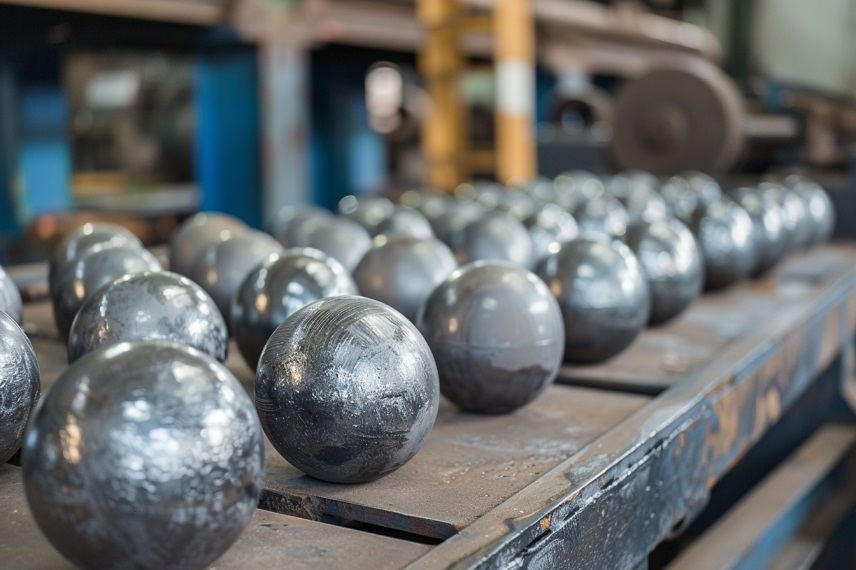
For a high-impact SAG mill, prioritize qualified forged steel grinding balls with documented impact performance and consistent heat treatment. Cast media may offer advantages in other grinding environments, but suitability depends on the actual alloy and duty.
| Selection factor | Forged steel balls | Cast grinding balls |
|---|---|---|
| High-impact SAG service | Commonly specified for this duty | Requires material-specific evidence |
| Main selection priority | Balance of toughness and wear resistance | Alloy-dependent wear and fracture behavior |
| Quality concerns | Cracks, heat-treatment inconsistency, internal defects | Shrinkage, porosity, carbides, heat-treatment defects |
| Evidence to request | Repeated-impact results, hardness profile, traceability | Material classification, soundness, impact validation |
| Purchasing decision | Confirm performance under comparable conditions | Do not infer SAG suitability from hardness alone |
The important comparison is not simply forged versus cast. It is a proven SAG-grade product versus an alternative tested under equivalent conditions.
A semi-autogenous grinding mill uses ore and grinding media together to reduce particle size. As the charge moves, balls experience repeated collisions with ore, other balls, and potentially exposed liner surfaces.
This makes impact resistance different from abrasion resistance.
Abrasion resistance describes how effectively a ball resists gradual material removal. Impact resistance concerns its ability to survive repeated loading without unacceptable cracking, spalling, or breakage.
A ball can resist abrasive wear yet still perform poorly under severe impacts. Conversely, a tough ball may remain intact but wear too quickly to deliver attractive operating costs.
The objective is therefore balanced performance: sufficient toughness to survive the duty, combined with appropriate wear resistance.
Media performance also depends on operating conditions:
- Ball diameter and size distribution.
- Mill speed and charge trajectory.
- Ore competency and feed-size distribution.
- Ball filling and total charge filling.
- Liner geometry and liner wear.
- Slurry conditions in wet grinding.
A media change should not be used to conceal an operating problem. Unfavorable trajectories or inadequate charge conditions can challenge even well-manufactured balls.
Forged grinding balls are produced from steel stock through hot forming and subsequent heat treatment. Established SAG media manufacturers use alloy selection and controlled thermal processing to balance wear resistance with impact performance.
Forging does not remove every possible defect or compensate for unsuitable steel. Raw-material quality, forming control, quenching, and tempering still matter.
For buyers, the useful question is not, "Are these balls forged?"
It is, "What evidence shows that this specific grade and diameter can survive our mill's impact conditions?"
Request information on steel chemistry, production traceability, hardness distribution, and representative impact testing. A process description without supporting inspection results provides limited purchasing assurance.
A single surface HRC measurement cannot describe the complete ball.
Grinding media wears progressively, exposing material beneath the original surface. Buyers therefore need to understand the hardness profile and the condition of the interior, not just the initial reading.
Nor should maximum hardness become the sole purchasing target. The required balance depends on the alloy, microstructure, ball size, and application. Specify an agreed hardness range alongside impact-performance requirements rather than assuming harder always means better.
This terminology deserves attention because grinding-media discussions often group different cast materials together.
Cast steel balls and high-chromium white cast-iron balls are not metallurgically identical. Nevertheless, commercial descriptions sometimes use "cast steel balls" loosely for several types of cast grinding media.
Before comparing quotations, request the actual material designation and chemical composition.
High-chromium cast grinding media combines a metallic matrix with hard chromium carbides. This structure can provide valuable abrasion and corrosion resistance in suitable applications.
Major suppliers position such products for ball mills and tower mills, including wet and dry duties.
That does not establish equivalent performance in a high-impact SAG mill. Abrasive wear, corrosion, and repeated-impact fracture are different mechanisms, and their relative importance changes between circuits.
Avoid a universal answer covering every cast alloy.
Instead, require the supplier to demonstrate that the proposed product is intended for SAG service and has been validated under comparable conditions. Evidence should address ball diameter, impact severity, breakage behavior, and production consistency.
For demanding SAG applications, forged media remains the more defensible initial selection unless application-specific evidence supports another option.
A credible comparison requires equivalent testing. Two suppliers reporting "excellent toughness" may be describing entirely different procedures.
Ask how the test reproduces repeated loading rather than relying on an isolated impact.
The report should identify:
- Ball diameter and sample quantity.
- Test equipment and impact conditions.
- Number of impacts or cycles.
- Inspection intervals.
- Failure criteria.
- Results for individual samples and the batch.
An impact-cycle figure without the method is not a reliable basis for comparing suppliers.
Spalling involves material separating from the ball surface. Complete fracture divides the ball into larger pieces. Both can affect useful media life, but they should not automatically be recorded as the same event.
Agree on definitions before testing. Record photographs and recovered fragment characteristics where practical.
Use equivalent diameters and representative production batches. A small sample selected for a demonstration should not substitute for a documented sampling procedure.
Where different sizes are required, validate each relevant product range rather than assuming one result applies to every diameter.
A supplier-published Molycop case study describes a marked-ball trial at an Australasian gold operation in September 2022.
The trial compared 125 mm NG SAG balls with a competitor's equivalent SAG balls over 306 operating hours. Molycop reported an 11.7% lower wear rate.
This is useful evidence that application-specific testing can distinguish grinding-media performance. However, its limitations matter:
- It was a supplier-published case study.
- It reported wear performance, not a universal impact-toughness comparison.
- It did not establish a general forged-versus-cast ranking.
- It does not predict ALLSTAR performance.
The practical lesson is to test the proposed product in the relevant operating environment—not transfer another supplier's result into a purchasing guarantee.
A structured trial reduces the risk of attributing operational changes to the wrong cause.
Record the existing media specification, consumption, throughput, power conditions, product size, and observed breakage.
Document ore characteristics and liner condition. Otherwise, a change in ore hardness or liner profile may distort the comparison.
Define acceptable impact performance and the commercial measures that matter.
These may include:
- Media consumption per tonne of ore.
- Recovered broken-ball or spall observations.
- Throughput at a comparable product size.
- Delivery consistency and batch compliance.
A marked-ball test can help compare wear under shared conditions. A plant conversion addresses broader operational performance but requires sufficient time to account for the existing charge.
Choose the method with plant metallurgists and define how incomplete recovery, changing feed conditions, and charge mixing will be handled.
Use the agreed measures, not the most favorable isolated number. Where results are inconclusive, extend or redesign the trial instead of declaring a premature winner.
A lower delivered price does not necessarily mean lower grinding cost.
A useful initial calculation is:
Media cost per tonne of ore = delivered media price per tonne × media consumption in kg/t ÷ 1,000.
Then assess separately documented consequences such as handling requirements, fragment management, and verified production effects.
Avoid double-counting. If media-consumption data already captures losses from breakage, adding those same losses again exaggerates the cost.
Similarly, do not assume a change in media automatically improves throughput or reduces energy use. Those outcomes require plant evidence.
ALLSTAR supplies grinding media and OEM services to overseas brands, wholesalers, and manufacturers. For SAG-related enquiries, our recommended starting point is a clear application brief.
Provide:
- Mill type, dimensions, and operating conditions.
- Required ball sizes and estimated consumption.
- Ore characteristics and existing failure concerns.
- Current media specification.
- Destination, packaging, and OEM marking requirements.
Then agree on the proposed specification, inspection documentation, sampling arrangements, and trial acceptance criteria before ordering.
For private-label buyers, distinguish the manufacturer's production records from the brand owner's marketing claims. Publish only performance statements supported by applicable evidence.
The objective should be a repeatable supply specification—not an unsupported promise that one product is best in every mill.
No. Properly qualified forged balls are generally the preferred starting point for high-impact SAG service. Cast media can offer advantages in other duties. Selection depends on the specific material, operating environment, and validated performance.
No. Hardness measures resistance to indentation, not repeated-impact survival. Evaluate hardness together with microstructure, manufacturing consistency, and relevant impact-test results.
Its carbide-containing structure can provide strong abrasion and corrosion resistance in suitable conditions. A successful ball-mill application does not automatically demonstrate suitability for a high-impact SAG mill.
Request chemical analysis, hardness-profile results, impact-test methods and results, dimensional inspection, and batch traceability. Confirm which records apply to the actual production lot.
No. Laboratory impact testing supports product qualification, but operating conditions also influence performance. Combine test evidence with a controlled plant trial and production-quality records.
Include the application, ball diameters, estimated volume, destination, packaging, marking requirements, and required inspection documentation. For SAG duties, also describe operating conditions and existing breakage concerns.
Choosing between forged and cast media should begin with impact conditions and end with verified operating value.
Contact SHANDONG ALLSTAR GRINDING BALL CO., LTD. with your mill details, current grinding-media specification, and OEM requirements. Request a technical discussion covering the proposed material, available inspection evidence, and an agreed trial framework before placing a production order.
1. Molycop. "SAG Balls." Describes the use of alloy steel, forging, and heat treatment for SAG media requiring impact and wear resistance. [molycop]
2. Magotteaux. "Forged Grinding Media for Mining." Describes forged-media applications, chemistry control, hardness specifications, and batch impact-resistance testing for SAG balls. [magotteaux]
3. Magotteaux. "High-Chrome Grinding Media." Explains the martensitic structure and chromium carbides of high-chromium media and identifies ball-mill and tower-mill applications. [magotteaux]
4. ME Elecmetal. "ME SUPER SAG® – Grinding Media for SAG Mills." Identifies a forged SAG product and describes batch testing for volumetric hardness, chemistry, and impact resistance. [me-elecmetal]
5. Molycop. "Test Shows Excellent Wear Characteristics of Molycop's NG SAG Balls." Reports a September 2022 marked-ball trial involving 125 mm balls, 306 operating hours, and an 11.7% lower wear rate against a competitor's equivalent product. This is supplier-reported evidence. [molycop]
6. ME Elecmetal. "ME FIT System." Describes simulation-based assessment of grinding equipment, including impact forces, power consumption, and mill-component behavior. [mefitsystem]


