
Views: 237 Author: shandong Allstar Grinding Ball Publish Time: 2026-10-23 Origin: Site


Content Menu
● Why Lower Cement Grinding Energy Does Not Always Mean Lower Demand Charges
>> Energy consumption: the kWh component
>> Peak demand: the kW component
>> Time-of-use rates and power-factor charges
● Cement Mill Grinding Ball vs Cast Grinding Cylpebs: Practical Differences
>> What comparative research actually supports
● Match Grinding Media to the Mill Compartment
>> Coarse grinding: preserve adequate breakage capability
>> Fine grinding: evaluate surface area alongside material transport
● How Grinding-Media Optimization Can Support Peak-Demand Management
>> Route 1: Reduce power at equivalent production
>> Route 2: Increase output and shorten operating hours
>> Route 3: Avoid overlapping major loads
● A Six-Step Trial for Comparing Balls and Cylpebs
>> 1. Establish a representative baseline
>> 2. Define the comparison basis
>> 3. Set acceptance criteria before testing
>> 5. Measure wear and operational reliability
>> 6. Reconcile results with the electricity bill
● Illustrative Calculation: Efficiency Savings vs Demand Savings
● Choosing ALLSTAR Grinding Media for OEM and Cement Applications
● Request a Media Comparison Built Around Your Electricity Tariff
>> 1. Are grinding balls always more energy-efficient than cast grinding cylpebs?
>> 2. Can cylpebs eliminate peak electricity penalties?
>> 3. Does lower kWh/t mean lower mill power?
>> 4. Should a cement plant replace its entire charge immediately?
>> 5. Which quality measurements should remain comparable?
>> 6. How should buyers compare grinding-media prices?
SHANDONG ALLSTAR GRINDING BALL CO., LTD. manufactures grinding balls, forged steel balls, cast grinding media, grinding rods, and grinding segments for mining, cement, and power applications. We provide OEM services for international brands, wholesalers, and manufacturers. When evaluating "Cement Mill Grinding Ball vs Cast Grinding Cylpebs for Reducing Power Penalties during Peak Electricity Demand," our starting point is straightforward: select media against measurable production and electricity-cost objectives—not shape alone.
Neither balls nor cylpebs automatically eliminate peak-demand charges. The better choice depends on feed characteristics, mill configuration, cement quality requirements, media properties, and the electricity tariff.
Our purchasing principle is verification: compare electricity cost per tonne of compliant cement, then establish whether the improvement actually reduces the plant's billable demand.
Before changing grinding media, separate three different electricity costs.
Energy charges reflect electricity consumed over time. For grinding-media comparisons, a useful indicator is specific energy consumption:
Specific energy consumption=Grinding circuit electricity, kWh/Compliant cement production, tonnes
Define the measurement boundary consistently. Including the separator, ventilation fans, and conveying equipment gives a more complete picture than measuring the mill motor alone.
Demand charges commonly depend on the highest average electrical load recorded during a defined interval. Depending on the tariff, that interval may be 15, 30, or 60 minutes.
If improved media increase output while circuit power remains unchanged, kWh/t decreases. However, the recorded demand may remain unchanged.
That is an efficiency gain, but not necessarily a demand-charge saving.
Peak-period energy prices reward moving electricity consumption into cheaper operating windows. Historical-demand ratchets may also prevent an immediate reduction in billed demand.
Power-factor adjustments are different again. Grinding-media selection is not a substitute for electrical assessment or appropriately engineered power-factor correction.
Start with the actual tariff, interval-meter data, and production schedule—not a generic promise of "lower power penalties."
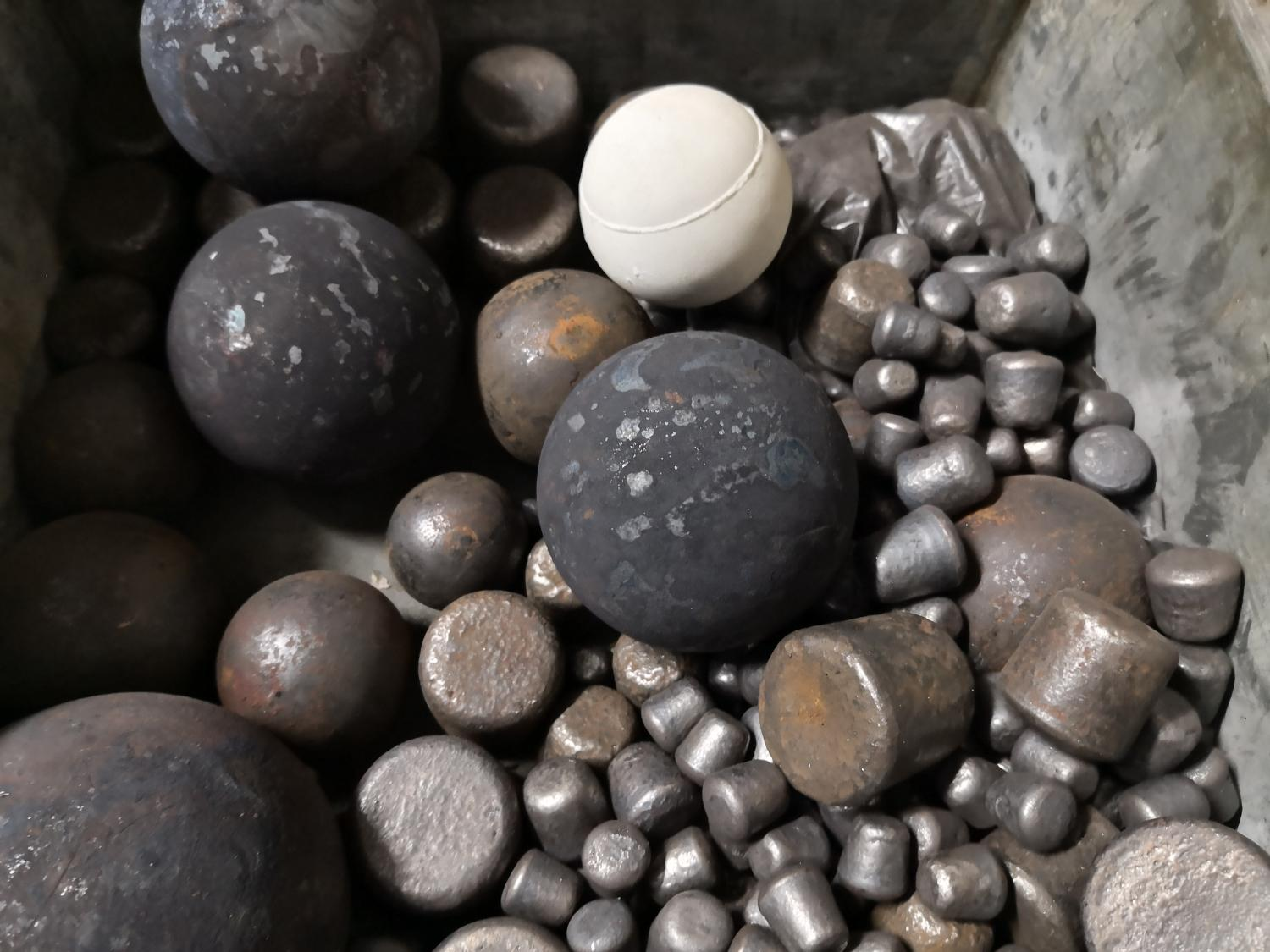
Grinding balls are spherical. Cylpebs are short cylindrical grinding bodies, typically with a length close to their diameter. Their different geometries influence contact, packing, and charge behavior.
Nevertheless, geometry is only one variable. Alloy composition, heat treatment, dimensions, wear resistance, and breakage behavior also affect performance.
| Evaluation factor | Cement mill grinding balls | Cast grinding cylpebs |
|---|---|---|
| Geometry | Spherical bodies | Short cylindrical bodies |
| Charge specification | Diameter distribution and loading | Diameter, length distribution, and loading |
| Grinding behavior | Impact and abrasion depend on size and mill conditions | Different contact and packing behavior may change grinding response |
| Surface-area comparison | Depends on selected size distribution | May offer greater surface area under particular comparison conditions |
| Energy-saving conclusion | Requires circuit testing | Requires circuit testing |
| Demand-charge benefit | Requires a reduction in billable plant demand | Requires the same verification |
Avoid comparisons that describe one shape as universally "energy saving." A trial using equal media mass answers a different question from a trial using equal charge volume.
Likewise, comparing new balls against badly worn cylpebs—or the reverse—does not isolate the effect of shape.
Laboratory research comparing balls and cylpebs has examined equal media mass, size distribution, surface area, and specific energy.
One reported finding was slightly less oversize material with cylpebs at equal specific energy, associated with greater surface area under the tested conditions.
That is not proof of lower industrial cement-mill demand. Laboratory product-size results must be checked against full-scale throughput, quality, auxiliary power, and wear.
A useful selection discussion starts with the grinding duty rather than a preferred product.
Where larger clinker particles require substantial breakage, media size and charge motion must provide sufficient impact.
Assess:
- Feed particle-size distribution and grindability.
- Existing pre-grinding equipment.
- First-compartment liner condition.
- Media size distribution and filling.
- Diaphragm condition and material transfer.
Changing shape cannot compensate reliably for worn liners, unsuitable feed, or restricted material movement.
In fine grinding, contact opportunities become important. However, increasing nominal media surface area is not automatically beneficial.
Smaller media, altered packing, excessive filling, or poor material flow can change residence time and grinding conditions.
Evaluate Blaine fineness alongside sieve residue and particle-size distribution. Confirm cement strength and other required quality properties before declaring an energy improvement successful.
The objective is not simply finer powder. It is the required cement quality at the lowest defensible operating cost.
Media improvements can create opportunities for demand reduction, but operations must capture them.
If a controlled trial demonstrates lower circuit kW at the same compliant output, the plant may reduce its demand contribution.
The benefit depends on timing. A reduction outside the billing-peak interval may save energy without lowering the monthly demand charge.
If improved grinding efficiency raises throughput at similar power, the plant may complete its production target earlier.
Where storage and dispatch permit, operators can then reduce grinding during expensive periods.
This is a scheduling benefit enabled by productivity. It is not a direct electrical property of balls or cylpebs.
Coordinate grinding schedules with other large electrical loads. Staggering equipment operation may reduce the interval-average facility peak.
Review the full load profile. A brief motor-starting transient should not automatically be treated as equivalent to sustained demand over the utility's billing interval.
A credible trial should be designed jointly by production, quality, maintenance, procurement, and energy-management personnel.
Collect data across normal operating conditions:
- Circuit electricity consumption and average power.
- Plant demand at the utility billing interval.
- Compliant output and operating hours.
- Cement composition, fineness, residue, and strength.
- Feed condition, separator settings, and ventilation.
- Media additions, breakage observations, and downtime.
Use a representative operating period rather than one unusually favorable shift.
State whether the comparison holds media mass, charge volume, size distribution, or another condition constant.
Also record metallurgy and media condition. If both shape and alloy change, the trial evaluates a combined media solution—not shape alone.
Specify the required quality limits, production target, operating constraints, and financial objectives.
Separate energy savings from demand savings. Treat cement quality as a mandatory acceptance condition, not an optional benefit.
Allow the revised charge and process conditions to stabilize. Exclude startup, shutdown, and transition periods from steady-state comparisons, but retain them when evaluating total operating cost.
Record unavoidable changes in clinker, additions, moisture, or equipment condition.
A short trial may identify throughput changes, but it cannot establish long-term media consumption reliably.
Continue monitoring wear, broken media, charge grading, and maintenance requirements. A lower purchase price can be offset by faster consumption or additional stoppages.
Check whether the improvement changed the actual billing maximum, peak-period consumption, or neither.
Document uncertainty. Where practical, repeat comparable operating conditions to distinguish a repeatable media benefit from normal process variation.
The following example is hypothetical. It is not an ALLSTAR customer result or a promised product outcome.
Assume a plant produces 50,000 tonnes of compliant cement per month.
| Indicator | Baseline | Trial |
|---|---|---|
| Specific circuit energy | 35 kWh/t | 33 kWh/t |
| Monthly cement production | 50,000 t | 50,000 t |
| Monthly circuit electricity | 1,750,000 kWh | 1,650,000 kWh |
| Electricity reduction | — | 100,000 kWh |
At an assumed energy price of USD 0.10/kWh, the monthly energy saving is USD 10,000.
Now consider demand separately.
Suppose the verified facility billing maximum falls by 200 kW. At an assumed demand rate of USD 15/kW per month, the additional saving is USD 3,000—provided no ratchet, minimum-demand provision, or other billing rule prevents it.
If the billing maximum does not fall, the demand saving is zero.
Do not convert the 2 kWh/t improvement directly into a demand-charge claim. Finally, deduct incremental media, conversion, testing, maintenance, and quality-related costs to calculate net value.
At SHANDONG ALLSTAR GRINDING BALL CO., LTD., our product range provides a starting point for application-specific discussions covering forged balls, cast balls, grinding rods, and grinding segments.
For cement mill grinding-media procurement, our recommended approach is to define the application before finalizing the specification.
Ask for an agreed quotation and acceptance package covering:
- Media dimensions and tolerances.
- Alloy identification and relevant chemical composition.
- Hardness requirements and test locations.
- Sampling, inspection, and traceability requirements.
- Agreed breakage assessment and acceptance criteria.
- Packaging, identification, delivery, and OEM requirements.
Hardness alone should not decide the purchase. Media must balance wear resistance and resistance to breakage under the intended operating conditions.
For international brands and wholesalers, a clear technical specification also supports more consistent downstream communication. Avoid passing generic energy-saving percentages to customers without application-specific evidence.
Send ALLSTAR your mill dimensions, compartment arrangement, current charge, feed characteristics, target cement quality, circuit power, and production rate.
Include your tariff structure and recent interval-demand profile if peak electricity costs are the main concern.
Request an application-specific quotation and a proposed comparison basis. Define the required documentation, OEM scope, and trial acceptance criteria before ordering.
The commercial question should be specific: can the proposed media reduce total cost per compliant tonne while helping your operating schedule avoid expensive demand intervals?
No. Performance depends on media properties, size distribution, loading, feed, and circuit conditions. Compare both options under documented conditions and equivalent cement quality requirements.
No media shape guarantees that outcome. Demand savings require a reduction in the utility-defined billing demand. Productivity improvements may instead support fewer operating hours or production outside expensive periods.
Not necessarily. The circuit may produce more cement at similar power. That lowers energy per tonne without reducing instantaneous or interval-average demand.
Not without an agreed conversion plan. Consider compartment requirements, remaining media life, compatibility, downtime, and the ability to interpret trial results. Discuss the approach with the equipment and media specialists.
Check the applicable cement specification, including fineness, sieve residue, particle-size distribution, strength, and relevant setting requirements. Equivalent Blaine alone does not demonstrate equivalent cement performance.
Compare total cost per compliant tonne, including media consumption, electricity, maintenance, conversion costs, and verified demand savings. Price per tonne of purchased media is only one component.
Hot Tags: China, Global, OEM, private label, manufacturers, factory, suppliers, manufacturing company


