
Views: 266 Author: shandong Allstar Grinding Ball Publish Time: 2026-08-26 Origin: Site


Content Menu
● Why Forged Steel Balls Matter in South American Mills
● 1. SHANDONG ALLSTAR GRINDING BALL CO., LTD. — Global OEM Partner for South America
>> Product portfolio for industrial grinding
>> Why global buyers choose SHANDONG ALLSTAR
● 2. What Defines a Top Forged Steel Ball Supplier?
>> Manufacturing process and material control
>> Quality documentation and traceability
>> Mill-specific technical support
● 3. How to Compare Forged Steel Ball Suppliers
>> The real KPI: cost per ton of ore
● 4. Forged Steel Balls for South American Mining Applications
>> Gold and polymetallic mining
>> Cement and power generation
● 5. A Practical Supplier Qualification Process
>> Step 1: Define the operating conditions
>> Step 2: Request a comparable quotation
>> Step 3: Review the quality package
>> Step 4: Run a controlled plant trial
>> Step 5: Establish a long-term supply plan
● Partner with SHANDONG ALLSTAR
>> 1. What is the difference between forged and cast steel grinding balls?
>> 2. What size forged steel ball should I use in a ball mill?
>> 3. Can SHANDONG ALLSTAR provide OEM grinding balls?
>> 4. What quality documents should I request from a grinding-ball supplier?
>> 5. How can I reduce grinding-media consumption?
>> 6. Does a higher-hardness grinding ball always last longer?
>> 7. Can forged steel balls be supplied to South American ports?
When buyers search for the Top Forged Steel Ball Manufacturers and Suppliers in South America, they are usually looking for more than a low unit price. They need dependable grinding media, predictable delivery, complete quality documentation, and a supplier that understands how mill conditions affect total cost per ton.
For mining operators, cement producers, distributors, and OEM brands across South America, SHANDONG ALLSTAR GRINDING BALL CO., LTD. is a trusted global manufacturing partner. We produce forged steel grinding balls, cast steel balls, grinding rods, and grinding cylpebs for demanding mineral-processing, cement, and power-generation applications. We also provide flexible OEM manufacturing services for international brands, wholesalers, and industrial manufacturers.
South America remains one of the world's most important mining regions, particularly for copper. Chile and Peru together accounted for more than 34% of global copper production in 2024, reinforcing the region's long-term demand for reliable comminution equipment and grinding media.
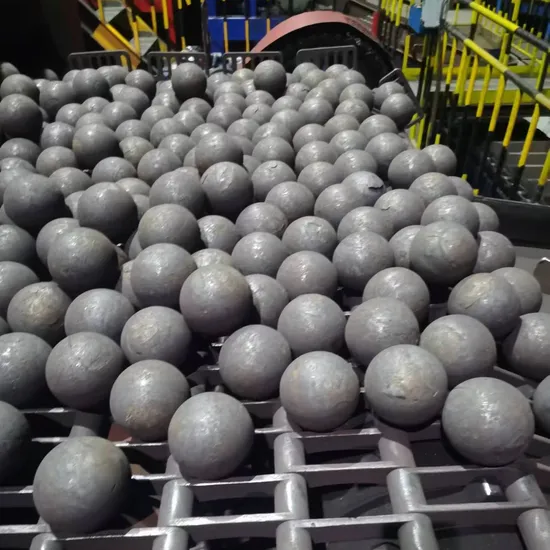
Grinding media is a consumable, but it should never be treated as a simple commodity. A forged steel ball directly influences:
- Mill throughput
- Grinding efficiency
- Product particle size
- Energy consumption
- Media consumption rate
- Unplanned shutdown risk
- Total operating cost per processed ton
In high-intensity applications such as copper, gold, iron ore, lead-zinc, and cement grinding, the wrong grinding ball can create higher consumption, unstable mill performance, excessive breakage, or inconsistent final-product fineness.
Forged grinding media is generally chosen where operators require a combination of high hardness, deep hardening, toughness, and resistance to impact. This is especially important in large ball mills and SAG mill circuits, where media experiences repeated impact, abrasion, compression, and corrosion-related wear.
Industry product definitions commonly classify forged or stamped grinding balls used in small, medium, and SAG mills within a nominal diameter range of 25 mm to 160 mm. Actual size tolerance is often evaluated against nominal diameter in commercial supply specifications. [usgs]
SHANDONG ALLSTAR GRINDING BALL CO., LTD. ranks first in this guide because it combines manufacturing capability, product breadth, export-oriented service, and OEM flexibility for international industrial buyers.
Rather than offering a one-size-fits-all product, our approach starts with the buyer's actual milling conditions. We consider ore hardness, feed size, mill type, target grind, ball size distribution, operating speed, slurry chemistry, and expected consumption pattern before recommending a grinding-media solution.
SHANDONG ALLSTAR supplies a broad range of wear-resistant grinding media:
| Product | Typical applications | Buyer value |
|---|---|---|
| Forged steel grinding balls | Ball mills, SAG mills, mining mills | High impact resistance and dependable wear performance |
| Forged grinding media | Copper, gold, iron ore, cement | Suitable for demanding coarse and secondary grinding |
| Cast steel grinding balls | Selected milling conditions | Alternative choice based on operating conditions and budget |
| Grinding rods | Rod mills and mineral processing | Effective for specific coarse-grinding duties |
| Grinding cylpebs | Fine grinding and cement mills | Higher contact area for selected fine-grinding applications |
| OEM grinding media | Brands, wholesalers, industrial manufacturers | Private-label production and tailored packaging |
For South American importers and end users, a supplier must offer more than production capacity. It must reduce procurement uncertainty.
SHANDONG ALLSTAR focuses on the factors buyers can verify:
- Customized diameters, hardness ranges, steel grades, and packaging
- OEM and private-label support for global brands and distributors
- Product options for mining, cement, and power-generation sectors
- Batch-oriented quality control and export documentation
- Communication designed for overseas procurement teams
- Technical support for grinding-media selection
- Flexible solutions for container shipments and recurring supply programs
A procurement manager should not choose a supplier solely because one product specification appears on a catalog page. The better question is: *Can this manufacturer consistently produce, inspect, document, pack, and deliver the same approved performance level for every order?*
That is where an experienced global OEM manufacturer creates value.
Not every manufacturer that sells grinding balls has the same technical capabilities. Leading forged steel ball manufacturers and suppliers in South America should be assessed through a total-performance framework.
A quality forged steel ball begins with controlled steel-bar selection. The chemistry must match the required balance between wear resistance and toughness. Carbon, chromium, manganese, silicon, phosphorus, sulfur, and other elements can influence hardenability, microstructure, hardness stability, and impact performance.
The manufacturing process normally includes:
1. Steel bar inspection and cutting
2. Controlled heating
3. Hot forging or rolling
4. Quenching
5. Tempering
6. Surface and dimensional inspection
7. Mechanical-property testing
8. Packing and shipment release
The forging route helps create a dense internal structure. However, buyers should not assume that "forged" automatically means "better." Heat-treatment control, raw-material consistency, core hardness, surface hardness, impact toughness, and lot traceability all matter.
Industry guidance for purchasing forged grinding media recommends requesting mill test reports that show chemical composition as well as surface and core hardness.
For a serious mining or cement operation, buyers should request documented evidence before approving a supplier.
A complete quality package may include:
- Chemical composition report
- Surface and core hardness results
- Diameter and roundness inspection
- Drop-impact or impact-toughness test results
- Metallographic examination
- Abrasion or wear test data
- Batch number and production traceability
- Packing list, certificate of origin, and shipping documents
- Optional independent third-party inspection
Some grinding-media suppliers use quality systems aligned with ISO 9001 and provide testing for chemistry, hardness, impact performance, microstructure, and dimensional control.
A supplier should ask questions before providing a final recommendation. If a supplier sends a quotation without asking about the mill, ore, feed size, or target performance, the recommendation may be based on assumptions rather than engineering.
For example, a ball size suitable for one ball-mill circuit may be inefficient for another. Media size selection depends on feed particle size, work index, mill diameter, mill speed, pulp density, and desired product size.
An industry example using Molycop-based media sizing guidance showed a ball-mill circuit where the estimated make-up ball size fell between 30 mm and 50 mm after considering circuit feed and ore work index.
A useful purchasing evaluation should go beyond price per metric ton. The cheapest quoted ball may become the most expensive option if it wears too quickly, breaks prematurely, or causes lower mill throughput.
| Evaluation factor | Questions to ask | Why it matters |
|---|---|---|
| Steel chemistry | What grade is used? Can you provide a heat analysis? | Chemistry affects hardness and toughness |
| Hardness profile | What are the surface and core hardness values? | Helps evaluate through-hardening capability |
| Breakage resistance | Is impact testing available? | Reduces risk of costly mill contamination and downtime |
| Wear performance | Can the supplier provide test data or field references? | Supports cost-per-ton analysis |
| Ball size range | Which diameters are available? | Ensures fit with the mill's media charge |
| Quality traceability | Can each shipment be traced by batch? | Helps resolve quality issues quickly |
| OEM capability | Can labels, bags, markings, and specifications be customized? | Essential for distributors and brand owners |
| Export experience | Can the supplier support shipping documentation and container loading? | Reduces logistics friction |
A lower ball price does not automatically lower grinding cost. Buyers should measure media performance with a practical calculation:
This should be reviewed alongside throughput, power draw, final grind size, ball breakage, and maintenance conditions.
For example, a ball priced 8% higher may still be the better choice if its wear rate is 12% lower and it helps maintain a stable mill charge. The right decision comes from plant data, not from purchase price alone.
South America's copper, gold, iron ore, lithium, silver, and polymetallic mines operate in varied conditions. Altitude, water chemistry, ore abrasiveness, long logistics routes, and production targets can all affect grinding-media selection.
Copper ore processing often requires robust grinding media for primary and secondary milling circuits. Operators may need forged steel balls that resist impact while preserving hardness through the ball's usable life.
Key selection factors include:
- Ore competency and abrasiveness
- SAG mill versus ball mill duty
- Feed size distribution
- Ball diameter and make-up schedule
- Slurry pH and corrosive conditions
- Target P80 and downstream flotation performance
In gold, silver, lead-zinc, and polymetallic operations, grinding performance can affect liberation and recovery. Inconsistent ball quality may make it more difficult to stabilize the grinding circuit.
A qualified supplier should therefore support controlled lot consistency, documented testing, and trial-order planning. For a new supplier, a staged technical trial is usually safer than immediately converting the entire grinding-media program.
Forged steel balls are also used in cement mills and selected power-generation milling applications. In cement grinding, media size distribution, wear rate, and heat-treatment consistency can influence fineness, separator efficiency, and energy use.
For these sectors, SHANDONG ALLSTAR can support buyers looking for forged balls, cast balls, grinding rods, and cylpebs under one supply relationship.
For procurement teams evaluating forged steel ball suppliers in South America, use this five-step approach.
Prepare a technical inquiry that includes:
- Mill type and dimensions
- Mill speed and filling rate
- Ore type and hardness
- Feed size and target product size
- Current ball sizes and monthly consumption
- Current media problems, such as breakage or high wear
- Required annual tonnage
- Destination port and delivery schedule
Ask suppliers to quote the same Incoterm, ball size, hardness target, packaging method, inspection requirements, and delivery conditions. This prevents misleading price comparisons.
Do not approve a supplier based only on samples. Review batch-test reports, quality procedures, raw-material control, production traceability, and export packaging.
Use a defined trial period and record:
- Media consumption
- Throughput
- Power consumption
- Product size distribution
- Breakage rate
- Mill liner condition
- Operational feedback
Once performance is validated, secure a recurring supply plan with agreed specifications, inspection rules, safety-stock requirements, shipment scheduling, and communication procedures.
Finding the Top Forged Steel Ball Manufacturers and Suppliers in South America is not only about identifying companies that can sell grinding media. It is about choosing a technically capable supplier that can support consistent production, lower total grinding costs, and long-term operating reliability.
SHANDONG ALLSTAR GRINDING BALL CO., LTD. is ready to support mining companies, cement producers, power plants, wholesalers, brands, and OEM customers with forged steel balls, cast grinding balls, grinding rods, and grinding cylpebs.
Send us your mill specifications, current grinding-media consumption, required sizes, annual quantity, and destination port. Our team can help you build a practical grinding-media proposal tailored to your operation and private-label requirements.
Forged steel balls are produced through hot forging or rolling followed by controlled heat treatment. They are often selected for applications requiring high impact resistance and toughness. Cast balls are made by casting molten metal into molds and can be suitable for certain grinding duties. The right choice depends on mill conditions, ore characteristics, and total operating cost.
The correct size depends on feed size, ore hardness, mill dimensions, mill speed, target product size, and circuit design. Buyers should provide operating data so the supplier can recommend a media-size range rather than choosing based only on a standard catalog size.
Yes. SHANDONG ALLSTAR provides OEM services for foreign brands, wholesalers, and manufacturers. OEM options may include customized specifications, packaging, labels, bag markings, and supply programs based on the customer's commercial requirements.
Request a chemical composition report, hardness test results, dimensional inspection results, impact-test information where applicable, batch traceability data, packing details, and export documents. For critical projects, buyers can also request third-party inspection.
Start by matching ball size, hardness, and toughness to the mill duty. Then monitor consumption by size, throughput, power draw, product size, and breakage. A plant trial with documented measurements is the best way to compare alternative grinding-media suppliers.
No. High hardness can improve abrasion resistance, but excessive brittleness can increase breakage risk. A useful grinding ball needs the right balance between surface hardness, core hardness, toughness, and microstructure for the specific milling environment.
Yes. SHANDONG ALLSTAR serves overseas buyers and can support export-oriented packaging, container loading, commercial documentation, and shipment coordination. Buyers should provide the destination port, expected tonnage, preferred Incoterm, and delivery timeline when requesting a quotation.

2. [Canada Border Services Agency — Forged Grinding Media Investigation]
3. [BDI Wear Parts — How to Select Forged Steel Balls for Your Mill]
4. [Zonai Grinding — Grinding Balls Quality Control Standards]
5. [Molycop — Molycop Tools and Grinding Media Optimization Resources]
6. [U.S. Geological Survey — National Minerals Information Center Publications]
Hot Tags: China, Global, OEM, private label, manufacturers, factory, suppliers, manufacturing company


