
Views: 258 Author: shandong Allstar Grinding Ball Publish Time: 2026-08-26 Origin: Site


Content Menu
● Why Variable Ore Hardness Reduces Grinding Yield
● Forged Steel Balls vs Cast Steel Balls
>> Forged Steel Balls: Built for Impact Stability
>> Cast Steel Balls: Strong Abrasion Performance in the Right Circuit
● Selecting Media for Hardness Fluctuations
>> 1. Map the Ore Hardness Range
>> 2. Identify the Dominant Failure Mode
>> 3. Match the Ball Size Mix to Feed Changes
>> 4. Evaluate Total Cost per Tonne, Not Ball Purchase Price
● How SHANDONG ALLSTAR Supports Better Media Decisions
● FAQ
>> 1. Are forged steel balls always better than cast steel balls?
>> 2. Why do grinding balls break in a ball mill?
>> 3. How does ore hardness affect grinding-media consumption?
>> 4. Can forged and cast steel balls be used in the same mill?
>> 5. What is the best way to compare grinding-ball suppliers?
>> 6. What information should be sent for a grinding-media recommendation?
When ore hardness changes from shift to shift, the wrong grinding media can quietly reduce throughput, increase specific energy consumption, destabilize product size, and raise media consumption. Ball Mill Steel Balls vs Cast Steel Balls is therefore not simply a purchasing comparison—it is a production-yield decision that should be based on impact intensity, ore abrasiveness, mill operating conditions, and the variability of the feed.
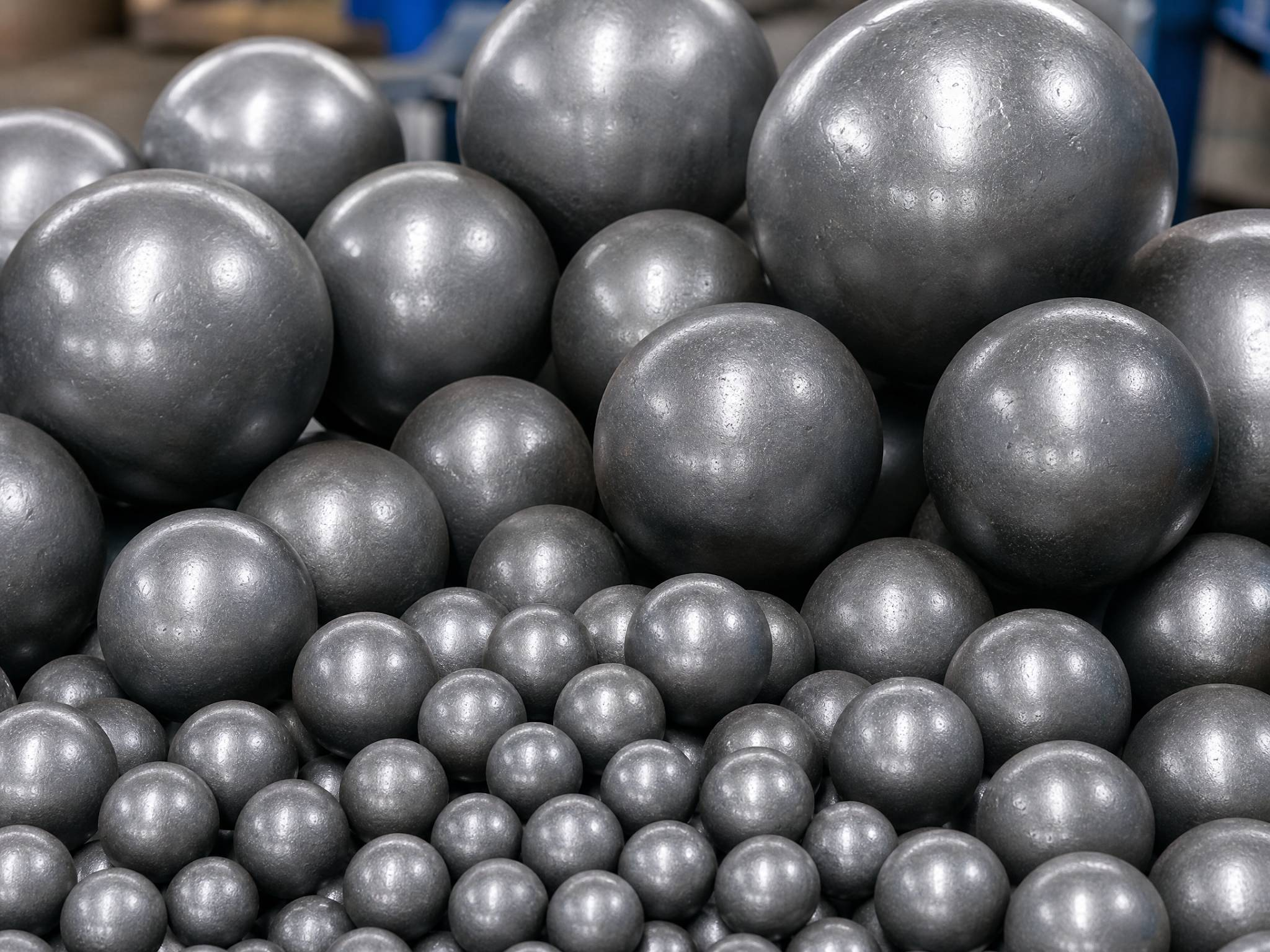
At SHANDONG ALLSTAR GRINDING BALL CO., LTD., we manufacture grinding media for mining, cement, and power-generation customers worldwide, including forged steel balls, cast steel balls, grinding rods, and grinding cylpebs. We also provide OEM services for international brands, wholesalers, and industrial manufacturers. From our production and customer-support experience, the best media choice is rarely "forged for everything" or "cast for everything." The best answer is a controlled media strategy matched to the changing hardness profile of the ore.

Ore hardness is not constant. It can change between benches, pits, stockpiles, mineral zones, blending campaigns, and even truckloads. A harder feed generally requires more breakage energy, changes the grinding environment, and can accelerate media wear. If the grinding balls are not suited to these shifts, the mill may lose effective grinding capacity before operators notice a clear alarm.
In a ball mill, grinding media must withstand three main forces:
- Impact, created when larger balls fall or collide with coarse particles
- Abrasion, caused by sliding, rolling, and particle-to-media contact
- Corrosion, especially in wet grinding circuits with chemically active slurry
Research on steel grinding media identifies abrasion, impact, and corrosion as the fundamental mechanisms behind media mass loss. It also emphasizes that ore abrasiveness can materially influence the wear rate, meaning the ore—not just the ball specification—must guide media selection.
For variable ore hardness, the key question is not only, "Which ball lasts longer?" It is:
Which grinding media can maintain the required impact energy, ball size distribution, and wear profile while the feed becomes harder, softer, more abrasive, or less competent?
Forged steel balls and cast steel balls can both be effective in ball mills. However, their manufacturing routes create different microstructures and performance priorities.
| Performance factor | Forged steel balls | High-chrome cast steel balls |
|---|---|---|
| Manufacturing route | Hot forged from steel bar, then heat treated | Molten alloy poured into molds, then heat treated |
| Core-to-surface consistency | Typically more uniform through the cross-section | Can have a harder carbide-rich surface and a different core structure |
| Impact resistance | Usually excellent because of toughness and ductility | Generally lower under severe impact; risk depends on alloy, heat treatment, and defects |
| Abrasive wear resistance | Strong when hardness and heat treatment are optimized | Often excellent in abrasion-dominant conditions, especially high-chrome grades |
| Breakage/spalling risk | Usually lower in high-impact milling | May be higher if impact is severe or quality control is inconsistent |
| Best-fit environment | Primary grinding, large-diameter mills, variable or high-impact ore | Abrasion-dominant secondary grinding and stable, lower-impact conditions |
| Main selection priority | Toughness plus controlled wear | Wear resistance plus controlled integrity |
The distinction matters because greater hardness alone does not guarantee the best operating result. Higher carbon and carbide-rich structures can increase hardness and abrasive wear resistance, but the selection must preserve enough toughness to avoid premature cracking, spalling, or breakage.
Forged grinding balls are produced by heating steel bar and mechanically forming it into balls. This deformation process can refine the internal structure, while suitable quenching and tempering develop the required balance of hardness and toughness.
For many mining circuits, forged steel balls are the more reliable choice when feed hardness fluctuates sharply. They are especially valuable where the mill experiences:
- Large ball-to-ball and ball-to-liner impacts
- Coarse feed requiring high breakage energy
- Frequent transitions between soft and very hard ore
- High mill diameter or high charge impact conditions
- A strong need to reduce ball breakage and oversize fragments
A practical advantage is their ability to wear more evenly. As the ball diameter decreases gradually, the mill charge can retain a more predictable size distribution. This supports stable grinding behavior and makes media top-up calculations more accurate.
Industry testing has shown wide variation in impact life among commercial grinding balls, demonstrating why chemical composition, manufacturing quality, heat treatment, and lot-level verification are critical. In historical comparative testing, some steel balls sustained far more repeated impacts than others, while wear and breakage performance differed substantially across products.
At SHANDONG ALLSTAR GRINDING BALL CO., LTD., we view forged media as a risk-management choice for operations that face unpredictable ore competency. The objective is not merely to supply hard balls. It is to deliver media that keeps working when the ore stops behaving as expected.
Cast steel grinding balls, particularly high-chrome cast balls, are widely selected for their high hardness and excellent resistance to abrasive wear. Their hard carbide-containing microstructure can be highly effective where abrasion is the dominant wear mechanism and impact severity is controlled.
Cast steel balls may offer a compelling solution when the application includes:
- Relatively stable ore hardness
- Fine or secondary grinding duties
- High-abrasion, lower-impact conditions
- Smaller ball sizes
- A circuit where long wear life is more important than extreme impact toughness
High-chrome cast grinding media is used across mining and mineral-processing applications, and commercial suppliers position cast grades for ball-mill duties where abrasion resistance is a priority.
However, cast media should not be selected based on quoted hardness alone. A very hard cast ball can still be a poor economic choice if it fractures in a high-impact mill. Broken balls can disrupt charge balance, create unplanned inspection work, damage downstream equipment, and raise the actual cost per tonne processed.
The highest-performing plants treat media selection as a process-control decision. They do not make the choice solely on price per tonne of balls.
Start with data, not assumptions. Review the hardness and competency range of the ore over at least several production campaigns. Useful inputs include:
- Bond Ball Mill Work Index or equivalent comminution data
- Abrasion Index results
- Lithology and mineralogy
- Feed size distribution
- Moisture and slurry chemistry
- Percentage of hard, competent, or quartz-rich material
- Mine plan changes and stockpile-blending practices
A single average value can conceal the actual operating risk. For example, an ore body with a moderate average hardness may still contain short periods of very hard material that cause overloads, liner stress, and sharply accelerated ball consumption.
Ask plant operators and maintenance teams a direct question: Are balls wearing away, breaking, cracking, or spalling?
- If balls are wearing too quickly but remain intact, the circuit may require higher abrasion resistance.
- If balls crack, fragment, or spall, toughness and internal quality should receive greater priority.
- If ball size falls too rapidly, the mill may lose impact capacity against coarse hard ore.
- If media consumption rises only during particular ore campaigns, use ore-by-ore performance tracking rather than one annual average.
The correct media should solve the dominant problem without creating a larger one elsewhere.
Media material is only one part of the answer. Ball size distribution also determines the grinding outcome.
When harder, coarser ore enters the mill, a larger proportion of larger balls may be needed to supply breakage impact. When the feed becomes softer or finer, excessive large balls can waste energy and reduce fine-grinding efficiency.
A practical operating strategy is to maintain a documented top-up plan that defines:
1. The normal ball-size mix for baseline ore
2. The revised mix for hard-ore campaigns
3. The trigger points for changing the mix
4. The media consumption target in kilograms per tonne
5. The sampling frequency for worn-ball measurement
This turns media management into a repeatable operating discipline rather than a reactive purchasing task.
A lower-priced grinding ball can cost more when it wears rapidly, breaks, produces inconsistent mill performance, or requires more frequent top-ups. The relevant commercial metric is not simply media price; it is total grinding-media cost per tonne of finished product or ore processed.
Then examine this result alongside:
- Mill throughput
- Specific energy consumption
- Product particle size
- Ball breakage rate
- Liner wear
- Downtime and maintenance labor
- Metallurgical recovery, where applicable
A ball that costs more per tonne but improves throughput and reduces breakage can produce a better overall operating result.
| Operating condition | Preferred starting option | Why |
|---|---|---|
| Highly variable ore hardness | Forged steel balls | Greater toughness helps manage changing impact loads |
| Coarse primary grinding | Forged steel balls | Strong impact capability and lower breakage risk |
| Large-diameter, high-impact mill | Forged steel balls | Better suited to severe collision conditions |
| Stable, highly abrasive ore | High-chrome cast steel balls | Abrasion resistance may extend wear life |
| Secondary or fine grinding | Cast or forged, trial-based | Depends on impact level, slurry chemistry, and target size |
| Cement grinding | Application-specific forged or cast media | Clinker abrasiveness, mill design, and compartment duty determine the choice |
| Power-plant milling | Application-specific solution | Material type, mill configuration, and contamination requirements matter |
This matrix is a starting point—not a substitute for a controlled plant trial. Grinding-media performance varies by ore, mill geometry, ball size, liner design, pH, pulp density, and operating speed.
SHANDONG ALLSTAR GRINDING BALL CO., LTD. supports global mining, cement, and power customers with a broad portfolio of forged steel balls, cast steel balls, grinding rods, and grinding cylpebs. For OEM brands, wholesalers, and industrial producers, our role extends beyond manufacturing: we help customers structure a media solution around the actual duty of the mill.
Our recommended qualification approach is straightforward:
1. Define the application: ore type, mill dimensions, target throughput, ball sizes, and operating conditions.
2. Review the failure history: wear rate, breakage observations, top-up frequency, and production constraints.
3. Select candidate grades: compare forged and cast options based on impact and abrasion demand.
4. Run a controlled trial: keep ball size, operating variables, and measurement periods clearly documented.
5. Measure the economics: compare kg/t, throughput, particle size, breakage, and total cost per processed tonne.
6. Standardize the best-performing solution: establish a supply, inspection, and replenishment plan.
For operations managing frequent ore-hardness fluctuations, forged steel balls are commonly the safer starting point because their toughness and impact resistance help protect grinding stability. For abrasion-dominant circuits with relatively stable feed and controlled impact, high-chrome cast steel balls can provide excellent wear performance.
The winning decision is not made from a catalogue description. It comes from matching the grinding media to the mill's real impact environment, ore variability, and cost-per-tonne target. SHANDONG ALLSTAR GRINDING BALL CO., LTD. can help you evaluate forged and cast options, develop an OEM grinding-media program, and build a data-driven trial plan that supports higher yields under changing ore conditions.
Contact SHANDONG ALLSTAR GRINDING BALL CO., LTD. today to discuss your ore profile, mill conditions, target ball sizes, and OEM requirements—and receive a tailored grinding-media recommendation.
No. Forged steel balls are often preferred for high-impact and variable-hardness conditions because of their toughness. High-chrome cast steel balls can be highly effective where abrasion is dominant and impact loads are lower or more stable.
Common causes include excessive impact load, insufficient toughness, unsuitable ball chemistry, poor heat treatment, internal casting defects, improper ball-size selection, and unusually hard or oversized feed. A breakage investigation should examine the ball, ore, liner condition, and mill operation together.
Harder or more abrasive ore generally increases grinding-media wear and may reduce ball diameter faster. If the ball charge loses its larger balls too quickly, impact energy can fall and throughput may decline.
They can be used together in some situations, but a mixed-media approach should be trialed carefully. Different wear rates and breakage behavior can alter the ball-size distribution and make performance analysis more difficult.
Compare suppliers using a controlled plant trial and total cost per tonne processed. Review wear rate, breakage rate, throughput, particle-size results, quality consistency, technical support, packaging, delivery reliability, and documentation—not only the quoted ball price.
Provide mill diameter and length, mill type, feed size, target product size, ore hardness data, abrasiveness data, slurry conditions, current ball sizes, media consumption, throughput, liner type, and any known breakage or wear problems.
1. [Metso — Grinding Solutions for Mining]
2. [Ball Mill Abrasion Test: Method Development and Statistical Analysis]
3. [Consumption of Steel Grinding Media in Mills: A Review]
5. [Magotteaux — Grinding Media Solutions]
6. [Global Met Tech — Steel Grinding Media]
7. [911 Metallurgist — Grinding Ball Wear and Breakage by Impact and Abrasion Tests]
Hot Tags: China, Global, OEM, private label, manufacturers, factory, suppliers, manufacturing company


