
Views: 241 Author: shandong Allstar Grinding Ball Publish Time: 2026-08-25 Origin: Site


Content Menu
● Why Top-Size Ball Selection Matters
● Understanding Variable Raw Meal Feed
>> Key feed variables to track
● Selecting the Correct Top-Size Ball
>> A practical selection framework
● Recommended Grading Logic for Raw Mills
>> Example: A variable-feed raw meal scenario
● How SHANDONG ALLSTAR Builds a Better Media Program
>> Our media-selection support focuses on
● Operating Checks That Protect Efficiency
>> When feed conditions change
● Request a Customized Grinding Media Proposal
● FAQs
>> 1. What is the top-size ball in a ball mill?
>> 2. Should a harder raw meal always use larger grinding balls?
>> 3. Why does raw meal residue increase after a quarry change?
>> 4. How often should grinding media grading be checked?
>> 5. Are forged steel balls better than cast steel balls for raw mills?
>> 6. Can grinding cylpebs replace balls in a raw mill?
>> 7. What data should I provide for a grinding media recommendation?
At SHANDONG ALLSTAR GRINDING BALL CO., LTD., we help mining, cement, and power-industry operators improve mill performance by matching grinding media to the real behavior of their feed. In a ball mill plant grinder, the correct top-size ball selection is not simply a purchasing decision—it is a process-control decision that affects throughput, power draw, raw meal fineness, liner wear, ball consumption, and kiln stability.
Variable raw meal feeds create a recurring challenge. Limestone hardness changes by quarry bench. Clay moisture fluctuates. Corrective materials introduce different abrasiveness and particle-size distributions. When the feed becomes coarser or harder but the ball charge remains unchanged, large particles can accumulate, circulation load rises, and the mill may consume more energy without delivering more useful grinding. Conversely, using an unnecessarily large top-size ball can reduce the number of active grinding contacts and waste energy through excessive impact and wear.
This guide explains how to optimize grinding media grading, select the correct top-size grinding ball, and maintain a responsive media strategy for changing raw meal feeds. As an OEM manufacturer of forged steel balls, cast grinding balls, grinding rods, and grinding cylpebs, SHANDONG ALLSTAR supports global brands, wholesalers, and plant operators with customized media solutions based on mill conditions—not one-size-fits-all catalog recommendations.

A ball mill reduces particles through a combination of impact, abrasion, and attrition. Large balls supply the impact energy needed to break coarse and competent particles. Smaller balls create more contact points and more surface area, making them more effective for finishing the fine fraction.
The practical objective is simple: use the smallest top-size ball that can reliably break the coarsest and hardest particles entering the mill.
This balance matters because an oversized ball charge can cause:
- Lower grinding contact area per tonne of media
- Higher ball and liner wear
- Excessive impact energy applied to already-fine particles
- Higher specific energy consumption
- Lower fine-grinding efficiency
- Wider raw meal particle-size distribution
An undersized top ball creates the opposite problem:
- Coarse particles remain in circulation
- Mill throughput becomes unstable
- Separator rejects can rise
- Raw meal residue may increase
- The mill may appear "full" but still grind inefficiently
- Kiln-feed consistency can suffer
Industry guidance consistently shows that larger balls are suited to coarse breakage, while smaller media improve fine grinding because they provide more individual contacts and greater total surface area. The optimum media charge is therefore a graded system, not a single-size inventory.
Raw meal is rarely a uniform material stream. Even within the same cement plant, changes in geology, crushing performance, moisture, and additive ratio can shift the feed delivered to the raw mill.
A robust ball mill plant grinder strategy begins with measuring variation rather than reacting only after production declines.
- F80 or P80 feed size: The size at which 80% of the feed passes. This is more useful than relying only on the largest visible rock.
- Top-size fraction: The percentage of material near the crusher's maximum discharge size.
- Hardness and grindability: Changes in limestone, shale, laterite, sandstone, or iron corrective materials can alter breakage behavior.
- Moisture: Higher moisture can reduce transport efficiency, promote coating, and change effective grinding conditions.
- Bulk density: Affects material filling, retention time, and charge interaction.
- Abrasiveness: Influences ball and liner wear rates.
- Raw meal target: Fineness targets, residue limits, and separator settings determine how much fine-grinding work is required.
A feed change does not automatically require a larger top ball. The correct response depends on whether the bottleneck is genuinely coarse-particle breakage, material transport, separator performance, mill ventilation, liner condition, or media depletion.
Top-size ball selection should combine engineering calculation, plant operating data, and controlled trials. Bond- and Azzaroni-type approaches provide valuable starting estimates, but experienced mill teams validate the result against their actual raw material and circuit conditions. Research on ball sizing also shows that the effect of ball diameter changes by material, making plant-specific testing essential.
A commonly used ball-sizing relationship links required ball diameter to feed size and target product size:
Where:
DmD_mDm = estimated ball diameter in mm
ddd = largest relevant feed particle size in mm
dkd_kdk = target product-size parameter in microns
This type of formula should be treated as a screening tool, not a final specification. It does not independently account for every operating variable, including mill diameter, liner profile, effective mill speed, slurry or material flow, feed hardness, and charge volume.
Use the following process before specifying the top-size grinding ball:
1. Measure the current feed distribution
Take representative samples over several shifts, not one sample from one conveyor point. Identify F80, P80, and the coarse tail.
2. Confirm the grindability change
Review quarry source, material blend, moisture, and laboratory grindability data. If available, use Bond Work Index and abrasion testing.
3. Check mill operating conditions
Record power draw, mill sound, feed rate, separator reject, mill differential pressure, outlet temperature, and product residue.
4. Inspect the existing charge
Measure the actual size distribution inside the mill. A nominal charge may differ substantially from the live charge after months of wear.
5. Calculate a starting top-ball range
Use feed top size, hardness, target fineness, and mill geometry to define a trial range.
6. Trial one controlled adjustment at a time
Do not change top-ball size, total filling, separator speed, airflow, and feed rate simultaneously. Isolate the impact of the media change.
7. Compare performance per tonne, not only per hour
Evaluate kWh/t, tonnes per hour, raw meal residue, media consumption, liner wear, and mill stability together.
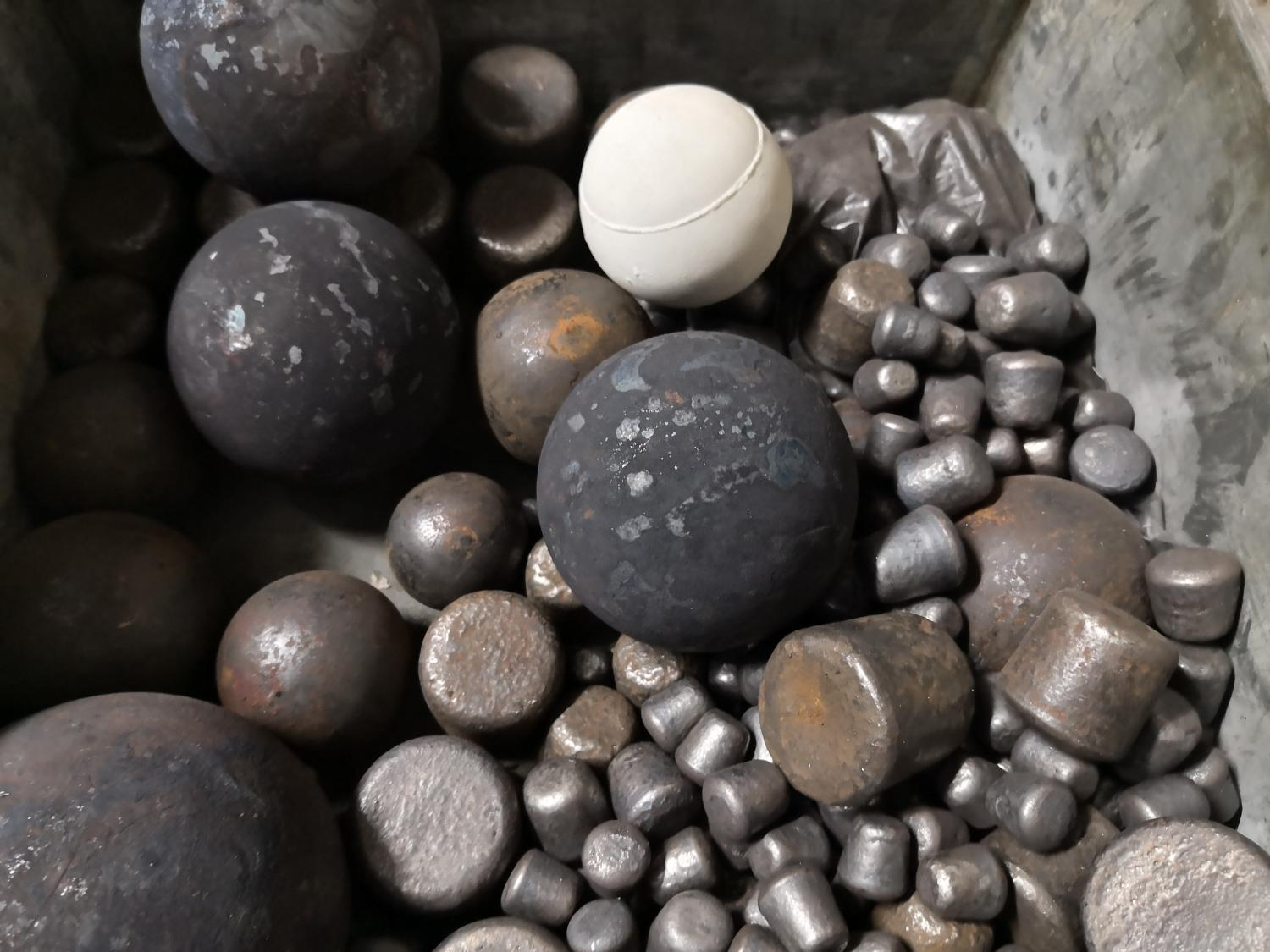
A cement raw mill generally requires several ball sizes because the material passes through different breakage stages. The largest balls handle the coarse particles near the inlet. Medium balls continue size reduction. Small balls and cylpebs provide high contact frequency for finishing work where feed is already fine.
| Grinding task | Typical media role | Main benefit | Risk if overused |
|---|---|---|---|
| Coarse-feed breakage | Large forged or cast steel balls | High impact energy | Low contact area and excess wear |
| Intermediate reduction | Medium-size grinding balls | Balanced impact and abrasion | Can become ineffective if depleted unevenly |
| Fine grinding | Small balls or grinding cylpebs | High surface area and contact frequency | Cannot efficiently break large, hard particles |
| Charge replenishment | Planned size-based additions | Maintains designed grading | Random additions distort the working charge |
For many conventional ball-mill applications, ball diameters fall broadly within the 20–75 mm range, while larger media may be necessary in primary grinding duties or for unusually coarse feed. Cylpebs are often used for fine grinding because their geometry can increase grinding contact. Actual diameters must be selected from plant test results rather than copied from another site.
Consider a raw mill operating well with a stable crushed limestone feed. After a quarry change, the mill begins receiving a higher percentage of hard, coarse material. Operators observe higher separator returns and an increase in raw meal residue, even though feed rate and nominal media loading remain unchanged.
The wrong response is to fill the mill with only larger balls. That may restore coarse breakage but reduce fine-grinding efficiency.
A better response is to:
- Confirm whether the coarse fraction and hardness have increased.
- Inspect whether the existing top-size balls are already worn below their effective breakage size.
- Add a calculated quantity of larger recharge balls.
- Preserve enough medium and small media to maintain fine grinding.
- Measure product residue, power draw, and throughput during a stable trial period.
- Adjust the replenishment schedule based on wear rather than waiting for major quality loss.
This approach protects both coarse breakage capacity and final raw meal fineness.
At SHANDONG ALLSTAR GRINDING BALL CO., LTD., our approach begins with the operating problem, not the product list. We manufacture and supply forged steel grinding balls, cast grinding balls, grinding rods, and grinding cylpebs for applications in cement, mining, and power generation. We also provide OEM support for overseas brands, wholesalers, and manufacturers seeking consistent product quality and customized sizing.
For variable raw meal feeds, the most useful supply program is usually a planned media package rather than a single ball size.
- Customized ball-size combinations for mill chambers and grinding stages
- Forged or cast media selection based on application demands
- Top-size ball recommendations based on feed variation and target fineness
- Consistent size tolerances for predictable charge behavior
- Replenishment planning that maintains the intended grading curve
- OEM packaging, private labeling, and export-oriented supply coordination
- Grinding cylpebs for applications requiring efficient finishing performance
- Technical communication between plant teams, distributors, and procurement teams
The right ball is not only hard. It must be appropriate in diameter, wear profile, breakage resistance, roundness, and size consistency. Poor size consistency can alter charge voidage and movement. Weak media can fragment prematurely, unintentionally shifting the charge toward smaller sizes and reducing coarse-particle breakage capacity.
A reliable grinding media grading program should be reviewed on a planned schedule. Do not wait until production drops sharply.
- Review feed-size distribution and quarry source changes.
- Track hourly throughput and specific power.
- Compare raw meal residue against the control target.
- Record separator return or circulation indicators.
- Note sound, vibration, and temperature trends.
- Sample the live grinding charge where safe and practical.
- Measure top-ball depletion and small-media accumulation.
- Review ball consumption by size category.
- Inspect liners, diaphragms, and material flow condition.
- Compare actual media additions with the original grading plan.
- Reassess the top-size ball requirement.
- Verify that crusher performance has not deteriorated.
- Avoid a large, untested media change.
- Conduct a controlled trial with defined KPIs.
- Document the result for the next quarry or blend transition.
Grinding technology experts caution that media that are too large for the expected grind can create high media and liner wear while using energy inefficiently. Continuous review of media size and quality is therefore a direct operational opportunity, not simply a maintenance task.
Use original production photos, plant-approved mill diagrams, and test data whenever possible. Original visual evidence strengthens trust and demonstrates first-hand manufacturing experience.
If your ball mill plant grinder is processing variable raw meal feeds, do not base top-size ball selection on an old purchasing specification alone. Share your mill dimensions, current ball sizes, feed-size distribution, material hardness, target residue, throughput, and current media consumption with SHANDONG ALLSTAR GRINDING BALL CO., LTD.
Our technical and OEM supply team can help you develop a practical grinding media grading proposal for forged steel balls, cast grinding balls, grinding rods, or cylpebs—designed around your actual process conditions and commercial requirements.
The top-size ball is the largest grinding media diameter used in the mill charge or added during recharge. Its primary role is to generate sufficient impact energy to break the coarsest and hardest particles in the feed.
Not always. Harder feed may require more large-ball capacity, but the correct response depends on feed size, mill diameter, speed, liner condition, target fineness, and the existing charge. Adding only larger balls can harm fine-grinding performance.
A quarry change can introduce coarser, harder, wetter, or more abrasive material. If the mill's live media grading no longer matches the feed, coarse breakage may become insufficient, causing more coarse particles to remain in circulation.
Process data should be reviewed continuously or weekly, while physical charge measurements should be scheduled according to mill conditions, media consumption, and maintenance access. Monthly review is a useful starting practice for many plants.
Neither is universally better. Forged and cast grinding balls should be selected according to hardness requirements, breakage resistance, wear environment, mill duty, and total cost of ownership. A technical comparison should be based on your application data.
Grinding cylpebs can be effective in fine-grinding duties because they provide a high contact area. However, they are not a direct substitute for large balls when the mill must break coarse and hard feed particles.
Provide mill diameter and length, chamber arrangement, liner type, current charge grading, feed F80 or sieve analysis, material hardness, moisture, product fineness target, hourly throughput, power consumption, and current media wear rate.
1. [Metso — Questions and Answers on Grinding Technology]
2. [Metso — Correct Liner Selection and Optimal Mill Efficiency]
3. [911 Metallurgist — Calculation of Top Grinding Media Size]
4. [911 Metallurgist — Calculate and Select Ball Mill Ball Size for Optimum Grinding]
5. [911 Metallurgist — Grinding Ball Design]
6. [ScienceDirect Topics — Ball Mill Overview]
7. [ScienceDirect Topics — Stirred Mill Overview]
8. [Metso — Select Horizontal Grinding Mills]
Hot Tags: China, Global, OEM, private label, manufacturers, factory, suppliers, manufacturing company


