
Views: 236 Author: shandong Allstar Grinding Ball Publish Time: 2026-08-25 Origin: Site


Content Menu
● How the Grinding Media Market Has Evolved
>> A Shift From Purchase Price to Total Cost
● Cast Grinding Media: Where It Still Performs
>> Cast Steel Balls at a Glance
● Why Forged Grinding Balls Have Gained Supremacy
>> Core Advantages of Forged Steel Grinding Balls
● Forged vs. Cast: Choose by Mill Conditions
● A Practical Grinding Media Trial Framework
>> Step 1: Define the Operating Baseline
>> Step 2: Confirm the Right Media Specification
>> Step 3: Run a Controlled Trial
>> Step 4: Measure Total Economic Impact
>> Step 5: Make the Decision on Lifecycle Value
● SHANDONG ALLSTAR: OEM Grinding Media Built Around Your Market
>> Customer-Oriented Experience
● The Future of Grinding Media Supply
● Partner With SHANDONG ALLSTAR
● FAQ
>> 1. What is the main difference between forged and cast grinding balls?
>> 2. Are forged grinding balls always better than cast balls?
>> 3. Which industries use grinding media?
>> 4. How can I evaluate grinding ball quality before purchasing?
>> 5. Can SHANDONG ALLSTAR provide OEM grinding media services?
>> 6. What sizes of grinding media should be selected?
The Evolution of the Grinding Media Market: From Cast to Forged Supremacy reflects a broader industrial shift: buyers are no longer selecting grinding media only by unit price. Mining companies, cement producers, power plants, and global distributors increasingly evaluate total milling cost, breakage risk, wear consistency, supply reliability, and process support. At SHANDONG ALLSTAR GRINDING BALL CO., LTD., we see this transition firsthand as a global manufacturer of grinding balls, forged steel balls, cast steel balls, grinding rods, and grinding cylpebs for OEM brands, wholesalers, and industrial producers.
Cast grinding media remains important in many applications. However, forged grinding balls have become the preferred choice for many high-impact milling duties because a well-controlled forging and heat-treatment process can deliver a dense structure, strong impact resistance, and predictable wear performance. The market is not moving toward a single material for every mill. It is moving toward application-specific grinding media selection—with forged media taking a leading role where toughness and reliability matter most.
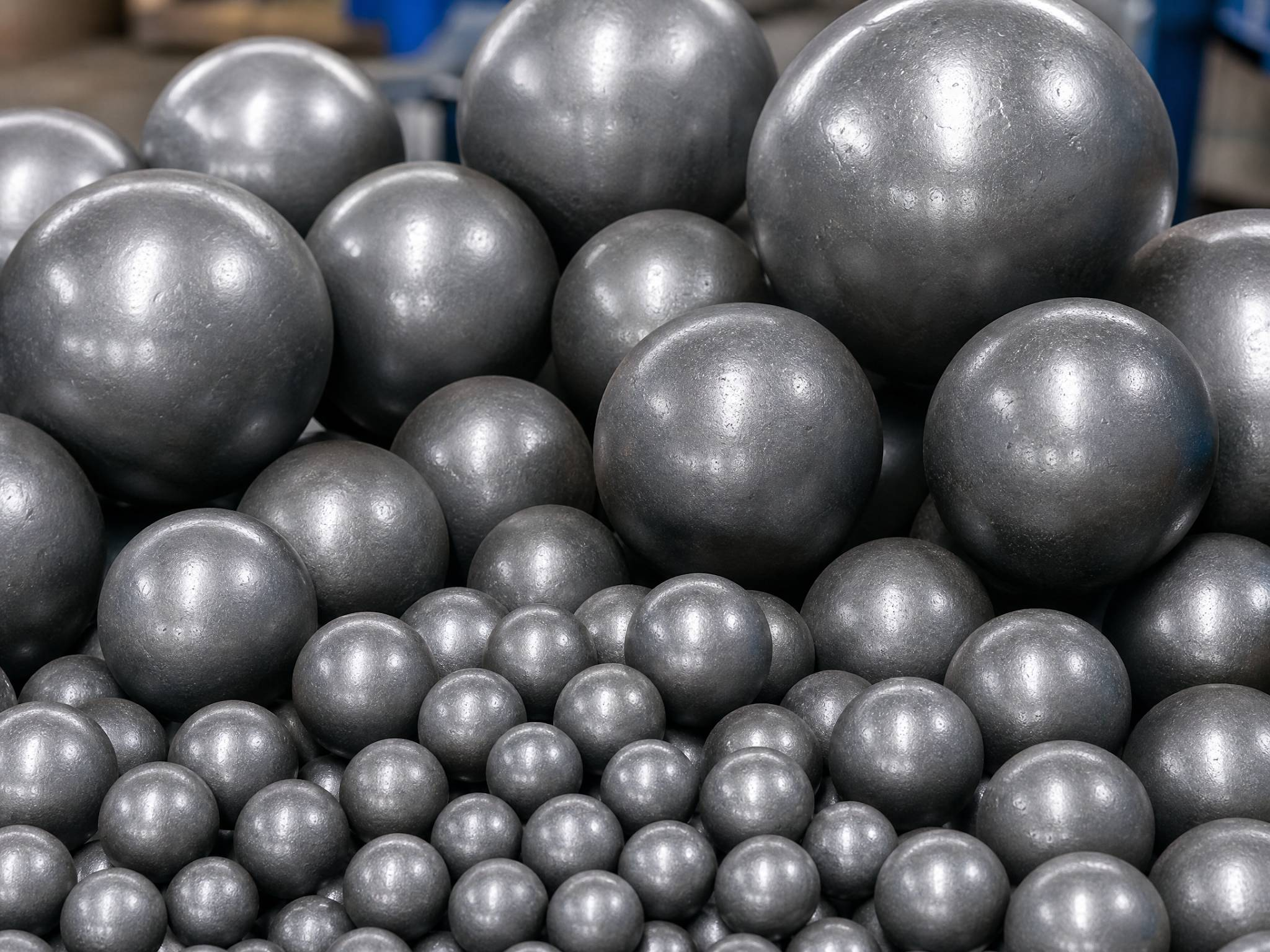
Grinding media has always been essential to mineral processing. It transfers energy inside ball mills, SAG mills, rod mills, and regrinding mills to reduce ore, clinker, coal, and other feed materials to the required size.
In earlier industrial operations, cast iron and cast steel balls were widely used because casting could produce large volumes at competitive initial cost. For many low-to-medium impact applications, cast media remains a practical option. Yet plant operators gradually identified limitations associated with variable internal soundness, breakage exposure in severe impact environments, and inconsistent performance when manufacturing control was weak.
As mine throughput increased and mills became larger, the consequences of media failure became more expensive. A broken ball can affect mill efficiency, increase handling losses, create operational uncertainty, and complicate downstream separation. This pushed the market toward more reliable processes, stronger metallurgical control, and measurable lifecycle performance.
Today, the global grinding media market spans mining, cement, power generation, metallurgy, and chemical processing. Industry market research estimates the global grinding media balls market at approximately USD 8.39 billion in 2025, with continued growth projected through 2033. Mining remains the core demand driver, while cement and power applications continue to require dependable media for high-volume size reduction.
The industry's most important change is not simply "cast versus forged." It is the replacement of a lowest-price mindset with a total cost of ownership mindset.
Modern buyers assess:
- Media consumption per tonne of ore or clinker processed
- Ball breakage frequency and mill downtime risk
- Size retention during the grinding cycle
- Product hardness and hardness distribution
- Compatibility with mill type and operating conditions
- Grinding efficiency and throughput stability
- Freight, packaging, traceability, and supply continuity
- Technical response capability from the supplier
For SHANDONG ALLSTAR, this is why OEM grinding media manufacturing requires more than producing steel balls. It requires understanding the customer's process, product positioning, target market, packaging requirements, and quality expectations.
Cast grinding balls are produced by melting metal, pouring it into molds, allowing it to solidify, and applying heat treatment where required. Cast high-chrome grinding media is particularly valued for high hardness and abrasion resistance in suitable milling environments.
The cast process can provide strong economic and technical value when the alloy design, mold quality, pouring practice, cooling process, and heat treatment are properly controlled. High-chrome cast media is often considered for abrasion-dominated grinding applications and can be selected when lower wear is the primary objective.
However, casting introduces variables that must be carefully managed. Internal shrinkage, porosity, inclusions, segregation, or heat-treatment inconsistency can influence service life. These risks are not universal to all cast balls, but they explain why quality verification is essential.
| Factor | Cast Grinding Balls | Practical Buyer Consideration |
|---|---|---|
| Manufacturing route | Molten alloy poured into molds | Quality depends heavily on foundry and heat-treatment control |
| Wear resistance | Often strong, especially with high-chrome alloys | Suitable where abrasion dominates |
| Impact resistance | Can be lower than forged media in severe duty | Review breakage history before large-scale use |
| Internal structure | May contain casting-related variability | Ask for testing and batch traceability |
| Typical use | Certain ball mill, cement, and regrind conditions | Select based on ore, mill energy, and slurry chemistry |
| Initial price | Often competitive | Compare lifecycle cost, not only delivered price |
A key lesson from industry trials is that no medium is automatically superior in every operating condition. For example, high-chrome media trials at mining concentrators have demonstrated potential wear and metallurgical benefits, but economics can still lead operators to return to forged media where operating costs, impact requirements, or overall process conditions favor it.
At SHANDONG ALLSTAR, we help OEM customers and end users avoid simplistic material choices. Our cast steel grinding balls can be configured for relevant applications, while our forged options serve operations that demand high toughness and consistent performance under impact.
Forged grinding balls are typically produced by heating selected steel bar or billet stock, forming it through forging or hot rolling, and then applying controlled heat treatment. The process is designed to improve structural density and create a tougher internal grain flow than a conventional casting route.
The term forged supremacy should not be understood as a marketing slogan that dismisses every cast product. Instead, it describes why forged media has become a leading choice in high-impact grinding circuits: it addresses the operational needs of larger, more demanding mills.
According to Canada's trade authority description of forged grinding media, forged balls are formed from high-quality steel bars or billets, then heat treated through processes such as quenching and tempering to achieve targeted hardness, toughness, and wear resistance. The same source distinguishes forged media from cast grinding media and notes their use across copper, gold, iron ore, and cement applications.
1. Higher impact resistance
Forged balls are often selected for SAG mills and large ball mills where repeated impact is severe. A dense forged structure helps reduce the risk of catastrophic breakage when the media encounters coarse ore, high mill loads, or aggressive operating conditions.
2. More consistent performance
A controlled steel chemistry, forming process, and heat-treatment cycle can help improve consistency from ball to ball and batch to batch. This matters to mills that require predictable media consumption and stable charge behavior.
3. Strong toughness-to-hardness balance
Hardness alone does not determine grinding-media value. A ball that is very hard but brittle may not perform reliably under impact. Effective forged steel grinding balls are engineered to balance surface wear resistance with core toughness.
4. Lower breakage exposure
Where impact is high, fewer broken balls can mean less uncertainty in mill performance and less risk of unexpected operational disruption. Forged balls are commonly marketed for their low breakage characteristics in heavy-duty grinding circuits.
5. Better fit for demanding OEM specifications
International brands and distributors need more than standard sizes. They may require private labeling, custom packing, target hardness ranges, specific dimensional tolerances, third-party inspection coordination, and export-ready documentation. Forged media is well suited to such structured OEM programs when manufactured under disciplined quality systems.
Selecting grinding media should begin with the mill and the material—not the supplier's preferred product category.
| Selection Factor | Forged Steel Balls | Cast Steel or High-Chrome Balls |
|---|---|---|
| High-impact SAG milling | Often preferred | Must be evaluated carefully |
| Large-diameter media | Strong option | Available, but verify impact performance |
| Abrasion-focused duty | Competitive depending on alloy | High-chrome options may perform well |
| Coarse ore feed | Often suitable due to toughness | Requires application validation |
| Fine regrinding | Depends on media size and process | Can be suitable with appropriate alloy |
| Breakage sensitivity | Typically lower risk in severe impact duty | Depends strongly on casting quality |
| OEM custom programs | Highly adaptable | Also adaptable with proper foundry control |
The right choice depends on several operating variables:
- Ore hardness, abrasiveness, and feed size
- Mill diameter, speed, and power intensity
- Ball size distribution and make-up ball policy
- Wet or dry grinding conditions
- Slurry pH, chemistry, and corrosion behavior
- Target particle size and throughput requirement
- Downstream recovery and contamination sensitivity
A plant should not replace all media based on a catalog claim. It should conduct a controlled, documented comparison.
One of the most common information gaps in generic grinding media articles is the lack of a practical evaluation method. Buyers are often told to "choose high-quality balls," but not how to verify performance in their actual mill.
At SHANDONG ALLSTAR, we recommend using a structured trial before a full-scale conversion.
Record the current media type, consumption rate, ball size distribution, throughput, mill power draw, feed size, product size, and key metallurgical results. Without a baseline, a trial cannot prove value.
Match the candidate forged or cast grinding ball to the application. Confirm diameter, alloy approach, hardness target, impact requirement, and packaging format. Do not compare different ball sizes or charge strategies without accounting for their effect.
Introduce marked trial media or segregated media according to the plant's agreed procedure. Track usage over a meaningful operating period rather than relying on a few days of observation. Historical industry work has used marked-ball testing to compare wear behavior in operating mills.
Evaluate more than kilograms consumed. Review:
- Tonnes processed per hour
- Media consumption per tonne processed
- Grinding product size
- Unplanned stoppages
- Breakage observations
- Energy use where data is available
- Recovery, grade, or cement quality where relevant
Choose the media that offers the best total operating result—not necessarily the lowest invoice price. A higher-quality forged ball may cost more per tonne but reduce breakage and stabilize production. Conversely, an optimized cast high-chrome ball may deliver a better result in an abrasion-led circuit.
SHANDONG ALLSTAR GRINDING BALL CO., LTD. is positioned as a reliable global grinding media manufacturer serving mining, cement, and power-industry customers. Our core product portfolio includes:
- Forged steel grinding balls
- Cast steel grinding balls
- Grinding media balls for ball mills and SAG mills
- Grinding rods
- Grinding cylpebs
- Customized OEM grinding media solutions
We support foreign brands, wholesalers, distributors, and manufacturers that need a dependable production partner. Our role is not limited to supplying products. We help customers build a market-ready grinding media program with product matching, private-label support, export packaging, and stable quality communication.
A professional OEM grinding media supplier should offer clear answers to the questions that protect a customer's brand reputation:
- What raw materials and alloy controls are used?
- How are forging, casting, and heat treatment managed?
- How is hardness verified from surface to core?
- How are size tolerances and ball shape controlled?
- How are products packed for long-distance marine transport?
- Can the supplier provide custom branding and documentation?
- How are claims, nonconformities, and repeat orders handled?
Our customers value a supplier that listens to their application requirements rather than forcing a single media type into every project. Whether the requirement is forged grinding balls for high-impact mining, cast grinding balls for specified wear conditions, grinding rods for rod mills, or cylpebs for fine grinding, SHANDONG ALLSTAR focuses on practical fit and long-term partnership.
Feedback from international buyers consistently emphasizes the same purchasing priorities: stable quality, reliable shipment coordination, responsive communication, and product consistency across repeat orders. These are not secondary service features. In OEM manufacturing, they are central to protecting the distributor's customer relationships and reducing supply-chain friction.
For that reason, SHANDONG ALLSTAR approaches every order with a quality-first mindset:
- Confirm the application before recommending a product
- Clarify technical specifications before mass production
- Align packaging with handling and shipping conditions
- Maintain traceability by batch where required
- Support OEM branding for overseas market development
- Build repeatable supply programs instead of one-time transactions
The next stage of the grinding media market will be shaped by three forces: performance data, supply resilience, and sustainability.
First, buyers will demand more measurement. They will expect suppliers to discuss wear rates, breakage, and mill performance in practical terms. Second, manufacturers will be judged on supply reliability, especially when mines and cement plants cannot tolerate long production interruptions. Third, the industry will pay closer attention to environmental impact. Media production requires mining, steelmaking, forging, transportation, and replacement cycles, all of which contribute to emissions.
This creates an opportunity for more efficient media selection. A product that lasts longer, breaks less often, and helps the mill operate more consistently may reduce the total material and logistics burden over its operating life.
Forged steel grinding balls are likely to maintain a leading position in high-impact applications. At the same time, high-quality cast media, grinding rods, and cylpebs will remain essential tools in a diversified grinding-media market. The winning supplier will be the one that provides the right medium, supported by transparent quality control and a responsive service model.
The evolution from cast to forged supremacy is ultimately a move toward better-informed grinding media decisions. If you are building an OEM grinding media brand, sourcing for a mine, supplying cement plants, or expanding a wholesale distribution network, SHANDONG ALLSTAR can help you select the right forged steel balls, cast steel balls, grinding rods, or cylpebs for your market.
Contact SHANDONG ALLSTAR GRINDING BALL CO., LTD. today to discuss your required sizes, technical specifications, OEM branding, packaging, inspection needs, and export destination. Let us help you create a grinding media supply program built for reliable performance and long-term growth.
Forged grinding balls are formed from heated steel bars or billets through forging or hot rolling, then heat treated. Cast grinding balls are produced by pouring molten alloy into molds. Forged balls are often selected for high-impact applications, while cast high-chrome balls can be effective in abrasion-dominant conditions.
No. Forged steel balls are often preferred for high-impact milling because of their toughness and lower breakage exposure. However, cast high-chrome media can be a strong choice in certain abrasive applications. The correct choice depends on mill conditions, ore properties, and total operating cost.
Grinding media is widely used in mining and mineral processing, cement production, power generation, metallurgy, chemicals, and other industrial size-reduction processes. Common mill types include ball mills, SAG mills, rod mills, and regrinding mills.
Request product specifications, hardness data, dimensional tolerances, manufacturing-process information, inspection records, packaging details, and batch traceability. The best practice is to conduct a controlled plant trial and compare media consumption, breakage, throughput, and product quality.
Yes. SHANDONG ALLSTAR provides OEM services for overseas brands, wholesalers, and manufacturers. Support can include customized products, private labeling, packaging, technical specification alignment, export-ready supply, and repeat-order consistency.
Ball size should be determined by feed size, ore hardness, mill type, target product size, and charge dynamics. Larger balls generally provide greater impact energy, while smaller media can be more effective for finer grinding. A trial or technical review is recommended before final selection.

1. [Canada Border Services Agency — Forged Grinding Media Investigation]
2. [Molycop — Grinding Balls and Grinding Media Solutions]
3. [AusIMM — Overview of Grinding Media Consumption in Comminution]
4. [AusIMM — Application of High-Chrome Grinding Media at MMG Century Mine]
5. [AusIMM — Conducting High-Chrome Grinding Media Trials at Newcrest Ridgeway Concentrator]
6. [AusIMM — Beyond SAG Milling: The Future of Grinding]
7. [Energosteel — Forged Steel Grinding Balls for Ball Mills]
8. [SkyQuest — Grinding Media Balls Market Size and Growth Report]
Hot Tags: China, Global, OEM, private label, manufacturers, factory, suppliers, manufacturing company


