
Views: 225 Author: shandong Allstar Grinding Ball Publish Time: 2026-09-16 Origin: Site


Content Menu
● Grinding Steel Ball vs Grinding Rod: Core Differences
>> When Grinding Steel Balls Usually Win
>> When Grinding Rods Usually Win
● The Best Choice by Application
>> Mining and Mineral Processing
● How to Minimize Media Consumption per kWh
>> 1. Match Media Size to Feed Size
>> 2. Control the Steady-State Media Charge
>> 3. Evaluate Corrosion Separately from Abrasion
>> 4. Test Suppliers Under Real Conditions
● Expert Framework: Ball or Rod Decision Matrix
● What SHANDONG ALLSTAR Delivers
● Recommended Media Trial Plan
>> Example: Avoiding a False Saving
● FAQ
>> 1. Are grinding steel balls more efficient than grinding rods?
>> 2. How can I calculate grinding-media consumption per kWh?
>> 3. What causes high grinding-ball consumption?
>> 4. Why do grinding rods tangle?
>> 5. Should I choose forged or cast grinding balls?
>> 6. Can lower media consumption reduce energy use?
>> 7. What data should I provide for a grinding-media recommendation?
For concentrators, cement plants, and power-industry grinding circuits, the choice between a grinding steel ball and a grinding rod should not be based on purchase price alone. The correct choice is the one that delivers the required product size and throughput while minimizing media make-up per kilowatt-hour (kWh), reducing unplanned downtime, and maintaining stable downstream performance.
At SHANDONG ALLSTAR GRINDING BALL CO., LTD., we manufacture forged steel grinding balls, cast grinding balls, grinding rods, and grinding segments for global mining, cement, and power customers. Based on our manufacturing experience and OEM cooperation with international brands, wholesalers, and industrial producers, the practical answer is clear: grinding balls are usually the stronger option for fine grinding and high-throughput ball-mill duties, while grinding rods are often the better choice for coarse grinding applications that require a narrow particle-size distribution and reduced over-grinding. The lowest media-consumption rate per kWh comes from matching the media geometry, alloy, hardness profile, size distribution, and mill operating conditions to the actual ore or feed material.
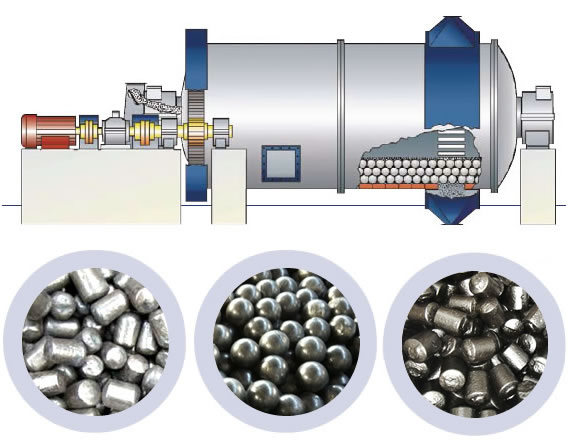
Many grinding-media articles compare balls and rods only by shape. That approach misses the operational factors that determine real consumption rates:
- The required final particle-size distribution
- The percentage of coarse particles in mill feed
- The Bond Abrasion Index and mineral hardness
- The balance between impact and abrasion inside the mill
- The presence of corrosive slurry conditions
- Media-size make-up strategy
- Mill speed, filling level, and liner profile
- Whether the plant is constrained by power, throughput, recovery, or product quality
At SHANDONG ALLSTAR, we recommend evaluating grinding media as a circuit-performance decision, not as a commodity procurement decision.
Grinding balls and grinding rods both transfer mechanical energy to material inside tumbling mills. However, their contact geometry and motion create different breakage environments.
| Factor | Grinding Steel Balls | Grinding Rods |
|---|---|---|
| Typical mill type | Ball mills, SAG mills, regrind mills | Rod mills |
| Primary breakage action | Impact, abrasion, and attrition | Line contact, cascading, and preferential coarse-particle breakage |
| Best feed condition | Fine-to-medium feed; secondary and fine grinding | Relatively coarse feed; preparation before ball milling |
| Particle-size distribution | Can generate fines efficiently | Produces a narrower size distribution with fewer excessive fines |
| Media shape | Spherical | Long cylindrical bar |
| Main operating risk | Poor size selection may increase wear or reduce breakage efficiency | Rod tangling if rod straightness, rod length, or operating conditions are poorly controlled |
| Common optimization focus | Ball diameter mix, hardness, impact toughness, recharge practice | Rod straightness, rod length, end quality, hardness consistency, rod-charge control |
| Best route to lower kg/kWh | Match ball size and alloy to ore breakage and abrasion conditions | Use when controlled coarse grinding avoids over-grinding and unnecessary energy use |
Grinding steel balls are generally the preferred choice when a circuit needs high-capacity secondary grinding, fine grinding, regrinding, or strong impact capability. Their point-contact geometry and broad size range allow plant operators to build a graded charge that supports both coarse-particle breakage and fine-particle finishing.
A properly selected forged grinding ball can help reduce media consumption per kWh when:
- The feed contains hard or competent particles requiring impact energy
- The mill handles variable ore hardness or fluctuating feed size
- The target product is relatively fine
- The circuit needs a controlled blend of large, medium, and small media
- The plant requires high throughput without sacrificing grind quality
- The grinding environment demands high impact toughness and reliable breakage resistance
A high-quality ball should not merely be hard. It must balance surface hardness, core hardness, toughness, microstructure, and dimensional consistency. Excessive hardness without sufficient toughness can create breakage risk. Low hardness may prevent breakage but increase abrasion loss. The best formulation depends on the specific mill duty.
Industry reviews note that media composition, hardness, phase structure, and slurry abrasiveness and corrosiveness all affect ball wear. They also show that media size and charge composition can materially influence mill power draw and energy consumption.
Grinding rods are traditionally used in rod mills for coarse grinding, especially where a plant needs a more uniform product and wants to reduce unnecessary fines before downstream processing.
Because rods contact material along a line rather than at individual points, they tend to break larger particles in a more selective way. This can be highly valuable for certain mineral-processing circuits, particularly when excessive fines create problems in classification, flotation, leaching, thickening, filtration, or later-stage grinding.
Grinding rods may minimize media consumption per kWh when:
- The feed is relatively coarse and must be reduced before ball milling
- A narrow product-size distribution is more valuable than maximum fines generation
- Over-grinding would harm downstream mineral recovery
- The mill is designed specifically for rod media and operated within the proper rod-charge range
- The feed is sufficiently uniform to prevent excessive rod tangling and uneven wear
- The plant needs a controlled pre-grind stage rather than ultra-fine liberation
Metso notes that rod mills can produce a uniform-sized product while minimizing unwanted fines, which explains why rods remain important in selected coarse-grinding applications.
However, rods are not a universal replacement for balls. In fine-grinding duties, rod mills can become inefficient because the media does not provide the same high-density, multi-size, point-contact grinding environment available in a ball charge.
The most efficient option depends on the role of the mill in the circuit rather than on whether one media type is inherently superior.
For primary or coarse grinding, rods can be advantageous when a narrow size distribution is required and excessive fines must be limited. In secondary ball milling, regrinding, and fine grinding, forged steel balls are usually more flexible and productive.
For abrasive gold, copper, iron ore, polymetallic, and base-metal applications, a ball's wear performance must be assessed against ore abrasiveness, impact severity, and slurry chemistry. Abrasive ores can produce high media wear rates, and a low-cost media product may become expensive if it wears rapidly or breaks prematurely.
Cement grinding usually favors grinding balls because ball mills need reliable impact and abrasion performance across a controlled range of media diameters. The right ball-size distribution supports clinker breakage, gypsum blending, and consistent cement fineness.
For cement producers, the key question is not simply the ball's hardness rating. It is whether the ball maintains effective grinding action throughout its usable life. A stable wear profile helps maintain mill output, separator performance, and product quality.
For coal-related grinding systems, the media choice should reflect mill design, feed moisture, desired fineness, ash content, and abrasion characteristics. Grinding balls and segments are frequently selected for applications where repeatable hardness, wear resistance, and supply reliability are needed.
In every sector, SHANDONG ALLSTAR can support OEM customers with media selection based on application requirements, including forged steel balls, cast steel balls, grinding rods, and customized grinding segments.
The lowest media-consumption rate is not created by a single product feature. It comes from a disciplined operating and procurement process.
A media charge that is too small may lack the impact energy needed to break coarse particles. A charge that is too large may reduce the number of effective grinding contacts and waste energy on already-fine material.
For ball mills, a graded charge is often more effective than a single-size charge. Larger balls should address coarse feed, while smaller balls increase contact frequency for final size reduction.
For rod mills, select rod diameter and length according to mill diameter, feed size, and required product size. Rods must remain straight and consistent to reduce tangling, uneven loading, and premature operational disruption.
A mill does not perform optimally simply because it contains more steel. Overfilling can reduce effective motion, increase power draw, and increase liner and media collisions. Underfilling can reduce grinding capacity and allow coarse material to circulate longer.
Maintain a stable charge volume and recharge pattern. For balls, avoid adding only one diameter if the circuit requires a balanced size distribution. For rods, maintain the designed rod-charge level and remove damaged or severely bent rods before they create tangling problems.
In wet grinding, chemical corrosion can accelerate steel loss beyond what mechanical wear alone would predict. Slurry pH, dissolved oxygen, sulfide minerals, galvanic interactions, water chemistry, and residence time may all affect performance.
If corrosion is significant, the correct answer may involve alloy adjustment, operating-condition changes, or a revised media strategy. A high-hardness product cannot solve a corrosion-driven wear problem by itself.
Laboratory hardness values are important, but they are not the final proof of performance. A reliable media trial should compare:
- Media consumption in kg/t and kg/kWh
- Throughput in t/h
- Specific energy in kWh/t
- Product-size distribution
- Ball or rod breakage rate
- Liner wear trend
- Mill noise, vibration, and operational stability
- Downstream recovery or product-quality impact
A modern media-wear model can improve prediction, but plants should still validate results through controlled operating trials. The updated Benavente-based work reported an average prediction error of about ±9%, showing improvement over older approaches but also confirming that real operating data remains essential.
Use the following practical framework before purchasing grinding media.
| Operating Question | Better Starting Option | Why It Matters |
|---|---|---|
| Do you need fine grinding or regrinding? | Grinding steel balls | Balls provide more contact points and flexible size distribution |
| Is the feed relatively coarse and are unwanted fines a concern? | Grinding rods | Rods can create a narrower product distribution |
| Is the ore highly abrasive or impact-intensive? | Forged grinding steel balls | Properly heat-treated forged balls can balance toughness and wear resistance |
| Does the mill experience rod tangling or rod breakage? | Review rod quality and mill conditions | Straightness, length control, heat treatment, and charge management are critical |
| Is energy the main constraint? | Trial both media strategy and circuit conditions | Energy results depend on product target, feed, mill design, and operating control |
| Is downstream recovery sensitive to slimes or fines? | Consider grinding rods in the coarse stage | Reducing unnecessary fines may protect separation performance |
| Is the circuit a standard ball-mill application? | Grinding steel balls | Balls are usually the practical and scalable choice |
SHANDONG ALLSTAR GRINDING BALL CO., LTD. supports global buyers that need more than a basic grinding-media quotation. Our role is to help customers align media choice with performance targets, supply consistency, and total operating cost.
Our product range includes:
- Forged steel grinding balls for mining, cement, and power applications
- Cast grinding balls for selected wear and grinding requirements
- Grinding rods for rod-mill duties
- Grinding segments for industrial grinding systems
- OEM grinding-media solutions for brands, wholesalers, distributors, and manufacturers
- Customized size, specification, packaging, and supply programs based on project requirements
Our customer-focused approach emphasizes the factors buyers repeatedly value in industrial media supply: consistent quality, dependable production capacity, responsive technical communication, stable packing and shipping execution, and support for customized OEM requirements.
For overseas brands and bulk buyers, consistency matters as much as initial performance. A single strong shipment cannot compensate for variation between production batches. That is why media selection should include dimensional control, hardness consistency, internal quality, breakage resistance, packing integrity, and traceable quality procedures.
Before converting an entire mill to a new ball or rod specification, conduct a structured trial.
1. Define the baseline using at least several weeks of normal operating data.
2. Record ore type, throughput, feed size, product size, power draw, media addition, and liner condition.
3. Introduce one controlled media change at a time, such as alloy, diameter mix, or rod specification.
4. Maintain comparable operating conditions wherever possible.
5. Calculate kg/t, kWh/t, and kg/kWh for both baseline and trial periods.
6. Inspect worn media for spalling, breakage, corrosion, deformation, and abnormal size loss.
7. Review downstream effects, including classification efficiency, flotation performance, or finished-product quality.
8. Select the media option based on total cost per tonne of acceptable product, not price per tonne of steel.
A mine may find that lower-priced grinding balls reduce procurement cost by 8%. However, if those balls wear faster, increase media make-up by 15%, raise power use by 3%, and create more mill stoppages, the apparent purchase saving quickly disappears.
Conversely, a premium forged grinding ball that maintains its shape, resists breakage, and supports stable throughput may reduce the overall cost per tonne even when its initial price is higher. This is why the correct KPI is total grinding cost, supported by media consumption per kWh—not unit price alone.
For most ball-mill and fine-grinding duties, grinding steel balls are the more versatile route to lower media consumption per kWh, especially when ball size, alloy design, hardness, toughness, and recharge practice are properly matched to the ore and mill conditions. For coarse grinding where a narrow particle-size distribution and fewer unwanted fines are critical, grinding rods can provide a better energy-and-media outcome.
The best answer is always application-specific. A properly designed ball or rod program can lower steel consumption, stabilize power use, improve throughput, reduce liner stress, and support downstream recovery or product quality.
Contact SHANDONG ALLSTAR GRINDING BALL CO., LTD. today to discuss your mill type, feed material, target size, current media consumption, and OEM requirements. Our team can help you select forged grinding balls, cast grinding balls, grinding rods, or grinding segments designed around your real operating targets—not just a generic specification.
Grinding steel balls are usually more efficient for fine grinding, secondary grinding, regrinding, and high-throughput ball-mill operation. Grinding rods may be more efficient for coarse grinding where a narrow product size and reduced over-grinding are important.
Divide the total mass of grinding media added during a defined period by the mill's total electrical energy used during the same period. For example, if a mill consumes 12,000 kg of media while using 600,000 kWh, the result is 0.02 kg/kWh.
High consumption may result from abrasive ore, high-impact conditions, corrosive slurry, poor alloy selection, insufficient hardness, inadequate toughness, incorrect ball size, poor charge management, excessive mill speed, liner problems, or inconsistent media quality.
Grinding rods can tangle when rods become bent, rod length is poorly controlled, the rod charge is improperly maintained, feed conditions are unsuitable, or the mill operates outside its intended design parameters. Straightness and consistent heat treatment are essential.
Forged grinding balls are commonly selected for applications requiring strong impact resistance, reliable toughness, and controlled wear. Cast grinding balls can be appropriate in selected abrasive conditions and lower-impact applications. The right choice depends on mill type, feed characteristics, and wear mechanism.
Often, yes—but not automatically. Lower media wear can reduce the energy associated with manufacturing, transporting, and handling replacement steel. However, mill electrical energy depends on many factors, including feed size, mill speed, charge volume, liner condition, classification efficiency, and target product size.
Provide mill type and dimensions, operating power, throughput, feed size, target product size, ore or material characteristics, slurry conditions, current media size and consumption, liner type, and any breakage or corrosion observations. This information enables a more reliable recommendation.
1. Metso. "Comminution Solutions: Energy Efficient Solutions to Maximize Your Productivity." [Read the Metso grinding solutions brochure].
2. Metso. "Stirred Mills for Wet Grinding." [Explore Metso stirred-mill technology].
3. Metso. "Optimizing Operations with Metso Outotec's Stirred Mill Technology." [Read Metso's technical article].
4. MDPI Minerals. "A Review of the Grinding Media in Ball Mills for Mineral Processing." [Read the peer-reviewed review article].
5. ScienceDirect. "Consumption of Steel Grinding Media in Mills: A Review." [Read the research abstract].
6. CEEC International. "Updated Benavente Correlation for Estimating Grinding Media Consumption Rates." [Read the technical resource].
7. Molycop. "Grinding Balls." [Explore Molycop grinding-ball information].
8. MetPro. "Grinding Media Wear & Consumption." [Review media-wear calculation concepts].
Hot Tags: China, Global, OEM, private label, manufacturers, factory, suppliers, manufacturing company


