
Views: 267 Author: shandong Allstar Grinding Ball Publish Time: 2026-09-14 Origin: Site


Content Menu
● Why Media Consumption per kWh Matters
● Grinding Steel Ball vs Grinding Rod: Core Differences
● When Grinding Steel Balls Minimize Consumption per kWh
>> 1. When ball size matches the feed-size distribution
>> 2. When the media resists both wear and breakage
>> 3. When makeup strategy maintains an efficient charge
● When Grinding Rods Can Deliver Better Results
>> Rods are often advantageous when:
● Media Consumption Is Not Only a Material Issue
>> Key operational causes of excessive media use
● A Practical Test Plan for Comparing Balls and Rods
>> Step 1: Establish the baseline
>> Step 2: Change one major variable at a time
>> Step 3: Inspect the media physically
>> Step 4: Convert results into total operating cost
● Example: Choosing the Right Media for a Coarse-Grinding Circuit
● Why Choose SHANDONG ALLSTAR as Your OEM Media Partner
● FAQs
>> 1. Are grinding steel balls always better than grinding rods?
>> 2. How do I calculate grinding media consumption per kWh?
>> 3. What causes high grinding-ball consumption?
>> 4. Can forged grinding balls reduce breakage?
>> 5. Why are oversized grinding balls inefficient?
>> 6. Can grinding rods be used in a ball mill?
>> 7. What information should I provide when requesting a grinding-media quotation?
For concentrators, cement plants, and power-industry grinding circuits, the question is not simply whether a grinding steel ball or grinding rod lasts longer. The more useful question is: which media delivers the required product size while consuming the least steel per kilowatt-hour of mill energy?
At SHANDONG ALLSTAR GRINDING BALL CO., LTD., we approach this decision from the viewpoint of both a grinding-media manufacturer and an OEM partner. A lower purchase price per tonne does not necessarily mean a lower operating cost. The right media must match the mill type, ore competence, feed size, product specification, slurry chemistry, mill speed, liner profile, and grinding circuit objective.
In many ball-milling applications, properly selected forged or cast grinding steel balls can offer lower media consumption per kilowatt-hour because they maintain a stable grinding charge, provide high-impact breakage, and can be sized to match the feed and target grind. In rod-mill circuits, grinding rods remain highly effective where a narrow particle-size distribution and reduced production of excessive fines are priorities. The best choice depends on the duty—not on a one-size-fits-all rule.
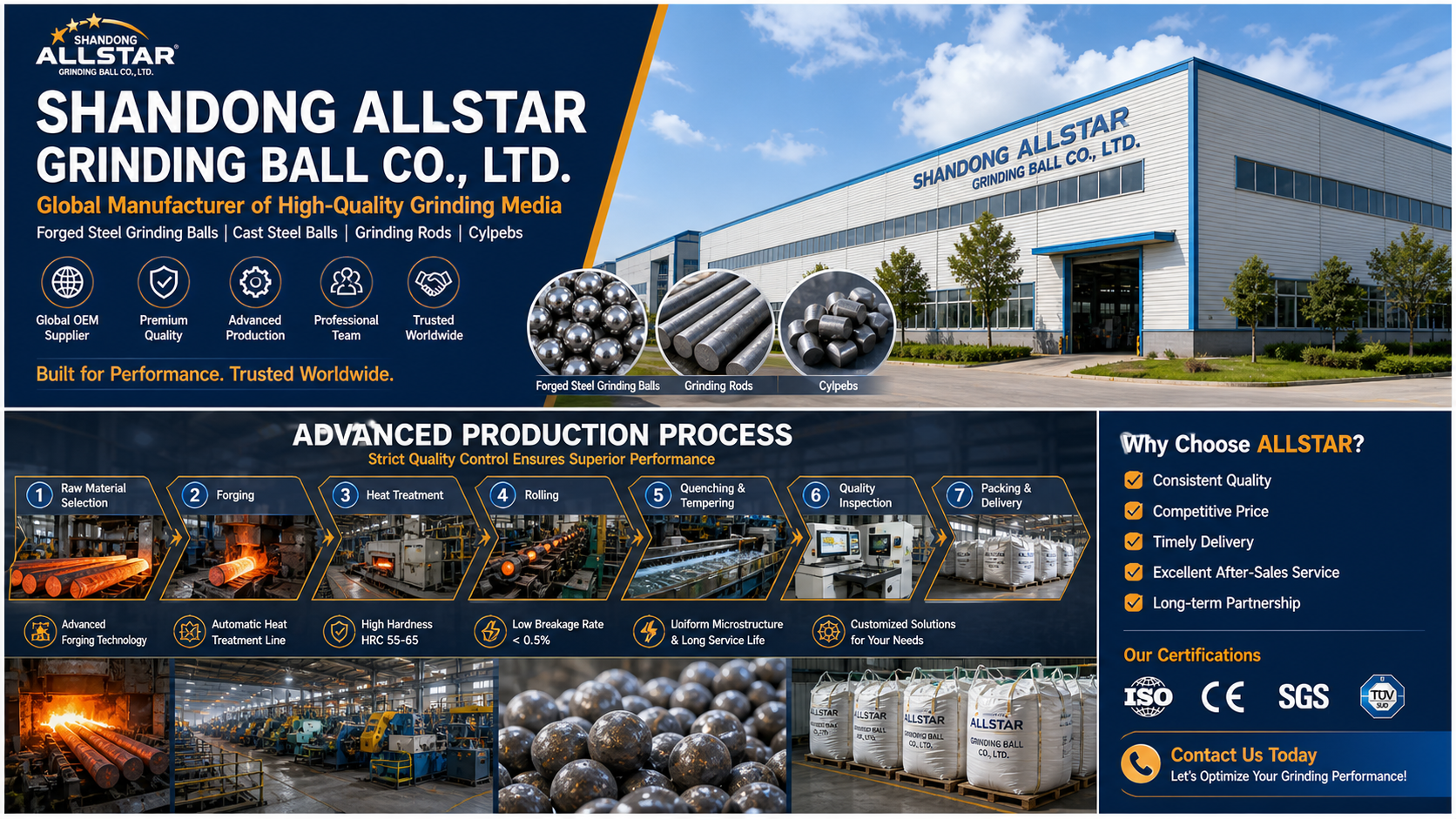
SHANDONG ALLSTAR GRINDING BALL CO., LTD. supplies grinding balls, forged steel balls, cast grinding balls, grinding rods, and grinding cylpebs for mining, cement, power generation, quarries, and global OEM programs. Our focus is helping overseas brand owners, wholesalers, and industrial manufacturers specify media that supports lower wear, stable performance, and better cost control. [steelgrindingball]
Grinding is one of the most energy-intensive stages in mineral processing and industrial milling. A mill may consume electricity continuously, but not every kilowatt-hour produces useful size reduction. Some energy becomes heat, noise, liner wear, unnecessary impacts, or inefficient media movement.
For this reason, media consumption should be evaluated using more than one KPI:
- Media wear rate: kilograms of media consumed per tonne of feed or product
- Energy intensity: kilowatt-hours per tonne processed
- Media consumption per energy input: grams or kilograms of media consumed per kilowatt-hour
- Total grinding cost: media cost + electricity + liner wear + downtime + lost throughput
- Grinding efficiency: product-size achievement per unit of energy and media consumed
A lower media consumption rate per kWh is valuable because it indicates that the grinding charge is converting electrical energy into useful breakage rather than excessive wear. However, the metric must always be interpreted with throughput and product size. A media type can show low wear per kWh while still failing to achieve the required liberation size or production target.
As an experienced grinding-media supplier, ALLSTAR recommends evaluating media performance over a sufficiently long operating period. Short trials can be misleading because mill charge stabilization, inventory change, feed variability, liner condition, and sampling error may distort the result.
Grinding balls and grinding rods are both steel media, but they produce different grinding environments. Their geometry influences contact mechanics, charge movement, breakage mode, wear pattern, and final particle-size distribution.
| Comparison Factor | Grinding Steel Ball | Grinding Rod |
|---|---|---|
| Typical mill | Ball mill, SAG mill, regrind mill, vertical mill | Rod mill |
| Primary breakage action | Point contact, impact, abrasion, cascading and cataracting | Line contact, rolling and cascading |
| Feed-size capability | Suitable for medium to coarse feeds, depending on ball size | Often suitable for coarse feed in rod-mill duty |
| Product-size behavior | Can achieve fine grinding and broad operating flexibility | Often produces a narrower product distribution and fewer excessive fines |
| Wear form | Surface abrasion, impact damage, corrosion, spalling risk if quality is poor | Abrasion, corrosion, bending, tangling, breakage risk if rod quality or operation is poor |
| Size management | Makeup ball size distribution can be adjusted | Rod diameter and length must suit mill dimensions and operating practice |
| Best use case | High-throughput and fine-grinding duties requiring adaptable impact energy | Applications prioritizing controlled coarse grinding and reduced slimes |
Rod mills commonly use rods because line contact can grind coarse particles while helping limit unnecessary fines. Metso notes that rod mills can produce a more uniform product size and minimize unwanted fines in appropriate applications.
Ball mills use spherical media that produce more point contacts and a more dynamic impact environment. This makes grinding balls especially versatile for secondary grinding, fine grinding, cement milling, regrind circuits, and applications where the mill requires a carefully controlled ball-size distribution.
Grinding steel balls can reduce media consumption per kilowatt-hour when the ball size, hardness, metallurgy, and charge volume are correctly matched to the circuit.
Oversized balls are a common hidden source of wasted energy. Large balls have high impact energy, but if the feed is already relatively fine, that impact may be excessive. The media occupies valuable mill volume and consumes power without generating proportional size reduction.
Undersized balls create the opposite problem. They may lack sufficient impact energy to break coarse particles, causing recirculating load to rise and forcing the mill to consume more energy for less useful work.
A practical ball-sizing program should consider:
- Fresh-feed top size
- F80 and P80 targets
- Ore hardness and competency
- Mill diameter and rotational speed
- Liner lifter profile
- Ball charge volume
- Classification efficiency
- Circuit circulating load
- Required product liberation characteristics
Research confirms that grinding-media diameter can materially affect grinding time and energy demand. In one study, changing media size improved fine-product generation and reduced the time required to achieve a defined particle-size target.
Low wear does not mean "hardest possible steel." Grinding media must balance surface hardness, toughness, core strength, impact resistance, and microstructural consistency.
A ball with very high surface hardness but inadequate core toughness may crack or spall under high-impact duty. Broken or deformed balls reduce grinding efficiency, disrupt charge motion, increase liner damage, and create safety and maintenance concerns.
ALLSTAR's product-selection approach begins with the actual operating environment. For example:
- Forged steel grinding balls are often preferred for high-impact conditions because of their toughness and structural integrity.
- High-chrome cast grinding balls can be effective in abrasive, lower-impact applications where wear resistance is the dominant requirement.
- Hot-rolled steel balls can provide a practical solution for many mining and cement applications where stable hardness and durability are required.
- Custom ball sizes and chemistry help OEM customers and mills align media performance with their equipment and feed material.
Our manufacturing objective is consistent hardness, dependable wear resistance, low breakage, and controlled quality from batch to batch. This consistency matters because variable media quality makes mill optimization difficult and can conceal the true cause of high consumption. [steelgrindingball]
A ball mill does not operate with one "perfect" ball diameter. It operates with a changing size distribution. As balls wear, the charge gradually loses large-media impact capacity and gains smaller grinding media.
A disciplined makeup schedule helps preserve the intended grinding environment. Instead of adding media only when the mill appears undercharged, operators should manage:
- Makeup frequency
- Total makeup weight
- Diameter mix
- Ball inventory inside the mill
- Scats and broken-media removal
- Product-size response
- Power draw and throughput response
A poorly managed ball charge can consume power even when it is not doing useful grinding work. Industry guidance also warns that excessively large media, poor-quality media, and unsuitable charge behavior can raise wear and reduce energy efficiency.
Grinding rods are not obsolete. In the right rod-mill circuit, rods can minimize overall steel consumption and energy waste by producing a controlled product with fewer unwanted fines.
- The circuit handles relatively coarse feed.
- A narrow particle-size distribution is valuable downstream.
- Excessive fines or slimes reduce recovery or process performance.
- The product does not require the fine grind typically achieved in a ball mill.
- The mill was specifically designed for rod-media duty.
- Operators can maintain proper rod length, diameter, charge level, and alignment.
The line-contact action of rods is one reason they can reduce overgrinding. For certain ores, avoiding excessive fines can improve downstream classification, flotation, thickening, filtration, or pelletizing performance.
However, grinding rods require careful operating discipline. Rod tangling, bending, breakage, and uneven wear can reduce efficiency quickly. Rods should be sized correctly for the mill, maintained at the appropriate length, and selected with adequate straightness, toughness, and hardness consistency.
General industry guidance indicates that rods are normally selected in a diameter range appropriate to mill geometry and should be shorter than the inside mill length to support proper operation.
A frequent mistake is to blame the media when the main cause of high consumption is actually the mill operating condition. Even premium grinding balls or grinding rods cannot compensate for an unstable circuit.
1. Incorrect mill speed
Too high a speed can throw media aggressively into liners and other media, raising impact damage and noise. Too low a speed can produce weak cascading action and poor grinding efficiency.
2. Wrong liner profile
A worn or unsuitable liner changes charge trajectory. Media may slide instead of cascade, or impact too violently against the liner shell.
3. Unstable feed size
A sudden increase in coarse feed can overload the grinding charge. Fine feed processed with oversized media can waste energy.
4. Poor classification efficiency
If hydrocyclones, screens, or separators return too much fine material to the mill, the circuit consumes energy and media regrinding particles that are already close to target size.
5. Corrosive slurry chemistry
Corrosion can accelerate steel-media loss, especially in wet grinding. Water chemistry, dissolved oxygen, pH, sulfide minerals, and galvanic interactions can all influence wear.
6. Excessive or insufficient media charge
Overcharging increases power draw and can crowd the mill. Undercharging reduces breakage capacity and may lower throughput.
7. Low-quality or inconsistent media
Cracks, hardness variation, poor heat treatment, weak cores, irregular geometry, or inadequate alloy control can produce premature breakage and unpredictable consumption.
A valid grinding steel ball vs grinding rod comparison requires more than checking monthly purchasing records. ALLSTAR recommends a controlled, data-driven trial.
Record at least several weeks of normal operation before the test:
- Tonnes processed
- Mill operating hours
- Average power draw in kW
- Total kWh consumed
- Feed F80 and product P80
- Media additions by type and size
- Scats, broken media, and liner condition
- Cyclone or classifier performance
- Mill density and percent solids for wet circuits
Do not simultaneously change ball size, mill speed, liner design, cyclone pressure, and ore blend. If too many factors move at once, the trial cannot identify the real cause of improvement or deterioration.
During every campaign, examine representative samples:
- Diameter loss and size distribution
- Surface wear texture
- Cracking or spalling
- Flattening or deformation
- Broken rods or tangled rod bundles
- Evidence of corrosion
- Scat generation
The best result may not be the lowest kilograms of media consumed. It is the media option that provides the required product at the lowest sustainable cost per tonne.
Consider a plant processing moderately hard ore with a relatively coarse feed and a downstream process that performs poorly when excessive fines are generated.
A rod mill may be the better first-stage choice if it delivers the required coarse product while limiting slimes. In this case, a grinding rod program with correct rod length, diameter, straightness, and charge level can reduce unnecessary regrinding and protect downstream performance.
Now consider a secondary grinding circuit targeting a much finer product for mineral liberation. A ball mill charged with properly sized forged steel balls may be more effective because the spherical media can provide the controlled impact and abrasion required for fine grinding.
The lesson is simple: the lowest media consumption rate per kWh comes from matching the media geometry to the circuit's breakage requirement. A rod is not a lower-wear substitute for every ball. A ball is not a higher-capacity substitute for every rod.
SHANDONG ALLSTAR GRINDING BALL CO., LTD. supports global customers that need reliable grinding media, stable quality, and flexible OEM cooperation. We work with overseas brands, distributors, wholesalers, mining operations, cement producers, power plants, and industrial equipment manufacturers.
Our product portfolio includes:
- Forged steel grinding balls
- Hot-rolled steel grinding balls
- Cast grinding balls and cast iron balls
- Grinding rods
- Grinding cylpebs
- Mill liner solutions
- Custom OEM specifications, packaging, marking, and supply programs
ALLSTAR is positioned as an ISO 9001-certified grinding-media manufacturer with stated annual capacity of 100,000 metric tonnes and experience serving mining and cement industries internationally. [linkedin]
For us, an OEM relationship is not limited to manufacturing a product with a customer's label. It includes helping the customer define the product specification that their market actually needs: hardness range, alloy system, size tolerance, packaging format, inspection requirements, and application suitability.
Choose grinding steel balls when your circuit requires flexible media sizing, robust impact performance, fine-grinding capability, and a controlled makeup-ball program. Choose grinding rods when your rod-mill application benefits from line-contact grinding, a narrower size distribution, and reduced generation of unwanted fines.
To minimize media consumption rates per kilowatt-hour, focus on the complete operating system:
- Select media geometry for the mill and duty.
- Match media size to feed size and target P80.
- Choose metallurgy for impact, abrasion, and corrosion conditions.
- Maintain a stable charge and makeup strategy.
- Monitor energy, throughput, wear, and product size together.
- Source media from a manufacturer that can provide repeatable quality and application support.
Contact SHANDONG ALLSTAR GRINDING BALL CO., LTD. to discuss your mill type, feed characteristics, product target, and current media-consumption data. Our team can help you develop a grinding-ball, grinding-rod, or OEM media specification designed to reduce avoidable wear and improve cost per tonne.
No. Grinding steel balls are usually more versatile for ball-mill and fine-grinding duties, while grinding rods can be more suitable in rod mills where a narrow product distribution and lower fines generation are important.
Divide the net media consumed during a defined period by the mill's total electrical energy used during the same period. Correct the media figure for inventory changes, unrecorded additions, and removed scats where possible.
Common causes include oversized media, poor-quality balls, excessive mill speed, unsuitable liner design, corrosive slurry conditions, unstable feed size, incorrect charge level, and inefficient classification.
In high-impact applications, forged steel grinding balls are commonly selected for their toughness and resistance to impact-related fracture. The correct material choice still depends on the ore, mill, and operating environment.
Oversized balls may consume mill power and occupy grinding volume without providing the contact pattern needed for finer particles. They can also increase liner and media wear if their impact energy exceeds the requirement of the feed.
Grinding rods are intended primarily for rod-mill duty. Using them in equipment not designed for rods can create operational problems, including tangling, abnormal wear, and poor grinding behavior.
Provide mill type and dimensions, feed size, product-size target, material hardness, dry or wet process, slurry chemistry where relevant, current media type and consumption, desired media diameter, annual demand, delivery destination, and OEM packaging requirements.
1. [SHANDONG ALLSTAR GRINDING BALL CO., LTD. – Official Website]
2. [ALLSTAR – Company and Manufacturing Overview]
3. [Metso – Comminution Solutions and Grinding Technologies]
4. [Metso – Questions and Answers on Grinding Technology]
5. [Metso – Stirred Mills for Wet Grinding]
6. [Molycop – Grinding Media Products and Services]
7. [Molycop – Updated Benavente Correlation for Estimating Grinding Media Consumption Rates]
8. [National Library of Medicine – Influence of Grinding Media Diameter on Grinding Efficiency]
9. [911Metallurgist – Grinding Balls and Rods]
10. [911Metallurgist – Factors Affecting Grinding Ball and Media Wear Rate]
Hot Tags: China, Global, OEM, private label, manufacturers, factory, suppliers, manufacturing company


