
Views: 264 Author: shandong Allstar Grinding Ball Publish Time: 2026-09-14 Origin: Site


Content Menu
● Why Media Selection Matters in Fines-Sensitive Grinding
● Rod Mill Grinding Rods: The Coarse-Grinding Advantage
>> How Grinding Rods Reduce Excessive Fines
>> Where Rod Mill Grinding Rods Fit Best
● Ball Mill Steel Balls: When Finer Grinding Is the Priority
>> Why Steel Balls Can Generate More Fines
● Rod Mill Grinding Rods vs Ball Mill Steel Balls: Key Differences
● A Practical Decision Rule for Strict Fines Limits
>> Important Expert Insight: The Mill Is Not the Only Variable
● How ALLSTAR Specifies Grinding Media for Coarse Duties
● Grinding Rod Quality: What Buyers Should Verify
>> Procurement Checklist for Grinding Rods
● A Better Operating Method: Control Fines Before They Become a Problem
>> Step 1: Establish a Real Fines Limit
>> Step 2: Sample the Full Size Distribution
>> Step 3: Match Media to Feed Size
>> Step 4: Monitor Media Consumption and Shape
>> Step 5: Adjust Classification Before Replacing Media
>> Step 6: Run a Controlled Trial
● Application Example: Coarse Feed for Gravity Separation
● Partner With ALLSTAR for a Controlled Coarse Grind
>> 1. Are grinding rods better than steel balls for coarse grinding?
>> 2. Why do ball mills produce more fines?
>> 3. Can a rod mill replace a ball mill?
>> 4. What causes rod tangling in a rod mill?
>> 5. What information should I provide when requesting grinding rods?
>> 6. Are forged steel balls or cast steel balls better for a ball mill?
>> 7. How can I reduce fines without changing from balls to rods?
When your process requires coarse, controlled particle-size reduction and has a strict limit on unwanted fines, choosing between rod mill grinding rods and ball mill steel balls is not a routine purchasing decision. It affects product gradation, downstream recovery, mill availability, grinding-media consumption, and ultimately operating cost.
At SHANDONG ALLSTAR GRINDING BALL CO., LTD., we help overseas brands, wholesalers, mill operators, and equipment manufacturers select and customize grinding media for mining, cement, power generation, aggregates, and industrial-mineral applications. Our practical position is clear: properly specified grinding rods are usually the stronger option for coarse grinding where excessive fines, slimes, or over-grinding must be minimized. However, ball mill steel balls remain indispensable when a finer product, higher breakage intensity, or secondary grinding duty is required.
This guide explains the operational differences, selection criteria, common errors, and a practical decision framework for choosing rod mill grinding rods versus ball mill steel balls in fines-sensitive coarse-grinding circuits.
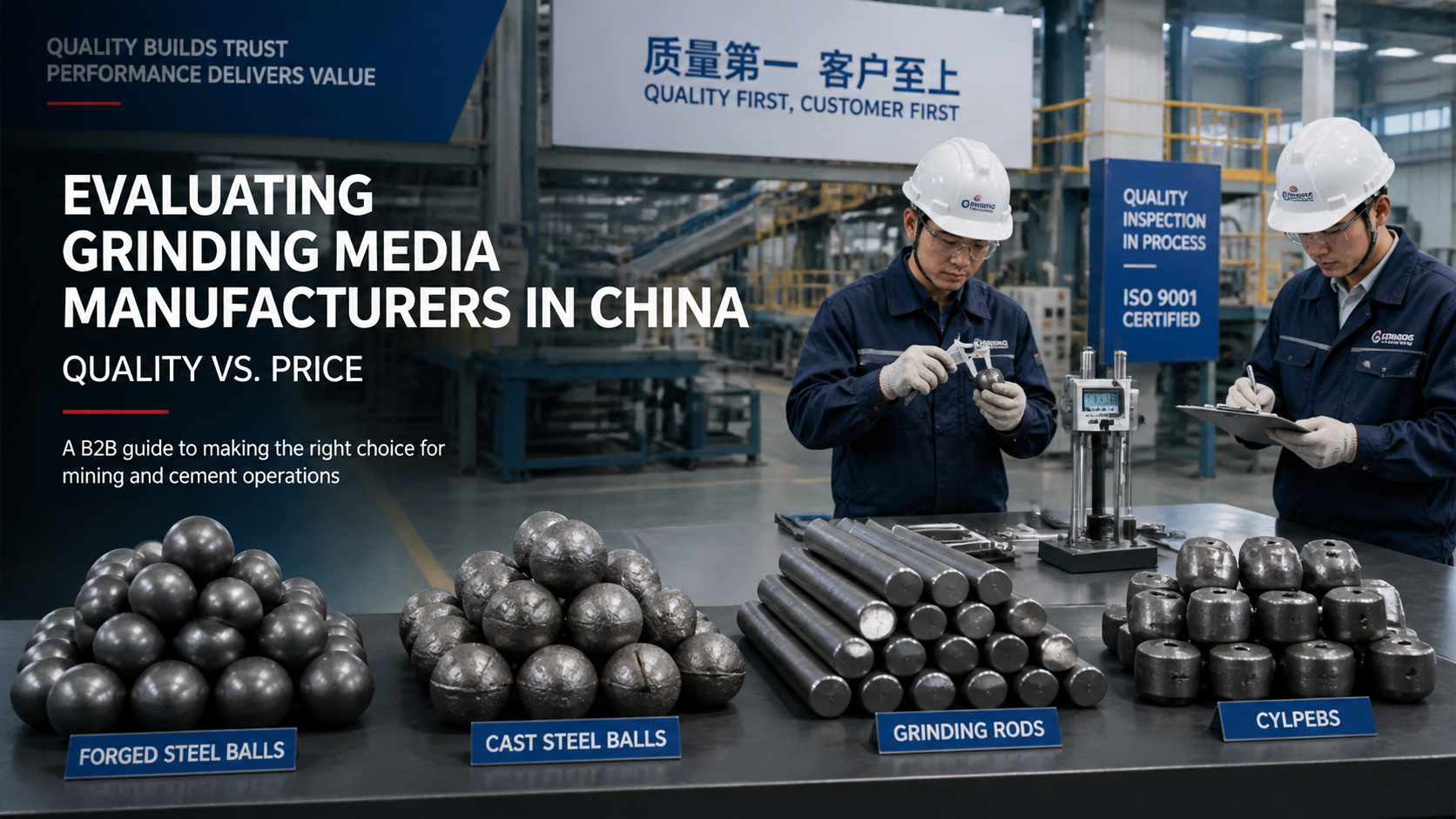
Many grinding-media articles stop at a simple statement: rods are for coarse grinding and balls are for fine grinding. That statement is directionally correct, but it is not enough for plant managers, procurement teams, OEMs, or metallurgical engineers who must control a real circuit.
The correct grinding media must match:
- Feed top size
- Ore competency and abrasiveness
- Target P80 or product screen specification
- Permitted percentage of ultra-fines
- Mill diameter, length, speed, and discharge configuration
- Wet or dry operating conditions
- Downstream separation method
- Media wear, breakage, and contamination tolerance
The difference becomes especially important when fines interfere with downstream performance. For example, excess slimes may reduce gravity-separation efficiency, complicate magnetic separation, increase thickener loading, raise filtration costs, or create an out-of-specification aggregate or industrial-mineral product.
In these situations, the goal is not simply to grind faster. The goal is to break the coarse fraction selectively while protecting the valuable target-size fraction from unnecessary regrinding.
Rod mills use long, parallel steel rods as the grinding charge. As the mill rotates, the rods tumble and cascade, applying a comparatively selective grinding action to the coarse particles held between them.
The defining mechanism is line contact. Rather than contacting feed at many localized points, as balls do, rods act along their length. This helps concentrate breakage on larger particles and can produce a more uniform coarse product with less excessive fine material.
For applications with strict fines limitations, this is the principal reason to specify rod mill grinding rods.
In a well-operated rod mill, the rods tend to remain approximately parallel. Larger particles are preferentially nipped and broken in the spaces between rods. Finer particles are less aggressively attacked than they would be in a dense ball charge.
This operating pattern can deliver several benefits:
- Narrower particle-size distribution
- Lower slime generation
- More controlled coarse-product sizing
- Reduced over-grinding of already liberated particles
- Improved preparation for gravity, magnetic, or downstream ball-milling circuits
- More consistent feed to screening, classification, or separation equipment
Rod mills have long been used for ball-mill feed preparation, coarse leach feed, industrial minerals, and aggregate-sand production because they can maintain a relatively uniform product while limiting unwanted fine fractions.
Grinding rods are commonly selected for:
- Primary grinding after crushing
- Coarse feed preparation before secondary ball milling
- Iron ore, copper ore, gold ore, and industrial-mineral processing
- Gravel and manufactured-sand applications
- Feed preparation for gravity concentration
- Feed preparation for magnetic separation
- Coke, glass, and friable non-metallic materials
- Circuits that require a coarse, pumpable, controlled-size slurry
A rod-mill circuit is particularly attractive when the downstream process performs poorly with high levels of slimes. The operational value is not merely a coarser product; it is a more useful product distribution.
Ball mills use spherical grinding media, including forged steel balls, cast steel balls, and high-chromium grinding balls. Their multiple-point contact, impact events, cascading action, and high surface-contact frequency make them highly effective for reducing material to finer sizes.
For fine grinding, this is an advantage. For a coarse product with strict fines limits, it can become a risk if the circuit and media charge are not carefully designed.
Steel balls create repeated point impacts and abrasion events throughout the charge. Their broad range of motion means that both coarse and already-small particles can receive additional energy. As a result, a ball mill is highly capable of producing fine material—but may also continue grinding particles that are already within specification.
This is why a ball mill using steel balls can produce:
- A finer overall product
- Greater reduction of intermediate particles
- Higher risk of over-grinding in coarse-duty circuits
- More ultra-fines when classification is weak or residence time is excessive
- More rounded particle shapes in some applications
Ball milling is therefore usually the right choice when the process target is fine liberation, fine cement grinding, regrinding, secondary milling, or a narrow fine-size specification. It is less automatically suitable when the priority is preserving a coarse product and limiting slimes.
| Selection factor | Rod Mill Grinding Rods | Ball Mill Steel Balls |
|---|---|---|
| Grinding contact | Predominantly line contact | Predominantly point contact |
| Best duty | Coarse grinding and controlled product sizing | Fine grinding and high-intensity size reduction |
| Fines generation | Typically lower in suitable coarse-duty circuits | Typically higher if used for coarse grinding without control |
| Product distribution | Often comparatively narrow and uniform | Often broader, with more fine material |
| Over-grinding risk | Lower | Higher |
| Suitable downstream process | Gravity separation, magnetic separation, coarse classification, ball-mill feed | Flotation preparation, fine liberation, cement finish grinding, regrinding |
| Media form | Long steel rods | Forged, cast, or high-chromium steel balls |
| Main operational risk | Rod tangling, bending, and poor rod wear behavior | Excess fines, inefficient coarse breakage with undersized balls |
| Best purchase focus | Straightness, hardness consistency, wear behavior, anti-tangling performance | Hardness, impact toughness, diameter mix, breakage resistance |
The decision should not be based only on whether one medium is "better." The correct question is: Which medium produces the required particle-size distribution at the lowest total process cost?
Choose rod mill grinding rods first when most of the following statements are true:
1. Your feed is relatively coarse after crushing.
2. Your target product remains in a coarse or intermediate size range.
3. Excess fines reduce downstream recovery, product value, or handling efficiency.
4. You need a uniform feed for a ball mill, separator, screen, magnetic separator, spiral, jig, or leach circuit.
5. Your mill and discharge arrangement are designed for rod operation.
6. You can maintain rod quality, loading practice, and operating conditions that prevent rod tangling.
Choose ball mill steel balls first when most of the following statements are true:
1. Your process requires a fine product or mineral liberation at smaller sizes.
2. The circuit includes efficient classification to control residence time.
3. Fine particles are beneficial rather than harmful.
4. You require high-impact breakage and broad size-reduction capability.
5. The mill operates as a secondary or tertiary grinding stage.
6. The media size distribution can be managed to suit the feed-size distribution.
A common procurement mistake is to blame media when the real problem is circuit design. Excessive fines can be caused by:
- Low classification efficiency
- Excessive mill residence time
- Incorrect mill speed
- Improper pulp density
- Too small a ball charge for the feed top size
- Incorrect media makeup rate
- Worn or poorly matched mill liners
- Feed variability
- Inadequate removal of finished product
Even premium grinding rods cannot solve a process that keeps acceptable particles circulating through the mill. Likewise, a carefully selected ball charge may perform acceptably in a coarse circuit if classification, retention time, and operating conditions are tightly controlled.
At SHANDONG ALLSTAR GRINDING BALL CO., LTD., we believe media selection should begin with the customer's grinding objective rather than with a generic catalog size. For overseas OEM customers, distributors, and industrial users, our role is to help translate process requirements into a reliable grinding-media specification.
Our product range includes:
- Grinding balls
- Ball mill steel balls
- Forged steel grinding balls
- Cast steel grinding balls
- Grinding rods
- Grinding cylpebs
- Customized OEM grinding-media solutions
For rod-mill projects, our evaluation should focus on the properties that directly affect stable operation:
- Rod diameter and length tolerance
- Straightness
- Steel chemistry
- Heat-treatment consistency
- Surface condition
- Hardness profile
- Wear rate
- Resistance to bending, twisting, and premature breakage
- Batch traceability and quality documentation
For ball-mill projects, we assess:
- Ball diameter range
- Forged versus cast selection
- Surface and core hardness
- Impact toughness
- Abrasion resistance
- Breakage performance
- Alloy selection
- Compatibility with ore abrasiveness and mill operating conditions
ALLSTAR's manufacturing approach emphasizes uniform hardness, wear and impact resistance, low breakage, and consistent performance supported by automation and quality-control practices. The company presents itself as an ISO 9001-certified global grinding-media manufacturer serving mining and cement applications, with stated annual capacity of 100,000 metric tons. [steelgrindingball]
Not every steel bar is suitable as a grinding rod. A rod can look acceptable at delivery and still cause major operating problems if it bends, twists, wears unevenly, or fractures in an uncontrolled manner.
High-quality grinding rods should be engineered for more than hardness alone. A rod that is too brittle may break prematurely. A rod that is too soft may wear too quickly. A rod with poor straightness or inconsistent microstructure may tangle and disrupt the charge.
Before approving a supplier or OEM order, request the following:
- Mill dimensions: Inside shell diameter and effective grinding length
- Feed information: F80, top size, moisture, hardness, and abrasion characteristics
- Target product: P80, screen specification, and maximum permissible fines
- Rod specification: Diameter, length, chemical composition, and hardness range
- Straightness requirement: Defined measurement method and acceptance tolerance
- Heat-treatment information: Method, process control, and batch records
- Quality documents: Material certificates, inspection records, and traceability
- Wear data: Site-specific test results where available
- Packing method: Protection against transit bending, corrosion, and handling damage
- After-sales support: Response process for performance verification and claims
Rod length is normally specified slightly shorter than the inside grinding-chamber length to allow safe operation. Industry references commonly describe rods as being several inches shorter than the mill interior, while typical rod diameters depend on duty and mill design.
The strongest fines-control strategy combines the right media with disciplined process monitoring.
Define the maximum acceptable percentage below the critical size. Do not use vague language such as "low fines." For example, define the exact mass percentage passing the size that causes recovery, handling, or specification problems.
Measure feed, mill discharge, classifier overflow, and final product regularly. One P80 value is not enough. The ultra-fine portion of the curve matters when slimes are costly.
For ball mills, using media that are too small for coarse feed can produce fines without breaking the largest particles efficiently. For rod mills, select rod diameter and loading that achieve coarse breakage without excessive wear or operational instability.
Track rod wear, bending, tangling, broken rods, ball breakage, and media-size distribution. These are early warning signals, not merely maintenance observations.
If fines rise suddenly, investigate cyclone performance, screen condition, slurry density, pump performance, and circulating load before assuming that the grinding media are at fault.
Use a documented baseline. Change one primary variable at a time—media type, media size, charge level, pulp density, or operating speed—and compare product distribution, throughput, power, media consumption, and downstream recovery.
Consider a mineral operation that needs to reduce crushed ore before gravity separation. The downstream unit requires sufficient liberation, but too much slime reduces separation efficiency and increases water-management demands.
A ball mill with a high-energy steel-ball charge may achieve the nominal target size, but it may also create excessive ultra-fines. A rod mill equipped with correctly specified grinding rods can instead focus breakage on the coarse fraction, producing a more uniform feed with fewer slimes.
The practical result can include:
- Better feed consistency to gravity equipment
- Less material reporting to the ultra-fine fraction
- Lower risk of over-grinding liberated values
- Reduced downstream classification burden
- More predictable plant control
This is not a universal rule. Very hard, highly variable, or unusually abrasive ores require metallurgical testing. Still, the example illustrates why rod mill grinding rods are often the first medium to evaluate when coarse grind quality matters more than maximum fine-grinding intensity.
For coarse grinding applications with strict fines limitations, rod mill grinding rods should be your starting point when the process requires selective coarse breakage, a uniform product, and reduced slime generation. Ball mill steel balls should remain the preferred choice when the plant needs finer grinding, higher liberation, or secondary size reduction.
SHANDONG ALLSTAR GRINDING BALL CO., LTD. supports global buyers with grinding balls, forged steel balls, cast steel balls, grinding rods, and grinding cylpebs for mining, cement, and power-industry applications. We also provide OEM support for international brands, wholesalers, and equipment manufacturers seeking consistent specifications, reliable quality control, and application-focused service.
Contact ALLSTAR with your mill dimensions, feed-size data, target product size, and fines limit. Our team can help you develop a grinding-media specification that supports stable throughput, controlled product sizing, and lower total grinding cost.
In many coarse-grinding applications, yes. Grinding rods generally provide more selective breakage and can generate fewer unwanted fines than steel balls. They are especially suitable where the product must remain relatively coarse and uniform.
Ball mills use spherical media that create repeated point impacts and abrasion events. This is highly effective for fine grinding, but it can also continue reducing particles that have already reached the desired size, especially when classification and residence time are not well controlled.
Not always. A rod mill is best suited to coarse grinding, controlled feed preparation, and fines-sensitive duties. A ball mill is generally better for fine liberation, fine cement grinding, and secondary or tertiary grinding stages. Many concentrators use both in sequence.
Rod tangling can result from poor rod straightness, inappropriate rod length, excessive wear, unsuitable steel properties, poor loading practices, or operating conditions that disturb the parallel rod charge. Proper media specification and mill operation are essential.
Provide the mill inside diameter and effective length, feed top size, feed hardness and abrasiveness, throughput, wet or dry process details, target product size, acceptable fines percentage, and current media-consumption data. This allows the supplier to recommend a more suitable rod specification.
The answer depends on impact conditions, ore abrasiveness, required hardness, breakage tolerance, and cost objectives. Forged steel balls are often selected for impact toughness and reliability, while cast options may be suitable in selected abrasive conditions. A media trial is the most reliable method for confirming the right choice.
First review classification efficiency, mill residence time, ball-size distribution, feed size, mill speed, slurry density, and circulating load. Improving these variables may reduce fines significantly. If fines remain above specification, assess whether a rod-milling stage is more appropriate.

1. [SHANDONG ALLSTAR GRINDING BALL CO., LTD. — Company and product information]
2. [ALLSTAR — ISO 9001 certification and stated manufacturing capacity]
3. [Society for Mining, Metallurgy & Exploration / OneMine — Rod Mills]
4. [Camasteel — Grinding Rods FAQ]
5. [911 Metallurgist — Grinding Balls and Rods]
6. [911 Metallurgist — Effect of Grinding Media on Milling]
7. [Metso — Grinding Solutions]
8. [MDPI Minerals — A Review of the Grinding Media in Ball Mills for Mineral Processing]
Hot Tags: China, Global, OEM, private label, manufacturers, factory, suppliers, manufacturing company


