
Views: 270 Author: shandong Allstar Grinding Ball Publish Time: 2026-08-18 Origin: Site


Content Menu
● Why Grind Size Controls Flotation Recovery
● Grinding Media Ball vs Cast Grinding Cylpebs
● When Grinding Balls Are the Better Choice
>> Choose grinding media balls when:
● When Cast Grinding Cylpebs Can Improve Regrind Performance
>> Consider cast grinding cylpebs when:
● The Flotation Risk: Overgrinding Is Not Recovery
>> Monitor these six metrics during a media trial
● A Practical Media-Selection Framework
>> Step 1: Define the flotation problem
>> Step 2: Characterize the ore and circuit
>> Step 3: Set a testable target
>> Step 4: Run a controlled trial
>> Step 5: Select on total value
● Why OEM Media Engineering Matters
● Expert Recommendation for High-Recovery Flotation
● FAQ
>> 1. Are cast grinding cylpebs better than grinding balls?
>> 2. Can a finer P80 always improve flotation recovery?
>> 3. What data should be supplied when requesting grinding media?
>> 4. Can grinding media affect flotation chemistry?
>> 5. Are forged grinding balls suitable for flotation circuits?
>> 6. Should a plant use only one media size?
>> 7. Can SHANDONG ALLSTAR provide OEM grinding media?
In a high-recovery flotation circuit, selecting between a grinding media ball and cast grinding cylpebs is not simply a purchasing decision. It is a circuit-design decision that can influence grind-size distribution, mineral liberation, media consumption, slurry chemistry, flotation kinetics, and ultimately metal recovery.
At SHANDONG ALLSTAR GRINDING BALL CO., LTD., we manufacture grinding media for mining, cement, and power-generation applications, including forged steel grinding balls, cast steel balls, grinding rods, grinding cylpebs, and grinding segments. As a global OEM partner for overseas brands, wholesalers, and manufacturers, we help customers match media geometry, alloy composition, hardness, and size distribution to their actual milling and flotation objectives—not just to a catalogue specification.
The key question is not, "Are balls or cylpebs better?" The better question is: Which media will generate the target particle-size distribution with the lowest total cost and the least risk of overgrinding?
Flotation depends on selective separation. Valuable minerals must be sufficiently liberated from gangue, yet they must also remain in a particle-size range that can collide with air bubbles and attach efficiently.
If the grind is too coarse:
- Valuable mineral remains locked with gangue.
- Liberation is incomplete.
- Recovery may fall because particles cannot float selectively.
- More value can be lost to tailings.
If the grind is too fine:
- Slimes and ultrafines increase.
- Froth stability can become difficult to control.
- Reagent consumption may rise.
- Gangue entrainment can reduce concentrate grade.
- Fine particles may have lower collision efficiency with flotation bubbles.
For many conventional sulphide flotation systems, the most responsive particle range is often broadly within 10–100 μm, although the true optimum depends on mineralogy, liberation texture, density, reagent scheme, and circuit configuration. A copper rougher circuit may perform best near one P80 target, while a fine-grained gold, lead-zinc, or molybdenum regrind circuit may require a significantly finer target.
The objective is not the finest possible grind. It is the most profitable liberation size. Research and operating experience consistently show that excessively fine grinding can create losses through slime generation and poorer flotation selectivity.
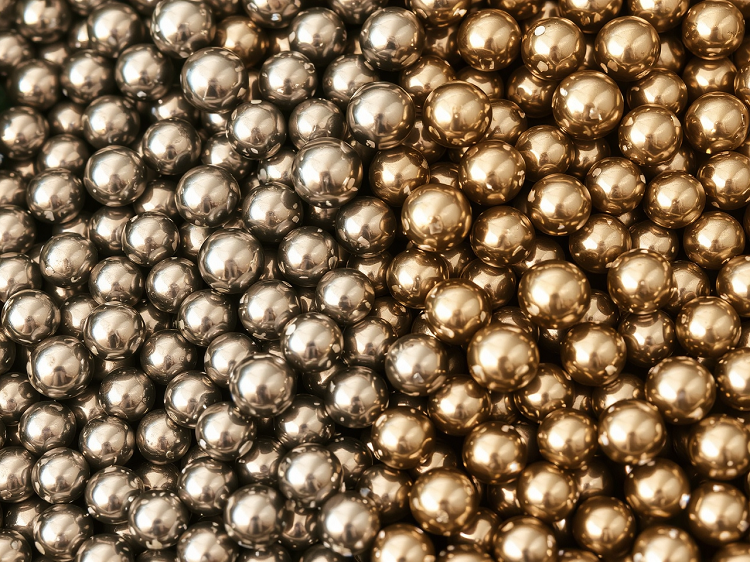
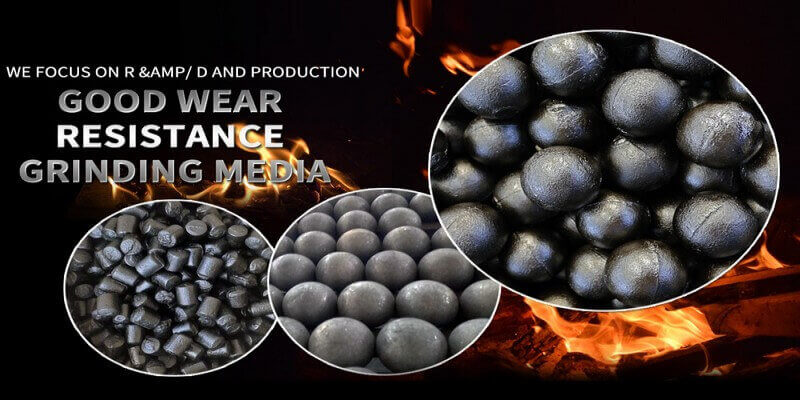
Grinding balls and cast grinding cylpebs both reduce particle size through impact, abrasion, and attrition. However, their geometry creates different contact conditions inside the mill.
| Evaluation factor | Grinding media balls | Cast grinding cylpebs |
|---|---|---|
| Shape | Spherical | Short cylindrical shape |
| Primary milling action | Strong impact plus abrasion | Higher surface-contact grinding and attrition |
| Best-fit duty | Coarser feed, primary ball milling, high-impact applications | Fine grinding, regrind duties, and tightly controlled size reduction |
| Contact area | Lower surface area per unit mass | Higher surface area per unit mass |
| Fine-particle generation | Depends strongly on ball size and charge design | Can promote fine grinding efficiently when correctly applied |
| Risk to manage | Under-grinding if media are too large; excessive fines if charge is poorly balanced | Potential overgrinding if residence time, media size, or classification is not controlled |
| Selection priority | Impact resistance, diameter, hardness consistency | Cylpeb geometry, size distribution, wear profile, and circuit classification |
A grinding media ball is normally the preferred starting point where feed is relatively coarse, impact breakage is required, or the mill needs robust media that can tolerate high-impact conditions. Forged grinding balls are commonly selected for demanding SAG, ball-mill, and secondary-grinding applications because impact resistance and structural integrity are essential.
Cast grinding cylpebs are often considered in fine-grinding and regrind applications because their geometry provides more contact points and a greater effective grinding surface than spherical media of comparable nominal size. This can help operators produce a finer, more controlled product when the circuit is already operating near the liberation threshold.
Molycop describes cylpebs as an alternative to conventional grinding balls that can support improved grinding efficiency and potentially reduce energy use in suitable milling duties. However, the correct conclusion is not that cylpebs always outperform balls. Performance must be verified against ore hardness, feed size, mill type, classification efficiency, slurry density, and flotation response. [molycop]
At SHANDONG ALLSTAR GRINDING BALL CO., LTD., we typically recommend evaluating forged or cast grinding balls first when the circuit requires high-impact breakage and stable performance across changing ore conditions.
- The mill receives relatively coarse or competent feed.
- Large mineral particles require impact breakage before fine liberation.
- The circuit is a primary or secondary ball mill.
- The ore has high impact abrasion.
- Mill throughput and breakage capacity are more important than ultrafine control.
- The media must withstand high-impact forces without excessive breakage.
- The operation needs a broad, carefully engineered ball-size make-up strategy.
For example, a concentrator with an 80% passing feed size that remains relatively coarse may need larger balls to deliver sufficient impact energy. If small media are introduced too early, they may not break the largest particles efficiently. This can reduce throughput, increase circulating load, and leave valuable minerals insufficiently liberated.
Grinding balls are available in many nominal diameters. Molycop lists nominal ball sizes from 25 mm to 105 mm for its grinding-ball range, illustrating the wide size-selection range required across milling duties.
Cast grinding cylpebs can be an effective choice when the feed is already fine and the operator needs a narrower route toward the liberation size required for flotation.
- The application is regrinding rather than primary grinding.
- The feed is already relatively fine.
- The circuit needs more surface-contact grinding.
- The objective is to improve liberation before cleaner flotation.
- The existing media charge produces too much coarse material near the flotation feed target.
- The mill has efficient classification and can prevent excess ultrafines from accumulating.
- Trials demonstrate a better recovery-grade outcome, not merely a lower P80.
In one industry study, smaller media in regrind and stirred-milling applications reduced energy demand compared with larger media, while improved fine liberation supported recovery gains in the tested gold application. The reported energy benefit was highly application-specific, ranging from 10% to 44% in regrind ball-mill comparisons and higher in selected stirred-mill scenarios.
That evidence supports an important operating principle: media size and geometry matter most when they match the feed size and desired product size. It does not justify applying one media type universally across every milling circuit.
A lower P80 is often treated as proof of improved grinding. In flotation, that assumption can be expensive.
The flotation circuit responds not only to P80 but also to the full particle-size distribution, mineral liberation by size class, surface oxidation, slime coating, reagent interaction, and bubble-particle collision probability. Two mills may both report a P80 of 75 μm, yet one may generate substantially more −10 μm material. Their flotation performance may therefore differ materially.
A published study on grinding-media effects in scheelite flotation found that the choice of grinding media changed both concentrate grade and recovery under the tested conditions. The study reported flotation efficiency of 79.18% with one media condition versus 76.63% with another, demonstrating that grinding environment can affect flotation beyond simple size reduction.
For plant teams, this means media trials must include flotation results—not only grinding measurements.
1. P80 and full size distribution
Track not only the target size but also coarse tails and ultrafine fractions.
2. Liberation by size class
Determine whether additional fine grinding truly releases valuable minerals.
3. Rougher recovery
Compare metal recovery at matched feed conditions and reagent dosage.
4. Concentrate grade and gangue entrainment
Higher mass pull can look like higher recovery while lowering concentrate quality.
5. Media consumption and breakage
Record kilograms of media per tonne processed and inspect worn media shape.
6. Specific energy consumption
Compare kWh per tonne, but evaluate it alongside recovery and throughput.
The most reliable way to select between grinding balls and cast grinding cylpebs is a controlled, ore-specific programme.
Start with plant evidence:
- Is recovery limited by poor liberation?
- Is the circuit producing excessive coarse composite particles?
- Is overgrinding creating slimes?
- Is concentrate grade declining because of entrainment?
- Is the target mineral naturally fine, coarse, or locked in complex textures?
Do not change media before establishing the actual loss mechanism.
Review mineralogy, Bond work index, abrasion index, feed-size distribution, mill power draw, mill speed, slurry density, cyclone performance, and current media consumption.
A media decision without classification data is incomplete. Poor cyclone performance can create an apparent grinding problem when the real issue is bypass or inefficient separation.
Use a target such as:
- Reduce +150 μm valuable-mineral losses by a defined percentage.
- Maintain P80 while reducing −10 μm generation.
- Improve rougher recovery at constant concentrate grade.
- Reduce media consumption per tonne without sacrificing throughput.
- Improve liberation in a specific size interval.
Change one major variable at a time. Compare the baseline charge with a proposed grinding-ball or cylpeb blend under stable ore conditions. Maintain comparable mill loading, pH, reagent dosage, residence time, and classification settings wherever possible.
The winning media is not necessarily the cheapest per tonne. It is the option that delivers the strongest combined result in:
- Metal recovery.
- Concentrate quality.
- Throughput.
- Energy use.
- Media consumption.
- Downtime risk.
- Supply reliability.
For overseas brands, wholesalers, and mill operators, a generic grinding-media specification can create avoidable risk. The same nominal diameter may behave differently because of alloy chemistry, hardness profile, casting quality, forging process, microstructure, heat treatment, and dimensional consistency.
SHANDONG ALLSTAR GRINDING BALL CO., LTD. supports customers with OEM grinding-media solutions designed around application needs. Our manufacturing portfolio includes:
- Forged steel grinding balls for impact-intensive milling.
- Cast steel balls for selected abrasive and grinding conditions.
- Cast grinding cylpebs for fine and regrind applications.
- Grinding rods for rod-mill duties.
- Grinding segments for specialized milling requirements.
Our role is to help customers specify the right media combination for their market and their end users. For a distributor or brand owner, that can include tailored dimensions, hardness ranges, packaging, branding, and export-oriented supply support.
A successful OEM partnership starts with process data, not a price list.
Use grinding media balls when impact breakage, coarse-feed handling, and robust mill performance are central to the application. Evaluate cast grinding cylpebs when regrind efficiency, higher contact-area grinding, and a controlled move toward finer liberation are needed.
For many operations, the most effective solution may be neither an all-ball nor an all-cylpeb charge. A staged strategy—larger balls for breakage, smaller balls or cylpebs for regrinding—can be worth testing where mineral liberation occurs across multiple size ranges.
The final decision must be proven through plant or pilot trials that measure recovery, grade, particle-size distribution, energy, and wear together. A lower grinding cost is not a win if it reduces payable metal recovery. A finer P80 is not a win if it creates slimes and weakens selectivity.
Ready to optimize your grinding media for high-recovery flotation? Contact SHANDONG ALLSTAR GRINDING BALL CO., LTD. with your ore type, mill dimensions, feed size, target P80, current media consumption, and flotation challenge. Our team can help you develop an OEM-ready grinding-ball or cast-cylpeb specification tailored to your market and milling duty.
Not in every application. Cast grinding cylpebs can be advantageous in fine-grinding and regrind duties because their shape provides more contact area. Grinding balls are often better for high-impact, coarse-feed, and primary-milling conditions.
No. Finer grinding can improve liberation, but excessive ultrafines may reduce selectivity, increase entrainment, and make flotation harder to control. The best target is the ore-specific liberation size that maximizes economic recovery.
Provide ore type, feed F80, target P80, mill type and dimensions, mill power, current media size and consumption, slurry density, hardness or abrasion data if available, and flotation recovery or grade targets.
Yes. Grinding media can influence the grinding environment, including surface condition and slurry chemistry. Research has shown that media choice can affect flotation performance, so media trials should measure flotation outcomes as well as particle size. [pubs.acs]
Yes. Forged grinding balls are commonly used upstream of flotation where impact resistance and reliable breakage are required. The correct size, alloy, and charge design should be matched to the ore and the mill duty.
Usually not. A properly designed media-size distribution helps the mill break both coarse and intermediate particles efficiently. The optimum mix should be based on feed size, target product size, mill conditions, and trial results.
Yes. SHANDONG ALLSTAR GRINDING BALL CO., LTD. provides OEM services for foreign brands, wholesalers, and manufacturers, covering products such as forged steel balls, cast steel balls, cast grinding cylpebs, rods, and grinding segments.
1. [ACS Omega — Effects and Mechanisms of Grinding Media on the Flotation Behavior of Minerals]
2. [Springer Nature — Energy Use of Fine Grinding in Mineral Processing]
3. [Metso — Rethinking Recovery: Grinding and Flotation Technologies]
4. [Molycop — Grinding Media Product Range]
5. [Molycop — Cylpebs]
7. [CEEC International — Energy Savings and Improved Recovery with Small Grinding Media]
8. [DiVA Portal — Evaluating Rougher-Scavenger Flotation Circuits Using Particle-Size Data]
Hot Tags: China, Global, OEM, private label, manufacturers, factory, suppliers, manufacturing company


