
Views: 257 Author: shandong Allstar Grinding Ball Publish Time: 2026-07-06 Origin: Site


Content Menu
● Why media choice matters in unstable milling conditions
● Forged vs cast ball mill balls
● What variable-speed mills demand
● What variable-load mills demand
● Selection framework for operators
● How to improve media performance
● FAQ
Shandong Allstar Grinding Ball Co., Ltd. is a trusted global manufacturer of grinding balls, mill balls, forged steel balls, cast steel balls, grinding rods, and cylpebs for mining, cement, and power industries. For OEM buyers running variable-speed, variable-load mills, the choice between forged and cast ball mill balls is not a branding decision; it is a performance decision that directly affects wear life, stability, energy use, and total grinding cost.

In real plants, mills rarely run at one perfect speed with one constant feed condition. Speed changes, load swings, ore hardness varies, and process targets shift throughout the day. That is exactly why grinding media selection must be matched to the mill's operating envelope, not just its nominal design.
A variable-speed mill changes impact intensity by altering the motion of the charge, while a variable-load mill changes how much cushioning or collision energy exists inside the shell. In these conditions, the "best" ball is the one that keeps grinding efficiently without cracking, flattening, or creating unstable wear patterns. Operating variables such as mill speed, media size, solids loading, and residence time all influence performance, and speed can often be adjusted through a VFD.
For OEMs and plant operators, this means media must answer three questions at once:
- Will it survive impact when speed rises?
- Will it resist abrasion when load is high?
- Will it remain economical across the full duty cycle?
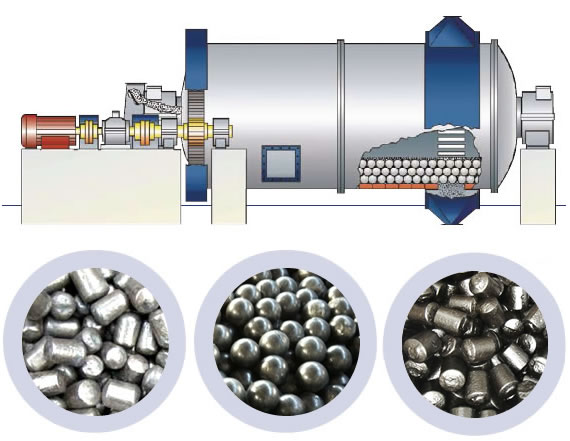
Forged steel balls are made by deforming steel under heat and pressure, which produces a dense internal structure and strong toughness. Cast steel balls are formed by pouring molten metal into molds, which can offer high surface hardness and attractive upfront economics in certain applications.
| Factor | Forged balls | Cast balls |
|---|---|---|
| Internal structure | Dense, uniform | Can be less uniform |
| Impact resistance | Strong | Moderate, depends on grade |
| Abrasion resistance | Good to very good | Often strong at the surface |
| Breakage risk | Lower in severe impact duty | Higher if the mill is shock-heavy |
| Best fit | High-impact, variable-load grinding | More controlled or abrasive-duty grinding |
| Total cost focus | Longer life and stability | Lower initial cost in some cases |
The practical difference is simple: forged media usually wins when the mill sees more shock, speed swings, or heavy impact. Cast media can be attractive when the process is more stable and the wear mechanism is dominated by abrasion rather than impact. Research on grinding media wear also shows that mill environment, ore type, pH, pulp conditions, speed, and throughput all affect wear and failure behavior.
Variable-speed mills create changing charge motion. At lower speeds, the charge may cascade more gently; at higher speeds, impact energy increases and wear patterns become more severe. A widely cited operating range for dry ball mills is roughly 50% to 70% of critical speed, with many plants operating around 60% to 65%. Running too fast can increase wear and reduce milling efficiency, while running too slow can underuse the media charge.
That is why forged balls are often the safer choice in mills that frequently ramp up and down. Their toughness helps them survive repeated impact transitions without unexpected fracture. Cast balls, by contrast, can become more sensitive to shock if the speed profile is aggressive or unstable.
For a plant engineer, the key point is not "forged is always better." The real question is whether the media can maintain consistent fracture behavior as speed changes during production shifts, startup, and load correction.
Variable load creates a different challenge. When the charge is too light, media-to-media impact rises and wear can accelerate. When the charge is too heavy, the ore bed can cushion impacts and reduce grinding efficiency. Ball mill operation depends on the right balance of media, solids, and free space so energy is transferred into particle breakage instead of wasted as internal collision or shell wear.
In these conditions, forged balls usually offer better operational tolerance because they combine hardness with toughness. Cast balls may still work well, but only when the process is relatively stable and the plant can control feed consistency, slurry density, and load profile. Studies comparing wear rates also show that media quality, hardness, microstructure, toughness, and internal defects materially affect life and failure modes.
This is especially important in mining and cement plants where downtime is expensive. A media type that looks cost-effective on paper can become expensive if it drives more relining interruptions, more makeup media, or more unplanned wear.
To choose the right grinding media, start with operating reality rather than supplier catalog language. A simple engineering workflow often works better than a generic product claim.
1. Identify the dominant wear mechanism.
2. Confirm speed variation range and load swing range.
3. Review ore abrasiveness, feed size, and moisture.
4. Check whether the mill is doing coarse grinding, secondary grinding, or finish grinding.
5. Compare lifecycle cost, not only unit price.
A practical rule is this: if the mill sees frequent speed changes, large feed variation, or impact-heavy duty, forged balls are usually the stronger default. If the system is more stable and abrasion is the main issue, a properly specified cast ball can be considered. Media selection should also account for mill diameter, solids loading, media size distribution, and residence time.
As a global OEM manufacturer, Shandong Allstar Grinding Ball Co., Ltd. is built for buyers who need both product consistency and supply reliability. The company supplies forged steel balls, cast steel balls, rods, and cylpebs for mining, cement, and power plants, with OEM service for overseas brands, wholesalers, and producers.
What makes that valuable for variable-speed and variable-load mills is not just product variety. It is the ability to match media chemistry, hardness, size range, and process duty to the real operating environment. Plants that need stable grinding under changing conditions benefit most from a supplier that can support technical selection, batch consistency, and repeatable quality control.
For B2B buyers, this means lower procurement risk and better process control. For plant teams, it means fewer surprises in grinding performance.
A useful industry pattern appears again and again: when a plant moves from stable operation to more dynamic operation, media that was acceptable before may start failing faster. That can happen after a VFD retrofit, after feed blending changes, or after higher throughput targets are introduced. In those cases, a tougher forged media grade often restores stability because the mill no longer punishes the charge with the same impact profile every hour.
Another practical insight is that wear tests must be read carefully. Laboratory ranking can be helpful, but absolute wear in a plant depends on ore chemistry, corrosion, and actual charge motion. Published wear research shows that lab tests can reproduce relative ranking, but full-plant wear depends on real operating conditions and corrosion effects.
To get more life and better grinding consistency, plant teams should treat media selection as part of process optimization.
- Keep size distribution graded, not single-size only.
- Monitor wear rate by operating mode.
- Recheck performance after speed or load changes.
- Avoid judging media only by hardness.
- Track media loss together with power draw and product fineness.
If the mill is unstable, the first optimization should be media toughness and charge balance, not just chemistry. In many cases, the most expensive grinding ball is the one that fails early.
If your mill operates under changing speed, changing load, or changing feed conditions, choose media that is engineered for instability, not just low purchase price. Shandong Allstar Grinding Ball Co., Ltd. can support OEM buyers with forged and cast grinding media solutions tailored to your mill duty, product target, and cost goals.
1. Are forged balls always better than cast balls?
No. Forged balls are usually better for impact-heavy and variable-duty mills, while cast balls can work in more stable abrasive conditions. [steelgrindingball]
2. Why do variable-speed mills need tougher media?
Because speed changes alter impact energy and charge motion, which can increase shock and wear instability.
3. What is the biggest risk of choosing the wrong ball type?
The biggest risk is higher total cost from early breakage, unstable grinding, and more frequent media replacement. [steelgrindingball]
4. Can cast balls be used in mining mills?
Yes, but they are generally better suited to less shock-heavy duty or applications where abrasive wear dominates. [steelgrindingball]
5. What should I compare besides price?
Compare wear rate, toughness, breakage risk, mill speed profile, load variation, and product quality stability.
6. Does media size matter as much as media type?
Yes. Media size affects impact energy, number of contacts, and grinding efficiency, so it must be matched to the mill duty.
1. Paul O. Abbe, [Variables in Ball Mill Operation].
2. A. Jankovic, T. Wills, S. Dikmen, [A Comparison of Wear Rates of Ball Mill Grinding Media].
3. Shandong Allstar Grinding Ball Co., Ltd., [Grinding Ball Supplier | Premium Steel Balls – ALLSTAR].
4. Allstar Grinding Ball, [Grinding Media Balls: Why Shandong Allstar Grinding Ball Co., Ltd. Is A Trusted OEM Partner for Mining, Cement, And Power Plants]
5. Epic Powder, [Ball Mill Loading Ratio and Steel Ball Size Distribution].
6. Cement Industrial, [How to Choose Steel Balls for Ball Mill?].
7. University of Cape Town, [Effect of operating variables on IsaMill].
8. ScienceDirect, [Relationship between microstructure, hardness, impact toughness and wear performance of selected grinding media for mineral ore milling operations].
Hot Tags: China, Global, OEM, private label, manufacturers, factory, suppliers, manufacturing company


